ABARTH: The Austrian Who Won 10,000 Races with Cars That Weren’t His

In Italy, if you walk into a bar and order a strong coffee — or a coffee with a shot of liquor — you don’t ask for a double espresso. You ask for a “caffè Abarth.” Not a lungo. Not a loaded cortado. An Abarth. The brand entered the language. It became synonymous with concentrated power in a small package. Something tiny that bites harder than it looks.
And that’s exactly what Carlo Abarth was. A small man who bit harder than anyone in the history of European motoring. Over 7,000 documented competition victories — the brand itself always claimed 10,000. 10 world records. 133 international records. 219 models wearing the scorpion on the hood. And it all started with an 11-year-old boy who wrapped leather belts around the wheels of his scooter to go faster than the older kids in the neighborhood.
From Vienna to nowhere (and everywhere)
Karl Alberto Abarth was born on November 15, 1908, in Vienna, when Austria was still an empire. His father was Italian, from Merano in South Tyrol. Karl grew up between two worlds: Austrian precision and Italian fire. By 15 he was racing bicycles. At 17 he was apprenticing at Carrozzeria Castagna in Milan, designing frames for motorcycles and bicycles. At 19 he was working in the racing division of Motor Thun in Austria.
And at 20, he built his first motorcycle. He didn’t buy it. He built it. Parts from different manufacturers, assembled by his own hands. A 600 cc Sunbeam engine. And with it, he started winning.
He won his first race in Salzburg on July 29, 1928. Then came more. Many more. Five European motorcycle championships, mostly in sidecar categories, all on machines he built or modified himself. No factory backing. No sponsor. No team. One man against the clock.
But there was something else. Something that defines Carlo Abarth better than any victory: in 1934, with the Austrian economy in ruins, he took a motorcycle with a sidecar he’d designed himself and challenged the Orient Express. The full route: Vienna to Ostend, over 1,300 kilometers. And he won. A guy on a motorcycle with a sidecar beat a luxury train that had been the symbol of European speed for decades. That’s not competition. That’s a statement of intent.
The accident that created a genius
In 1938 or 1939, depending on the source, Carlo suffered a devastating crash during a race in Ljubljana, Yugoslavia. He was hospitalized for over a year. His career as a rider was over. But the war trapped him in Yugoslavia, where he worked for Ignaz Vok converting engines to run on kerosene. When the war ended, he returned to Italy, to Merano, where his family roots lay. He became an Italian citizen. Karl became Carlo.
And here the story intersects with the biggest names in motoring. Carlo Abarth knew Ferry Porsche. The connection ran deep: in 1934, Carlo had married the secretary of Anton Piëch, Ferdinand Porsche’s son-in-law. They were practically family. When Ferry Porsche needed to get his father Ferdinand out of a French prison — where he was held as a war criminal — Carlo helped broker a deal with Piero Dusio, founder of Cisitalia, to post bail in exchange for Porsche’s engineering services.
Carlo collaborated with Ferry Porsche, engineer Rudolf Hruska, and Dusio at the Compagnia Industriale Sportiva Italia — Cisitalia, founded by Dusio in Turin. Carlo served as designer, engineer, and test driver. The flagship project was a Formula 1 car, the Tipo 360, designed by Porsche. A revolutionary machine with a 12-cylinder boxer engine, 1.5 liters, supercharged, all-wheel drive. A car a decade ahead of its time. But costs spiraled out of control. Dusio fled to Argentina on a deal with Perón. Cisitalia collapsed.
And that’s where most people would have given up. Carlo Abarth was not most people.
March 31, 1949: The scorpion is born
When Cisitalia went bankrupt, Carlo Abarth took what he was owed. Not money. Cars. The team’s racing cars, which he accepted as payment for his unpaid wages. He rebadged them “Abarth-Cisitalia” and kept racing them.
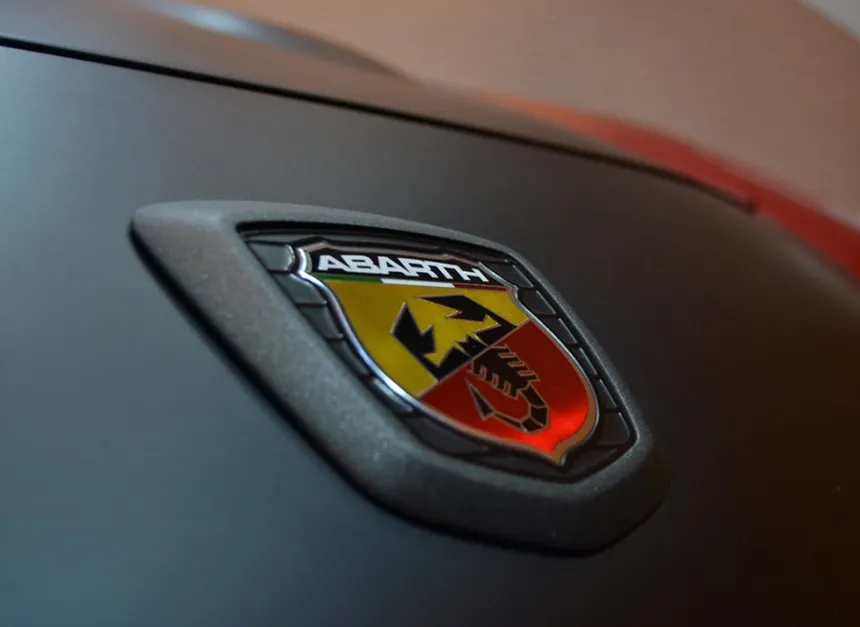
On March 31, 1949, Carlo Abarth and Armando Scagliarini — father of Guido Scagliarini, a Cisitalia driver — founded Abarth & C. in Bologna with 35 employees. The company relocated to Turin the following year. The logo: a scorpion. Carlo’s zodiac sign, born November 15 under Scorpio. It wasn’t a design crafted by a branding agency. It was the horoscope of a stubborn Austrian who believed in the stars and in carburetors.
The first car was the 204A Roadster, based on the Fiat 1100, with a modified engine featuring twin carburetors producing 62 hp. Aerodynamic bodywork by Giovanni Savonuzzi. And it worked. It won the Italian 1100 Sport championship and the Formula 2 title. In two years, it racked up around 20 victories.
But the moment that ignited the myth was different. On April 10, 1950, at the Palermo-Monte Pellegrino hillclimb, Tazio Nuvolari — the greatest Italian racing driver of all time, in the twilight of his career — won his class and finished fifth overall in an Abarth 204A. It was Nuvolari’s last victory. And the scorpion’s first great one.
Transforming the ordinary into the extraordinary
That was Carlo Abarth’s philosophy. Not building cars from scratch. Taking a stock Fiat — a small, cheap, people’s car — and turning it into something that made the competition tremble. Tuning kits. High-performance exhausts. Upgraded carburetors. Modified camshafts. Forged pistons. Everything you needed to turn your Fiat 500 or Fiat 600 from a commuter car into a weapon.
Abarth exhausts became a colossal business. By the mid-1960s, the factory was producing over 250,000 exhaust systems per year. Not just for Fiat. For most European manufacturers. The Abarth exhaust was an industry standard.
But where Abarth truly shone was at Monza. The first record attempt came on June 17-18, 1956. A Fiat Abarth 750 designed by Bertone, with four drivers alternating, covered 3,743 kilometers in 24 hours at an average speed of 155.98 km/h. Abarth’s first international record. 132 more would follow.
In 1958, Carlo did something that encapsulates his character: he took a Fiat 500 — the Cinquecento, the smallest and humblest car in Italy — and transformed it completely. Enlarged engine, raised compression, Weber carburetor, free-flow Abarth exhaust. Six drivers alternating every three hours for seven days at Monza. 18,186 kilometers covered in 168 hours. Six international records for production cars in the 351 to 500 cc class. With a Fiat 500.
And in 1965, at age 57, Carlo Abarth lost 30 kilograms on an apple-only diet to fit into the cockpit of his Fiat Abarth 1000 Monoposto. At 57. He dropped 30 kilos. To fit inside a racing car. And he set acceleration records in Class G and Class E at Monza. With his own hands on the wheel.
Carlo was no saint. He was obsessive, fanatical about punctuality, and probably unbearable for his employees at six in the morning on a Monday when he’d call emergency meetings the week before a race. If someone criticized one of his cars, the relationship ended on the spot. But saints don’t accumulate thousands of victories. Difficult men do.
Fiat: The embrace that became suffocation
The relationship with Fiat was symbiotic for years. Fiat paid Carlo a bonus for every victory a Fiat-based car achieved in competition, anywhere in the world. With thousands of accumulated victories, that deal cost Fiat dearly. Very dearly.
On July 31, 1971, Carlo Abarth sold the company to Fiat for 250 million lire. The official version is that it was a logical business decision. The version that circulates among those who were close tells a different story: Carlo was exhausted. The financial pressure of maintaining a racing operation at that scale, without the resources of a major manufacturer, had drained him. Fiat offered an exit that seemed dignified — stay on as CEO, keep the name, keep running things. But when you have a boss, you stop being you. And Carlo stopped being Carlo. He stayed for a while. Then he went back to Vienna. And on October 24, 1979, under the sign of Scorpio — the same sign that saw his birth — he died at 70. Alone. Far from Turin. Far from the cars that bore his name.
But the name lived on. Abarth became Fiat’s racing department. And there it wrote another glorious chapter: the Fiat 131 Abarth won the World Rally Championship manufacturers’ title in 1977, 1978, and 1980. Three world championships. After that, the racing operation moved to Fiat’s Lancia subsidiary, where it accumulated 11 more championships.
The coffee that went cold
And then came the desert. The 1980s and 1990s were the badge-engineering era for Abarth. The name became a sticker. An appearance package. A set of wheels and trim pieces. Fiat Ritmo Abarth. Fiat Stilo Abarth. Cars that wore the scorpion but lacked the engineering to justify the name. Carlo Abarth dismantled engines piece by piece and rebuilt them with forged pistons and modified camshafts. Fiat stuck a decal on the trunk lid. In the workshops, real mechanics called them “sticker scorpions.” It wasn’t a compliment.
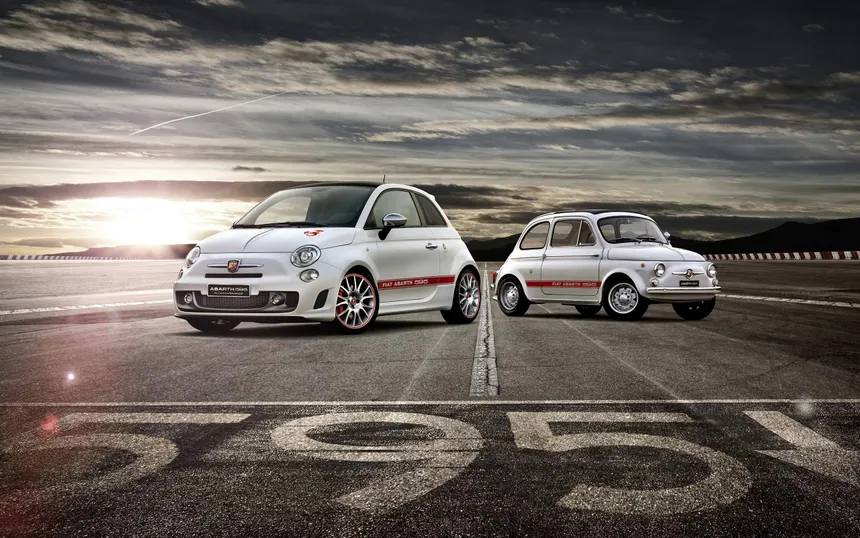
In 2007, Abarth was relaunched as an independent brand within the Fiat group. The Abarth 595, based on the new Fiat 500, was a hit. 1.4 T-Jet turbo engine, up to 178 hp in the 695 70° Anniversario version. Record Monza exhaust. Sound. Character. Customization. The Abarthisti community had something to wrench on with their own hands again. In 2018, the UK alone moved 5,631 units.
And then Stellantis decided Abarth’s future was electric. Only electric.
The Abarth 500e makes 155 hp and does 0 to 100 km/h in 7 seconds. Not bad for an urban EV. But Abarthisti don’t buy an Abarth for the numbers on paper. They buy an Abarth to get their hands inside the engine. To swap the exhaust. To remap the ECU. To feel the turbo pushing. To hear the engine. With an EV, you can’t do any of that.
Gaetano Thorel himself, Abarth’s European boss, has publicly admitted it: “The Abarth customer wants a combustion engine not only for the power but because Abarth customers fundamentally buy the car and then modify it with their own hands. On the electric one you cannot, so for them it’s a limitation.”
The numbers speak without filters. In 2025, Abarth sold 291 cars in the UK. In 2018 it was 5,631. In Italy, across all of 2025, 104 Abarth 600e and 73 Abarth 500e were registered. Fewer than 200 Abarths in all of Italy in one year. In the country where “Abarth” is slang for a strong coffee. That’s not a sales decline. That’s a disappearance.
Stellantis is already studying a return to combustion. A hybrid Abarth based on the new Fiat 500 Hybrid is on the table. But the 500 Hybrid’s 1.0-liter three-cylinder makes 65 hp. And the platform wasn’t designed for combustion engines. Space is minimal. Cooling is a problem. And the 1.4 T-Jet engine that defined the Abarth 595 and 695 doesn’t fit in the new body.
Carlo Abarth lost 30 kilograms to fit inside a race car. His corporate heirs can’t fit a decent engine inside the car that bears his name.
The scorpion doesn’t die
What Stellantis does with the brand is Stellantis’s problem. What Carlo built is already written in history.
There’s something no boardroom can kill. The Abarth name survives because what it represents is bigger than any corporate decision. Thousands of victories — nobody knows the exact figure, and it doesn’t matter. An Austrian who beat a train. A zodiac sign that became the most feared logo in European competition. A strong coffee. A promise: that something small can be fierce if someone with the right hands puts what it needs inside it.
Carlo Abarth died under the sign of Scorpio. He was born under the sign of Scorpio. He lived like a scorpion: small, fast, and with a sting nobody forgot.
Check you’re still alive.
4 thoughts on “ABARTH”