THE WAR FERRARI LOST AGAINST ITSELF.
June 1969
Enzo Ferrari signs the papers. Fifty percent of his company is no longer his. He has just sold it to Fiat. In exchange he receives a brutal sum of money that he needs for a single reason: to build a car capable of beating Porsche.
The Porsche 917 has been running for months. It debuted in March in Geneva, it impressed in testing. For 1970, the FIA has changed the Group 5 rules: 5.0-liter engines are allowed again, but only if you build 25 identical units for homologation. Porsche has done the unthinkable: they have built all 25. Not one. Not two. Twenty-five 917s lined up in a hangar, each one with a 4.5-liter engine, 580 horsepower, and an aluminum chassis so light that the gearshift knob is carved from balsa wood. Balsa. Model-maker’s wood. Because every gram counts.
Enzo Ferrari has two options. Stay out of the fight and let Porsche win the entire World Sportscar Championship. Or respond. He signs with Fiat, takes the money, and calls in Mauro Forghieri.
“Mauro, build a car. It has to beat Porsche. You have three months.”
Three. Months.
This is the story of the impossible car that came out of that order. Of the twenty-five chassis Ferrari had to build without knowing if they could sell them. Of the 1970 season, where Ferrari lost everything it could lose except one race. Of the Le Mans accident that ended with a track marshal dead in the gravel. And of chassis number 1046 — the one left over, the one nobody wanted, the one that ended up as the strangest concept car in the brand’s history.
Forghieri and his three months
Mauro Forghieri is Scuderia Ferrari’s chief engineer. Thick glasses, unruly hair, Emilian accent. The man who designed the 312P engine, the 312 Formula 1 chassis, Ickx’s triple-wing. If anyone can pull off a miracle, it’s him.
The problem is structural. Porsche has been running the 917 for eight months. Forghieri has twelve weeks to start from scratch. On top of that, massive strikes across Italy in the winter of 1969-70 paralyze entire factories. And while he builds the 512S, he still has to run the Formula 1 team. Because Ferrari isn’t Porsche: Porsche has a sports car program and that’s it. Ferrari has sports cars, F1, road cars, and an Enzo who doesn’t take no for an answer on any of the three fronts.
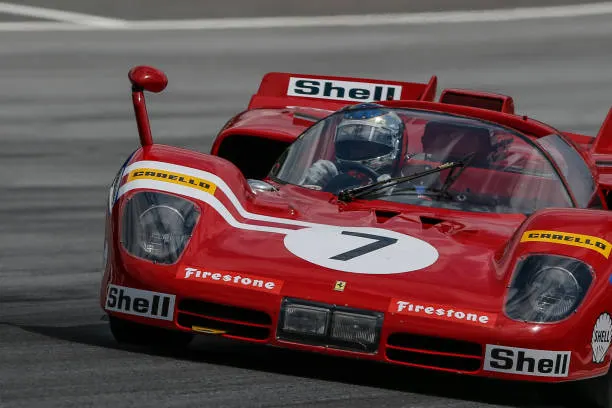
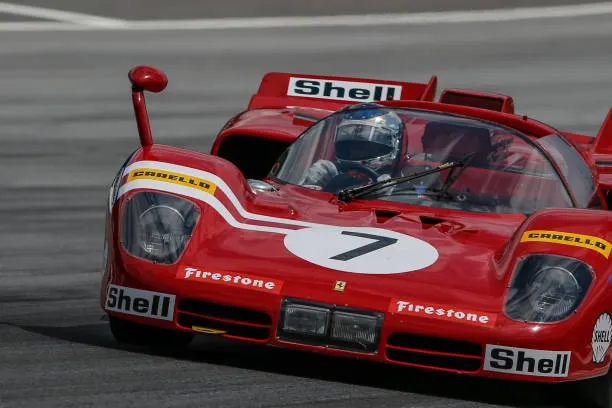
Forghieri’s technical decision is pragmatic. No time to invent anything new. He takes the 312P chassis — tubular, reinforced with riveted aluminum panels — and scales it to fit a five-liter V12. He takes the 612 Can-Am engine — that existing 60-degree V12 — and reduces it to 4,993 cc exactly. Adds four valves per cylinder. Lucas fuel injection. Twin overhead camshafts. 550 horsepower at 8,500 rpm from the very first version.
And here is the problem that will condition the entire season. Porsche, in its obsession with weight, has built the 917 chassis in pure aluminum. Forghieri, with no time or budget to experiment, builds the 512S chassis in steel. The result: the Ferrari weighs 880 kilos. The Porsche weighs 800. Eighty kilos. That sounds like nothing until you do the math on power-to-weight. Porsche: 725 hp per tonne. Ferrari: 625. One hundred horsepower per tonne less. On the Le Mans straights, that’s seconds a lap. Over twenty-four hours, that’s full laps.
Forghieri knows it. Enzo Ferrari knows it. But there is no time. The car is shown to the press in November 1969. In January 1970, Ferrari presents to the FIA homologators 17 complete cars and 8 assembly kits. That technically satisfies the 25-unit requirement. The 512S exists. The season begins.
The twenty-five chassis
Ferrari numbers the chassis with even numbers from 1002 to 1050. Exactly twenty-five numbers. Nineteen cars will race in 1970. Five will be open-top spyders. Another six will remain as spares, unbuilt kits, or reserve material. Among them, one specific chassis that nobody will want: 1046. The twenty-third in the series. Built, numbered, and buyer-less.
Four cars are kept for the official Scuderia. The rest are distributed among privateer teams that Enzo Ferrari neither controls nor supports the way he should — and here lies one of the strategic errors of the season. Porsche, in contrast, has JWA Gulf, KG Porsche Salzburg, and later Martini Racing all under its direct umbrella. All with official factory support. Maranello scatters the 512S cars among Scuderia Filipinetti, NART (Luigi Chinetti’s team in the US), Écurie Francorchamps, Scuderia Picchio Rosso, GeLo Racing Team, and Escudería Montjuich (yes, the Spanish one). Each with its own budget, its own workshop, its own technical problems. No coordination. No shared feedback loop. Each fending for itself.
From the very start, it’s a decentralized war against a coordinated army.
Daytona, February 1970
The debut. Mario Andretti shares the car with Arturo Merzario and Jacky Ickx. The 512S chassis #1004 goes well, but finishes third. The two JWA Gulf 917s win one-two. The other four 512S: all out. Not a single one finishes. Assorted mechanical problems — weak suspension, gearboxes that don’t hold up, mounting points that crack on Daytona’s banking.
Ickx, incidentally, finishes the race driving Andretti’s car because his own broke after 115 laps. It will later be discovered that the suspension mounting points cracked on the bumps of the Daytona banking, which increased toe-in and blew a tire. Minor detail but revealing: the 512S has detail problems, not concept problems. Forghieri has a lot to fix in very few weeks.
Sebring, March 1970
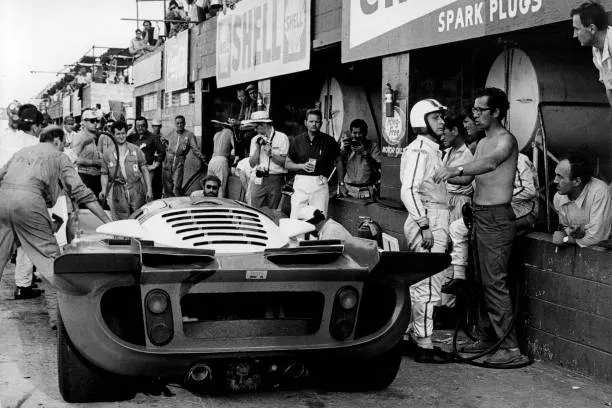
Seven weeks later. Florida. A track built on an old airfield with brutal bumps, famous for breaking cars that had survived Le Mans. Ferrari arrives with homework done: the cars going to Florida are lighter, aerodynamically refined, and with an improved Lucas injection that reportedly raises power and lowers consumption.
Andretti grabs pole. This time in the dry, beating the two fastest factory Porsches.
The race lasts twelve hours and it is chaos. The Porsche 917Ks start falling: electrical problem, a puncture, a broken suspension. Of the four 917Ks entered, they drop one by one. Ferrari finds itself with the three official 512S cars running up front. Andretti leads in chassis #1026. But then #1026 starts having gearbox issues. Andretti keeps returning to the pits. Retires after 227 laps.
It all looks lost. One Porsche 917 is now leading. Porsche is going to win Sebring one-two, just like Daytona. With half an hour to go, Ferrari’s sporting director makes a decision that enters the history books: he pulls Giunti out of chassis #21 and puts Andretti — who had already gotten out of his car and changed clothes — back in the cockpit. Andretti goes out a lap down on the leading Porsche.
Andretti does what he does best: he drives. He unlaps himself. When he’s four laps from the end, the leading Porsche suffers a front hub failure and retires. Retires four laps from the end. Andretti passes the new leader, but has to make one more fuel stop to make the finish. He comes out of the pits a full race lap behind. He hunts the leader down. Wins by 22 seconds.
Ferrari wins Sebring with chassis #1026. First victory of the season. First victory of the 512S. Andretti, Giunti, and Vaccarella lift the trophy. Behind them, the Porsche 908 of Peter Revson and an amateur driver making history: Steve McQueen, who is preparing Le Mans and racing by immersion. Second place.
It is the 512S’s highest moment. The only high moment of the 512S in the World Championship. What comes next is a free fall.
The middle of the season
Brands Hatch: Chris Amon and Merzario fifth. Monza: the 512S cars take second, third, and fourth, but the winner is Porsche. Targa Florio: Vaccarella and Giunti third. Spa: Ickx and Surtees second, Vaccarella and Giunti fourth. Nürburgring: Ickx and Surtees third, Parkes and Müller fourth.
They are results. They are podiums. But they are not wins. And the wins go to Porsche, race after race. The 917 is more reliable. Lighter. Already has a year of development. The 512S is fast — Ickx demonstrates in every qualifying session that on a single clean lap he can match any 917 — but it doesn’t last 24 hours. Or 1,000 kilometers. Or 12 hours. The reliability never arrives.
And on top of it all, Ferrari has a problem Porsche doesn’t have: a Formula 1 team running in parallel, with Ickx and Regazzoni trying to fight the championship against Jochen Rindt. Ickx arrives at Le Mans in June with an injury — he has just escaped a burning car at the Spanish GP barely two weeks earlier, and at Spa had a fuel leak that nearly cost him dear. That is the level of exhaustion with which Ferrari’s star driver arrives at the most important race of the year.
Le Mans, June 13, 1970
Ferrari enters four factory 512S cars. Special long-tail body, the famous coda lunga, designed for the Hunaudières straight, then over five kilometers long with no chicanes. The cars are set up to run flat out.
Four works 512S:
- Ickx / Schetty (car #5)
- Regazzoni / Merzario
- Vaccarella / Giunti
- Bell / Peterson
Seven more private 512S cars. Facing them, eleven Porsche 917, a mix of short-tail 917K and long-tail 917 LH.
The race goes wrong for Ferrari in the opening hours and never comes right. Vaccarella and Giunti are out after seven laps. Merzario and Regazzoni’s car ends up in a multi-car accident in which Derek Bell pulls off a miracle swerving past a Porsche 908 that has spun out of Reine Wisell’s control — but Regazzoni’s 512S hits Wisell’s car, and then Mike Parkes arrives in his 512S and takes both of them down, bursting into flames. The marshals get there in time. Nobody dies. Three of the four factory 512S are out before midnight.
Only car #5 of Ickx and Schetty remains. And then it starts raining.
Ickx, in the rain, is probably the best driver in the world at that moment. In Brazil, Canada, and Germany he has demonstrated time and again that water opens doors for him. He takes the car from sixth to second during his night stint. He is chasing the leading Porsche down. For the first time all season, a factory 512S is leading a real fight against a 917.
Past midnight, Ickx arrives at the Ford chicane trying to unlap himself from Siffert. The 512S’s rear brakes fail. Fail without warning. The car buries itself in a pile of wet sandbank and flies over it. Lands on fire on the other side. The corner marshal Jacques Argoud is killed on the spot. Another is injured.
Ickx climbs out of the car unharmed. The fire is put out. Flags come down. Racing resumes. The last factory 512S has vanished from the scoreboard. Porsche wins with Herrmann and Attwood in the red Salzburg 917K — Porsche’s first Le Mans victory ever. Of the nine 512S cars that started, only two cross the line: the privateers Bucknum/Posey (NART) and Fierlant/Walker (Ecurie Francorchamps), fourth and fifth.
The Italian press calls it a débâcle. There is no better word. Ferrari has lost Le Mans in the worst possible way.
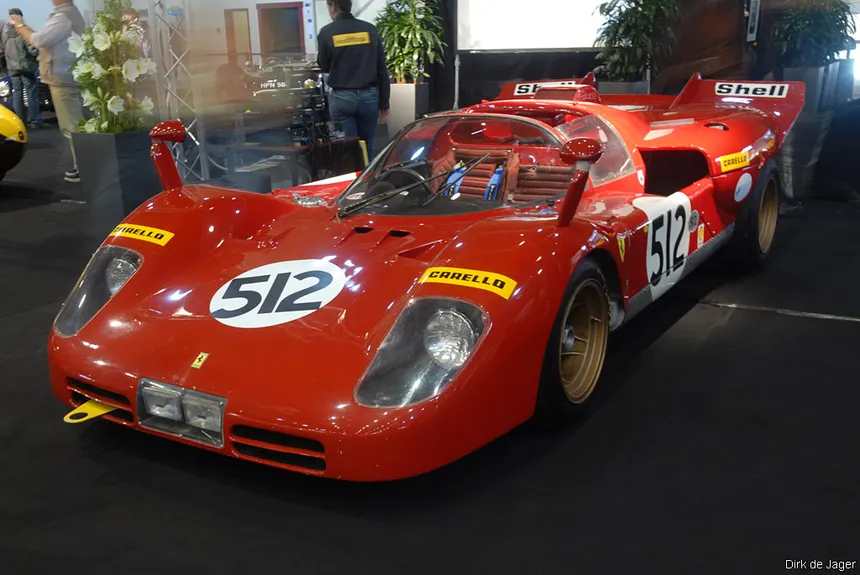
The 512M and the end
Late in 1970, with the World Championship season already decided in Porsche’s favor, Ferrari introduces an evolution: the 512M (modificata). Redesigned bodywork echoing the 917K’s lines, lighter, more powerful. The engine climbs to 620 horsepower at 9,000 rpm. The chassis drops weight. In theory, a new car.
The factory 512M debuts at the 9 Hours of Kyalami at the end of 1970, outside the championship. Ickx and Giunti win with chassis #1010. It’s the only other victory in the entire 512 program. Sebring and Kyalami. Two wins. An entire season, and that’s it.
Then Ferrari makes the decision that liquidates the project. For 1971, the Scuderia is going to focus on the new 3-liter 312 PB, looking ahead to the regulations that will come in 1972. The 512 is abandoned by the factory. It’s handed to the privateers. Penske-Donohue with chassis #1040 in blue and yellow Sunoco livery becomes the most developed 512 in history — Donohue and his team rebuild the car’s center section, rework the aerodynamics after testing at a local airport, redesign the suspension and the engine. It’s the fastest 512 ever. But it delivers a third place at Daytona 1971 and that’s the peak.
The 1972 rules change finishes everything off. Five-liter engines are banned. Some converted 512s appear in Can-Am and Interserie for years, in increasingly modified form, until they disappear. The program has lasted barely two complete seasons.
Enzo Ferrari sold half his business to fight this war. He won two races.
The chassis nobody wanted
Back to chassis 1046. The twenty-third of the twenty-five. Built, numbered, and buyer-less. Ferrari tries to sell it. First as a straight 512S. Nobody wants it. They convert it to 612 Can-Am spec — with the 6.2-liter V12 and 620 horsepower designed for America. They assign it the 612 Can-Am number 0864. Nobody wants that either.
In the end it becomes the car with the most designations without ever racing: 512S #1046, then 612 Can-Am #0864, then a stripped chassis emptied out by Ferrari, engine and gearbox removed, reduced to an empty tubular frame. And in that state, they load it onto a truck and send it to Cambiano. To Pininfarina. Where a certain Paolo Martin has been waiting for months to dress it in something that will not look remotely like a Ferrari.
What happened to that chassis afterwards has nothing to do with the war against Porsche. It’s another story — that of the most radical car ever to come out of Maranello, the one that never raced, the one that sat still for 44 years, the one that burned in Monaco half a century later. You can read that story elsewhere.
This one ends here. The story of the 512S in competition. Of the car that Enzo Ferrari paid for with half his company. Of the engine Forghieri built in three months. Of the twenty-five chassis scattered around the world like cards from a deck. Of that Saturday at Sebring when Andretti unlapped himself in thirty minutes. Of that night at Le Mans when Ickx flew over a sandbank and a man died on the other side.
Ferrari built twenty-five. Lost the war. Won two races. And the one left over became something else.
Check you’re still alive.