

Porsche 911 GT1: the legal loophole that won Le Mans

Here’s the part most people get backwards: the Porsche 911 GT1 is not a road car they turned into a race car. It’s a race car they were forced to register for the road. Because if they hadn’t, the FIA wouldn’t let it onto the grid at Le Mans.
Get that flipped, and the entire car makes sense.
The McLaren F1 was a road-going supercar that almost accidentally ended up winning Le Mans in 1995. The Ferrari F40 was a road car that fit a regulation and went racing on the side. The 911 GT1 is something else entirely. It’s a Weissach prototype that Norbert Singer dressed up with 993 headlights, a Speedster Recaro seat, and a 5.3 cubic foot luggage compartment so the German Ministry of Transport would stamp it road-legal. Beyond that there’s no compromise. No marketing layer. No “brand philosophy.” It’s a race car wearing a license plate.
That distinction matters. It explains how the car drives, why it exists, and why nearly thirty years later it remains one of the most extreme homologation specials ever produced.
The setup: Stuttgart wakes up to a problem
By the mid-1990s, sportscar racing was in the middle of a quiet renaissance. The BPR Global GT Series had pulled endurance racing back from the brink, and manufacturers smelled blood again. McLaren turned up with the F1 GTR and won Le Mans outright in 1995, on its first try. For Stuttgart, that was personal.
Porsche had owned Le Mans for decades. The idea that a British boutique builder — because that’s what McLaren was at the time, a one-model garagiste — was now showboating in their own backyard didn’t sit well. Not industrially, not emotionally. Porsche’s identity is wrapped around the La Sarthe trophy cabinet. Losing it to McLaren wasn’t just a sporting setback. It was an identity crisis with a sponsor list.
The first response was the cheap one. They took the road-going 993 GT2, built an Evo version, and ran it as a GT1. It didn’t work. The 993 GT2 was vicious in a straight line, but in real racing conditions against the McLaren F1 GTR it had no answer. Different architecture, different weight distribution, different generation of thinking entirely.
So Herbert Ampferer, head of Porsche Motorsport, made the call. He went to Norbert Singer — the brain behind the 956 and the 962 — and to Horst Reitter, the engineer who had designed the 956’s monocoque. The brief was the only one you give three men like that: build something that wins.
The fix: a prototype with a license plate
The GT1 regulations were beautifully thin. To compete, you had to sell the car to the public. The rules didn’t specify how many. They didn’t specify when. They didn’t specify a price ceiling. The BPR took a manufacturer’s word for it: “we’ll build 25 road cars, Porsche promises.” When the FIA took over the championship in 1997, they tightened the rules a little. Not much.
That gave Singer all the room he needed.
The 911 GT1 isn’t a 911. This needs saying clearly because it matters. A real 911 — a 993, a 996 — has its engine slung behind the rear axle like a backpack. That’s Ferdinand Porsche’s awkward inheritance, the brand’s original sin, the thing that makes a 911 a 911 and not something else. The GT1 has its engine in front of the rear axle. It’s mid-engined. The front clip is from the 993 because that bodywork was already crash-tested, which let Porsche skip an entire round of homologation costs. The rear is a derivative of the 962’s tubular chassis — the Group C car that dominated the eighties. Bridging the two is a 3.2-liter, water-cooled, twin-turbo flat-six that has nothing to do with anything you’d find in a 911 you can buy at a dealership.
Is it a 911? It shares the badge and the headlights. That’s about it. But here’s the trick: when you see one go past, when your eye catches the silhouette and the lighting signature, your brain says “911.” That’s exactly what Porsche needed your brain to say.
The engine: 3.2 twin-turbo, water-cooled, race DNA
This is where the GT1 stops pretending.
The block is a 3,164 cc flat-six, four valves per cylinder, double overhead cams per bank, fully water-cooled — not just the heads, the entire engine — with two KKK turbochargers running in parallel. Race-spec, it produced approximately 600 horsepower. Road-spec, in the Strassenversion, it was detuned to 544 hp to meet European emissions law and to make the car, within the limits of physics and good taste, drivable on a public motorway.
That 3.2 didn’t fall from the sky. It’s a direct descendant of the work Hans Mezger and his team had done over two decades developing Porsche’s competition engines, sharing DNA with the 956 and 962 Group C cars. It is not — repeat, not — a derivative of the road-going 911 Turbo, regardless of what some lazy writeups will tell you. It’s a racing engine that they fitted with a catalytic converter and dialed back the boost on.
A six-speed sequential gearbox sits longitudinally behind the motor. Cast iron brake discs on the road version replaced the racing carbon discs. Suspension was raised and softened — but only in relative terms. Anyone expecting Audi A8 ride quality is going to have a very bad time.
Dry weight on the Strassenversion: 1,150 kg. Zero to sixty took 3.9 seconds. Top speed: 308 km/h, around 192 mph.
Is that fast? In 1997, it was savage. Today, a Tesla Model S Plaid family sedan accelerates harder in a straight line. But the GT1 was never about straight lines. The GT1 was built for the Porsche Curves at Le Mans, at three in the morning, with a driver who knows what he’s doing. That’s the metric.
Two generations, two faces
There’s a detail almost nobody gets right that’s worth getting right.
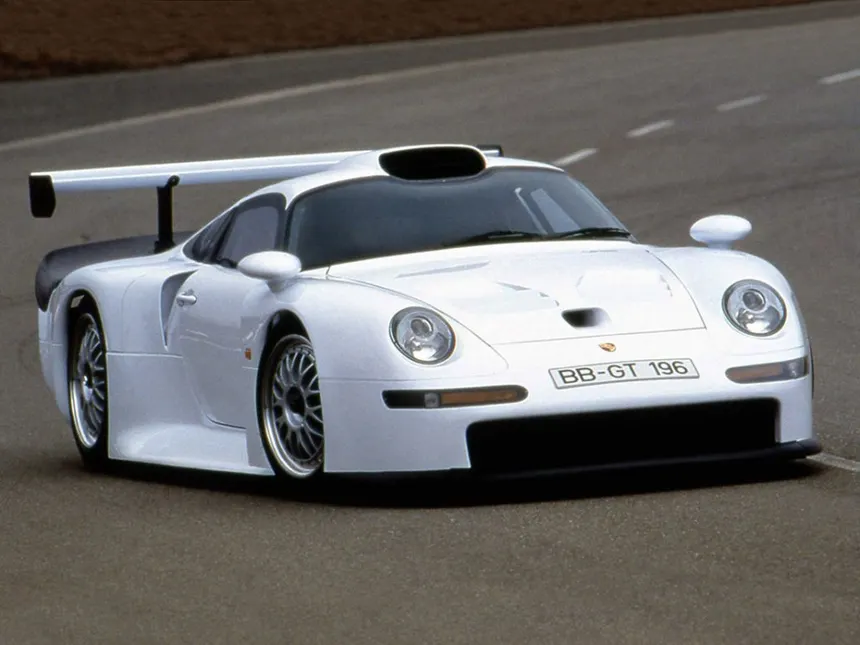
The original 1996 GT1 wore the round headlights and front clip of the 993. That generation includes only two road-legal prototypes Porsche built: one delivered to the German Federal Ministry of Transport for compliance testing, the other passed into private hands and now lives in a Middle East collection. Two cars. That’s it.
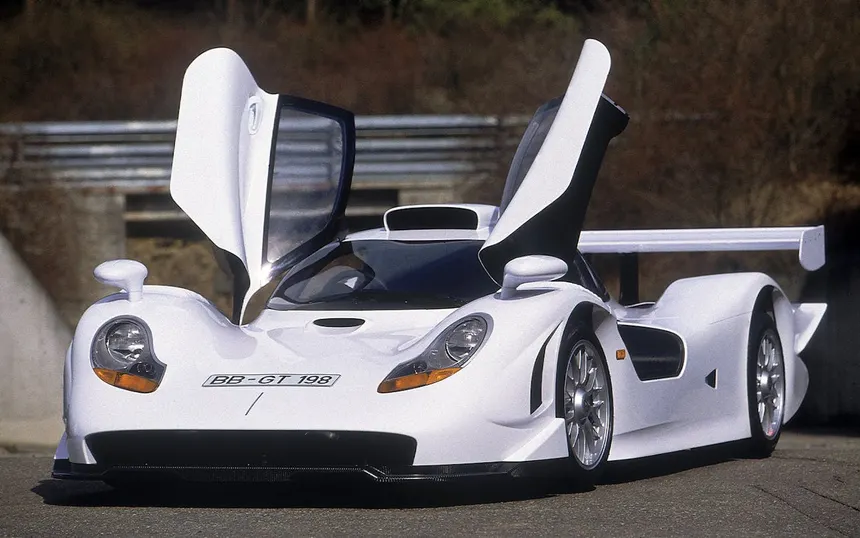
By late 1996, Porsche revised the car aerodynamically and grafted on the headlights of what would become the 996 — a model that hadn’t been officially launched yet. That revised car, the GT1 Evo, raced in 1997 and is the version most people picture when they hear “911 GT1.” The 1997 Strassenversion — the bulk of the road-car run, around twenty units — uses those 996 lamps.
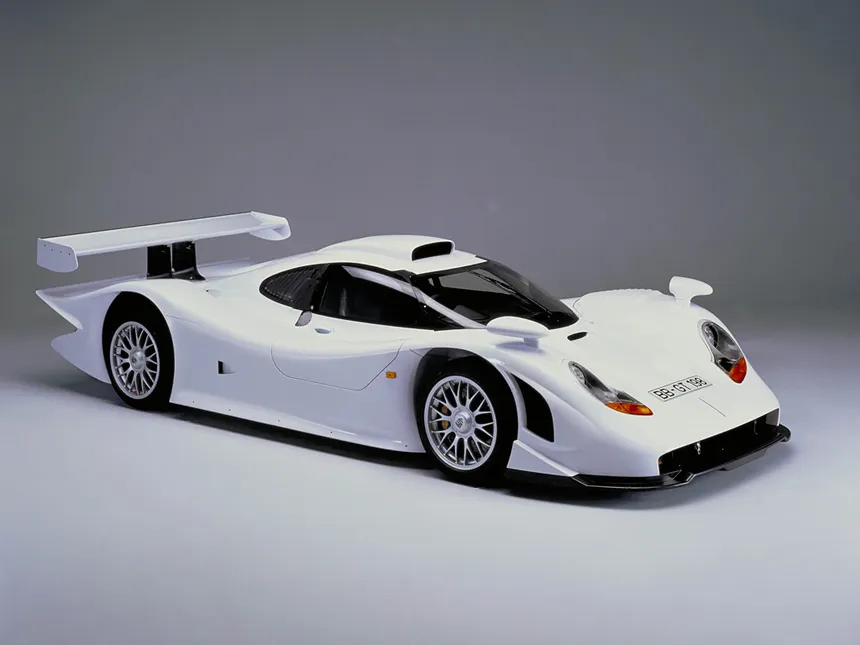
Then in 1998 came the GT1-98. A nearly all-new car: carbon fiber monocoque, fuel tank repositioned, new aerodynamics. A single road-legal example was built to homologate this new version under FIA rules. Just one. Built to satisfy a piece of paperwork.
That single-unit production run tells you everything about how Porsche read the rulebook.
Le Mans 1998: the win Stuttgart needed
The GT1-98 wasn’t the fastest car at Le Sarthe in 1998. That has to be said. The Toyota GT-One was the quickest of the bunch, and the Mercedes CLK-LM wasn’t far off. But endurance racing isn’t won by going fastest. It’s won by finishing.
On June 14, 1998, while Toyota’s gearboxes shredded themselves and Mercedes’ new V8s killed themselves with oil pump problems, the two factory 911 GT1-98s rolled across the finish line in first and second. Allan McNish, Laurent Aïello and Stéphane Ortelli took the win. Jörg Müller, Uwe Alzen and Bob Wollek finished second.
It was Porsche’s sixteenth overall victory at Le Mans, more than any other manufacturer in history.
Was it the fastest car on the grid? No. Was it the most reliable that day? Yes. And when you’ve been racing for 24 hours and all that’s left is the run to the chequered flag, reliability is the only metric that exists.
The road cars: how many, and where they are now
The numbers are deliberately murky. Porsche talks about “approximately 25 units” produced between 1996 and 1998 to satisfy homologation. The actual documented production is: two prototypes from 1996 with 993 headlights, around twenty units from 1997 with 996 headlights, and a single unit from 1998 to homologate the new race generation.
The Strassenversion cars don’t surface often. Most live in private collections, walled off from the world. But the public record gives us hard numbers. Original retail to Porsche’s hand-picked VIP customers in period was $912,000. Since then, only a handful have crossed the auction block. The 1998 chassis 396005 — the only example legally imported into the United States, under the Show and Display exemption — sold at RM Sotheby’s in Monterey in August 2012 for $1,175,000. The same car came back to auction in March 2017 at Gooding & Company’s Amelia Island sale and went for $5,665,000, a record for the model at the time. In May 2016, RM Sotheby’s sold a 1997 GT1 Evolution race car that had been converted to road use by British firm Lanzante for €2,772,000 in Monaco.
Those are the real numbers. You’re not going to scroll past a GT1 listing on Bring a Trailer next Tuesday.
What does ownership get you? One of the most uncompromising machines ever stamped legal for public roads. A car with a laughable luggage compartment, submarine-grade visibility, cooling systems engineered for circuits, and fuel consumption figures that would make an EU policymaker weep. And, more importantly, the last serious example of a major manufacturer building a prototype first and a road car second. After the GT1, homologation rules tightened. After the GT1, manufacturers started building street hypercars first and deriving racing versions second, if at all. The GT1 was the last time the logic ran the other way around.
Why the GT1 matters
Because it tells you something about how cars get built and how rules get written.
The GT1 is what happens when a manufacturer looks at a regulation and sees a treasure map instead of a roadblock. Singer wasn’t interpreting the rules. He was dancing with them. The rules said “build a road car.” Singer said “fine, I will” — and built a prototype with a passenger seat and a small luggage shelf. The rules said “must be homologated.” Singer took the already-homologated 993 nose, stuck it onto a 962-derived chassis, wrapped some carbon fiber around the rest, and called it done. The rules said “the road version has to actually drive on roads.” Singer made sure it could, in the most literal possible sense, and then got back to the actual job.
That doesn’t happen anymore. Today’s hypercars are built front-to-back the conventional way: road car first, with airbags and Euro 7 emissions and IIHS crash testing baked in from the start, and a stripped-down racing variant — if there is one — derived later. The flow of engineering goes from showroom to circuit, not the other way. Safer. More reasonable. More responsible. The lawyers approve, the regulators approve, the safety bodies approve, and the marketing department gets a coherent product story to sell.
Also infinitely more boring.
There’s something else worth saying. The GT1 is one of the cleanest mechanical objects ever produced by Porsche, in the sense that nothing about it exists for any reason other than performance. The pillarless cockpit, the bare carbon, the gearshift that requires both hands and bad language to use, the windscreen wipers that look like they were stolen from a Cessna — none of it is decoration. None of it is brand storytelling. It’s all there because somebody at Weissach calculated that it was the cheapest, lightest, fastest way to do whatever job that part needed to do. The car has zero ornament. That’s what makes it beautiful.
The 911 GT1 is the last monument to a moment when the rulebook was flexible and the engineers were sharks. That’s why it still moves you. That’s why, if you ever see one in person, the image stays burned into the back of your eye for years.
And if you want to understand the engineering bloodline behind the 3.2 twin-turbo that pushes this car, you know where to look: the Mezger engine piece in this same issue.
Check you’re still alive.