
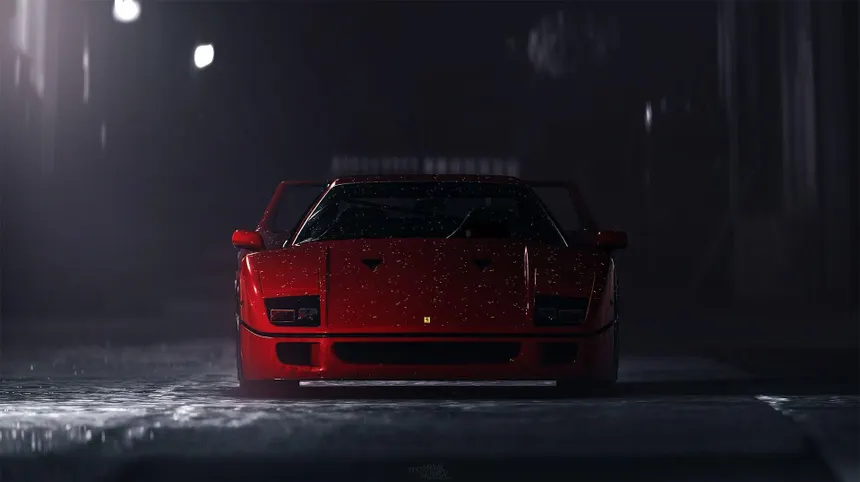
Ferrari F40: The Car That Was Born So Five Prototypes Wouldn’t End Up In The Scrapyard
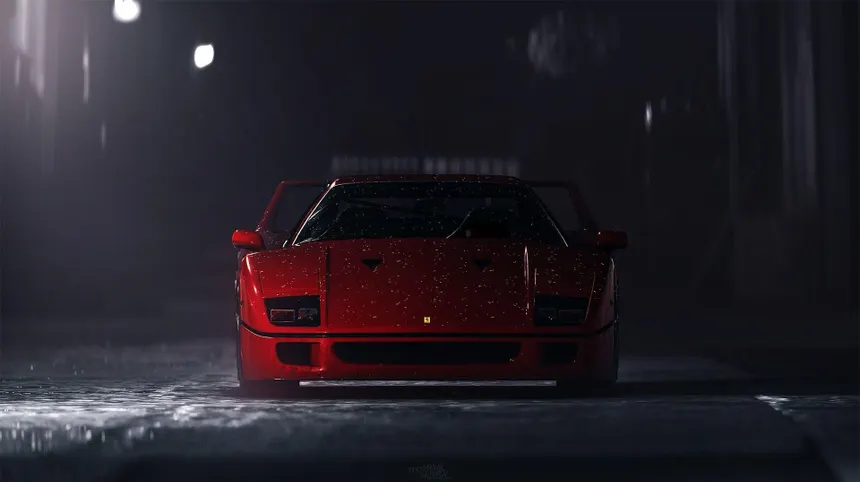
Everything you’ve been told about the origin of the Ferrari F40 is half-true.
That it was Enzo’s gift to celebrate forty years of the factory.
That it was the answer to Porsche and the 959.
That it was the Le Mans tribute Enzo always wanted to build.
That it was the founder’s last great romantic gesture before he died.
All those sentences are partly true. And all of them are history written after the launch, when Ferrari’s marketing department and the specialist press sat down to invent the epic narrative the car deserved. The reality of how the F40 was actually born — the dirty, industrial, calculated reality — is something else. And almost nobody tells it.
The F40 was born because Ferrari had five orphaned 650-horsepower prototypes sitting in the competition warehouse at the end of 1986. Five 288 GTO Evoluzione units, designed for Group B, complete, ready to race. With no category. No effective homologation. No sporting future. Five complete cars with twin-turbo V8 engines, racing chassis, Formula 1-grade aerodynamics, redesigned suspension and bodywork in advanced composites. Each one carrying development hours and invested money equivalent to a small Italian town’s annual GDP.
And a test driver who climbed into one of them and said one sentence to Maranello that changed the history of the modern road car.
If you missed the first part of this triptych — the article on the 288 GTO + Evoluzione — I’d recommend reading it before this one. Because the F40 without understanding the Evoluzione is a brilliant car. The F40 understanding the Evoluzione is something else.
Let’s get straight to it.
10 June 1986
That’s the date Ferrari officially started the F40 project.
Mark it down.
Five and a half weeks earlier, on 2 May 1986, Henri Toivonen and Sergio Cresto had been killed on the Tour de Corse. The FIA had announced days later the end of Group B at the close of the 1986 season. Maranello, which had spent two years developing the 288 GTO Evoluzione for that exact category, was sitting on five orphaned prototypes in the warehouse and a sixth prototype chassis already being used as a test mule for something else.
On 10 June 1986, Enzo Ferrari calls Nicola Materazzi into his office.
Ferrari is 88 years old. He has leukaemia, although few people know it yet. He has just received a message from Marco Toni, one of the factory’s internal test drivers who has been driving the Evoluziones over the previous weeks. The message, according to Ferrari’s own subsequent official documentation, contained one sentence.
“This is a great car, we have to make it.”
That’s the sentence that starts the F40. It wasn’t Enzo who decided a car was needed to celebrate the brand’s 40 years. It was a test driver who climbed out of the Evoluzione and told the factory it couldn’t stay in the warehouse.
Enzo passes the message on to Materazzi and gives him three conditions. Deadline: eleven months — the car must be ready for presentation in summer 1987. Team: Materazzi can personally choose every engineer he wants. Philosophy: the car must be “fast, sporting in the extreme, Spartan.” Those three exact words appear in the Ferrari press release at launch. They appear in the mouth of Giovanni Perfetti, from the marketing department. And they’re the executive translation of what Materazzi and his team had designed in the Evoluzione a year earlier.
The F40 brief wasn’t “design a car to celebrate the brand’s 40 years.” The F40 brief was “take the Evoluzione, make it road-legal, sell it to customers.”
That apparently subtle difference changes everything.
Why The 40 Years Are An Excuse, Not A Reason
Here’s the data point almost nobody articulates well.
The F40 is called F40 because it celebrates the 40 years since the Ferrari 125 S was built, Maranello’s first production car, launched in 1947. So far, the official version. But if you read it carefully, you notice something curious.
The Ferrari 250 LM, Maranello’s first official mid-engine car, was launched in 1963. There was no “F16” to celebrate the 16 years of the 125 S.
The Ferrari 288 GTO, the car we discussed in the first part of this triptych, launched in 1984. There was no “F37” either, to celebrate 37 years of the 125 S.
The Ferrari Testarossa, also launched in 1984, had no associated anniversary car.
Only the F40 uses the 125 S anniversary as the central communication theme. And it does so, by sheer coincidence, at exactly the moment Ferrari has five Evoluziones to industrially justify.
This doesn’t take anything away from the F40 or from Enzo’s decision to approve it. But it does put things in their proper place. The F40 wasn’t born because 40 years of anniversary needed celebrating. The F40 was born because five cars Ferrari had already built couldn’t simply be scrapped. The anniversary came afterwards. As a perfect marketing excuse. As the sentimental wrapper around an industrial decision.
Maranello is very good at the wrapper. Let’s not take credit away from them for that. But let’s tell the story properly.
Eleven Months, A Hand-Picked Team, Zero Committees
If there’s one thing that distinguishes the F40 from every modern Ferrari, it’s the speed of its development.
Eleven months between the project’s official start (10 June 1986) and the public launch (21 July 1987 at the Civic Centre in Maranello). Modern Ferraris take between four and six years from concept to launch. The LaFerrari was five. The SF90 was four and a half. The current F80 is at over five. How did Maranello build the F40 in eleven months?
The answer is simple: because they didn’t build it from scratch.
Materazzi was given by Enzo permission to personally choose every engineer on the team. No votes. No technical committees. No product meetings. The Italian culture of the 1980s, the pride of Maranello’s engineers focused on a single mission, and a starting point that was practically already built in the competition warehouse.
The F40’s engine — internally designated Tipo F120A — is a direct evolution of the 288 GTO road car’s Tipo F114B, with displacement raised from 2,855 to 2,936 cubic centimetres through increased piston stroke. But its internal architecture is closer to the Evoluzione’s Tipo F114CR (530 horsepower) than to the road F114B. Same conceptual heads. Same intake philosophy. Same IHI turbocharger system with Behr intercoolers. The difference is in calibration: where the Evoluzione runs 1.4 bar of boost to make 530 horsepower, the F40 drops to more conservative boost levels to guarantee road-use reliability. Official result: 478 horsepower at 7,000 rpm, 577 Newton metres at 4,000 rpm, according to Ferrari’s homologation figures. Independent dyno testing in the 1990s consistently showed higher numbers in production, which gave rise to the F40’s “underdeclared” legend.
The F40’s chassis is practically the same as the 288 GTO Evoluzione’s. Tubular chrome-molybdenum steel structure, with composite panels in kevlar, carbon fibre and nomex in specific areas, exactly like the GTO Evoluzione. Wheelbase of 2,450 millimetres, identical to the road 288 GTO. Double-wishbone suspension at all four corners, with configuration practically identical to the Evoluzione’s, with adjustments for road use and softer springs.
What changed compared to the Evoluzione? Three concrete things:
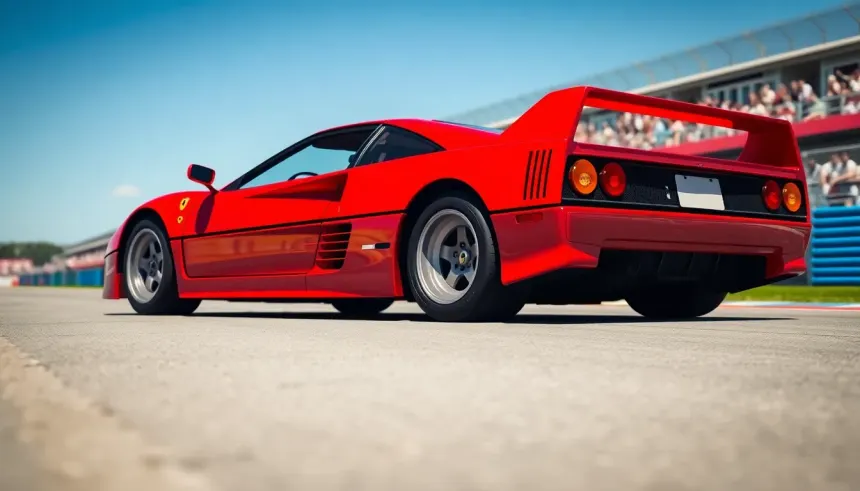
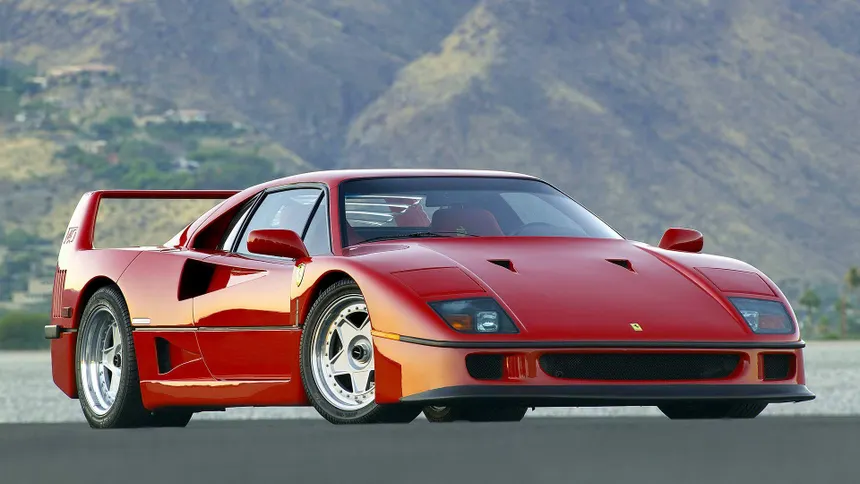
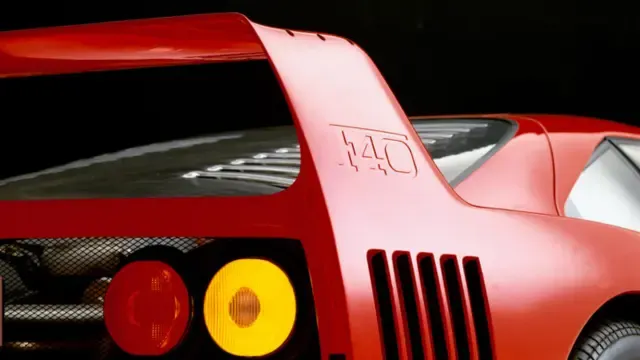
1. The body. Pininfarina, under direction from Aldo Brovarone with detailed design by Pietro Camardella, simplified the Evoluzione’s radical body to make it visually more manageable and easier to series-produce. The huge front canards were gone. The integrated rear wing of the Evoluzione became cleaner on the F40. The NACA ducts were reorganised. The side view was softened. The F40 is the Evoluzione domesticated for showroom sale, not the Evoluzione disguised to be raced.
2. The tyres. This is the part almost nobody mentions and it’s pure engineering. Materazzi personally called Mario Mezzanotte, head of development at Pirelli, whom he’d known since the years they both worked at Lancia on the Group 4 Stratos cars. Pirelli developed a specific tyre for the F40 — the original P-Zero — using a Kevlar carcass derived from the Formula 1 tyres of the 1980-1985 seasons and an asymmetric tread pattern. The P-Zero, today one of the best-selling sports tyres on the planet, was born specifically for the F40. Without the F40, no P-Zero as a commercial product. Without the Evoluzione before it, no technical need for Materazzi to ask for a competition-derived road-homologated tyre.
3. The interior. The Evoluzione had pure competition interior — full roll cage, carbon bucket seats, zero concessions. The F40, to be sold to customers, had to have a minimum of habitability. But that minimum was literally minimal. No door panels. No interior trim across most of the cabin. No radio. No conventional door handles — the doors close by pulling on a fabric cord. The only concession to comfort is an air-conditioning system, optional according to the original documentation. The F40 isn’t a Spartan Ferrari by philosophy. The F40 is a Spartan Ferrari because its origin is a competition car somebody bolted plates onto to sell.
What Separates The F40 From The Dominant Story
Now comes the part where we need to talk about what the F40 actually is. Because so far this might sound like we’re tearing the car down. We’re not.
The F40 is genuinely brutal. That’s beyond debate. 0 to 60 mph in 3.8 seconds according to Road & Track’s October 1991 test, which is the most reliable independent figure. Top speed certified at 201 mph (324 km/h), making it the first homologated road car capable of breaking the 200 mph barrier in production trim. All of that with a dry weight of 1,100 kilos — sixty less than the road 288 GTO, a hundred and sixty more than the competition Evoluzione.
It’s the last Ferrari personally approved by Enzo before his death. That’s also true. Enzo Ferrari died on 14 August 1988, just over a year after the F40’s launch. And although the decision to approve the car was industrial — driven by the need to find an outlet for the orphaned Evoluziones — it was Enzo who signed the green light. And in Ferrari mythology, that matters. It matters because Enzo didn’t sign just anything. It matters because Enzo, old and ill, saw the car running before he died and gave it his blessing. It matters, ultimately, because the F40 is the last road Ferrari from Maranello with the founder’s personal fingerprint.
It’s the first road Ferrari to break 200 mph. Real milestone, not marketing.
Its production far exceeded the initial plan. Ferrari announced a production plan of 400 units in 1987. It ended up producing 1,311 units between 1987 and 1992 — the best-selling car of the “Big Five” (288 GTO 272, F40 1,311, F50 349, Enzo 400, LaFerrari 499). The explanation is industrial: the planned 400 units were sold on pre-order before production even started. Ferrari expanding production is something almost never seen in Maranello — and it happened with the F40 because demand was brutal and the car was relatively cheap to manufacture (remember: most of the engineering was already done in the Evoluzione). And here’s the other part nobody tells you: Maranello, which never expands production on principle, did so with the F40 because the per-unit margin was enormous and demand wouldn’t stop. The F40 didn’t just save the five orphaned Evoluziones from the scrapyard. It filled Maranello’s coffers during the toughest years before Enzo’s death, when Fiat already controlled operations and Ferrari’s cash flow was watched more closely than the Vatican’s. The F40 was a cash register before it was a myth.
The F40 established the modern supercar archetype. After the F40 came the F50, the Enzo, the LaFerrari, the F80. But also the McLaren F1, the Bugatti EB110, the Jaguar XJ220 and every hypercar that has come since. Composite bodywork. Mid-mounted engine. Minimum interior comfort. Maximum performance. The F40 set that formula. The F50 refined it. The rest of manufacturers copied it.
All of that is true. And all of that justifies the F40’s place in the mythology.
But the origin is industrial, not sentimental. That’s also true. And nobody tells you.
The Sixth Chassis: The Mule Nobody Acknowledged
Remember the data point we left open at the end of the 288 GTO article. Of the six Evoluzione examples, one — the prototype chassis, not a production unit — was used as a test mule during F40 development.
That trail, as far as public documentation allows reconstruction, runs as follows. The Evoluzione prototype chassis was used internally at Maranello between June 1986 and mid-1987 to validate components of the new F40. Suspension, brakes, cooling, aerodynamics, the F120A engine in its various development iterations. When the F40 was launched in July 1987, that chassis returned to the technical department, where it remains today.
Why does it matter? Because it physically demonstrates, not anecdotally, the technical continuity between Evoluzione and F40. It wasn’t inspiration. It wasn’t loose derivation. It was direct work on the same chassis, with the same engineers, with the same philosophy, during the same calendar year. The F40 and the Evoluzione are, technically, the same car with two different calibrations and two sister bodies.
If you could climb into the Evoluzione and the F40 on the same day and drive them back to back, you’d feel the F40 as a calmer version of the Evoluzione. Not as a different car. That’s the technical reality the commercial mythology has been hiding for forty years.
That sixth chassis sits today in Maranello’s technical department, where probably nobody has ever asked it how it felt when it watched the F40 take shape out of its own mechanical flesh.
What Comes Next
This isn’t the end.
In 1989 Ferrari decided to take the F40’s mechanical base back to circuit racing. It commissioned official preparer Michelotto, in Padua, to take the F40 to genuine competition specification. The idea was to race in the American IMSA championship and, later, in the BPR Global GT Series being put together in Europe. What Michelotto built — the F40 LM and later the F40 Competizione — is what the road F40 never was. And, paradoxically, what the 288 GTO Evoluzione should always have been from the start.
That story deserves its own article. It’s the third and final part of this triptych. And if you think the road F40 is brutal, wait until you see what Michelotto did with it once Enzo wasn’t around to tell him no.
Ten years after Toivonen died and the FIA killed Group B, Ferrari finally put a car with Evoluzione DNA back on a racing circuit. It came late. It came after Enzo. But it came.
That’s another story.
Why The F40 Matters More Now Than Ever
Because in an industrial era where Ferrari builds cars calculated to the millimetre by marketing departments, launched with synchronised global campaigns and sold through five-year waiting lists to hand-picked customers, the F40 is a reminder of what Maranello was like when it still did things the wrong way.
Wrong in the good sense. Wrong in the industrially improvised sense. Wrong in the sense that a test driver climbed into a car on a Friday and on Monday the founder was approving an eleven-month road car programme. Wrong in the sense that the engine of Ferrari’s most expensive and fastest car of the 1980s was a calibrated version of the engine from five orphaned prototypes that almost ended up in the scrapyard.
Today, no manufacturer on the planet can afford to build a car like this. Too much regulatory risk. Too much shareholder pressure. Too many processes. The F40 is the last Ferrari built with the we’ll see logic, not the five-year plan logic.
That’s why it costs what it costs. That’s why, when one comes up at auction today, prices break 3 million euros for original-condition examples. That’s why collectors fight over specific units with documented history. And that’s why, almost forty years after its launch, it’s still the modern supercar par excellence.
Not because it’s the fastest. Not because it’s the most exclusive. Not because it celebrated Ferrari’s 40 years.
Because it’s the last road Ferrari that was decided by a test driver, not by an executive committee.
Check you’re still alive.