Aramco DHE: the oil giant’s pushrod hybrid engine, built in Michigan, is brilliant and that’s exactly the point
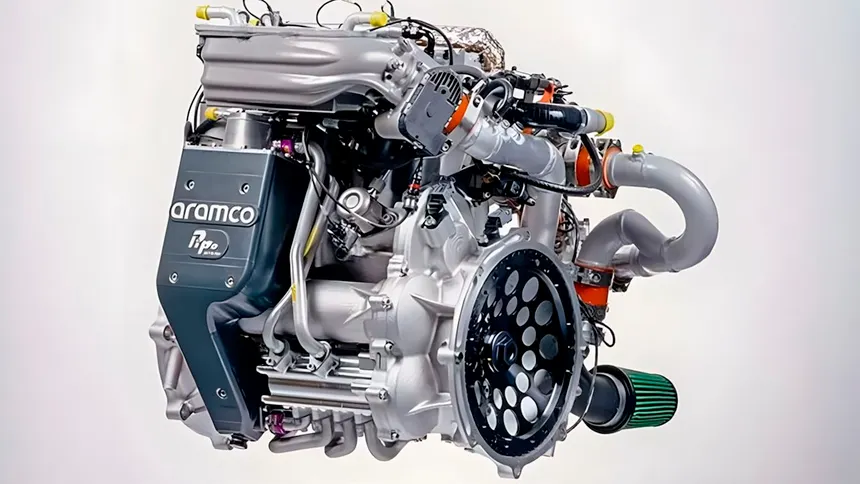
Detroit spent the last forty years being told pushrods were dead. Overhead camshafts, four valves per cylinder and variable valve timing were the future; the Chevy small-block and its two-valve heads were a dinosaur kept alive by stubborn Americans. Then, of all companies, Saudi Aramco, the world’s largest oil producer, went to its research center in the Detroit area, hired a French race-engine shop, and designed a hybrid engine with pushrods and two valves per cylinder. On paper it’s one of the cleverest hybrid layouts anyone has shown in years. It is also part of a much bigger plan to keep the world burning gasoline for decades.
Both things are true, and the story only makes sense if you look at them together.
What Aramco actually built
The project is called the Dedicated Hybrid Engine, or DHE. It was developed at Aramco Americas’ research and development center in Michigan, under a lead engineer whose surname, by pure coincidence, is Engineer: Nayan Engineer. The starting question was simple and surprisingly rarely asked: what would a gasoline engine look like if you designed it from scratch knowing it would only ever live inside a hybrid?
Most hybrid engines today don’t start that way. Toyota’s engines, Honda’s and Hyundai’s are refined versions of engines that also have to work, or once had to work, in conventional cars. That means they carry hardware designed for a wide range of jobs: high revs, strong response at low speed, smooth idling, emissions across every driving condition.
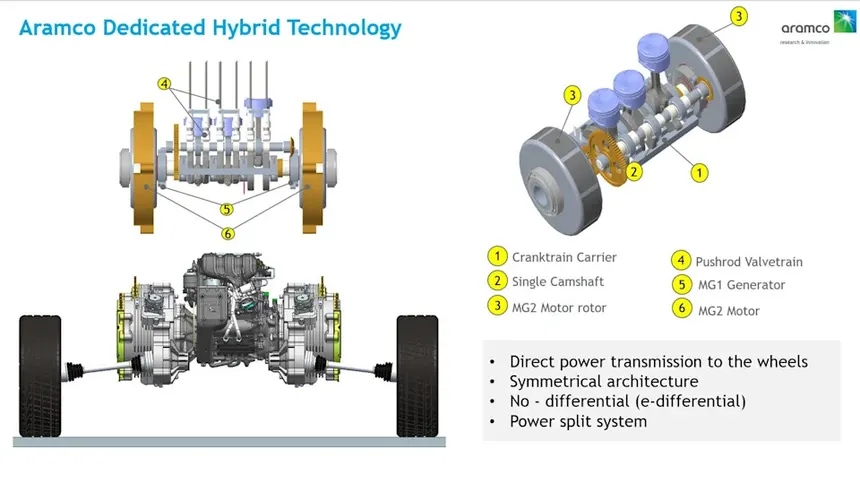
Aramco’s answer is a naturally aspirated three-cylinder of 1,599 cc, about 98 cubic inches, mounted transversely, with an electric motor-generator at each end of the crankshaft. Each end of the crank drives the carrier of a planetary gearset; the sun gear goes to a motor-generator, and the outer ring gear connects to a traction motor geared to a wheel. In other words, it’s a power-split hybrid, the same family of system Toyota uses in the Prius and the auto industry often calls an e-CVT, but doubled, with one complete set on each side of the engine.
That matters. In a pure series hybrid, like Nissan’s e-Power, the gasoline engine only ever makes electricity. All of its power has to be converted from mechanical to electrical and back again before it reaches the wheels, which costs efficiency, especially at highway speed. In a power-split design, the engine can drive the wheels mechanically through the planetary gears when that’s more efficient, charge the battery when that’s better, or do both at once. The electronics decide, many times a second, based on speed, load and the state of the battery, and the driver never feels a gear change because there are no gears to change in the usual sense.
Having two sets also lets the system send different torque to the left and right wheels. It acts as an electronic differential. That means no mechanical differential, no conventional transmission, no clutch and no torque converter: four heavy, expensive components that simply aren’t there.
How a planetary gearset splits the power
If the phrase "power-split" sounds abstract, the hardware is easier to picture. A planetary gearset has three parts. In the middle is the sun gear. Around it, several small planet gears are held by a carrier. Around them is a large ring gear with teeth on the inside. Connect three different things to those three parts, here the engine, a motor-generator and the wheels, and the gearset lets them turn at different speeds while sharing torque among themselves.
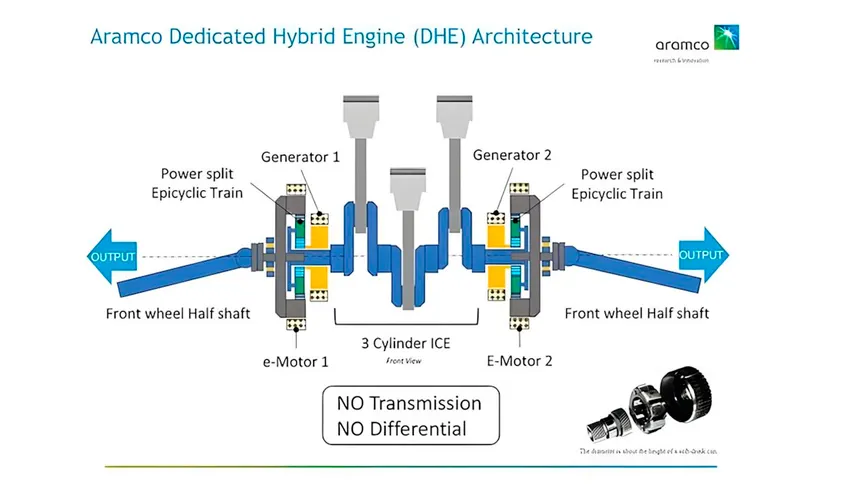
That’s the trick Toyota made famous in the first Prius in 1997. By controlling how fast the motor-generator spins, the computer effectively sets the gear ratio between engine and wheels, continuously and without any shifting. The engine can run at its most efficient speed while the car speeds up or slows down. Aramco’s DHE uses two of these sets, one at each end of the crankshaft, which is what allows it to manage each driven wheel separately.
Old-school hardware in exactly the right place
Here is where it gets interesting for anyone who grew up with American V8s.
Because the engine only has to run in a narrow band of speeds and loads, its sweet spot of efficiency, Aramco’s engineers threw out a lot of what modern engines carry. The DHE uses pushrods and a single camshaft in the block, like a classic American V8, instead of overhead camshafts. It has two valves per cylinder instead of four. The cylinder head is cast as one piece with the block, a monoblock design that eliminates the head gasket, one of the most common failure points in modern engines. There’s no variable valve timing, because an engine that always runs in the same range doesn’t need it. It uses a long stroke for efficiency and can be fitted with a dry sump so it can be mounted low and flat.
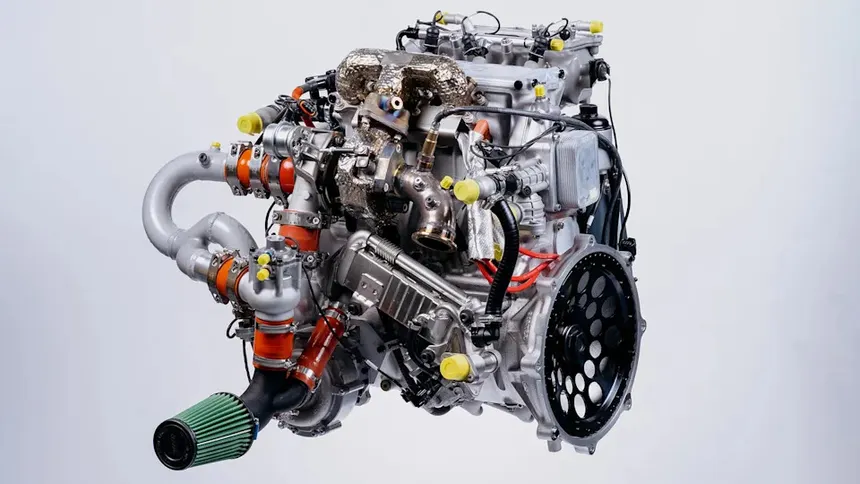
If a budget Chinese carmaker had announced that spec sheet, the industry would have laughed. Coming from a company with more cash than many countries, it reads more like a challenge.
The obvious objection is that pushrods don’t like high revs. The rods are heavy and flex, and above a certain speed the valvetrain gets unstable. That’s a big part of why Japanese manufacturers moved to overhead cams and four valves decades ago. But an engine that never needs to spin fast doesn’t have a high-rev problem. Pushrods aren’t better in general. For this job, they’re good enough, and good enough at a lower cost is the whole point.
GM never fully abandoned the idea, of course. The pushrod small-block V8 in the Corvette and Silverado survived precisely because, for its job, it was compact, light, torquey and cheap to build. Aramco simply applied the same logic to a tiny three-cylinder inside a hybrid.
Others tried to reinvent gasoline from the wrong end
This isn’t the first attempt to rethink the gasoline engine, and the earlier ones are instructive.
In the 1980s, the legendary NASCAR builder Smokey Yunick developed his "hot vapor" engine, which tried to recover exhaust heat, vaporize the fuel and cut cooling losses. The numbers he quoted were extraordinary, but the metallurgy of the time couldn’t take it and the engine never worked in everyday use. Mazda attacked the problem from another angle with SkyActiv-X, the first production gasoline engine to use compression ignition under some conditions, a goal the industry had chased for decades. It worked, but it cost significantly more than a conventional engine for a fuel-economy gain most buyers barely noticed.
Both tried to change how gasoline burns. Both ran into cost and reliability. The DHE doesn’t touch combustion. Its cycle is ordinary. What it reinvents is the cost and complexity of the whole system around it, an area where nobody had looked hard.
Why a French race shop built it
To build the prototype, Aramco didn’t go to one of the big engineering consultancies like AVL, FEV or Ricardo. It went to Pipo Moteurs, a small company in Le Pontet, near Avignon in southern France, known for rally, endurance and off-road racing engines. Pipo designs, machines, assembles and tests under one roof.
Aramco could have hired anyone. Choosing a race shop says something: the idea was unusual enough that a traditional corporate R&D process might have killed it in the first meeting, and Aramco wanted people used to building strange engines quickly. Engineer himself described them as "engine people," which anyone who has spent time around a dyno will understand as a compliment.
Cheaper than what, exactly?
Aramco says the system costs 23 to 25 percent less than current hybrid systems. That’s the number that went into the headlines, and it deserves scrutiny.
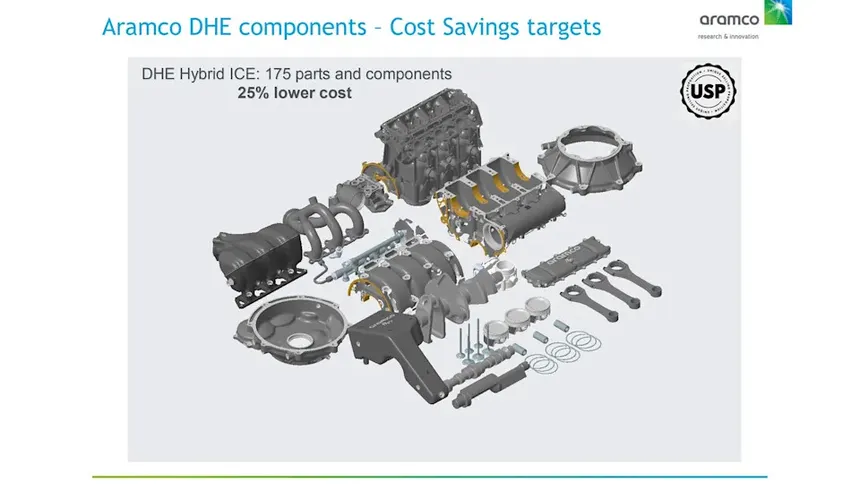
First, it’s a modeled figure from Aramco, not a cost measured on a real production line. Second, the comparison is with "standard hybrid systems," without saying which. Toyota’s Hybrid Synergy Drive? BYD’s DM-i, which is already cheap and sold in the millions? At what production volume? The unit cost of any engine falls dramatically with volume, and without that detail a percentage is a promise, not a price. The underlying logic is sound: take out parts and you take out cost, and Aramco has taken out a lot. But until an engine comes off a real assembly line, the number is a well-argued projection.
It’s also worth remembering that the DHE isn’t entering an empty market. BYD’s plug-in hybrids have been squeezing European and Japanese rivals for years, and other suppliers are working on cheap hybrid units of their own.
The numbers that can be verified
What Aramco has confirmed publicly is limited: a 1,599 cc naturally aspirated three-cylinder, mounted transversely; pushrod valve actuation with a single camshaft and two valves per cylinder; a monoblock design with the head integrated into the block; a long stroke; compatibility with a dry sump; a dual power-split layout with planetary gearsets; a modeled cost reduction of 23 to 25 percent; and a midsize SUV as the initial target. Other figures circulating online, such as a total part count or a peak thermal efficiency in the low 40 percent range, don’t appear in Aramco’s official material, so we’re not repeating them as fact.
Not Aramco’s only bet
The DHE isn’t the only unusual engine program Aramco has backed. The company has also worked with Achates Power, the San Diego developer of opposed-piston engines, in which two pistons share each cylinder and there’s no cylinder head at all. It has funded research into low-carbon and synthetic fuels, and into how combustion engines can run on them. Seen one by one, each project is interesting engineering. Seen together, they form a portfolio with a single theme: making sure combustion has a technical answer to every argument for going fully electric.
Follow the money
Now the part most coverage skipped. In December 2024 Aramco completed the purchase of a 10 percent stake in Horse Powertrain, based on an enterprise value of 7.4 billion euros. Renault and China’s Geely each own 45 percent.
Horse is the joint venture that took over the combustion engine and transmission businesses of Renault and Geely. According to its own figures it builds around five million powertrain units a year in 17 plants, for customers that include brands across the Renault, Dacia, Geely and Volvo families. It’s one of the largest suppliers of combustion powertrains in the world.
Put those facts side by side. The world’s largest oil company owns a slice of one of the world’s largest makers of combustion engines. And on its own, it has designed what may be the simplest, cheapest hybrid engine anyone has shown.
The CEO says it out loud
This isn’t a theory. Horse Powertrain’s chief executive, Matias Giannini, has said publicly that more than a billion vehicles with combustion engines will still be on the road worldwide in 2040, and that hybrids are a central solution for reaching net zero rather than a mere transitional technology. He has also called for hybrid engines to be standardized across manufacturers to cut costs. Horse has its own family of compact range-extender and hybrid units designed to fit platforms originally meant for electric vehicles.
Nobody is hiding the plan. Keeping gasoline engines relevant for decades is the business model, and it’s being presented at auto shows with a microphone.
Why the Detroit address matters
It’s not an accident that the DHE came out of Michigan. The Detroit area still has one of the deepest pools of powertrain engineers in the world, trained at GM, Ford and Stellantis, plus suppliers who can prototype castings, gears and electronics quickly. By placing its research center there, Aramco gained access to that talent without being tied to any one carmaker’s priorities. It’s the same reason so many Asian and European companies keep technical centers in southeast Michigan: the know-how built up over a century of engine development doesn’t disappear just because the industry is moving toward batteries.
The trap
Put the pieces together. Aramco sells crude. Aramco owns part of a company that builds engines that burn it. Aramco has designed a cheap hybrid engine it can license to any carmaker that wants it. If hybrids end up cheaper than battery-electric cars, people buy hybrids. If carmakers license Aramco’s design and Horse builds the engines, Aramco earns on the hardware. Every one of those cars still burns gasoline, and Aramco sells the oil. Multiply by hundreds of millions of vehicles over thirty years.
It’s smart, legal and exactly what any company whose economy depends on oil would do. It works best if Europe, China and the United States slow down their move to fully electric cars, and every delay to electrification targets, loosening of combustion bans or push for e-fuels helps the case for something like the DHE.
What it means for American drivers
For buyers in the United States, the most likely place to meet an engine like this is under the floor of a midsize crossover, the exact segment Aramco named as its first target and the best-selling kind of vehicle in the country. Hybrids have been the fastest-growing part of the US market in recent years, helped by buyers who want better fuel economy without worrying about charging. A cheaper hybrid system would let carmakers sell those vehicles at lower prices or with bigger margins. Either way, the driver gets a quieter, more efficient SUV, and the oil company keeps a customer for the next twenty years.
Is it a good engine?
Yes. The motive doesn’t take anything away from the engineering. If anything, the motive allowed Aramco to engineer without the usual compromises. Toyota can’t easily put a two-valve pushrod engine in a Prius, because the same engine family has to serve cars that aren’t hybrids. Aramco doesn’t build cars and has no reputation to protect. It can design an engine for exactly one job and license it.
That freedom shows. An engine like this should be simpler to build, has fewer parts to fail and could adapt well to alternative fuels like e-fuels or hydrogen thanks to its simple layout. If it reaches production close to what’s been shown, it will be a problem for any carmaker that doesn’t license it.
The bottom line
On the surface, it’s good news for anyone who loves internal combustion. Gasoline engines survive, and your next car might have a small three-cylinder humming under the floor while the battery does most of the work.
Underneath, something should make you think. For nearly three decades since the first Prius, the auto industry didn’t rethink the hybrid engine this radically, and it took an oil company to do it. The future of the car isn’t only being decided in Detroit, Stuttgart or Nagoya anymore. Part of it is being decided by people whose main product comes out of the ground in Saudi Arabia, and who hired an engineer named Engineer to break rules the rest of the industry treated as sacred.
The engine is excellent. That’s what makes the strategy work, and it’s why the rest of the industry should be paying much closer attention than it has so far.
Full guide: Legendary Engines: the NEC Guide
Check you’re still alive.
Images: Aramco Americas press material.