Ferrari F40 LM and Competizione: Maranello’s Group B Debt, Paid Ten Years Late
There are cars that arrive on time and cars that arrive late.
The Ferrari F40 LM arrived late.
It arrived three years after Henri Toivonen was killed in Corsica and the FIA killed Group B. It arrived two years after the road F40 went on sale as the industrial replacement for the orphaned 288 GTO Evoluzione. It arrived a year after Enzo Ferrari died of leukaemia on 14 August 1988. And it arrived because a French importer named Daniel Marin got tired of waiting for Maranello to do what should have been done from the start.
This is the car that closes the triptych. The historic debt Ferrari paid ten years late. The car the 288 GTO Evoluzione should have been in 1986 and that only made it to a circuit in 1989, with Enzo gone, in a different category from the one originally planned, with a French customer putting up the money because Maranello wouldn’t dare do it on its own.
If you missed the first two parts of the triptych, I’d recommend reading the article on the 288 GTO + Evoluzione first and then the one on the F40. Because this F40 LM, without understanding where it came from, is just another race car. Understanding where it came from, it’s the car that closes an open industrial wound that lasted a decade.
Let’s get straight to it.
The Frenchman Who Got Tired Of Waiting
By the end of 1988, with the road F40 already on sale and orders maxed out, Daniel Marin called Maranello.
Marin was the general director of Charles Pozzi SA, the official Ferrari importer for France. His company had been the principal channel for racing Ferraris in Europe through the 1970s and 1980s. He’d known the factory forever. And he had French customers with budgets large enough to pay whatever was needed in exchange for being able to race at Le Mans with the prancing horse on the bonnet.
Marin had an idea. And the idea was simple.
Take the road F40. Bring it up to real competition specification. Enter it in Le Mans.
The idea wasn’t new. Materazzi and Maranello had been thinking about it from the start of the F40 project, back in June 1986. But Ferrari, since Enzo’s death in August 1988, was in the middle of internal reorganisation. Fiat had taken effective operational control. Priorities had shifted. The Scuderia was concentrating on Formula 1 with Berger and Mansell. And the sportscar competition department, which had built the 288 GTO Evoluzione three years earlier, had effectively been dismantled.
Marin knew it. And he made Ferrari a proposal the factory couldn’t turn down without looking foolish. Pozzi would put up the money. Pozzi would put up the racing team. Pozzi would enter the cars in IMSA and, eventually, Le Mans. All Ferrari had to do was sanction the project officially and give Michelotto, Maranello’s historic preparer in Padua, permission to do the technical work.
Ferrari said yes. But Ferrari said yes through gritted teeth.
It was an operation that left Maranello in an awkward position. On the one hand, the factory couldn’t allow an external importer to build a competition Ferrari without official sanction — that would erode the brand. On the other hand, it didn’t want to invest its own money in a sportscar competition programme while Fiat reorganised cash flow. The solution was to let Pozzi pay and Michelotto work, while Ferrari just supplied the stamp.
That’s the industrial reality of the F40 LM. It wasn’t an official Ferrari programme. It was a private commission with an official seal. And that changes everything.
Who Michelotto Was And Why It Matters
To understand the F40 LM you have to understand Giuliano Michelotto.
Michelotto was — and is — an Italian preparer based in Padua, officially registered as Centro Servizio Ferrari Padova. In practice, he was Maranello’s external hand for everything the Scuderia couldn’t or wouldn’t do inside its own factory. The relationship dated back to the 1970s.
Michelotto’s CV up to 1989 ran like this. He’d built the Group 4 Lancia Stratos that won World Rally Championships under Sandro Munari. He’d converted Ferrari 308 GTBs into Group 4 racers for private customers. He’d worked on development of the Ferrari 333 SP that would soon debut in IMSA. He’d been a key contractor on the 288 GTO Evoluzione prototypes. He’d built the pre-production F40s before the factory began series manufacture.
When Marin called Maranello asking permission to make the F40 LM, there was no debate about who would do the job. Michelotto was the only workshop on the planet with documented experience in every car that led to the F40 LM. Stratos. 308. 288 GTO. Evoluzione. Road F40.
And Michelotto, on top of that, had an advantage the factory didn’t have. He wasn’t Ferrari. He could do things Maranello couldn’t allow itself to do for image reasons. He could say yes to a customer when Ferrari had to say no. He could push radical modifications without going through the Pininfarina filter. He could — and this matters — build the car Materazzi and the 288 GTO team had wanted to build three years earlier, without the political restrictions that had prevented it then.
Michelotto received the commission from Marin at the end of 1988. Ten months later, the first F40 LM was on track in the United States.
What Michelotto Did To The F40
To understand the F40 LM you have to go engine by engine.
The road F40’s engine was called Tipo F120A. Twin-turbo V8, 2,936 cubic centimetres, 478 horsepower at 7,000 rpm, around 1.1 bar of boost. A good engine. Plenty for a road car. Not enough for an IMSA circuit or a Le Mans straight.
Michelotto took the F120A, stripped it piece by piece, and rebuilt it as Tipo F120B.
The modifications were what any competition engineer would have done to the GTO Evoluzione three years earlier if Ferrari had let him. Larger IHI turbochargers. Bigger Behr intercoolers. Camshafts with more aggressive profiles. Reprogrammed engine management. Higher-flow injectors. And the key data point: boost raised to 2.6 bar — more than double the road F40’s.
Result: 720 horsepower in IMSA specification. And here comes the figure almost nobody articulates well. For European customers wanting to race in FIA-GT category, Michelotto developed a second configuration with more open intake restrictors: F40 LM GTC, 760 horsepower. The most powerful engine ever fitted to any car wearing the Ferrari badge up to that point. Above the 288 GTO Evoluzione (650 hp). Above the road F40 itself (478 hp). And far above any subsequent road Ferrari until the LaFerrari era.
To grasp the magnitude of the jump: the F40 LM GTC has 282 more horsepower than the road F40 it came from. More than 60% additional power. Same block, same displacement, no fundamental architectural changes to the engine. That’s what a turbo engine lets you do when you remove road homologation concessions. That’s what the 288 GTO Evoluzione had promised in 1986 and never officially demonstrated. And that’s what Michelotto materialised three years later, with Enzo already underground.
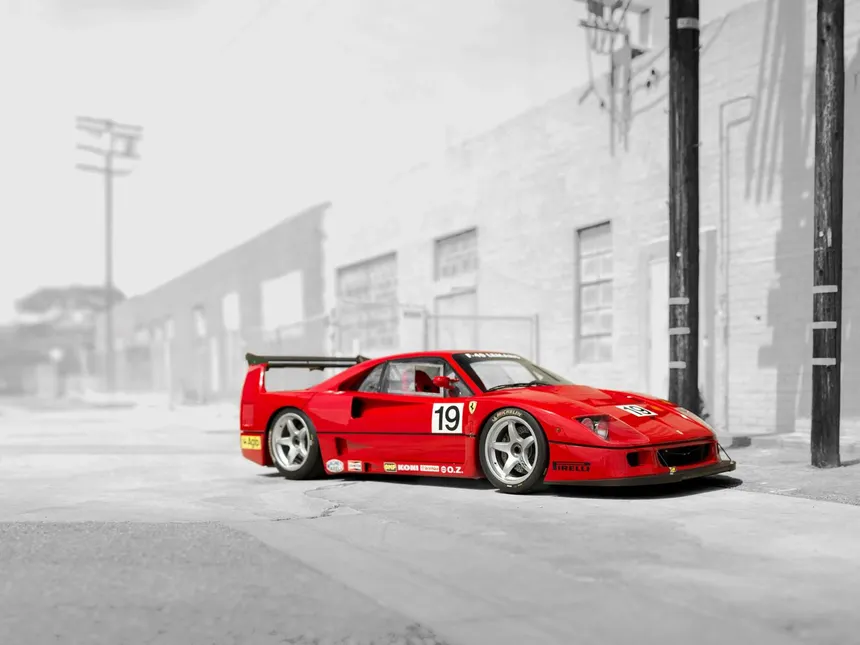
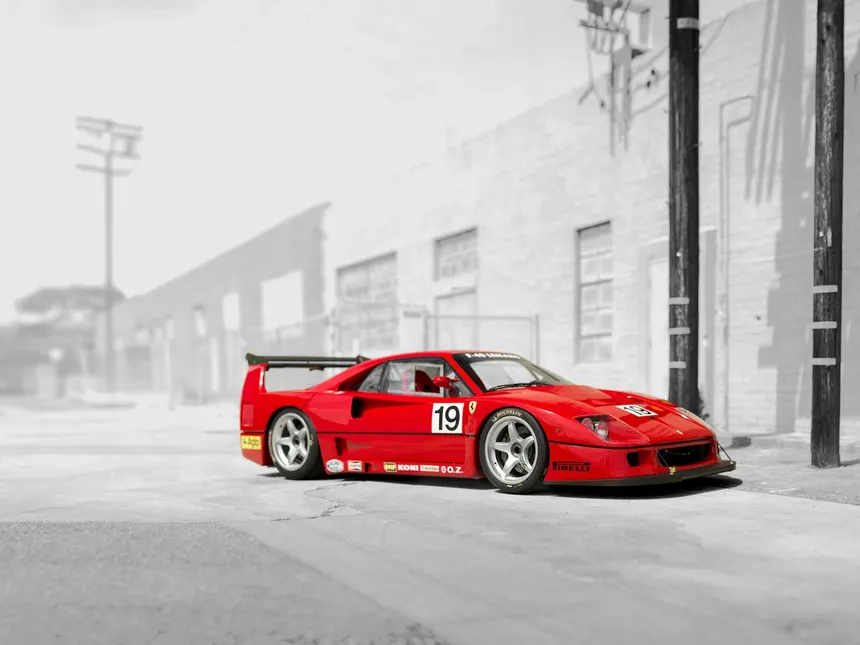
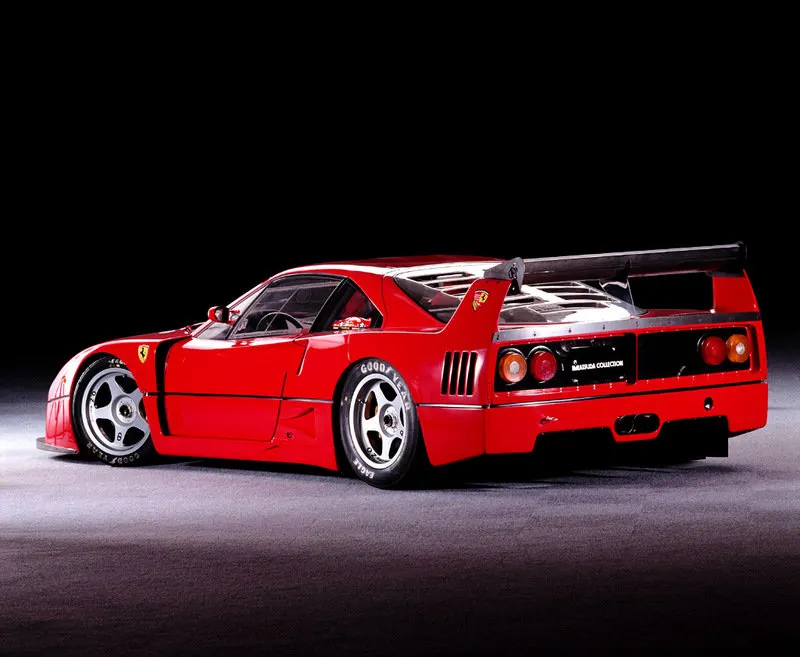
The chassis was reinforced with additional triangulation in critical areas. Weight dropped to 1,050 kilos, against the road F40’s 1,100. Aerodynamics gained front canards, an adjustable rear wing with Gurney flap, rear diffuser, additional NACA ducts, a new bonnet with large frontal air intake, fender vents. Larger Brembo brakes. Wider wheels. Recalibrated suspension with lowered ride height. Five-speed manual gearbox with triple-plate hydraulic clutch, against the road F40’s single-plate setup.
Final F40 LM GTC numbers: 0 to 60 mph in 3.1 seconds. Top speed beyond 228 mph (367 km/h). In 1992, when many of these cars were built, that was one of the highest figures any non-prototype competition car had reached on any circuit on the planet.
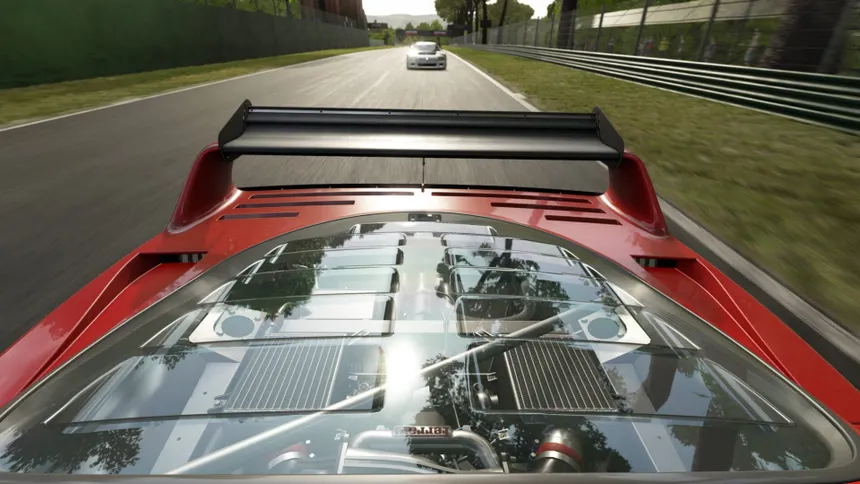
Laguna Seca, 1989: Jean Alesi Sets The Tone
The F40 LM made its official debut on 1 October 1989 at the IMSA round at Laguna Seca, California.
Behind the wheel of the number 23 car of Ferrari France — Pozzi’s racing operation — was a 25-year-old French driver who’d barely had two seasons in single-seaters and was about to sign for Ferrari’s Formula 1 team. His name was Jean Alesi.
Alesi rolls out of the pits with a 720-horsepower car that has never raced and was built in less than a year by a workshop external to Ferrari. He puts in a few warm-up laps. Slots into first. And puts the car on the podium.
Third overall in the GTO category, in the F40 LM’s debut race, against rivals who’d had two or three seasons to refine their cars: Nissan GTP, Audi 90 IMSA GTO, Mercury Cougar XR-7. Alesi didn’t win. But he made the podium. And in the context of a freshly built car, that was almost as good as winning.
What followed in IMSA was a chain of podiums. Between Laguna Seca 1989 and the end of the 1990 season, Ferrari France entered F40 LMs in five IMSA rounds with chassis 79890 and 79891. Result: five podiums in five races. Three second places. A third. And the Laguna Seca third. No outright wins, but a consistency no other European manufacturer had shown in IMSA all season.
At the end of 1990, however, Ferrari France abandoned the IMSA programme. The reasons were economic — the championship demanded expensive transatlantic logistics — and sporting, since Marin wanted to take the F40 LM to Le Mans, where Ferrari carried far more weight than in the United States. But the fundamental problem was different: the F40 LM, in IMSA spec, wasn’t homologated for Le Mans GT1 category. The FIA and ACO had different regulations from IMSA. And while Ferrari’s lawyers tried to square European homologation, the Americans went back to their own cars.
The F40 LM, in IMSA configuration, left the tracks at the end of 1990. The Le Mans promise was still pending.
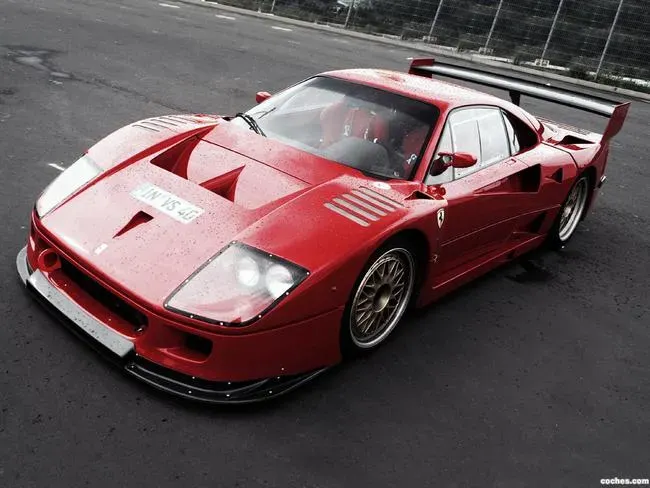
Second Life: BPR Global GT Series 1994-1996
In early 1994, Stéphane Ratel — French, former private team manager — founded with Patrick Peter and Jürgen Barth the BPR Global GT Series, a European championship open to GT cars with free homologation, designed expressly to revive the category after the Group C disaster. The idea was simple: let manufacturers and preparers build whatever they wanted on the basis of road cars, as long as they raced on classic European circuits.
The BPR rulebook was exactly what the F40 LM needed.
Michelotto, this time on commission from Strandell (a Swedish racing preparer), went back to his Padua workshop and developed a new version: the F40 GTE. The F120B engine displacement was first enlarged to 3.5 litres and then, in 1996, to 3.6 litres. Power: 620 horsepower in BPR configuration, with intake restrictors. Aerodynamics were redesigned with a new rear wing, front splitter, rear diffuser, rear fender air intakes, and front fender extractors.
Seven F40 GTE units were built by Michelotto between 1994 and 1996. Existing F40 LM units were also reconverted to BPR specification.
F40 sporting results in BPR:
- 1994: victory at the 4 Hours of Vallelunga (Strandell chassis, first F40 win in international competition).
- 1995: victory at the 4 Hours of Anderstorp (Sweden).
- 1996: second consecutive Anderstorp win.
Three outright BPR victories against McLaren F1 GTR, Bugatti EB110 SS, Porsche 911 GT2, Lotus Esprit GT1 and Venturi 600LM. Three wins in a category dominated by infinitely larger budgets. The F40 GTE, eleven years after the road 288 GTO had defined the base mechanicals, beating cars designed with technology five years more modern.
And then, in 1995, at Le Mans, the F40 LM finally appeared at La Sarthe. A single unit entered in GT1. It made it through the 24 hours — sixth in class, twelfth overall. It wasn’t a win. It wasn’t a podium. But it was the first Ferrari to finish a complete Le Mans in many years, and in Maranello language, that was already symbolic.
By the end of 1996, with the entry of new pure GT1 prototypes like the McLaren F1 GTR LongTail and the Porsche 911 GT1, the F40 LM and F40 GTE became obsolete as racing weapons. The BPR championship transformed into FIA GT Championship and regulations changed. The F40 stopped racing. Its competition career had lasted seven years: 1989 to 1996.
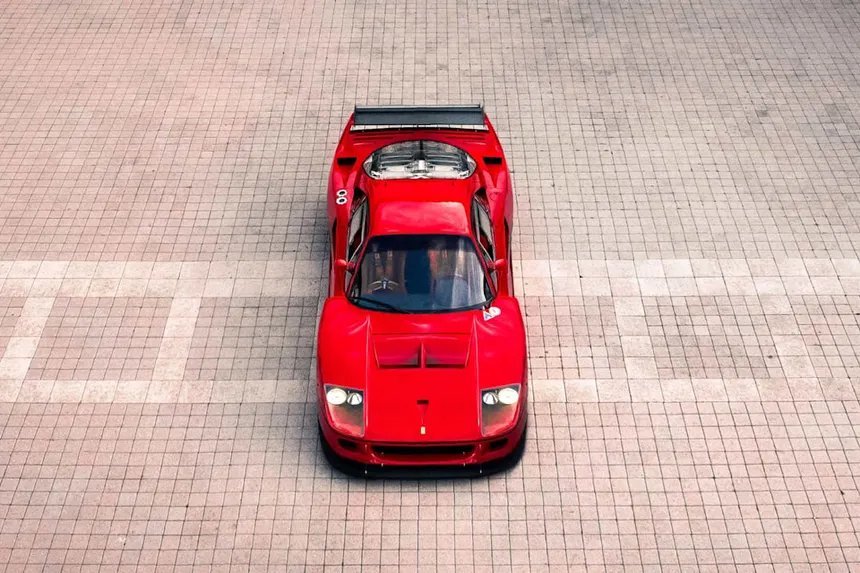
What Michelotto Built In Total
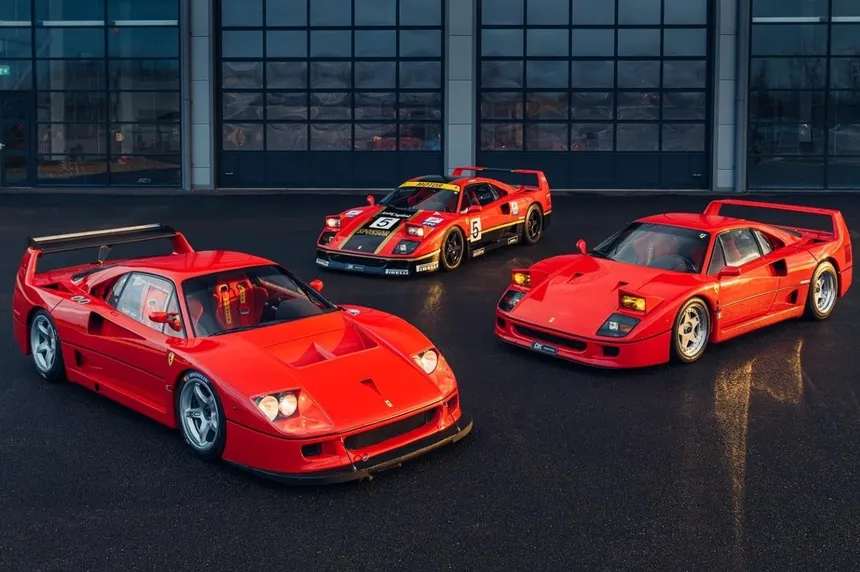
To grasp the scale of the Padua workshop’s output: Michelotto built 19 official F40 LM units with Ferrari sanction between 1989 and 1994. The first two (chassis 79890 and 79891) raced IMSA with Ferrari France. The rest were delivered to private European customers.
When additional orders started arriving from customers wanting an LM but not necessarily for racing, Ferrari rebadged the units as F40 Competizione because “LM” implied Le Mans homologation that not every unit met. Same Michelotto work, different paperwork seal. Then came a later evolution — the F40 GTE of 1994-1996, enlarged to 3.6 litres for BPR — of which Padua produced another seven units.
If you add the secondary versions for national championships (the 560-horsepower F40 GT for the Italian championship, where Vittorio Colombo won the 1994 title), the unsanctioned private conversions, and the chassis recovered as test mules, the figure runs above sixty F40s modified for competition circulating between 1989 and 1996. Serious collectors already know the exact numbers. Everyone else needs to know only this: the F40 was, in practice, the most-produced competition Ferrari of the modern era. More than any 333 SP, more than any 550 GT1, more than any 575 GTC.
All of that, with no official Ferrari sportscar competition programme.
The Price Today For A Debt Paid Late
If you want to buy an original F40 LM or Competizione today, brace yourself.
In August 2025, chassis number 14 — delivered in December 1992 to Swiss collector Walter Hagmann, crashed at Mugello in 1993, restored by Michelotto, certified by Ferrari Classiche in 2009, owned successively by various European collectors — went to auction at RM Sotheby’s Monterey with an estimate of 9.5 million dollars. The figure is consistent with the few documented F40 LM transactions in recent years.
For comparison: a road F40 in original condition runs around 3 million euros. An F40 LM or Competizione triples that figure. The F40 LM GTC, the 760-horsepower version, is the most expensive F40 on the planet and, according to RM Sotheby’s official sources, “the most powerful version ever made by Maranello”.
A curious paradox, when you think about it. The car Ferrari let an external importer build, with somebody else’s money, by an external preparer, with no official competition programme, in a category it arrived to late, is today the most valuable F40. And by extension, one of the most valuable Ferraris in existence, behind only the great historics like the 250 GTO or the 250 LM.
Sometimes the market says things the official mythology doesn’t dare to articulate.
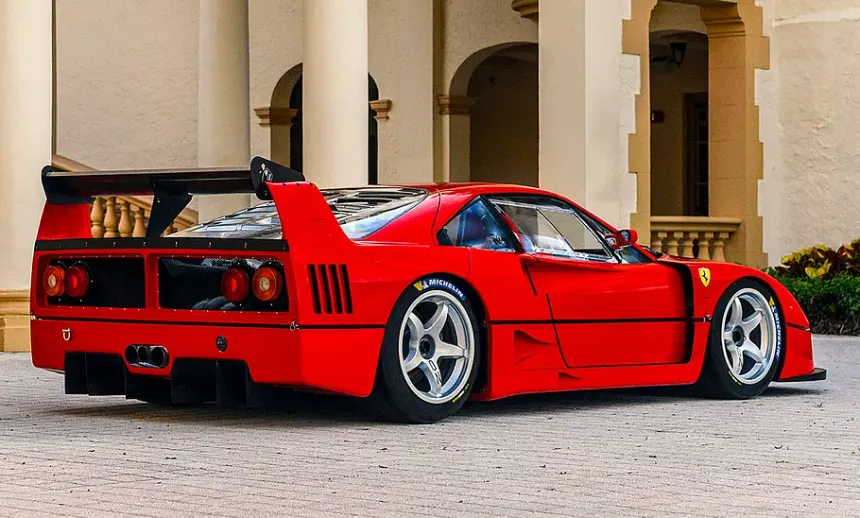
Why The F40 LM Closes The Group B Circle
Go back for a moment to the first article in this triptych. The 288 GTO + Evoluzione.
Materazzi proposes to Enzo in 1982 returning to GT competition. Enzo says yes but demands the work happen outside Maranello’s regular working hours. The engineers develop the road 288 GTO between 1983 and 1984. They follow with the Evoluzione between 1985 and 1986. Six units are built — five production plus a prototype. Toivonen dies on 2 May 1986. The FIA kills Group B.
Maranello is left with five orphaned Evoluziones and 650 horsepower per turbocharger that never reach an official circuit.
Three years later, Daniel Marin from Pozzi calls Maranello. And then something happens that is, literally, the consummation of the Materazzi project.
Michelotto takes the F40 — which is the road version of the Evoluzione — and gives it back the 720 horsepower the Evoluzione had but never got to demonstrate.
Read that sentence again. The F40 LM is, technically, the 288 GTO Evoluzione taken to actual competition. Same block (F114B → F120A → F120B). Same philosophy (high-pressure turbocharging without road restrictions). Same engineering team (Materazzi had left Ferrari in 1988, but the technical base he designed is what Michelotto exploits). Same aerodynamic solutions (adjustable rear wing, front canards, NACA ducts — all foreshadowed in the Evoluzione three years earlier).
The difference is that the F40 LM did race. And won. Vallelunga 1994. Anderstorp 1995. Anderstorp 1996. Five consecutive IMSA podiums. Le Mans completed in 1995. Track time. Stopwatch verified. Trophies. The Group B that Ferrari never raced was raced in BPR and IMSA with the right car, ten years late, under a different name, with the prancing horse seal barely visible in an operation that, on the books, belonged to a French importer.
That’s the F40 LM. The historic debt settled through the back door.
And if you stop to think about it, there’s something profoundly Italian in how that circle closed. Maranello couldn’t allow itself, in 1989, to run an official sportscar competition programme. Fiat’s internal politics, the cash flow, the F1 focus — everything blocked it. But Maranello also couldn’t allow itself to let the F40 die as nothing but a road car. The legend demanded it. The customer demanded it. Enzo’s memory demanded it.
The solution? Let an external agent do the work, while the factory watched from a distance and provided only the seal. It isn’t the first time this has happened in Ferrari history. It won’t be the last. But few times has the result been as clean as with the F40 LM.
Why The F40 LM Matters More Now Than Ever
Because the F40 LM is the last Ferrari competition car built on customer logic.
After the F40 LM came the Ferrari 333 SP in 1994, also built with Michelotto support and partly financed by Giampiero Moretti of Momo, another customer project — but already with a dedicated department inside Maranello. Then came the F50 GT, programme cancelled in 1997. Then came the Ferrari 575 GTC, 550 Maranello GT1 and Challenge Stradale Trofeo — but always with the factory as direct protagonist, not as external seal.
The F40 LM is the last Ferrari where an external importer has more weight than the factory itself. That, in the modern era, is unthinkable. No current customer could turn up at Maranello with the proposal Daniel Marin made in 1988. The factory would say no before reading the contract. But in 1988, with Enzo just dead and Fiat reorganising operations, the gap existed. And it was used.
Today Ferrari personally approves every customer competition car, controls every bolt, dictates the regulations of each XX Programme operation, and limits the list of authorised drivers to its own private circuits. The Maranello era of “let somebody else do it while we provide the seal” ended in 1996, when the F40 stopped racing. After that came processes, committees, legal departments and brand manuals. Industrial efficiency went up. The drama walked out.
That’s why the F40 LM is worth what it’s worth on the market. That’s why collectors chase it. That’s why, at RM Sotheby’s, a unit can come up with a 9.5-million-dollar estimate and nobody raises an eyebrow.
It isn’t a rare Ferrari. It’s a politically irrepeatable Ferrari.
And that, in 21st-century Maranello mythology, is worth more than the power, more than the wins, more than three seasons of accumulated BPR results.
The 288 GTO was designed for a category the FIA invented and killed in five years. The Evoluzione took that promise to 650 horsepower without homologation. The road F40 saved those five prototypes from the scrapyard and became the last car personally approved by Enzo. The F40 LM finally put that technical heritage where it always should have been — on a racing circuit, against real rivals, with stopwatches in hand, ten years late, under a different name, with somebody else’s money.
Sometimes the big brands take their time paying their debts. But when they pay them, they pay them in full.
Check you’re still alive.