
Ferrari 125 S, A Promising Failure: How Ferrari Began with Three Broken Words
May 11, 1947. Piacenza circuit, northern Italy. The first car ever to wear the Ferrari name is leading its debut race. Then a fuel pump dies. The driver pulls in. The car stops.
There are two normal reactions to this scenario.
One: rage. Heads roll. Engineers get fired. The programme is questioned. The press gets a tight-lipped statement about teething problems and unspecified bad luck.
Two: damage control. Spin it. Brief the journalists. Call it a learning opportunity in the careful corporate language of the 1947 motorsport press release, which was much the same as today’s just with worse paper.
Enzo Ferrari did neither. He looked at the data, looked at the car, looked at the championship potential of what had just blown up in his face, and said something that no automotive founder before or since has ever managed to package so cleanly. Un insuccesso promettente. A promising failure.
Three words. The entire philosophical foundation of Ferrari, condensed into a phrase you could fit on a coffee mug. Decades later it still describes how the company thinks. Long after the man who said it had died. Long after the V12 had been replaced in most of the range by V8s, hybrids, and the engineering complications of modern emissions regulations. The DNA of that sentence is still in every car the factory builds.
But to understand why those three words mattered, you have to understand what came before them.
The six-year silence
Enzo Ferrari was not a young man when his first car raced.
He was nearly fifty. He had been racing director at Alfa Romeo through the 1930s, running their factory motorsport programme. His Scuderia Ferrari was the official Alfa Romeo race team. He knew the business inside out, had built relationships with every driver, engineer, and supplier in northern Italy, and was widely considered one of the sharpest operational minds in European motorsport.
Then in 1939 he left Alfa. Or was forced out, depending on whose memoir you read. The exit came with a non-compete clause: Ferrari could not build cars under his own name for four years.
So he didn’t. He founded Auto Avio Costruzioni in Modena and built two cars called 815 — eight cylinders, 1.5-litre, derived from Fiat components. They ran at the 1940 Mille Miglia. Technically not Ferraris because of the contract. A workaround masquerading as engineering exercise.
Then the war came. The factory was relocated from Modena to Maranello in 1943 to escape the bombing. Production shifted to machine tools and aircraft components. Cars were the last thing on anyone’s mind.
By the time the dust settled in 1945, Enzo had spent six years without putting his own name on a car. He was running out of time. He was almost fifty. And he had one idea he had been turning over in his head for years.
The engineer Alfa had fired
He called Gioacchino Colombo.
Colombo was Neapolitan, brilliant, and freshly unemployed. He had designed the Alfa Romeo 158 — the single-seater that would later win the first two Formula One World Championships in 1950 and 1951. He was, on any objective measure, one of the most talented engine designers in Italy. And Alfa had let him go in 1946. The reasons were political. Whatever they were, Colombo was available.
Enzo signed him immediately.
This is the part that doesn’t get told often enough. Ferrari didn’t just build a car to compete against Alfa Romeo. He built it with the engineer Alfa had thrown away. A quiet, surgical kind of revenge that takes patience and contacts and the right phone call at the right moment. The man your former employer rejected is now the man who will beat them.
Colombo was given a blank sheet and one instruction.
Twelve cylinders.
Twelve pistons for a litre and a half
Here is where the story turns specifically Ferrari.
The sports category of the late 1940s allowed up to 1,500 cc of naturally aspirated displacement. Most manufacturers used four-cylinder engines for that capacity. Some used six. The Maserati A6, the closest direct rival, ran a 1.5-litre straight-six pushing somewhere between 65 and 90 horsepower depending on the spec.
Enzo wanted twelve cylinders.
Twelve. In 1,500 cubic centimetres. That meant each cylinder was 125 cc — and that’s where the “125” in 125 S comes from. The number refers to the unit displacement, not the total. Multiply 125 by 12, you get 1,500. That naming convention stayed with Ferrari throughout the Colombo era.
Why twelve? Because Enzo had a fixation that lasted his entire career: the engine was the heart of any car. Not the chassis, not the suspension, not the aerodynamics. The motor. And a twelve-cylinder engine at small capacity has a throttle response, a rev ceiling, and a sound that no other architecture can give you for the same displacement.
It was inefficient. It was complicated. It was expensive. Twelve connecting rods, twenty-four valves, twelve tiny pistons. A tolerance nightmare for a small operation just getting started. None of that mattered. Colombo, supported by Giuseppe Busso and Luigi Bazzi on the tuning, got the engine to 118 horsepower at 6,800 rpm on the dyno.
For comparison: the Maserati A6, the closest direct competitor on European tracks at the time, used a 1.5-litre straight-six that produced somewhere between 65 and 90 horsepower depending on the variant. The Ferrari, on the same displacement allowance, came in nearly 30 percent stronger than the best Maserati could muster. That gap was not marginal. That gap was a generation.
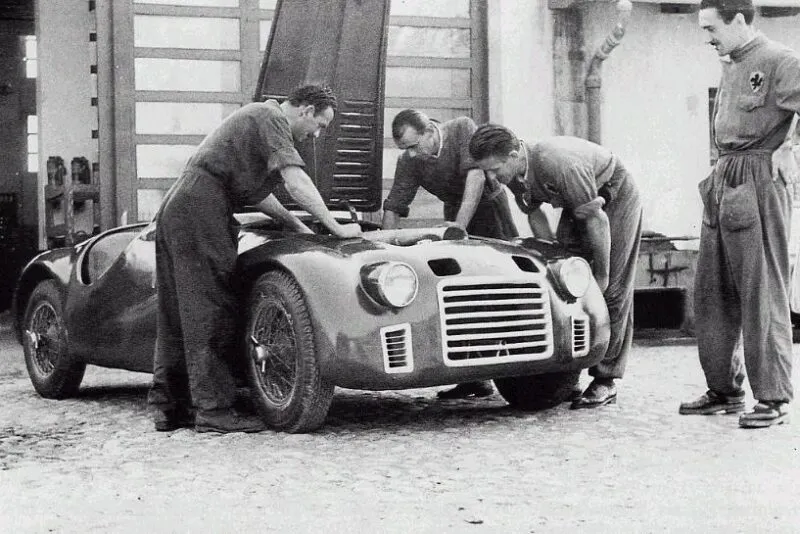
The chassis was built by Gilco in Milan, specialists in high-strength steel tubing for the aircraft industry. Tubular frame. Independent front suspension with unequal-length wishbones and a transverse leaf spring. Live rear axle. Drum brakes on all four corners, hydraulically operated. Standard for the era, executed with precision.
But the engine. Always the engine.
March 12, 1947: the old man takes the wheel
Before the official racing debut, there was a day that rarely gets told.
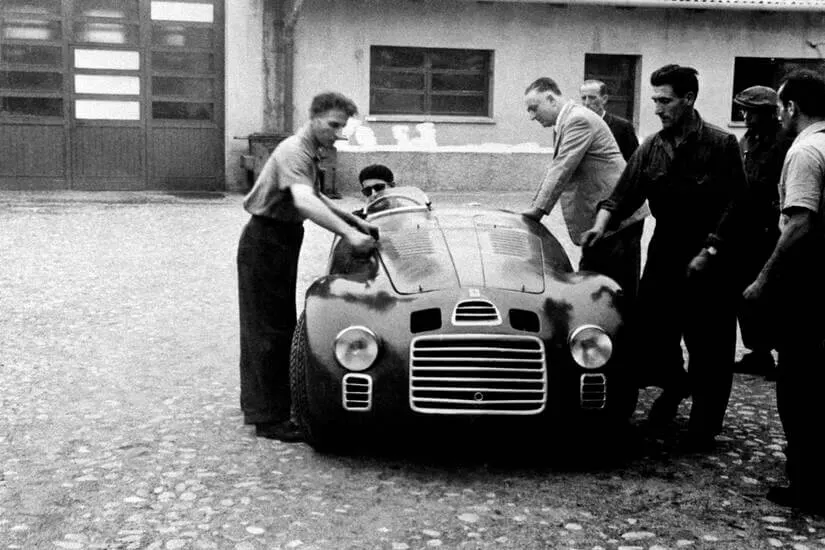
On 12 March 1947, on the country roads between Maranello and Formigine, the first Ferrari engine fired up and turned its first wheels. The car had no bodywork yet. Just a bare tubular chassis with a V12 mounted on top. And the man behind the wheel was Enzo Ferrari himself.
He was forty-nine years old. He had stopped racing professionally two decades earlier, when his first son Dino was born. But on that day, for one afternoon only, he climbed back into a driver’s seat to test what he had been dreaming about for six years.
Picture it. Italian countryside in March, still cold. A naked metal skeleton with no seats to speak of, no protection of any kind. A Neapolitan-Modenese V12 howling between two small villages in the Emilian Apennines. And a middle-aged man in a flat cap, no dark glasses yet, head full of decisions, putting his foot down on his own creation for the first time.
That image is worth more than any of the championships that came later. It is the precise moment the idea became a running engine.
Piacenza, May 11
Two months later came the race debut.
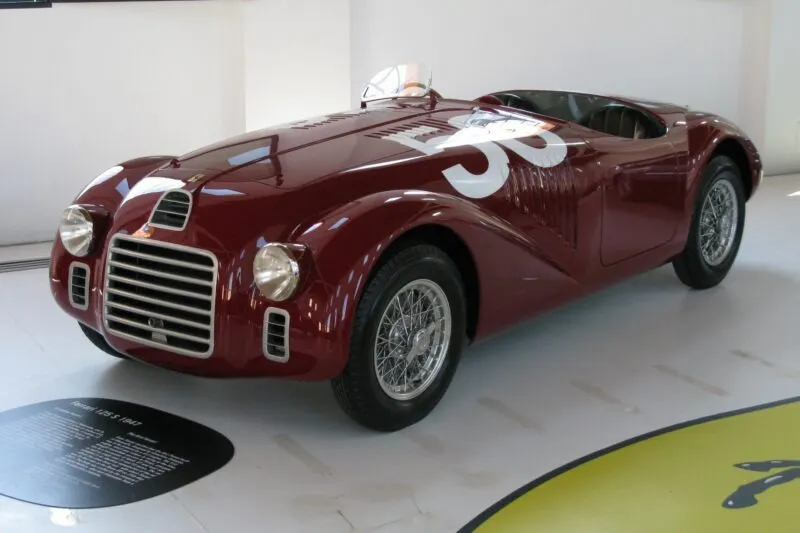
The team entered two cars at Piacenza. One was the 125 S, with open sports bodywork — the S stood for Sport — driven by Franco Cortese. The other was a 125 C, with a narrow single-seater body, theoretically for Nino Farina. But Farina, an established Turinese name, walked into the paddock, looked at his assigned car, decided it was worse than his teammate’s, and demanded a swap. Enzo refused. Farina didn’t start.
Cortese did. Number 128 on the bodywork. He led the race with authority. And then the fuel pump failed.
That’s the moment.
And then Enzo said it. Un insuccesso promettente. A promising failure.
Read that slowly. It is a phrase from a man who has waited six years. Who has bet everything he has on this car. Who has long since abandoned the idea of driving for a living and replaced it with the gamble of building. And when the moment arrived, the machine broke down on track in front of everyone.
Anyone else would have called it a disaster. Would have looked for someone to blame. Would have suspended the programme. Enzo didn’t. Enzo looked at the stopwatch, saw that his car had been the fastest in the field, and filed the breakdown as a solvable engineering detail. The promise was the speed. The failure was just plumbing.
Decades later, in his office in Maranello, he kept what he called l’armadio degli errori — the cupboard of errors. A collection of mechanical components that had failed in racing, catalogued and shelved as reminders. He didn’t throw them away. He kept them so he wouldn’t repeat the same mistake twice.
Piacenza was the first item in that cupboard.
Fourteen days later, Rome
On 25 May 1947, exactly two weeks after the promising failure, Franco Cortese drove the 125 S at the Rome Grand Prix. Terme di Caracalla circuit. Forty laps. 137.6 kilometres covered. Average speed 88.5 km/h.
He won.
The first official victory in Ferrari history. The first of the thousands that would follow. And it came exactly fourteen days after the most public mechanical embarrassment of the year. The promise contained in the failure was paid back at the very next attempt.
What followed was an absurd season. In the four months after Rome, the 125 S returned to competition thirteen more times. It won six of those races. By September, at the Coppa Acerbo at Pescara, the engine had grown to 1,900 cc and the car was renamed the 159 S — same chassis, bigger heart. With that evolution Raymond Sommer won the Turin Grand Prix in late October.
That Turin win mattered to Enzo in a way no other result that season did, and it was nothing to do with the racing.
Rewind to 1918. Enzo is twenty years old, just discharged from the Italian army. The Great War has killed his father and his older brother. He needs work, badly. He travels to Turin and applies for a job at Fiat — at that point the only serious car manufacturer in Italy, the obvious place for a young man with a vague interest in motorsport to start. Fiat turns him down. No reason given that’s worth recording. The provincial kid from Modena walks back to the train station and goes home with nothing.
Thirty years pass. The Modena kid becomes Enzo Ferrari. He builds his own company in defiance of Alfa Romeo. He hires Colombo. He designs the 125 S. And on a cold afternoon in October 1947, in the same city that had told him to get lost three decades earlier, a car with his own name painted on the nose wins the Grand Prix.
Enzo wasn’t at the podium. He almost never travelled to races. He was in Maranello listening to a radio bulletin. But the people who were with him that afternoon said he smiled in a way they hadn’t seen before. Some debts can only be settled by outliving the people who owed you the answer.
What happened to Colombo
The engineer who started all of this didn’t stay long.
Gioacchino Colombo and Enzo Ferrari clashed. Strong personalities — Enzo’s louder than Gioacchino’s, to be fair — and by the late 1940s Enzo was openly talking about handing engine design over to Aurelio Lampredi, another Italian engineer who had joined Maranello in 1947. In January 1950, Alfa Romeo came knocking. They wanted Colombo back to finish developing the Alfetta 158, the single-seater whose engine he had designed in 1937 before the war froze everything.
Colombo said yes.
Here is the cosmic punchline that closes the circle.
The Alfetta 158, with Colombo back in Milan overseeing its development, won the very first Formula One World Championship in 1950 with Nino Farina driving. It then won the second one, in 1951, with Juan Manuel Fangio. Two consecutive world titles. Powered by a Colombo engine. Under Alfa Romeo colours. Against Ferrari.
The man Alfa had fired and Enzo had rescued ended up going back to Alfa to beat Ferrari in the first two world championships in history. The quiet revenge of 1947 came back to bite the old man across the face with twelve years of compound interest.
After Alfa, Colombo went to Maserati and designed the 250F, one of the most beautiful single-seaters of the twentieth century. Then on to Bugatti, where he worked on the troubled Type 251. Then to MV Agusta, where he designed motorcycle engines until 1970. He died in Milan in 1987, aged 84, one year before Enzo. Two old stubborn Italians, looking back at a Neapolitan-Modenese V12 that had been sitting under the bonnet of progressively faster Ferraris for four decades.
That’s the final detail. The Colombo V12 — that first 1.5-litre engine launched in the 125 S — stayed in Ferrari production, in successive evolutions and enlarged eventually to 4.8 litres, until 1988. Forty-one years. The 412i was the last road car to carry it. Colombo left Ferrari in 1950. His engine stayed for another four decades.
No engineer leaves a mark like that. Not even by staying.
What doesn’t exist anymore
This is the strange part of the story, and the slightly sad one.
No original 125 S survives intact.
Two chassis were built — some sources say three if you count very early evolutionary versions. The cars were stripped, modified, converted into 159 S, then into 166. That was standard practice in post-war Italian motorsport. Frames were cut, engines updated, components recycled. Nobody was thinking about museum-grade preservation because there were no museums waiting. They were working tools.
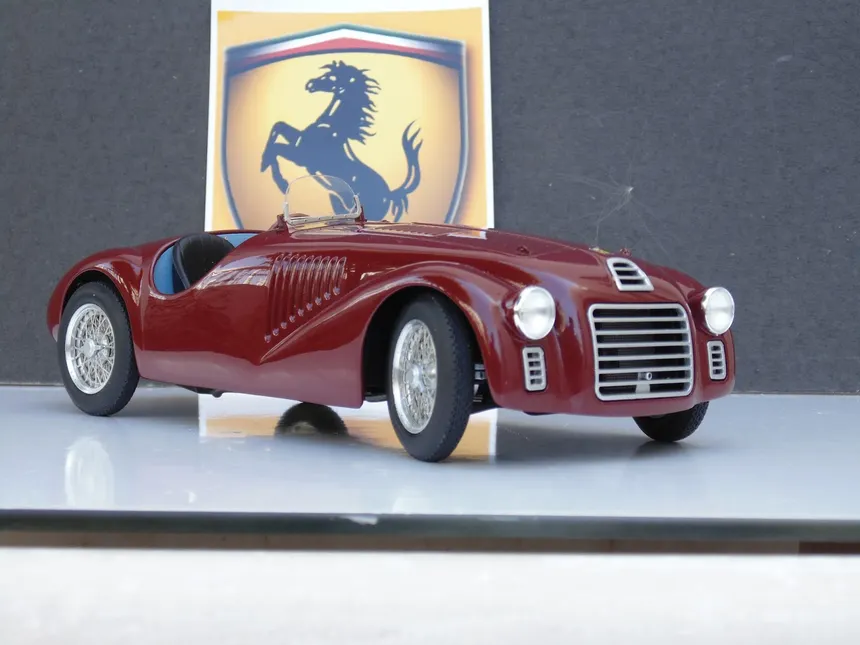
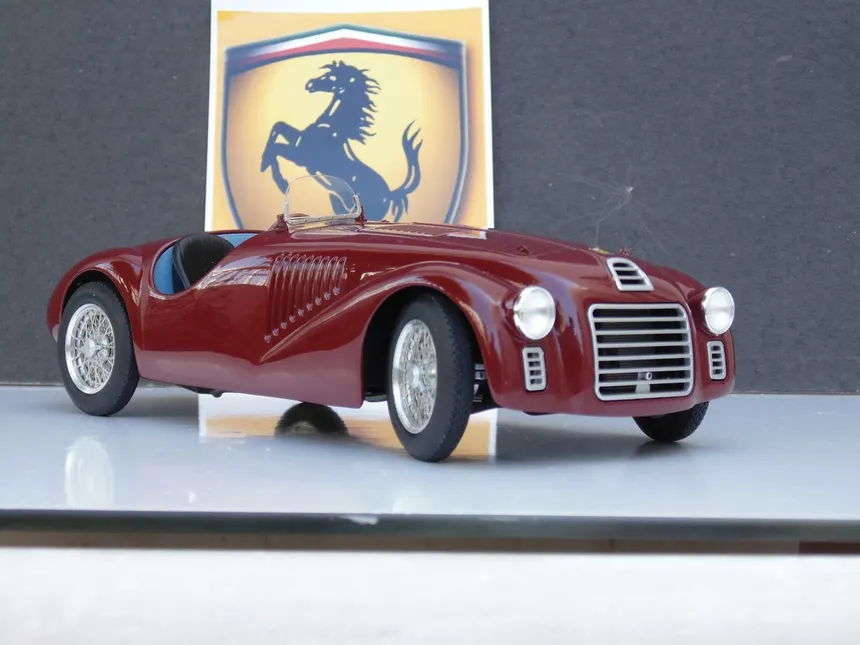
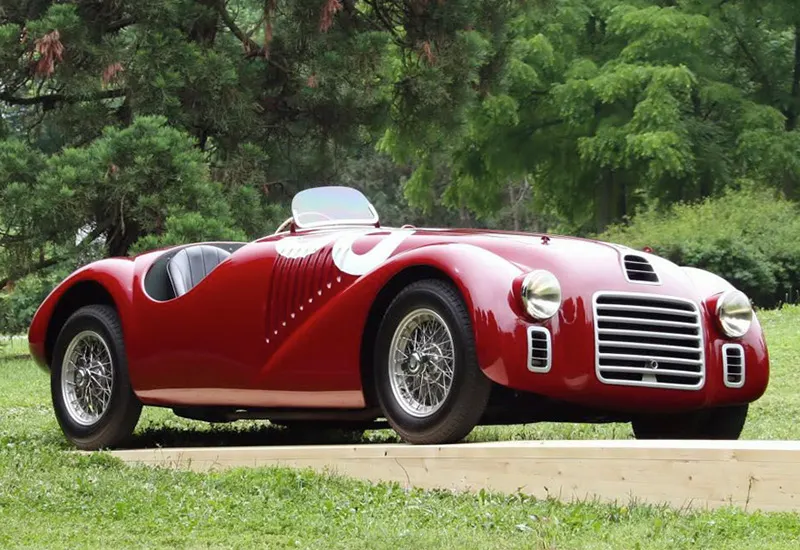
What you see today in Maranello — that red, open-cockpit car with the narrow nose and the round headlights on either side — is a replica that Ferrari built in 1987 to celebrate the brand’s fortieth anniversary. It is beautifully made. It is faithful. But it isn’t original.
There is a hard kind of irony in that. The most important car in Ferrari history, the car everything else descends from, doesn’t physically exist anymore. Only its descendants and the idea it left behind.
What every modern Ferrari inherits
Take a 296 GTB. Or an SF90. Or a Purosangue, which some purists refuse to acknowledge by name. Take any of them and pull them apart conceptually.
What connects all those cars to the 125 S of 1947 is not the V12 architecture. The SF90 is a hybrid V8. The Purosangue is a V12 but most of the current range isn’t. Not the open bodywork. Not the brakes. Not the chassis layout.
What connects every Ferrari to the first one is that sentence.
A promising failure.
It is the idea that perfection doesn’t exist but direction matters. That when something breaks, what counts is not the breakage but the speed at which it broke. That the promise of victory is measured in how you fail, not just in how you win. That philosophy runs through every decision the company has made since 1947. When the F50 was breaking on the dyno while chasing its numbers. When the 333 SP came back to Maranello with problems that Maranello had chosen to solve outside its own walls. When the 499P returned to Le Mans in 2023 with technical doubts and took the race anyway. Always the same head. Always the same old man, even forty years dead, speaking from a cupboard full of broken parts.
The 125 S didn’t matter because it won. It won later. It mattered because it broke the inertia. Because it proved that one man, with an engineer nobody else wanted and a V12 nobody had asked for, could build the fastest car in his class from a blank sheet in less than two years.
And because when it broke down, instead of crying, he smiled.
Check you’re still alive.