BMW NAZCA C2: THE M1 SUCCESSOR BMW WAS TOO SCARED TO BUILD
A 350 hp BMW V12 that weighed less than a Mini Cooper S
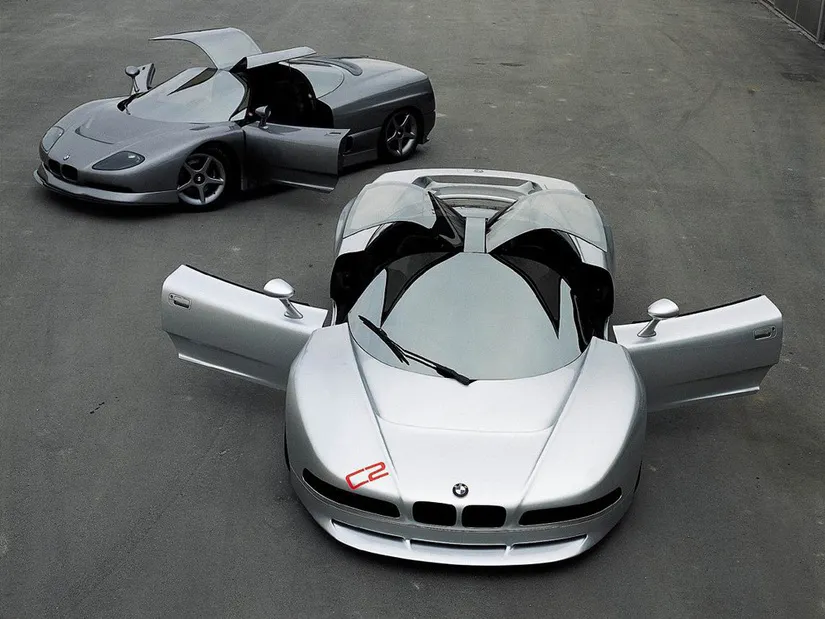
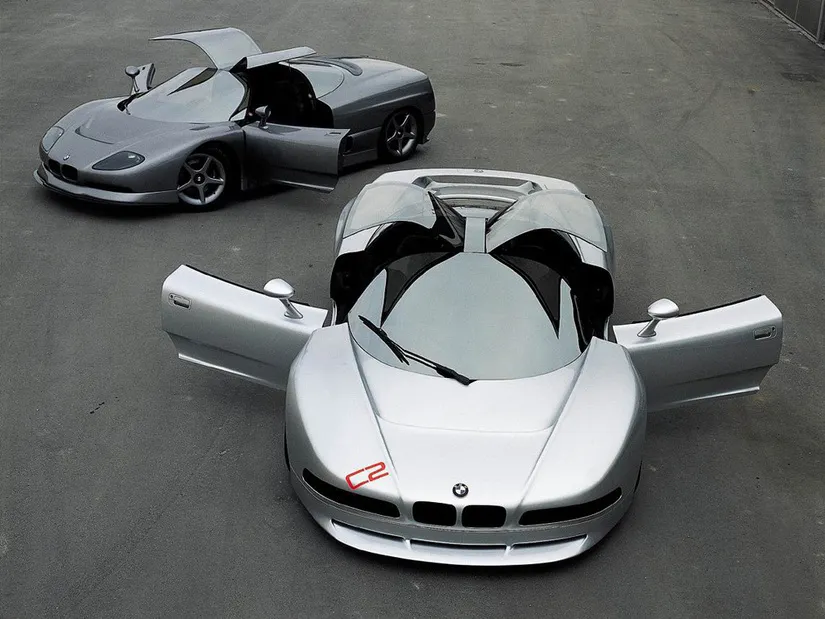
For all the heritage BMW has built around the M1, for all the magazine covers Top Gear and Evo have given the M1 Hommage and the more recent retro pieces, there was a working, finished, fully validated M1 successor in 1992. It had a carbon-fibre monocoque. It had a V12 from the 850i with Alpina cylinder heads and a 350 bhp output. It weighed 1,041 kg in road trim. Its drag coefficient was 0.26, lower than nearly anything BMW had ever measured in its own Munich wind tunnel.
It was called the Nazca C2. Three prototypes were built between 1991 and 1993 across the M12, C2 coupé and C2 Spider variants. None of them was approved for production. BMW killed the project before it really began.
This is not the story of a supercar killed at the boardroom door after years of engineering work. This is the story of a supercar that BMW never even let walk up to the door. And the reason has a name and a number plate: M1.
A Bugatti the customer rejected
Most of the Anglo-American press treatments of the Nazca skip the part where it did not start as a BMW. It started as a Bugatti.
In 1990, Giorgetto Giugiaro and his team at Italdesign presented the Bugatti ID 90 at the Paris Motor Show, a 12-cylinder mid-engined concept commissioned by Romano Artioli for the resurrected Bugatti brand. Artioli rejected the proposal and selected the design that would become the EB110. Giugiaro filed the ID 90 sketches away, but he believed in the architecture and intended to find another customer for it.
A year later he found one. In 1991, Italdesign approached BMW with a proposal: take the rejected Bugatti sketches, restyle them around a BMW grille and a BMW engine, and use the project to test the market for an M1 successor. BMW was emerging from the late-eighties slump with a new V12 in production, the M70B50 used in the 750i and 850i, and that engine was looking for a chassis worthy of it. The 850i was a grand tourer with all the wrong kind of mass; the V12 deserved better.
The deal Italdesign and BMW signed was elegant. Italdesign would design and build the car. Alpina would tune the engine. BMW would supply the V12, the grille, the badges and the brand licence. Italdesign would keep ownership of the prototypes. BMW would retain veto over production.
Fabrizio Giugiaro signs his first car
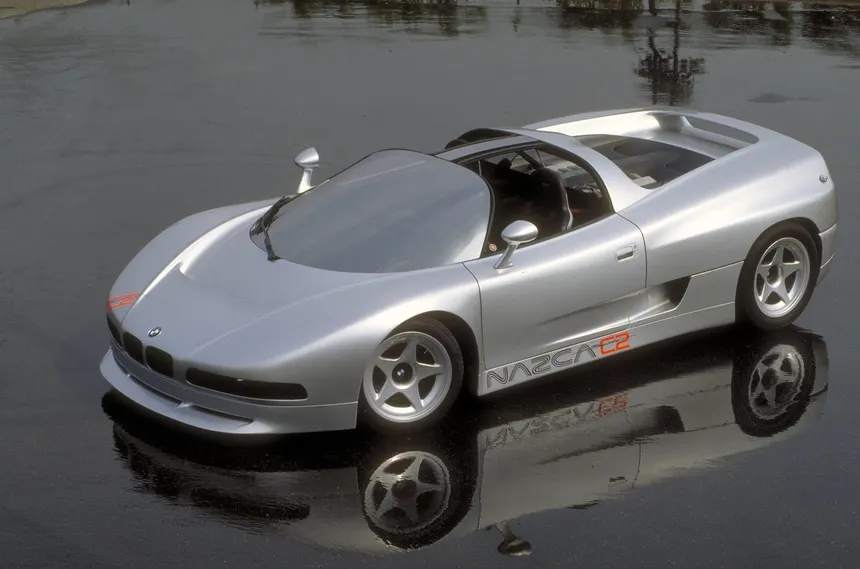
The first Nazca, the M12, made its debut at the Geneva Motor Show in March 1991. The designer was Fabrizio Giugiaro, son of Giorgetto, then 26 years old. The Nazca M12 was the first car Fabrizio signed in his own right. It was also a debut without precedent in modern supercar history. No previous catalogue, no minor saloon design hiding in his portfolio, no compromise commission. Clean sheet, BMW V12, his father’s name in the door pocket.
What Fabrizio drew did not look like anything else on a 1991 show floor. The car was 4.37 metres long, just under two metres wide, 1.10 metres tall. A wedge in the manner of the era, but a wedge with a fully glazed roof, side windows that opened upward like gullwings while the doors themselves opened conventionally outward, and BMW twin-kidney grilles shrunk to a size that read more like an ironic wink than a corporate badge. The rear was lifted directly from the Group C prototype school that was filling Le Mans grids that same year: vertical fins, large rear wing, perforated bonnet cover.
The British and American magazines of 1991 called it a car beamed in from another planet, and the simile was not entirely wrong.
Why it weighed what it weighed
This is the figure that should make every modern hypercar reader stop. The Nazca M12 weighed 1,100 kg in M12 trim and 1,041 kg in the later C2. The chassis was a carbon-fibre monocoque with carbon-fibre tubular subframes. The front bonnet, engine cover and front end were a single moulded carbon-fibre piece. The doors and roof were carbon-fibre composite. Even the seats in the C2 were carbon-fibre buckets borrowed directly from Group C racing.
For context against the cars that would arrive alongside it: the McLaren F1 of 1992 weighed 1,140 kg. The Bugatti EB110 GT weighed 1,620 kg. The Ferrari F40 weighed approximately 1,100 kg in race-stripped trim, without leather, air conditioning or paint. The Nazca C2 came in lower than all three, with a finished cabin, air conditioning, full upholstery and Group C-spec seats included.
Drag coefficient, measured at BMW’s Munich wind tunnel: 0.26. Better than the McLaren F1, better than the Ferrari 348, better than the Lamborghini Diablo, better than the 850i donor car from which the engine came.
The original M12 engine was the production M70B50 straight from the 850i: 5.0 litres, V12 at 60 degrees, 300 bhp at 5,200 rpm. Five-speed ZF manual gearbox, rear-wheel drive. Zero to 60 mph times were never officially homologated because BMW never certified the car, but cross-magazine estimates of the era placed it in the low four-second bracket. Top speed claim: comfortably over 300 km/h.
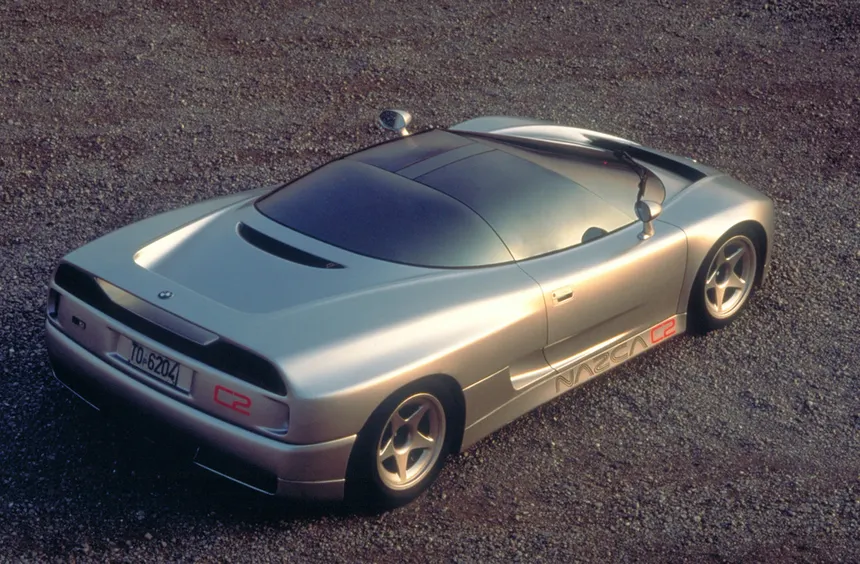
The C2 and the Alpina intervention
A year after Geneva, at the Tokyo Motor Show in October 1992, Italdesign and BMW presented the evolution. It was renamed the Nazca C2, and this was the moment when the project shifted from styling exercise to production-credible proposal.
The visible changes were front-end and aero. The headlights, previously integrated into a single horizontal strip above the grille, were moved either side of the kidneys, reducing the nose profile. The track was widened. A more pronounced rear wing was fitted, alongside a deeper front splitter. The interior was largely carried over from the M12 but with the Group C carbon seats.
The mechanical change was the headline. BMW sent the M70B50 V12 to Alpina at Buchloe with a brief to extract more power without compromising reliability. Burkard Bovensiepen, Alpina’s founder, and his team worked over the base block: new camshafts, redesigned intake system, Alpina’s own stainless steel exhaust manifolds and catalytic converters, rewritten Bosch Motronic injection mapping. Block, crankshaft, connecting rods and intake/exhaust manifolds remained factory. Compression untouched. The cylinder head remained SOHC two-valve. Output: 350 bhp at 5,300 rpm, 470 Nm at 4,000 rpm. The same Alpina-tuned V12 also appeared in the contemporary B12 5.0 Coupé based on the 850i, of which 97 units were built between 1990 and 1994.
On the sound of that engine, accuracy matters more than enthusiasm. The Nazca C2 was never road-tested by a journalist who left a written account of its exhaust note, so the closest reference point is the road-going B12 5.0. The base M70 was engineered for luxury saloon refinement, designed with two distributors and two parallel ignition systems (essentially two straight-sixes joined at the crankshaft). Its baseline character is contained, silky, almost imperceptible at low revs. The Alpina intervention, according to Secret Classics analysing the closely related B12 5.7, produced a more sonorous note than the base 850i but, in the magazine’s own assessment, did not come close to the sound of Italian V12 sports cars. The Alpina V12 in the Nazca, with shorter exhaust routing and no luxury saloon insulation in the cabin, would presumably have been more audible than its road-going B12 counterpart, but the fundamental character of the M70 remained refined rather than aggressive. Anyone expecting a screaming Ferrari V12 behind their head would have been surprised. This was a contained German twelve, building up like a modern electric motor with the mechanical presence of twelve cylinders working in unison. Not a singer. A muttering aristocrat.
Cross-source figures, consistent between Grokipedia and Wikipedia, give the C2 a 0 to 60 mph time of 4.1 seconds and a top speed of 311 km/h (193 mph). In 1992, that put it in direct fighting territory with the McLaren F1 (still in testing), the Bugatti EB110 (still ramping up deliveries) and the ageing Ferrari F40. The Nazca was production-ready, on paper.
The M1 problem
Here is the heart of the story. The Nazca C2 was conceived, designed, built and marketed as the spiritual successor to the BMW M1, the only mid-engined supercar Munich had ever put into production. The M1 had launched in 1978, sold 453 units up to 1981, and left BMW with a bitter taste. The project had been mismanaged on the supplier side, costs had spiralled, Lamborghini (the original contracted manufacturer) had collapsed financially mid-development leaving BMW holding a half-finished car, and Munich had needed to rescue the project with Baur and other improvised suppliers to deliver any cars at all.
The M1 was not a technical failure. Commercially it lost money. And BMW, for the following fifteen years, made a deliberate corporate decision that mid-engined supercars were not a category Munich wanted to revisit.
When Italdesign brought the M12 to Geneva and then the C2 to Tokyo, the project structure was deliberately built to avoid every problem that had killed the M1 commercially. Italdesign would build the car, not BMW. Alpina would tune the engine, not an improvised consortium. The carbon monocoque would be subcontracted by Italdesign to an Italian composite specialist. Munich’s industrial exposure was minimal. All BMW had to do was approve the project, supply engines, and collect a licensing fee.
Munich still said no.
The reasons that did and did not get printed
The sources line up well on the explanation. The official press line of the time was the global recession of 1991 to 1993, which genuinely hit the luxury segment hard and forced McLaren to deliver F1s at a loss. Bugatti EB110 went into liquidation in 1995. Cizeta-Moroder folded earlier. Vector W8 disappeared. The high-end supercar market contracted violently between 1992 and 1994. From a pure financial-risk perspective, BMW’s caution was vindicated within three years.
But the less-printed reason, recorded retrospectively by BMWblog and HotCars, is the M1 scar tissue. BMW’s leadership in 1992, under Eberhard von Kuenheim before Bernd Pischetsrieder took over, had decided as a matter of corporate philosophy that mid-engined production supercars were not Munich’s business. The Nazca project structure could have minimised every operational risk and the answer would still have been no. The wound from the M1 was too recent. The fear of repeating that experience was institutional, not analytical.
The Nazca C2, technically ready, commercially backed by Italdesign, mechanically endorsed by Alpina, simply could not find a German signature on the production approval line. Italdesign kept the prototypes and continued to present new variants of the same chassis to maintain the conversation, hoping BMW might change its mind.
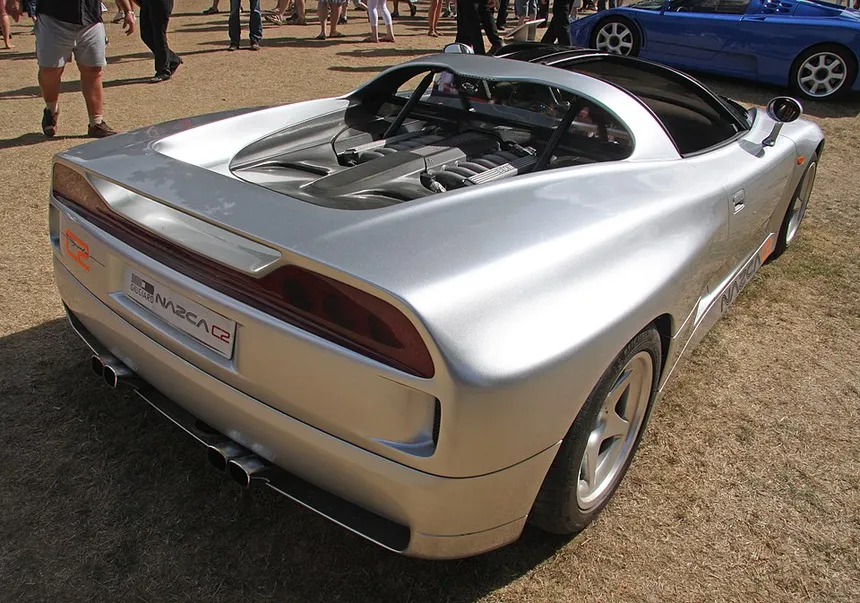
The Spider, and the end of the conversation
At the 1993 Monaco Grand Prix paddock, Italdesign unveiled the third variant: the Nazca C2 Spider. The semi-gullwing window arrangement of the coupé was replaced by removable glass panels stored in the front luggage compartment. A body-coloured rollover bar was added to compensate for the loss of structural stiffness from the missing roof. The intake manifold was redesigned to handle open-cabin operation.
The engine also changed. Out went the Alpina-tuned 5.0; in came the S70B56, the new 5.6-litre V12 from the production 850 CSi developed by BMW Motorsport, rated at 380 bhp. The transmission grew from five to six speeds to handle the extra torque. The engine cover was replaced with a transparent panel, leaving the V12 fully visible from outside. The Spider was the most extreme variant of the family.
The detail rarely included in technical write-ups is that the Spider did not just sit on the Italdesign stand at Monaco. Italdesign drove it onto the street circuit between Formula One sessions, parading it through the tunnel and the Casino corner in front of FOM cameras and global television audiences. According to Supercar Nostalgia, this was the most aggressive commercial debut Italdesign could engineer: the Spider, on the F1 track during the most watched race of the season, with the implicit offer to build a small run of customer Spiders for VIP buyers if BMW approved production. The offer was put to BMW’s stand at Monaco. It was not answered. The Spider remained a one-off.
After Monaco 1993, the conversation ended. BMW formally communicated to Italdesign that production was not going to happen. The brand licence eventually lapsed. Italdesign retained the three prototypes and continued to exhibit them at classic events and shows, occasionally driving them.
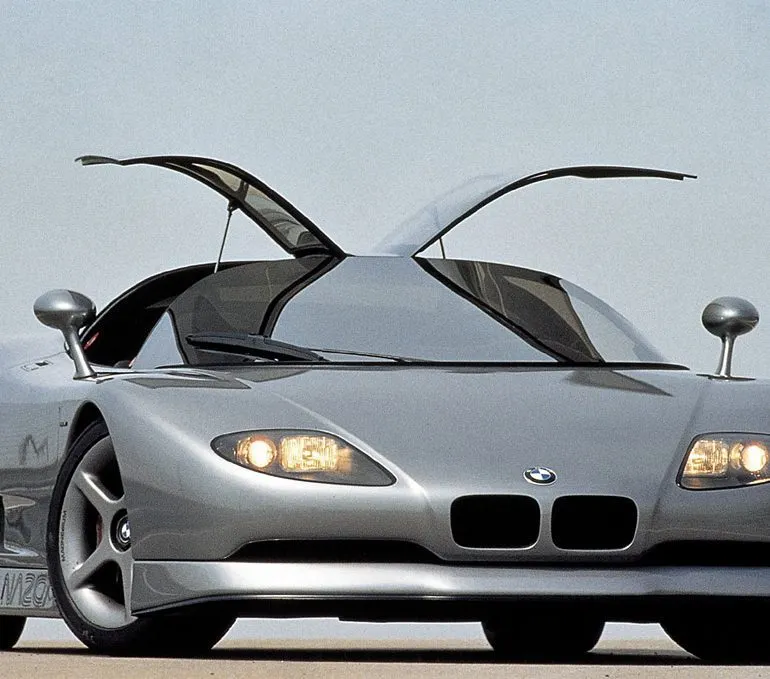
Where they are now
All three Nazca prototypes survive. The M12 coupé, the C2 coupé and the C2 Spider. Italdesign keeps them at its headquarters in Moncalieri, near Turin, and rolls them out for major heritage events and motor show retrospectives. They are kept in functional running condition and have been demonstrated periodically over the past three decades.
There is a separate chapter that deserves to be told properly because most accounts get it wrong. When Sultan Hassanal Bolkiah of Brunei saw the Nazca M12 in a published photograph, he commissioned Italdesign to build him a personal example for his private collection. Italdesign accepted. A fourth M12 was constructed, finished in blue, with a purple leather interior and bespoke seats because the standard buckets were reportedly too small for the client. The Sultan retained the car until 2011, when a dealer listed it for sale alongside several other vehicles from his collection at “price on request” levels. There is no public record of whether the sale actually closed or whether the car remains in Brunei. In late 2024, The Drive published a leaked photographic archive of the Brunei royal collection taken in the early 2000s, in which a black Nazca M12 appears in a folder labelled “AA Unknown Exotic Car”, though it is unclear whether this is the same car repainted or a second commissioned unit. Sources: SlashGear, Spyscape, Luxurylaunches and The Drive.
What is firmly established is that there was never a customer Nazca C2 or Spider. Three Italdesign prototypes plus the Sultan’s commissioned M12. Four BMW V12 Giugiaro mid-engined cars in existence worldwide.
The Nazca had an oddly persistent afterlife. It appeared in the 1996 Italian film A spasso nel tempo, alongside two other Italdesign concepts of the era (the Aztec and the Machimoto). And it became a fixture of early Need for Speed games: the C2 coupé was a playable car in NFS II Special Edition on PC, and the Spider appeared in NFS III Hot Pursuit on PlayStation. For a generation of late-nineties teenagers, the Nazca was as iconic as a Diablo or an F50. To the real automotive industry, it meant nothing.
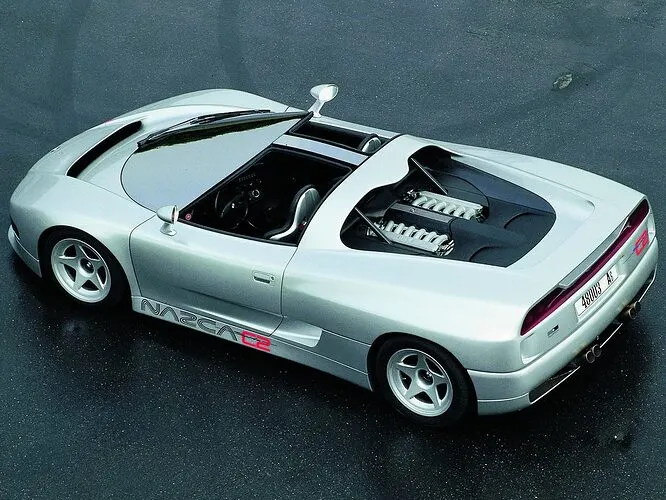
What is left
There is a detail about this case that deserves recognition. Unlike most other cars in the prototypes-killed-by-the-boardroom canon, the Nazca was not switched off after months of industrial preparation. It was never switched on. The car sat in the antechamber of production, ready to enter Italdesign’s small-volume line as soon as the BMW approval signature came. The signature never came.
The interesting question is not whether BMW would have sold the Nazca. It would have, in small numbers, somewhere between 50 and 200 units to collectors across Europe, North America and Asia, at a price point comfortably above the Ferrari F40 and probably below the McLaren F1. The interesting question is what owning a real mid-engined supercar in production between 1993 and 1998, during the F1 era and the EB110 era and the Diablo era, would have meant for BMW.
Munich chose financial caution and ended up without a mid-engined supercar in its catalogue until the M1 Hommage of 2008, a non-functional styling tribute for the M1’s thirtieth anniversary. The real, road-legal, producible M1 successor BMW had been offered in 1992 was left to Italdesign, in Italy, on a shelf, with three prototypes for the world to remember it by.
That is probably the cleanest moral the entire hub offers. Prototypes killed by the boardroom are not always killed deliberately. Sometimes they die because nobody ever said yes.
Check you’re still alive.