Spyker 60HP: The 1903 Car That Beat Audi, BMW And Land Rover By 80 Years
Top Gear once put together a list of the most innovative cars of all time. Chris Harris has spoken at length about the cars that shaped what we drive today. Every motoring journalist worth their salt has, at some point, weighed in on which automobile changed the world the most.
Almost none of them mention the Spyker 60HP.
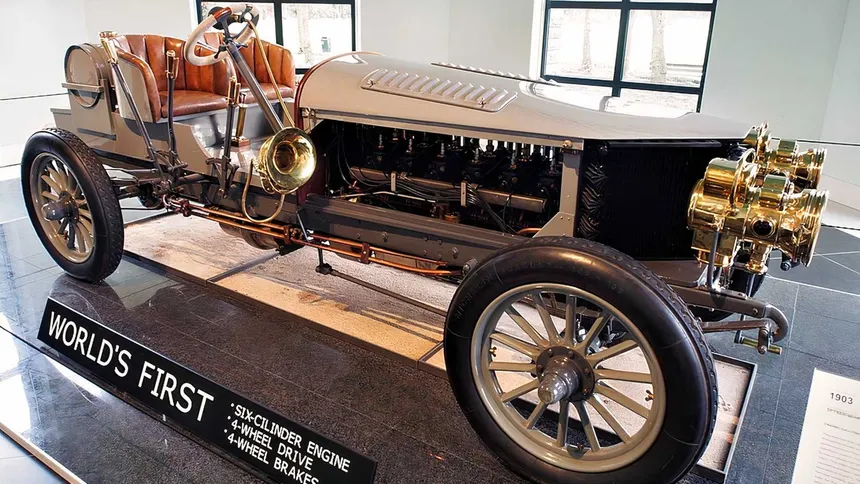
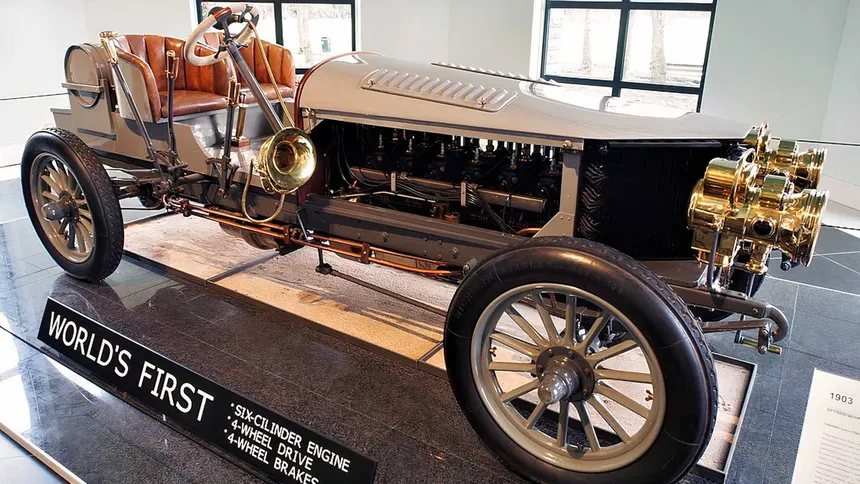
They should. Because this Dutch racing car, built in 1902 and presented in late 1903, was the first automobile in history to combine three things that today we take for granted: a six-cylinder engine, four-wheel drive, and brakes on all four wheels. Three world firsts. One car. And it predates the Audi Quattro by 77 years, the BMW M30 straight-six by six decades, and Land Rover entirely.
If you grew up watching Stig Blomqvist destroy stage rallies in his Audi Quattro, or listening to a Toyota Supra’s 2JZ singing its straight-six song, or trusting the four wheels of your modern car to bring you to a stop in the rain, you owe a small debt to a Belgian engineer named Joseph Valentin Laviolette and two Dutch brothers nobody remembers.
A coronation, a name change, and a leap
The Spijker brothers, Hendrik-Jan and Jacobus, didn’t start out building cars. They started out in 1880 as blacksmiths and coachbuilders in Hilversum, Netherlands. For two decades they hammered, welded and shaped carriages for the Dutch upper class, building a reputation for finish quality that eventually reached the royal household.
In 1898 they got the commission that would change everything: the Golden State Coach for Queen Wilhelmina’s coronation. The Gouden Koets. A gilded ceremonial carriage still in use by the Dutch monarchy on state occasions today. Imagine the prestige.
The same year, they made two decisions that defined the company. First, they Anglicised the name to “Spyker” with a Y, because nobody outside the Netherlands could pronounce “Spijker.” Second, they pivoted out of carriages and into the new motor industry. They started with Benz engines underneath their own bodywork, learning the business by doing it. By 1900 they were building entire cars. And by 1902, Jacobus Spijker had decided he was going to build the most advanced racing car in the world and enter it in the Paris-Madrid road race of 1903.
The man who would make that ambition possible had just walked into the Spyker workshop. He was Belgian, he was young, and he had a design in his pocket that nobody else in Europe had successfully built.
The engineer who skipped two decades
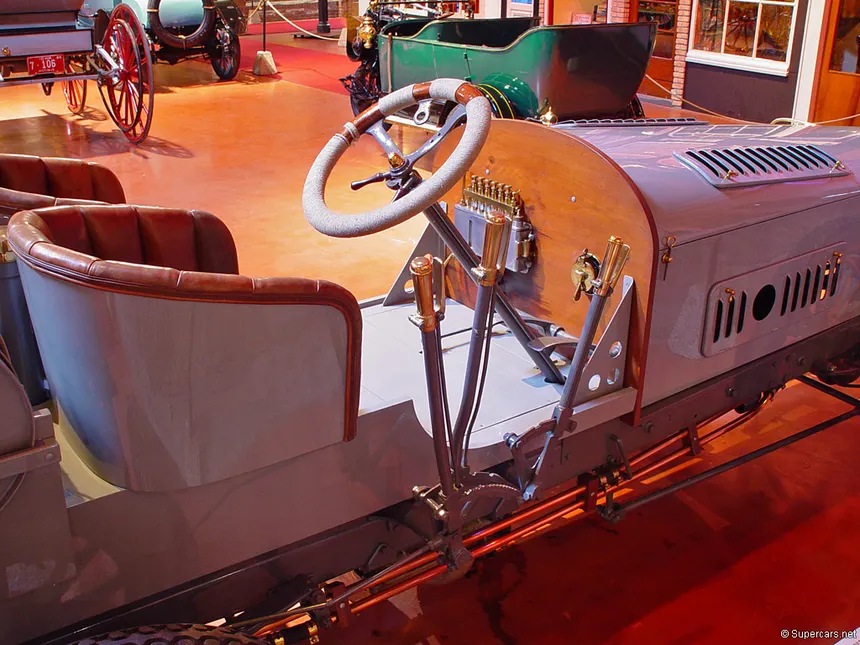
Joseph Valentin Laviolette arrived at Spyker in 1902 with sketches for a straight-six engine. Six separate cylinders mounted on a common crankcase. A single Zenith carburettor. Two camshafts on either side of the crankshaft, driven by exposed chains and gears. One spark plug per cylinder.
To put this in perspective: in 1902 the automotive mainstream was still arguing about whether two cylinders or four was the optimum number. Single-cylinder engines were everywhere. Air-cooled boxer twins were considered modern. Most racing cars had four cylinders and were considered the bleeding edge.
Six cylinders in a row, displacing 8,676 cubic centimetres according to the Louwman Museum’s own technical records, producing a claimed 60 horsepower, was not the bleeding edge. It was a different planet. Each individual cylinder displaced roughly 1.45 litres. The whole assembly was the size of a steamer trunk and weighed accordingly. The claimed top speed was around 110 km/h, or about 80 mph, which in 1903 wasn’t far off the world land speed record.
But the engine was only the start. Laviolette took the propeller shaft coming out of the gearbox and, instead of sending it only to the rear axle as everyone else did, he extended it forward to drive the front axle as well. Three differentials. Permanent four-wheel drive in a petrol-powered car. First time it had ever been done in the history of the automobile.
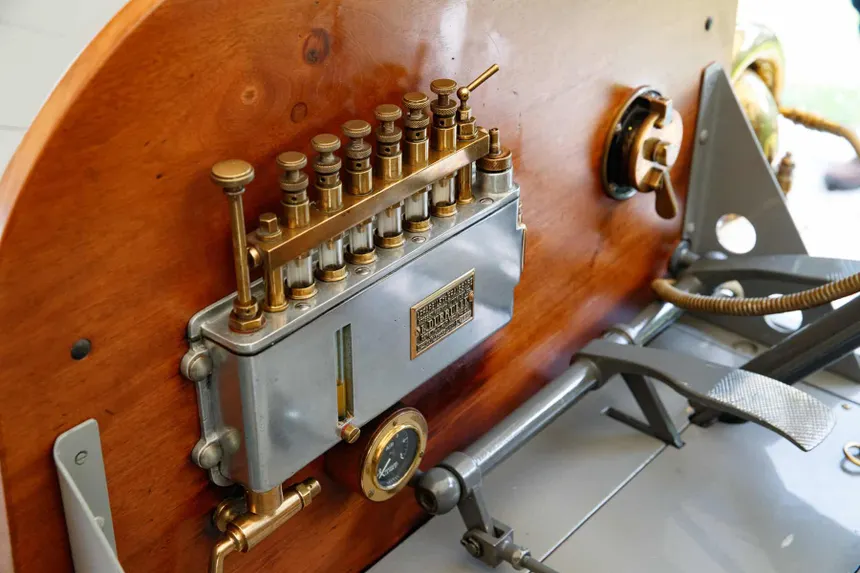
And then, because three world firsts in one car apparently weren’t enough, he put drum brakes on all four wheels plus an additional transmission brake. In an era when most cars stopped using nothing more than a brake shoe acting on the rear axle, with the front wheels rolling freely, this was an entirely different philosophy of vehicle design.
What each “first” actually means
The temptation with a car like the 60HP is to list its world firsts in bullet points and move on. That would be a disservice. Each of those three innovations is its own story.
The straight-six engine matters because the inline-six became, eventually, one of the defining engine layouts of the twentieth century. BMW built an entire brand identity on it. Jaguar’s XK engine ran for forty-three years. Toyota’s 2JZ powered the Supra into legend. Nissan’s RB26 turned the Skyline GT-R into a god. Volvo built its modern identity on transverse straight-sixes. The Spyker 60HP was the first functioning automobile straight-six in the world. Napier launched their own commercially successful straight-six in 1904, beating Spyker to mass production by roughly a year, and Napier’s own historical sources openly acknowledge that the Dutch firm built the first one. The race in mass production was won by Napier. The race in existence was won by Spyker.
The four-wheel drive matters because every rally car, every off-roader, every modern performance crossover descends from that idea. The Audi Quattro that rewrote rallying in the 1980s did so on principles that Laviolette had implemented eighty years earlier. The Subaru Impreza WRX that gave Colin McRae his world championship. The Lancia Delta Integrale of Miki Biasion and Juha Kankkunen. The Ford RS200 of group B madness. Every single one of them traces its conceptual lineage to a Belgian engineer fitting an extended propeller shaft to a Dutch racing car in 1902.
The four-wheel braking matters because it is, frankly, the part that’s hardest to forgive everyone else for not having done first. The physics of braking with only the rear axle, while the heaviest end of the car carries on under its own momentum, were not a mystery in 1903. People died because of it. That a one-off Dutch racing car already had what we’d today call balanced four-wheel braking, plus a transmission brake for redundancy, while production cars from major European factories were still fitting a single shoe on a rear-axle drum, says everything you need to know about the gap between what Spyker built and what the industry was willing to manufacture.
What’s especially striking about Laviolette’s brake solution is how he integrated it. The transmission brake wasn’t a redundant afterthought bolted on for safety theatre. It worked alongside the four wheel-mounted drums to distribute deceleration force across the entire drivetrain, reducing peak loads on any single component. Modern engineers would call it a balanced braking architecture. In 1903 it was simply called “the way this Dutch engineer thinks.” Mainstream four-wheel braking on production cars wouldn’t become the norm until the mid-1920s, and it took Hispano-Suiza‘s H6 of 1919, with its servo-assisted brakes adapted under licence by Rolls-Royce, to convince the luxury sector that stopping the front wheels was worth the engineering effort. Spyker had already done the work two decades earlier and nobody noticed.
There’s also the suspension story, which gets forgotten in the rush to celebrate the three big firsts. The 60HP rode on semi-elliptical leaf springs at both axles, with no dampers fitted. By modern standards that sounds primitive. By 1903 standards it was completely normal, but combined with permanent four-wheel drive and an 8.7-litre engine, it meant the car’s road behaviour must have been a singular experience. Imagine launching a 1.5-tonne machine on unpaved roads, with all four wheels clawing for grip, with no shock absorbers to control the chassis movement, with the seat of your pants as the only feedback system. The drivers of the Blackpool and Birmingham events that the 60HP did contest were essentially test pilots for technology the industry wasn’t ready to handle.
The race that never happened
Jacobus Spijker built this car for one event: the Paris-Madrid of May 1903. A city-to-city road race across France and into Spain, the kind of event where drivers died on the public road and spectators died standing next to it.
The 60HP didn’t make it. The engine was too new, the differentials needed sorting, the build was incomplete. The race itself became one of the bleakest chapters in motoring history. Two hundred and twenty-four cars left Paris on 24 May 1903. By nightfall, before the field had even reached Bordeaux, Motor Sport Magazine records at least ten people dead: six drivers and riding mechanics, four spectators. Marcel Renault, co-founder of the Renault company, lost the road in a dust cloud near Couhé-Vérac, hit a tree and never regained consciousness. He died forty-eight hours later. His brother Louis won the light-car category the same day and the photographs from the finish at Bordeaux show him collapsing as the news reaches him. The French government halted the race that very night. The cars were towed back to Paris behind horses, the surviving drivers in disgrace, the spectacle finished forever. It was the last city-to-city open-road race in European motorsport history. Even if Spyker had made the start line, the 60HP wouldn’t have reached Madrid.
The 60HP eventually surfaced in December 1903 at the Paris Motor Show, then crossed the Channel in February 1904 to be exhibited at the Crystal Palace in London. And here’s the part that breaks your heart: the most technically advanced car in the world only raced twice in its entire competitive life. Twice. It finished third at the Blackpool speed trials in 1904. It won the hillclimb at Birmingham in 1906. That was the entire racing résumé of the car that invented three of the most important automotive technologies ever conceived.
The reasons are mundane. It was too advanced for the available tyres. It was expensive to maintain. Spyker as a business needed to sell normal cars to keep the lights on. The 60HP was a technology showcase, not a viable racing programme. The motor industry of 1904 simply wasn’t ready to absorb what it implied. By the time it was, nobody remembered.
How the Mona Lisa of motoring survived
Spyker’s story between the 60HP and its eventual bankruptcy is one of those slow-motion industrial tragedies that motoring historians tend to skip in a single sentence. It deserves more than that. In 1907 Hendrik-Jan Spijker died at the age of 42 in a ferry accident in the North Sea, returning from England after meetings with prospective investors. Think about that for a moment. Your brother and business partner is travelling across the Channel to find financial oxygen for the company you’ve built together, and he never comes back.
The original Spyker company collapsed shortly afterwards. A group of investors bought it and restarted production under a new name: Nederlandsche Automobiel en Vliegtuigfabriek Trompenburg, the Dutch Automobile and Aircraft Factory of Trompenburg. Jacobus Spijker, broken by the loss, was no longer involved. The Spyker name lived on as a brand, but the company that had created the 60HP was effectively gone.
What’s rarely mentioned is that Joseph Valentin Laviolette stayed. The Belgian engineer continued working for the company for years after the founders had been removed from the picture. Just before the First World War he designed a small, economical 7-horsepower twin-cylinder prototype intended to open up a mass-market segment for Spyker. One of the directors believed at least a hundred could be sold. The rest of the board disagreed. The project was shelved. The engineer who had given the world three simultaneous firsts in 1903 watched his proposal for a sensible city car go in the drawer.
The Netherlands stayed neutral during the First World War, and the company pivoted to building aircraft and aero engines for the duration. The full company name, “Automobile and Aircraft Factory,” tells you everything about what the business had become. After the Armistice, with military contracts gone, Spyker added trucks and buses to the line-up in 1920. Road cars continued, but nothing remotely on the level of the 60HP. Luxurious enough, technically unremarkable.
Production ceased in 1925 after roughly 1,500 cars built across the company’s entire history. The bankruptcy was finalised the following year. A firm that had begun by building a gilded carriage for a Dutch queen, and that had then dared to invent the most advanced car in the world, ended its days making buses. There is a kind of bitter poetry to that arc.
When the receivers came in, the one-and-only 60HP, the survivor, was bought by a former company director.
What followed was forty-odd years of well-meaning but, in the Louwman Museum’s own blunt words, “incompetent” restoration. The bodywork was modified. Original parts disappeared. The car drifted between Dutch museums from 1953 to 1993 as a curiosity, an heirloom nobody quite knew what to do with.
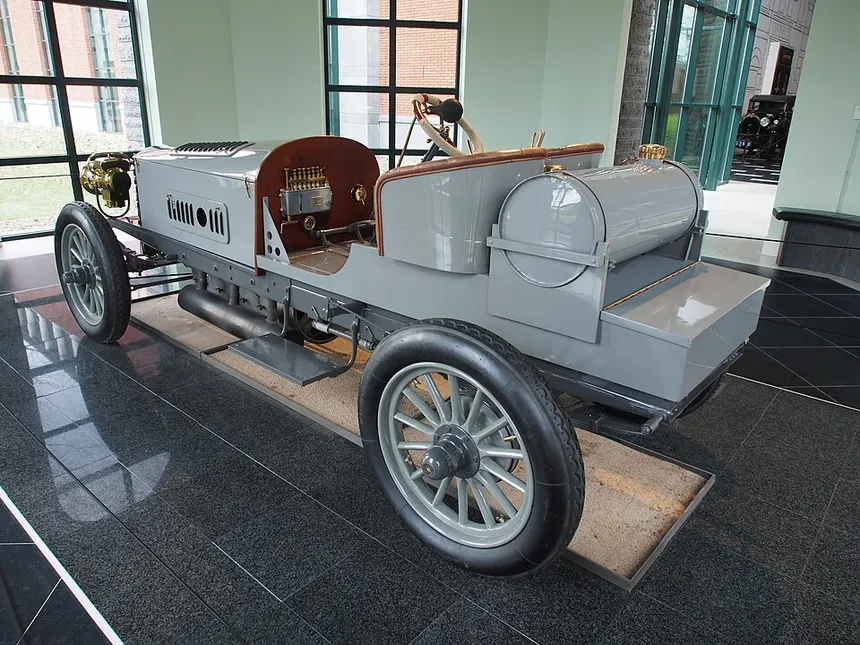
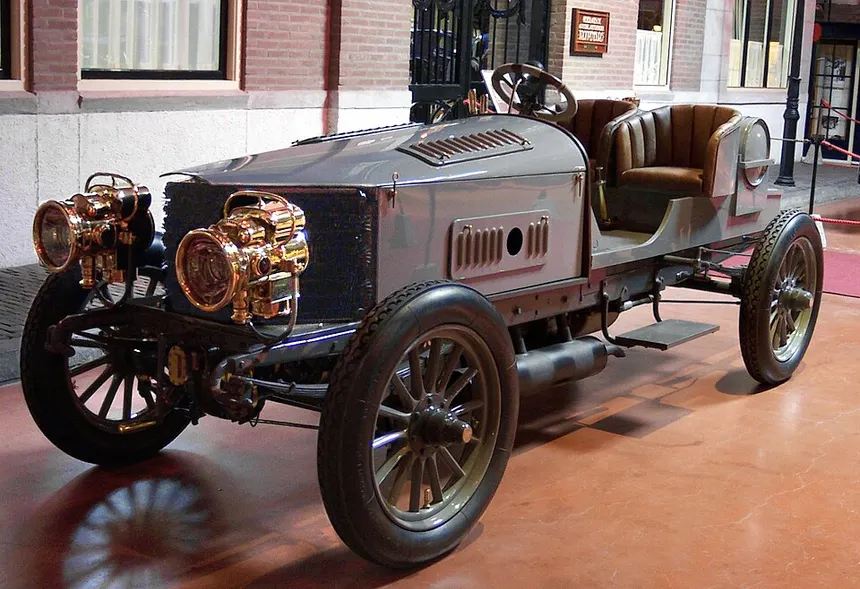
In 1993 the Louwman Museum acquired it. They spent the next five years putting it back the way it had been when it stood at the Crystal Palace in 1904. Period photographs, archival research, painstaking reverse-engineering of solutions that had been lost. When they were done, they had what they openly call the Mona Lisa of their collection. A functioning, original, single example of the most important early racing car in the history of the automobile.
Today you can walk into the Louwman Museum in The Hague and stand in front of it. In 2003, the centenary year, the 60HP took top honours at the Pebble Beach Concours d’Elegance. The recognition came a century late, but it came.
The unsung influencer
There’s a tendency in motoring journalism to anoint the same handful of cars as the influencers that shaped everything afterwards. The Ford Model T. The Citroën Traction Avant. The Mini. The Lotus Elan. The Audi Quattro.
The Spyker 60HP belongs on that list and it never appears on it. It’s the most quietly important car ever built. Three world firsts, all of them genuinely first, all of them genuinely important, all of them executed on a single chassis by two Dutch brothers and a Belgian engineer in a workshop nobody outside the Netherlands remembers.
The next time someone tells you BMW invented the straight-six, or that Audi pioneered four-wheel drive, or that four-wheel brakes were a 1920s breakthrough, point them towards The Hague. There’s a car in a museum there that did all three before any of those companies existed.
Check you’re still alive.