The Supercar That Dared to Be Comfortable: The Maserati Bora’s Secret French Heart
Ask any supercar of 1971 the questions that actually mattered to an owner and you’d usually get a sneer. Can I climb in without wrecking my back? Can I drive it for two hours without going deaf? Can I park it without a degree in mechanical engineering? The mid-engined Italian exotics of the day answered all three with a shrug. They were gorgeous, temperamental beasts, and you were expected to suffer for the privilege.
Then along came the Maserati Bora and said: actually, yes. Yes to all of it. Here was a car that could hit nearly 175 mph, look like a spacecraft, and adjust your pedals at the push of a button.
The Bora is one of the most fascinating and least-told cars of the 1970s. Maserati’s first mid-engined production road car — there had been earlier mid-engined Maseratis, but all of them racing machinery like the legendary Tipo 60/61 Birdcage of the late 1950s. A Giugiaro masterpiece. And, above all, a philosophical oddity: the supercar that decided luxury and comfort weren’t sins. But to understand it fully, you have to talk about a secret a lot of people would rather skip over. The most advanced thing about the Bora wasn’t Italian at all. It was French.
Maserati was stuck in the past
By the late 1960s, Maserati had a problem. It built cars that were fast, beautiful and — let’s be straight — technologically behind the times. While the world went mad for new ideas, Modena kept selling front-engined grand tourers: magnificent, but conservative, even as the ground shifted beneath them.
Because in 1966 something had changed everything: the Lamborghini Miura. The Miura put the engine in the middle, behind the driver, racing-car style, and overnight it made everything else look ancient. From then on, any manufacturer who took itself seriously needed a mid-engined supercar. Ferrari was already working on one. De Tomaso had the Mangusta. Maserati had nothing — and no money to develop anything either.
Salvation arrived from an unlikely place: France. In 1968, Citroën bought Maserati. And the French, who were anything but conservative, weren’t about to let their new Italian toy keep playing in the second division. The brief was blunt: build a mid-engined supercar, and build it now.
The Tipo 117 is born
The project kicked off in October 1968 under the internal name Tipo 117. It moved fast: a prototype was running by mid-1969, and the finished car broke cover at the Geneva Salon in March 1971. The first customer deliveries came before the year was out.
They named it Bora, after a strong, dry wind off the northern Adriatic. Maserati had a habit of naming its cars after famous winds, and it suited a machine built to slice through the air.
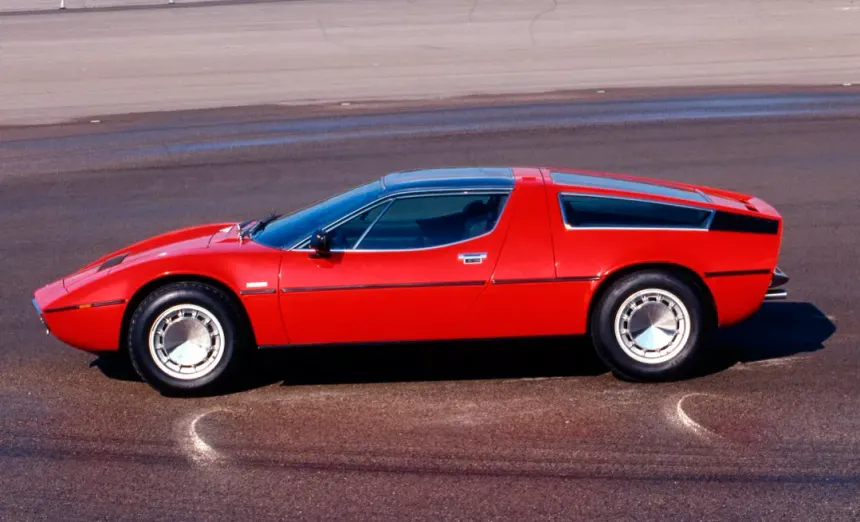
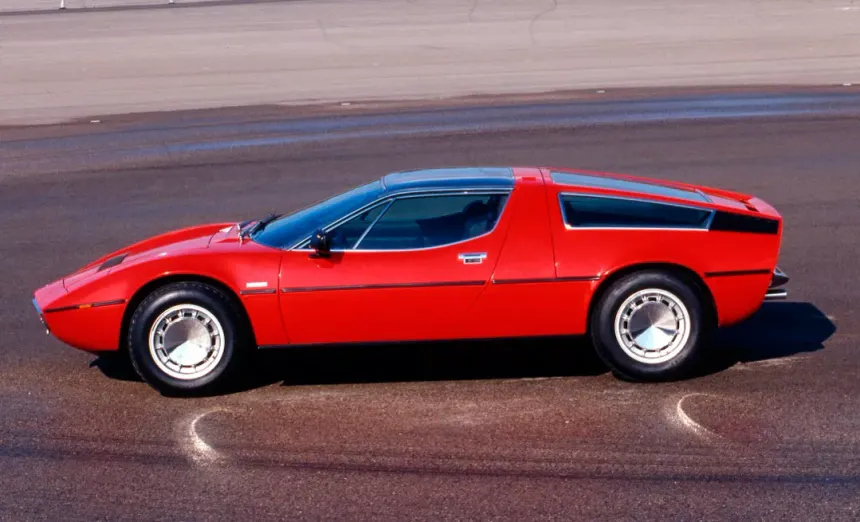
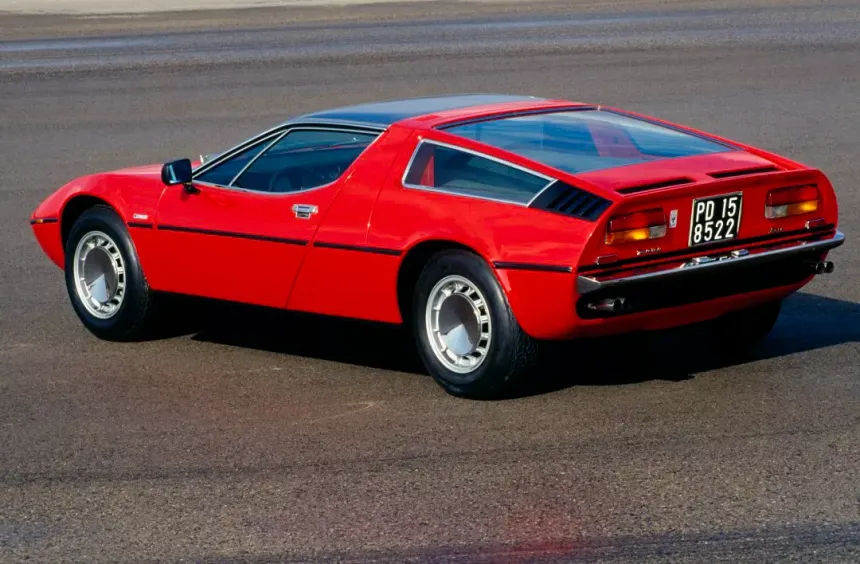
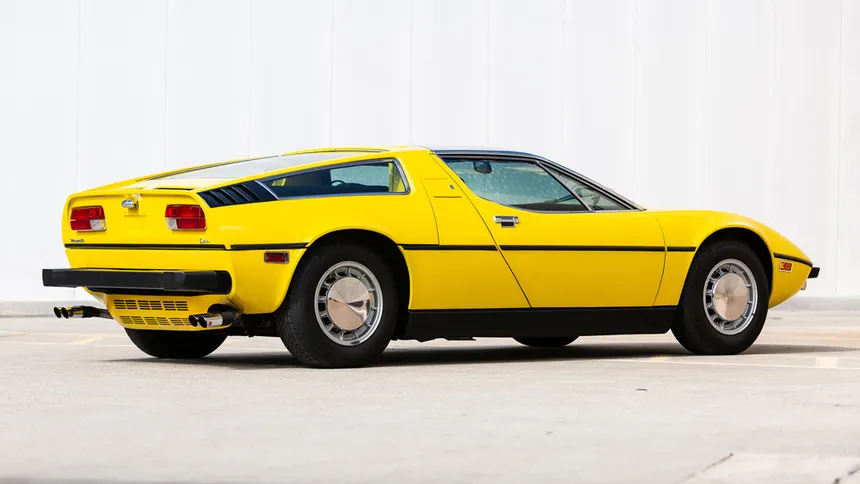
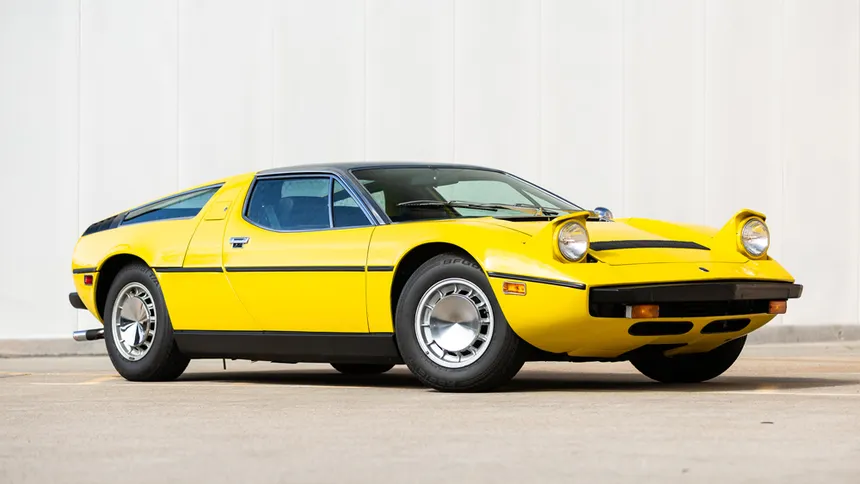
The design went to Giorgetto Giugiaro, who’d just founded his own studio, Italdesign. There was competition: Pietro Frua submitted a full-size mock-up too. But Giugiaro’s proposal won because it captured the spirit of the new decade without breaking from the Maserati family. And good grief did he nail it. The Bora is that magic moment where Giugiaro blends the sensuous curves of the 1960s with the sharp wedge that would dominate the 1970s. Unpainted stainless steel for the roof and pillars, a clean, elegant silhouette with no shouting. Where a Countach screamed, the Bora spoke softly. The bodies were built in Modena, by Officine Padane.
The heart: a V8 with racing blood
Beneath that body sat a 90-degree Maserati V8, mounted longitudinally amidships. It started at 4.7 litres and around 310 hp, with a 4.9-litre version arriving later. This was no improvised engine: it descended directly from the legendary 450S racer, with an aluminium-alloy block and hemispherical combustion chambers. The man behind it was engineer Giulio Alfieri, who’d learned the mid-engined craft on Maserati’s Birdcage race cars and knew how to translate that knowledge to the road.
The chassis was a pressed-steel monocoque with a tubular rear subframe carrying the engine and transmission. The gearbox was a ZF five-speed — the same German firm supplying the De Tomaso Pantera and other exotics of the era. And for the first time on a Maserati road car, fully independent double-wishbone suspension at all four corners — the prototype had run MacPherson struts up front, but the engineers had to abandon them because, combined with very wide front tyres and rack-and-pinion steering, they generated severe kickback through the wheel; reverting to double wishbones was the fix. Performance was genuine supercar territory, and the two versions deserve to be reported separately rather than smudged together. The original 4.7-litre car ran 0–60 mph in around 6.5–6.8 seconds and topped out between 165–168 mph. The later 4.9-litre brought that down to 6.0–6.3 seconds and pushed top speed to 170–175 mph. Properly quick, not brochure quick.
Context matters here, because it reveals the play. Its direct rivals were the Lamborghini Miura, the Ferrari 365 GT4 BB brewing at Maranello, and the Pantera itself. They all shared the basic recipe: mid-engine, two seats, dizzying performance. But where the Miura was a wild stallion and the Pantera bet on cheap American muscle, the Bora played a different card. It didn’t want to be the fastest of the gang. It wanted to be the one that arrived at dinner first, shirt uncreased. On paper, the Ferrari and Lamborghini could match or beat it. In the real world, neither treated you half as well.
There’s one engine chapter worth closing before we move on, because the evolution from 4.7 to 4.9 tracks the misery of the era. The 4.7 was happiest in European trim, but American emissions rules were tightening fast and strangling its output. Maserati’s answer for the US was to drop in the larger 4.9-litre V8 borrowed from the Ghibli, the extra capacity clawing back some of the power lost to emissions gear. From 1973 the engine gained an air pump to clean up its exhaust. The US cars also wore bigger, clumsier bumpers to meet American impact standards — many owners later swapped them back for the slim European items — and the taillight indicators changed from amber to red. Small humiliations of regulation that tell you exactly what decade this car was fighting through.
The French secret: the hydraulics that changed everything
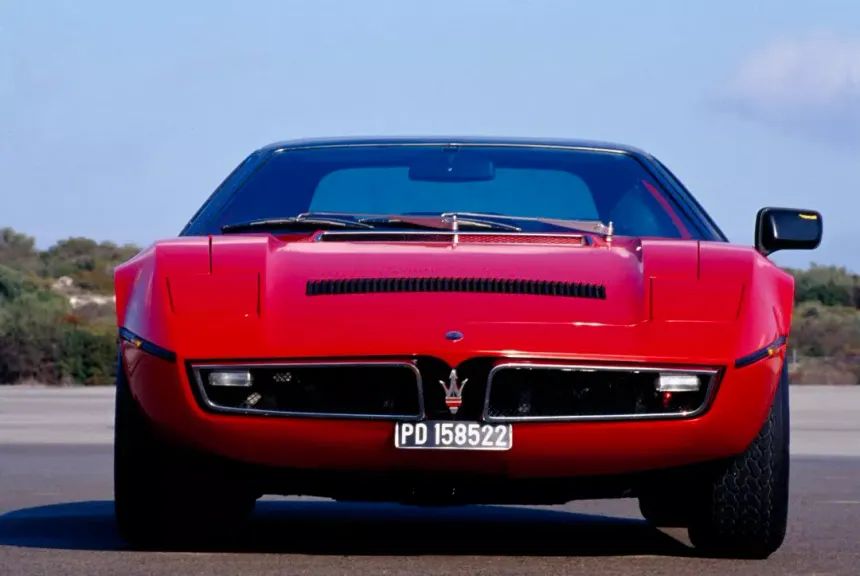
And here we reach what made the Bora unique, what no Italian rival had: Citroën hydraulics. The French were the world champions of high-pressure hydraulic systems — that wizardry that made a Citroën rise off the ground as if by magic. And they poured that tech into the Bora.
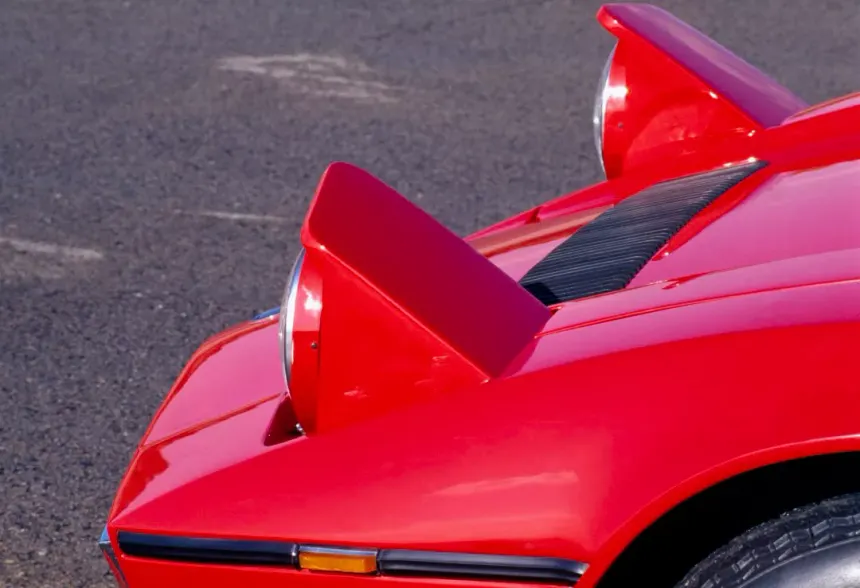
But careful, because there’s a myth worth dismantling. The Citroën hydraulics in the Bora did not work the suspension, as many people assume. The suspension was conventional double wishbones. What the French hydraulics controlled was something else, and arguably more impressive for the era: the ventilated disc brakes, the pop-up headlights, the adjustable steering column and — the truly mind-bending part — the pedal box and the driver’s seat. Yes, really. In a 1971 supercar, you could slide the entire pedal cluster fore and aft at the touch of a button, while the seat adjusted electro-hydraulically. At a time when setting your driving position in an exotic basically meant putting up with whatever you were given.
That was the Bora’s real revolution, and the reason it deserves remembering. It wasn’t the fastest or the most savage. It was the most civilised. It had a decent front boot. It had double glazing between cabin and engine, plus a lined, carpeted engine bay, so the bellow didn’t leave you deaf. It had factory air conditioning, electric windows, hydraulically-assisted power steering. It was, in essence, what we’d now call an everyday supercar, decades before that phrase existed. The niche distinction is worth being precise about, because someone could wave the Porsche 911 flag and argue that car was already daily-usable. They’d have a point: the 911 was indeed a usable sports car. But the 911 was rear-engined, with token rear seats — not a mid-engined two-seat exotic. What the Bora did, and nobody had done before, was bring real comfort to that specific niche: the Italian mid-engined two-seater with the engine sitting behind the driver. That particular throne — the liveable mid-engined exotic — was the Bora’s first.
The paradox that defines the car
Pause to savour the irony, because it’s a good one. The most Italian car in the world — a Maserati, from Modena, with a race-derived engine and Giugiaro styling — owed its most advanced, most comfortable, most memorable trait to French engineering. French comfort, Italian performance. A strange, almost unnatural marriage that nonetheless worked beautifully.
And like every strange marriage, it had its tensions. And here it’s time to open the can, because the piece would be incomplete without doing so. The very hydraulics that made the Bora magic were also, over time, a nightmare. System leaks were frequent. The brakes running off that hydraulic system drew serious criticism. Worse still: finding qualified technicians to work on it grew steadily harder beyond a handful of specialist shops. Owner forums for classic Maseratis have spent decades dedicating entire threads to the subject — one well-known FerrariChat conversation is literally called “Citroen hydraulics,” covering the Bora, Khamsin, early Merak and late Indy. Many surviving Boras today run with the hydraulics disconnected or replaced by conventional systems. That’s the B-side of the car most fans skip past. The French magic that made the Bora unique ended up, for many owners, its biggest headache.
A broken promise, in a way. The hydraulics promised a forever-civilised car. They worked beautifully when new. But the “forever” came with fine print: leaks, maintenance, vanishing specialists. The Bora inherited the best and the worst of its French heart at once.
What might have been: the racing Bora
There’s a chapter almost nobody knows. In 1973, Maserati’s French importer, Thépénier, asked for a racing version to compete in Group 4. Maserati got to work and coaxed over 430 hp from the V8. The snag was bureaucratic: to homologate the car for Group 4 you had to build at least 500 units, and Maserati, with sales collapsing, wasn’t remotely close to that number. So the competition Bora withered on the vine. The first mid-engined Maserati, a car with track DNA running through its veins, never got to race in anger. One of those painful “what might have been” stories.
The end: the oil crisis ran it over
The Bora had the rotten luck to be born just before the storm. The 1973 oil crisis flattened the market for anything that drank fuel in great gulps, and a near-five-litre V8 gulped with the best of them. Sales, never huge to begin with, dried up as fast as OPEC’s crude.
Between 1971 and 1978, Maserati built just 564 Boras in total: 289 with the 4.7-litre engine and 275 with the 4.9. A tiny number, almost hand-built, which today makes it a sought-after rarity. Among its original owners were genuinely high-flying names, like the Aga Khan and film producer Carlo Ponti, husband of Sophia Loren. The car also spawned a cheaper little brother, the Merak, which used a V6 derived from the Citroën SM and sold far more. And Giugiaro, while he was at it, used the Bora’s underpinnings to create one of his most influential concepts, the Boomerang, an extreme wedge that shaped a whole era of design.
Why this car matters
The Bora wasn’t the fastest of its generation, nor the most exclusive, nor the one that grabbed the most headlines. But it did something none of its rivals dared: it proved a supercar didn’t have to be a punishment. That you could have the mid-engine layout, the spaceship silhouette and the beastly performance, and still arrive in one piece, rested, without having wrestled the car at every set of lights.
That idea, completely normal now, was close to heresy in 1971. And it’s deliciously fitting that pulling it off required an alliance as improbable as an Italian maker of firecrackers teaming up with a French maker of comfortable, eccentric machines. From that clash of cultures came something that hadn’t existed before: an exotic you could genuinely live with.
Next time you see one, notice how serene it looks. How little it needs to shout. Where a Miura or a Countach demanded your attention through sheer drama, the Bora trusted that elegance, intelligence and a little French hydraulic magic would do the job. And do the job they did.
Then check you’re still alive.