
The Maserati Boomerang: the Wedge That Drew Your Hatchback
There’s a concept-car trope that Jeremy Clarkson loved to mock: the show stunner that turns up at Geneva, gets a thousand photographs, and is never seen or heard from again because it can’t actually move, steer, or stop. A non-car. A sculpture on a turntable.
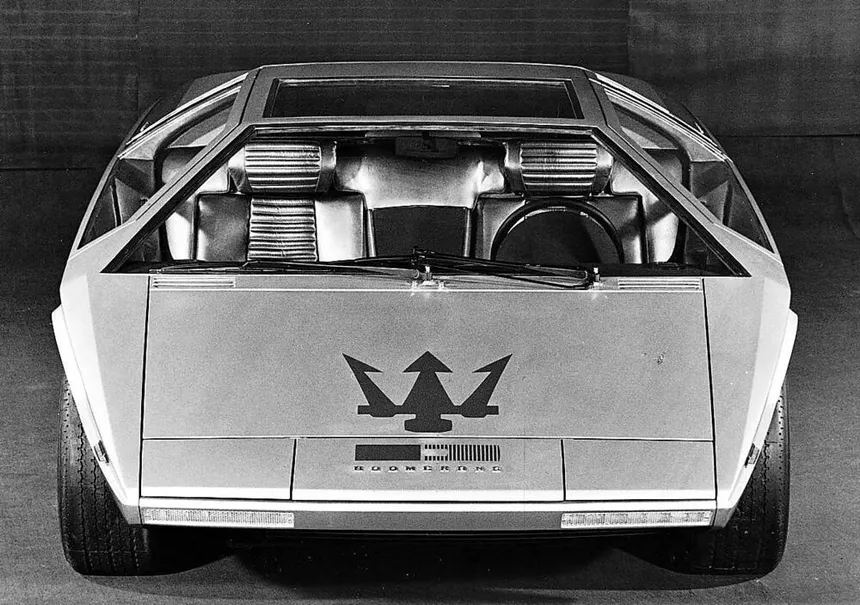
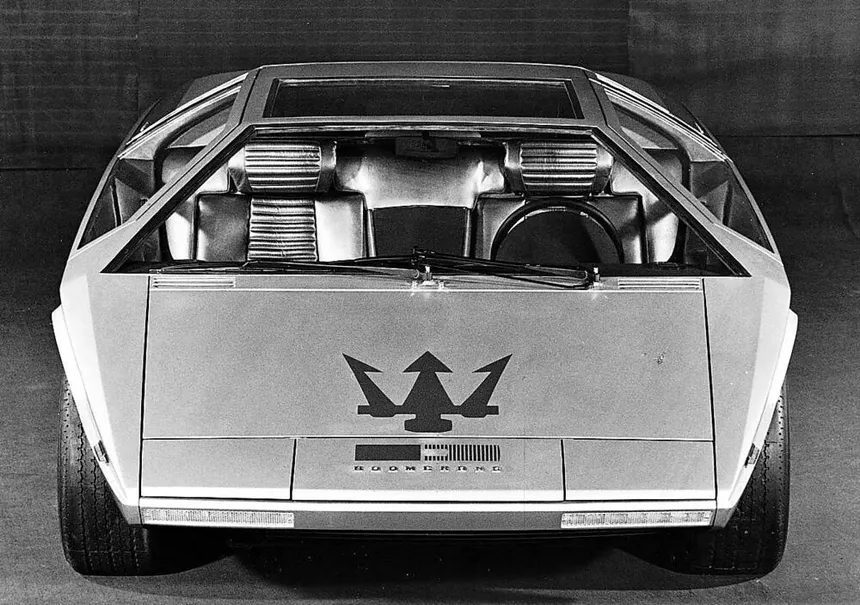
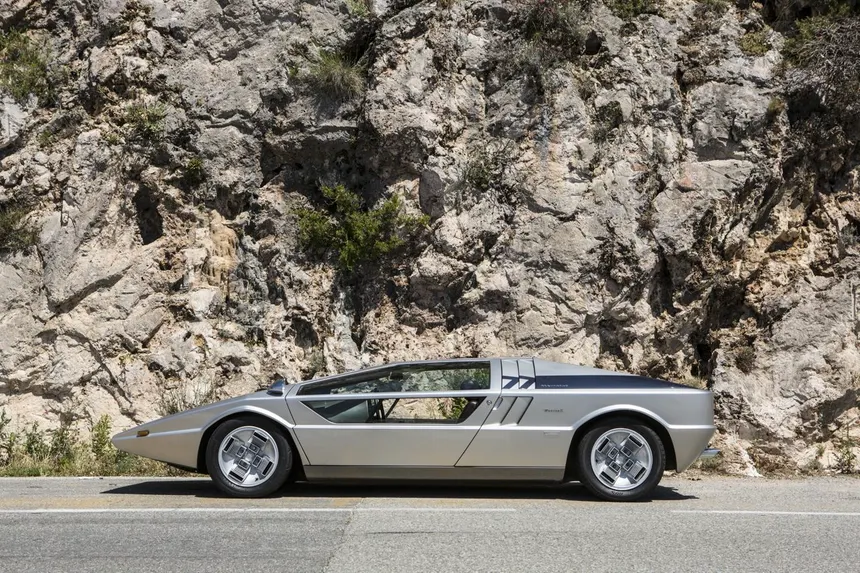
The Maserati Boomerang was not that. The Boomerang ran. It had a real Maserati V8 behind the seats, a real gearbox, and a genuine claimed top end the wrong side of 180 mph. And yet it was, in every way that matters to a sane person, completely useless. The windscreen alone tells you why. It was raked to thirteen degrees off horizontal — thirteen according to Italdesign itself, though you’ll find sources quoting twelve and a half or simply “under fifteen” — so flat the glassmakers warned Giugiaro you’d see almost nothing through it. He didn’t care. The Boomerang wasn’t drawn to see the road. It was drawn to show the world where the car was going.
And here’s the part nobody tells you: out of that thirteen-degree lunacy, refined and calmed and made sensible, came the most ordinary car in Europe. Quite possibly one you, or your family, have driven. Hold that thought.
A Maserati that was really a manifesto
The Boomerang showed up twice. First at the 1971 Turin Motor Show as a static model — a sculpture with no working mechanicals, an idea made solid to gauge the reaction. The reaction was strong. Then at the 1972 Geneva show it returned as a fully running car, with mechanicals derived from the Maserati Bora: a 4.7-litre V8 mounted amidships, 310 horsepower, a five-speed manual, and a claimed top speed pushing 300 km/h. Borrowed mechanicals, it’s worth saying — nothing new under that impossible skin. We’ll come back to that.
You need the context, or the Boomerang just looks like a folly. It wasn’t. This was peak wedge fever. The Lamborghini Countach, the Lancia Stratos Zero — a whole generation of Italian designers decided at roughly the same moment that the future was knife-shaped. Gandini was pushing from inside Bertone. Giugiaro, from his newly founded Italdesign, was pushing from the other side. The Boomerang was his shot. His way of saying: I can take this to the edge too, and frankly I’ll take it further than any of you.
Because thirteen degrees isn’t a styling whim. It’s a statement. Giugiaro had already drawn the Bizzarrini Manta in 1968 with a wildly raked fifteen-degree screen. With the Boomerang he shaved off two more. He took his own record and broke it. That’s not a man playing. That’s a man racing himself and everyone else at once.
And it’s worth knowing who “everyone else” was, because it wasn’t just anybody. In the other corner stood Marcello Gandini, drawing the Miura, the Stratos and the Countach out of Bertone. Two Italian geniuses, near enough the same vintage, pushing the same language in different directions and watching each other out of the corners of their eyes. The wedge wasn’t invented by one man — it was invented by both at once, each trying to take it further than the other. The Boomerang is Giugiaro’s answer to that duel. His way of planting himself in the middle of the show floor and saying, without opening his mouth, that he could do science fiction too, and that his came with a thirteen-degree windscreen nobody else had the nerve to draw.
Inside, proper science fiction
The outside was outrageous enough, but the cabin was from another planet. The steering wheel wasn’t a wheel with dials behind it, the way every car had done it forever. The wheel had the entire instrument cluster mounted inside the rim. Speedo and rev counter up top, switches for lights, wipers and indicators in the middle, gauges for battery, water, oil and fuel below. The rim itself rotated around that fixed block of instruments.
Sit with that for a second. In 1972, when most cars had a dashboard with four dials scattered across it, Giugiaro drew an interface. A theory of how the driver and the car’s information ought to relate to each other. Everything in your eyeline, nothing cluttering the space between your hands and the road. The idea was so far ahead that half a century later we’re still fighting touchscreens trying to solve the same problem, and usually solving it worse.
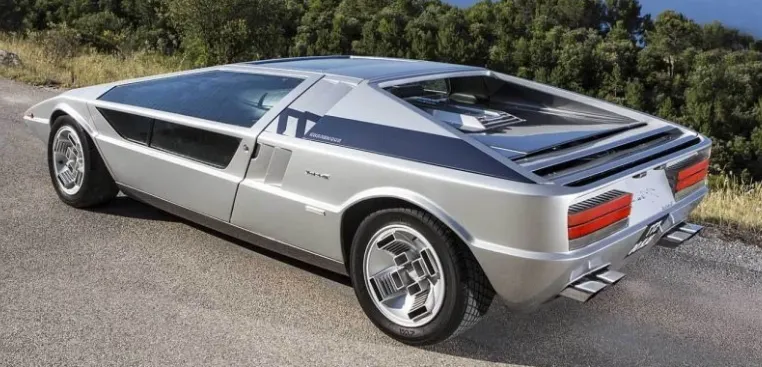
The rest of the interior matched: a box of glass and metal, the whole car split by a single horizontal line, the windscreen melting into a glazed roof. It wasn’t comfortable. It wasn’t practical. It was a statement, from the first panel to the last.
The beauty of the totally pointless
Here’s what separates the Boomerang from a mere styling exercise. The thing was useless. You weren’t doing the weekly shop in it. You weren’t crossing a country in it without a stiff neck and partial blindness courtesy of that screen. In practical terms it was a bad idea on wheels.
But it was one of the most beautiful bad ideas ever drawn. And the point isn’t that it was beautiful — it’s that it was beautiful in a new way, in a language nobody had used quite like this: big tensioned surfaces, straight lines crossing each other, volumes that look carved from a single block. Giugiaro wasn’t decorating a car. He was inventing a grammar. And that grammar is what actually matters, because it’s the one he’d use afterwards to speak to the whole world — not just the handful of rich men at a motor show.
And “grammar” isn’t a stretch, because look at what came out of that hand and that language afterwards. The Lotus Esprit of 1976, the sharpened wedge that stayed in production for nearly thirty years and famously went underwater in a Bond film. The DeLorean DMC-12, brushed stainless and tensioned planes that Hollywood made immortal. The Lancia Delta, the BMW M1. They all speak the dialect the Boomerang invented. The prototype didn’t die in a glass case — it broke down into strands of DNA that resurfaced, one by one, in cars that were actually built and actually driven. That’s the difference between a folly and a manifesto. A folly gets admired and forgotten. A manifesto gets handed out on the street for decades.
From a nightclub to Pebble Beach
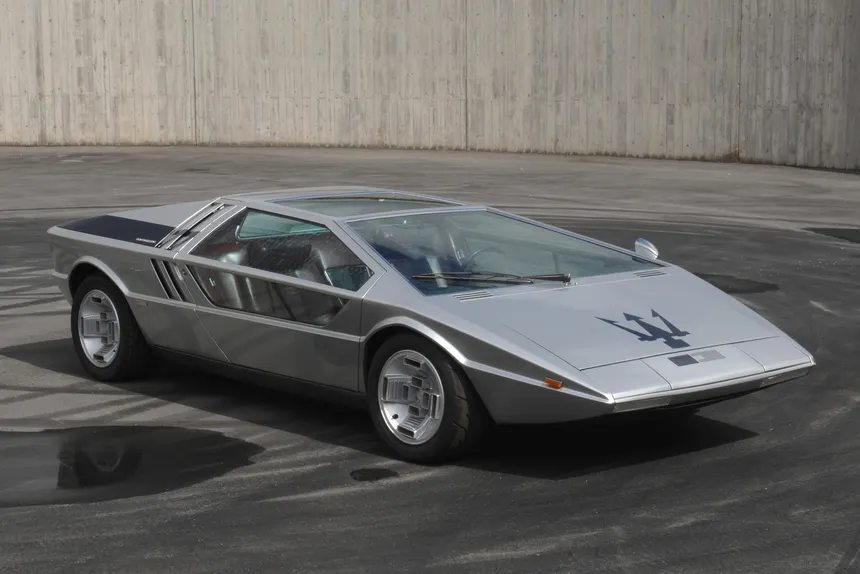
What happened to the physical car next is almost as good as the car. After touring half of Europe’s motor shows — Geneva, Paris, London, Barcelona — the Boomerang was sold. And it ended up, of all places, in Benidorm. Giugiaro’s one-off, the most extreme wedge in design history, in the hands of a Spanish cabaret owner on the Costa Blanca. I’m not making this up. This happened. The man’s actual name isn’t documented in any reliable source, so I won’t invent one for you — just keep the image, which is plenty. The impossible wedge parked by the sea, under the neon.
There it sat, half-forgotten, until 1980, when a German Maserati enthusiast on holiday spotted it, realised what he was looking at, and bought it. Eight years earlier he’d seen it at a show and could only afford a scale model of it; now he was taking the original home. Exactly how that deal was struck, with whom and for how much, isn’t precisely recorded either, and I’d rather tell you that than paper over the gap with decoration. What we do know is the detail that sums up the whole madness of the car: to restore it and register it for the road, they had to fit yellow bulbs in the indicators, because the originals didn’t meet regulations. The most futuristic wedge ever drawn, made street-legal with little yellow bulbs like any econobox. That’s the real world getting its hands on science fiction.
After restoration, the Boomerang reappeared in 1990 at the Bagatelle Concours in Paris. And here’s the detail that closes the loop: on the judging panel sat Giorgetto Giugiaro, who recognised his own creation and, proudly, signed it by hand on the rear panel.
From a Benidorm cabaret to a car signed by its own creator at a concours d’elegance, and from there into the orbit of the great collectors. The price trail tells its own story: in 2002 it changed hands for a little over $640,000; in 2005 Christie’s sold it for a million at Rétromobile; and in 2015 Bonhams hammered it away at its Chantilly sale for $3.7 million. Three documented sales, gavel down, not vague estimates. A car a cabaret owner once kept parked by the coast, now a living museum piece some collectors rank alongside a painting.
The magic trick: from scream to whisper
Now the bit I actually want to tell you, the part that connects this car to your life whether you know it or not.
Two years after the Boomerang, the same man, the same head, the same pencil, sat down and drew the Volkswagen Golf. 1974. A sensible box, rational, buildable by the million, designed so any European family could buy one and park it without drama.
What does a thirteen-degree Maserati have to do with a German hatchback? More than it looks, but not in the way everyone assumes. The Golf isn’t “a cheap Boomerang.” They share a method. Look at a Golf MK1 in profile and notice the specifics: the straight waistline running the full length of the car, the clean flanks with no fussy mouldings, the broad vertical rear pillar that gives it that serious face, the sense of a car resolved in a single piece. Now go back to the Boomerang and look for those same decisions. They’re all there. The difference is that in the Boomerang they were made with no brakes on, taken to breaking point, and in the Golf they were made with an engineer at his elbow saying “this has to be stamped out by the million, this has to fit through a garage door, a small-town body shop has to be able to fix this.”
And that’s the real craft, the part you don’t see. In the Boomerang, Giugiaro tested how far a surface could be tensioned, how low a line could go, what happened if you deleted everything round. It was the test bench. By the time he sat down to do the Golf, he already knew which of all that survived the move to a real car and which stayed behind in the prototype. He didn’t copy the Boomerang. He used it as a notebook. The prototype is where you learn the language with nobody correcting you. The street car is where you prove you can speak it quietly, in front of a budget and a production line, without sounding like fancy dress.
That’s why this car — one you never drove, one almost nobody has seen in the metal — is wired into your life. Because without the Boomerang’s scream, there’s no Golf’s whisper. And out of the Golf’s whisper comes half the history of the European hatchback. You drive a descendant of the Boomerang every time you start a small car. Nobody just bothered to tell you.
What the Boomerang wasn’t
To avoid sliding into worship, let’s be straight about what the Boomerang wasn’t. It wasn’t a car. It was a running prototype, an exercise, an idea with an engine. It worked, yes — it could move under its own power, which was already more than most concepts of the era managed. But it wasn’t a car to use, and never pretended to be. Anyone selling it as a frustrated supercar that could’ve reached production has missed why it existed.
Nor was it, technically, a revolution. The mechanicals were lifted wholesale from the Bora; there was nothing new under that impossible skin. And here’s the caveat almost nobody makes: the Boomerang left no direct descendants at Maserati. No production model came out of it. The Bora and Merak already existed, and the firm itself never returned to that extreme shape. The Boomerang’s legacy wasn’t a Maserati bloodline — it was something rarer and bigger: a language that spread to brands with nothing to do with one another. Its DNA resurfaces in the Golf, the Passat, the Panda, the Lancia Delta, the DeLorean, the Lotus Esprit, even the Quattroporte III. It left no children in its own house. It left a way of drawing cars all over the world.
And with that said, let’s be blunt to finish: the Boomerang is an extraordinarily beautiful and completely useless object. Both at once, no contradiction. Don’t ask it for more than it gives. It’s not a car we lost, not a wasted opportunity, not a supercar that should have been built. It’s a sculpture that moves, a notebook on wheels, the place a genius tried things out before taking them to the street. And that’s enough. Anyone who needs it to also have been “a good car” before they’ll rate it has missed the entire point.
The circle that closed half a century later
The story has an epilogue that reads like a script. In 2025, Fabrizio Giugiaro, Giorgetto’s son, revealed the Peralta S: a one-off, commissioned by a collector, built on a Maserati MC20 and clothed in mirror-polished aluminium, inspired directly by his father’s Boomerang. The wedge returns. The name returns. On a Maserati, again. But that’s another story, and we’ll tell it on its own.
Keep the thirteen degrees. Keep the car that was good for nothing and yet drew the car that’s good for everything. Keep the idea that the genius who screams and the genius who whispers are, very often, the same man — and that the second is harder than the first. Next time you see a tired old Golf parked on your street, you’ll know you’re looking at the distant echo of a Maserati that ended up in a Benidorm nightclub with the flattest windscreen in history.
Check you’re still alive.