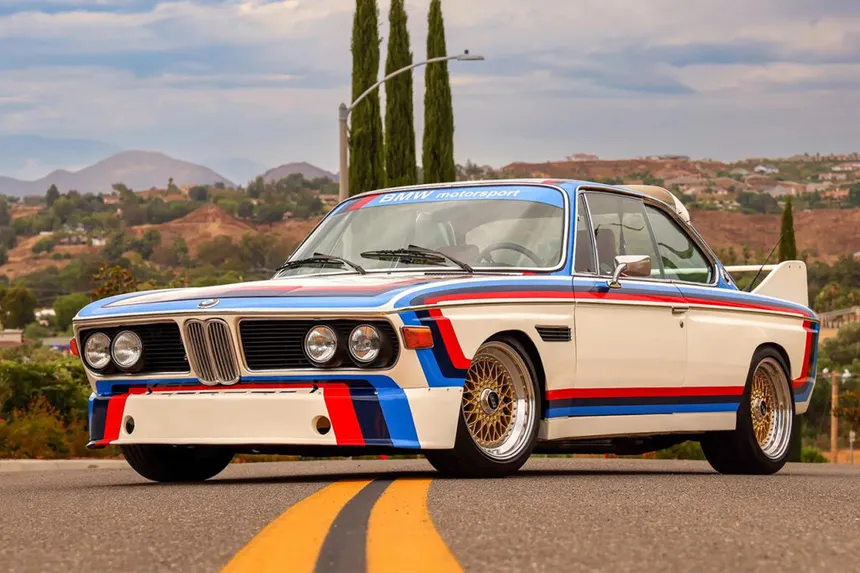
BMW 3.0 CSL Batmobile: The Car BMW Sold You With the Wing Dismantled in the Boot
There’s a photograph that circulates in BMW collector circles of a German customer in 1974 taking delivery of his brand-new 3.0 CSL. He opens the boot. Inside, lying neatly across the carpet, are three pieces of black-painted aluminium — the two vertical mounting struts and the single horizontal blade that make up the most famous rear wing in the history of touring car racing. Not bolted to the boot lid where it belongs. Stacked inside the boot. As parts.
Most retellings of the story file this under “amusing anecdote”. Hagerty’s Rob Siegel mentions it in passing in his retrospective on E9 coupés. Top Gear treats it as a quirky footnote. Almost nobody explains why it actually happened. The reason is that BMW Motorsport, the brand-new performance division founded barely a year earlier, found itself trapped between two non-negotiable requirements. FIA homologation rules demanded that the road-going CSL carry the same aerodynamic package as the race car. German road traffic law banned exactly that aerodynamic package as illegal on public roads. The only compromise BMW could engineer was to deliver the car in Germany with the wing present but not installed, and leave the legal liability of fitting it to the customer.
That’s the Batmobile. The most extreme car BMW M Division ever signed off arrived in German showrooms looking like a parts kit.
This is its story.
Before there was a Batmobile, there was a problem at Spa-Francorchamps
To understand the CSL you have to go back to 1970. BMW has been campaigning the 2800 CS in the European Touring Car Championship for two seasons. The car is the elegant E9 coupé built by Karmann in Rheine for BMW, all flowing lines and chrome bumpers. It’s quick in a straight line. Against the Ford Capri RS2600 that dominates the category, it has no answer. Too heavy. Too civilised. Year after year, BMW is being beaten on European tracks by a Cologne-built Ford coupé. For a brand whose identity was being built around becoming “the ultimate driving machine,” that situation was intolerable.
The response arrived in May 1972. BMW formally established BMW Motorsport GmbH in Garching, under the direction of Jochen Neerpasch — a German engineer recently poached from Ford’s racing programme, which is its own kind of corporate revenge. This was the first time the brand had ever spun off a wholly owned subsidiary dedicated exclusively to motorsport. And the very first car to roll out of BMW Motorsport’s doors wasn’t an M3, an M5, or an M1. It was the 3.0 CSL. The Batmobile we’re discussing is the third generation of that car, but the chronology matters: the CSL is what created BMW M Division, not the other way round. Every M car that has ever existed — every M3 with a screaming inline six, every twin-turbo M5, every V10 E60 — is the cultural descendant of this homologation coupé.
What CSL actually means
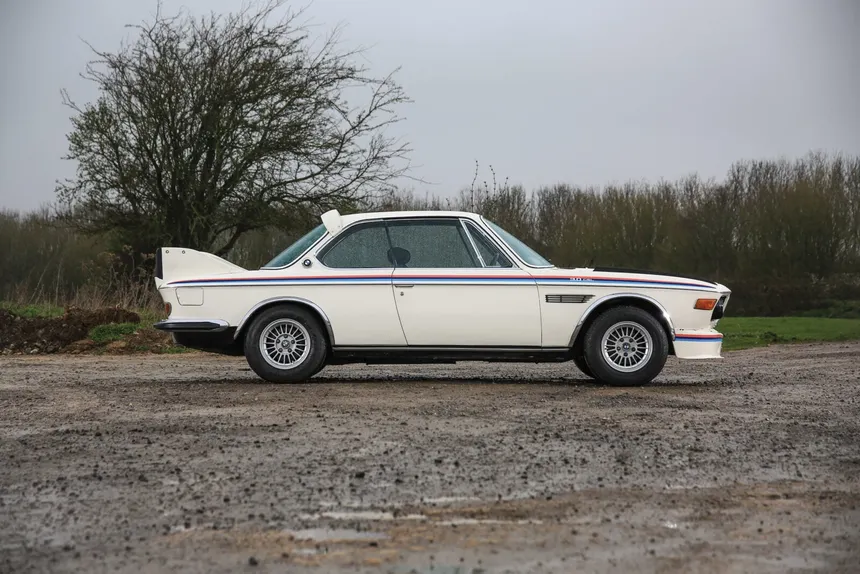
CSL is the German abbreviation of Coupé Sport Leichtbau. The literal translation is “lightweight sports coupé,” but it’s worth pausing on Leichtbau as a term, because it has a specific engineering resonance in German that “lightweight” doesn’t quite capture in English. Leichtbau doesn’t mean “the car happens to be light.” It means “the car has been systematically redesigned with weight reduction as a governing principle on every component.” Each part of the car is examined, weighed, and questioned. If it doesn’t carry structural or mechanical function, it gets removed or replaced with something lighter. To put it bluntly: the CSL is not a 3.0 CS with things removed. It’s an E9 redesigned from the ground up around the discipline of taking weight out.
There’s a side note worth marking. The modern BMW M4 CSL re-uses the abbreviation, but BMW has officially redefined the L from Leichtbau to Competition. So when you see CSL on any post-2003 BMW, you’re being sold “Competition,” not “lightweight build.” The original is the only CSL that actually meant the German word.
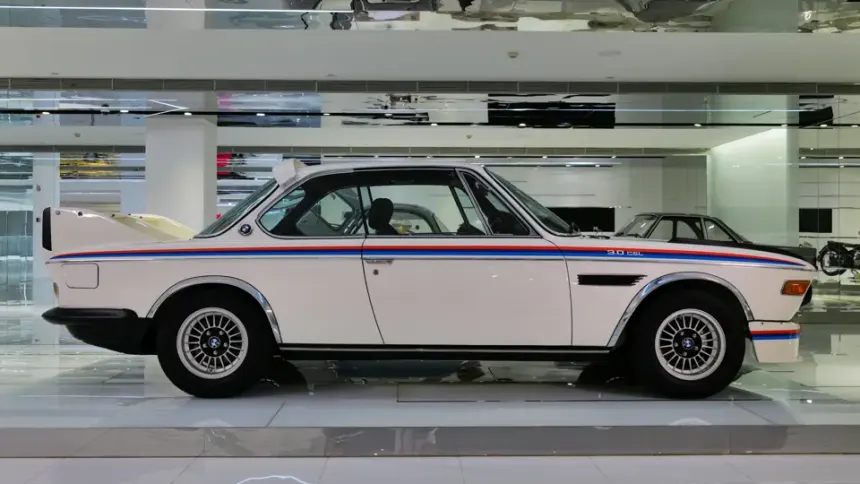
The weight reductions on the original CSL are a masterclass in seventies engineering. The entire body shell is built from thinner-gauge steel than the 3.0 CS donor car. The bonnet, boot lid and door skins are pressed in aluminium. The windscreen is thinner glass. The rear side windows are Lexan polycarbonate — a plastic that weighed roughly a third of the equivalent tempered glass. The rear bumper is polyester resin rather than steel. Lightweight Scheel buckets replace the CS’s electric leather chairs. No floor or door insulation. Manual window winders rather than electric motors. Result: 1,270 kilograms versus the 1,420 kg of the standard 3.0 CS. One hundred and fifty kilos removed from a car of the same external dimensions. Roughly the mass of an adult passenger.
Some of those decisions deserve workshop explanation because they’re not obvious to the non-technical reader.
The Lexan rear side windows are polycarbonate, an aerospace-grade thermoplastic that in the 1970s was considered exotic material. It weighed about a third of equivalent tempered glass and resisted impact without shattering. The downside: it scratches easily, yellows with UV exposure, and you can only polish it so far before it loses optical clarity. A genuine 1973 Batmobile that has spent fifty years exposed to sunlight has those windows opaque and crazed. Current restorers face a choice: replace them with modern Lexan and keep the original character, or substitute tempered glass and lose the period-correct material. Either decision changes the car.
The resin rear bumper follows the same aggressive logic. A steel bumper weighed around twenty kilos. The CSL’s polyester one weighed five. But the functional difference, if you take a low-speed shunt from behind, is that steel dents and resin shatters. In 1973, with no impact regulations, that was an acceptable trade. No manufacturer could ship that part today.
Why the engine grew from 3.0 to 3.2 litres
The third-generation CSL — the Batmobile under discussion — uses a different engine to the first-generation car. Worth explaining why.
The block is still the M30, BMW’s iron-block aluminium-head inline six with single overhead camshaft and two valves per cylinder, in production since 1968. The standard 3.0 CS displaced 2,985 cc. The early-1972 CSL, the same. The late-1972 CSL with Bosch D-Jetronic injection, 3,003 cc — three additional cubes achieved through a minor rebore to clear the three-litre displacement threshold for the higher ETCC capacity class.
The Batmobile in July 1973 brings a more significant change. BMW Motorsport wanted serious displacement to give the race engine room to breathe in development. The most efficient way: keep the bore at 89.25 mm but extend the stroke from 80 to 84 mm. Four extra millimetres of piston travel. Result: 3,153 cubic centimetres. And here’s the engineering trade-off worth marking.
Extending stroke gets you displacement but costs you maximum rpm. Mean piston speed at any given crank speed is proportional to stroke length. If you increase stroke, then for the same mean piston speed — which is what governs reliability at high rpm — you have to lower the rev ceiling. The 3.0-litre CSL spun cleanly to 7,000 rpm in race trim. The 3.2-litre CSL, with the same mechanical piston speed limit, couldn’t safely exceed about 6,700 rpm. That’s the classic engineering dilemma: more displacement or more revs? BMW chose displacement, because the ETCC rules penalised competitors above 3.0 litres into a higher capacity class where there was only one serious rival (Ford) and a great many championship points to be claimed.
Bosch D-Jetronic injection, 206 horsepower at 5,600 rpm, 286 Newton metres at 4,200. Those are catalogue figures, the ones you got on the road. The race version of the same engine, with open intake and aggressive cams, would deliver 360 horsepower in early-1973 trim and well over 430 by the time the racing programme ended.
The wing that German law refused to register
Now the section that gives this article its title.
In 1973, German road traffic regulations — codified in the §19 of the Straßenverkehrs-Zulassungs-Ordnung — prohibited the installation of aerodynamic elements protruding prominently beyond the standard outline of a road vehicle. The official rationale was safety: a poorly mounted spoiler could detach at high speed and become a projectile; a sharp-edged wing could injure a pedestrian in a collision. The actual rationale was cultural. Postwar Germany of the early 1970s did not want road cars on its autobahns that looked like racing machinery. It was still rebuilding the industrial credibility of a country whose engineering had been associated, in much of Europe, with very different machines two decades earlier. A massive rear wing on a coupé read as the wrong kind of bragging.
BMW Motorsport had a problem. To race the CSL under Group 2 homologation rules in the ETCC, FIA regulations required selling at least 1,000 road-going examples carrying the same aerodynamic configuration as the race car. FIA rules were unambiguous: if the wing appears on the race car, it must also appear on the homologation car. And BMW could not legally register that car in Germany with the wing installed.
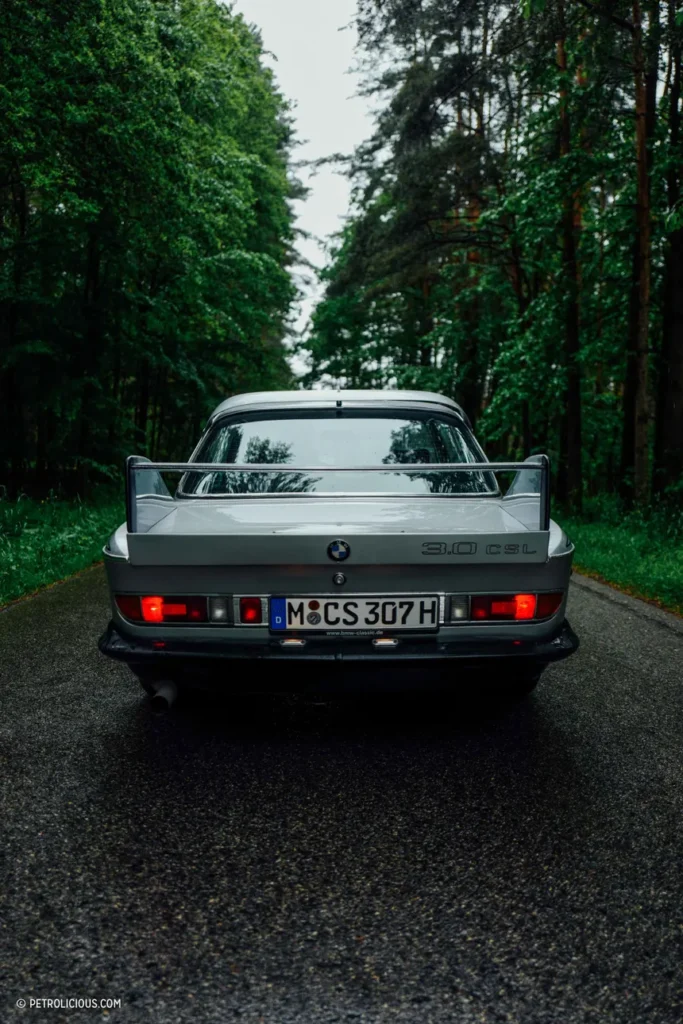
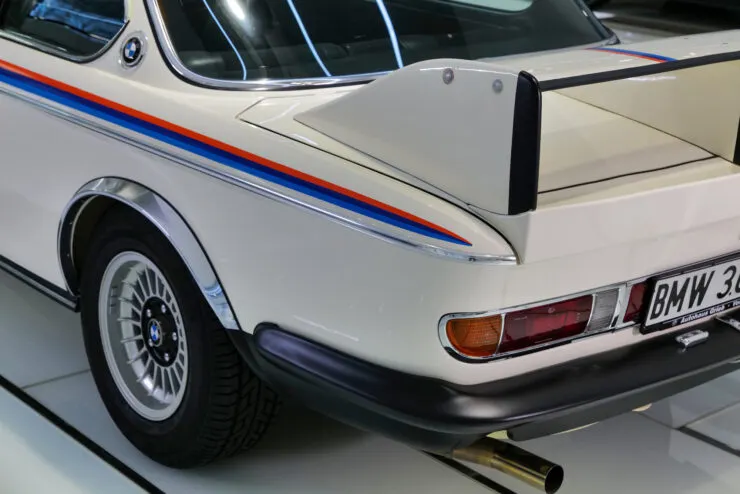
The solution was elegant and absurd in equal measure. BMW removed the rear wing from the production line, disassembled it into its three components — the two vertical mounting struts that bolt to the boot lid and the single horizontal aerofoil blade — and packed the parts inside the boot of the car. The German customer received his Batmobile with the wing present but not fitted. Once off the dealer’s premises, the owner could choose whether to install it. If installed, the car was no longer legal on public roads and had to be driven on private property or on track. If not installed, the car missed the very feature that gave it its name.
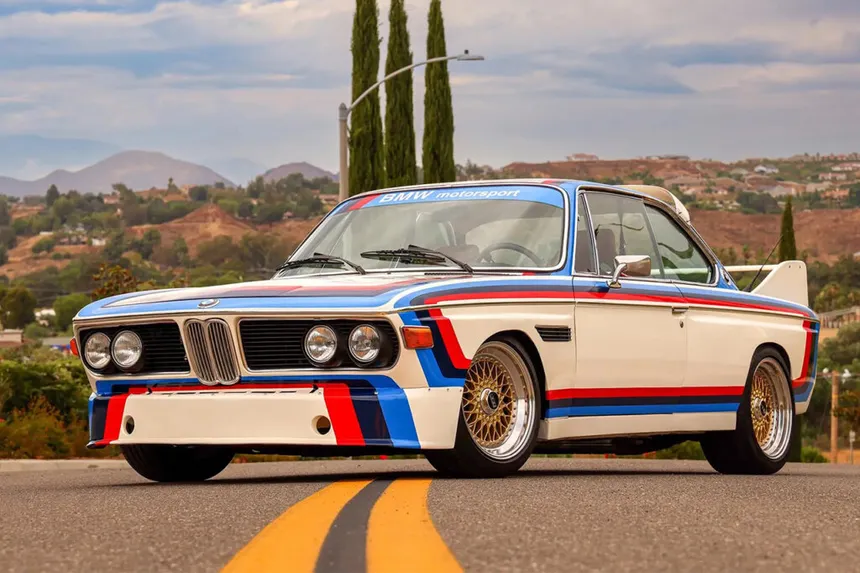
In markets like the United Kingdom or Italy, where regulations didn’t carry the same restriction, the wing was factory-fitted. The British Batmobiles — and they did exist, though all in left-hand drive for reasons we’ll come to — left Karmann’s Rheine plant looking exactly like the car the cultural memory remembers. The German cars left looking like a lightly tuned E9 with the most prominent piece missing.
The boot lid BMW had to remake in steel
There’s a mechanical consequence of all this that virtually nobody covers, and it deserves marking.
The CSL’s standard boot lid, as already noted, was aluminium for weight reasons. When BMW Motorsport began track-testing the car with the wing fitted at high speed, they discovered something predictable: the aluminium couldn’t take the load.
Here’s why, from a workshop perspective. The Batmobile’s rear wing at 250 km/h generates a downforce estimated around 60-80 kilograms split between the two anchor points on the boot lid. That load isn’t static: it cycles with speed, with airflow incidence angle, with road irregularities. The cyclic loading on a thin aluminium panel — the CSL’s aluminium was roughly 1 mm thick, optimised for weight rather than localised load-bearing — produces cumulative structural fatigue. Aluminium in fatigue doesn’t give you warning: it holds, holds, holds, and suddenly cracks. The CSL’s aluminium boot lid was failing in track testing within a very small number of laps with the wing installed.
The fix: BMW Motorsport replaced the aluminium boot lid with a steel boot lid specifically for the Batmobile, and only for the Batmobile. It’s one of very few cases in automotive history where a lighter car ended up heavier in its more aggressive variant precisely because of aerodynamic demands. The steel boot lid weighs about five kilos more than the aluminium one. The Batmobile as a complete car, counting that steel boot and all the aero hardware, ends up a touch heavier than the second-generation CSL without aero. It’s the first documented technical evidence that aerodynamics starts fighting weight reduction beyond a certain performance threshold. A lesson the M Division would learn and relearn for the next fifty years.
What the Batmobile invented visually that’s still alive today
Stand next to a 1973 Batmobile and a 2023 M4 CSL side by side and you’ll see the same design elements engineered around the same principles, separated by exactly fifty years.
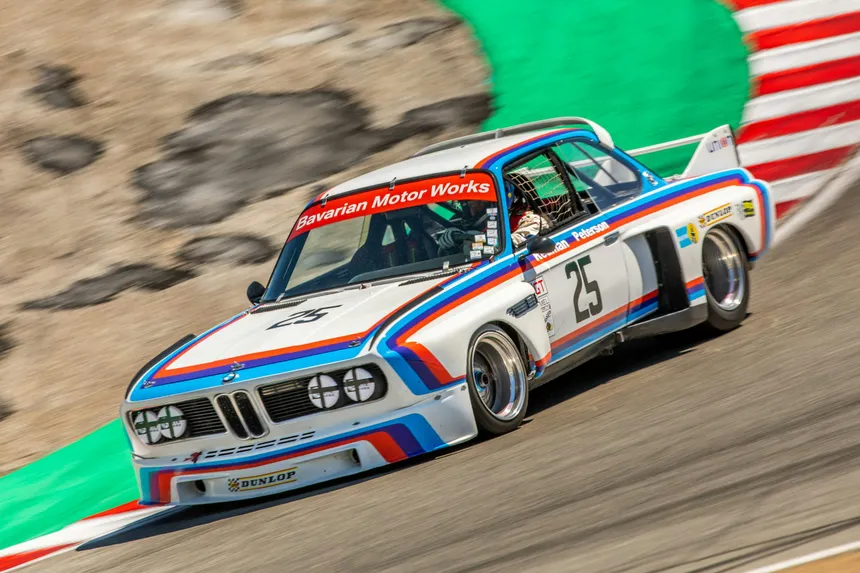
The front air dam below the bumper is the same concept invented in 1973: reduce the volume of air passing under the car, where it does nothing useful, by forcing it over the top or around the sides. The fender fins on the leading edges of the front wings — what BMW marketed as “air rails” — were a CSL original, designed to channel airflow from the nose toward the sides without allowing it to lift over the front wheel and destabilise the front axle. You’ll see those fins on every M car with a serious aero package.
The hoop spoiler at the trailing edge of the roof creates a low-pressure zone immediately above the rear window glass, which keeps airflow attached to the car for a longer distance before separating and creating turbulent wake. The M3 GT, the M4 GTS, the modern M4 CSL — all wear that same component.
And the rear wing is still what it was: an aluminium aerofoil supported by two struts generating downforce on the rear axle. Dimensions have changed, materials have evolved, but the geometry is a direct inheritance of the CSL. When BMW launched in 2022 the 3.0 CSL Hommage on the M4 Competition platform — 540 horsepower, six-speed manual, RWD — what they were publicly acknowledging is that the car that defines the M Division half a century later is still this 1973 coupé with the wing parts in the boot.
The paradox of the car that almost doesn’t exist
Total Batmobile production between July 1973 and October 1975: 167 units. One hundred and ten in the first batch (the one that homologated the aero kit), fifty-seven in the second. All left-hand drive. No factory right-hand-drive Batmobile ever left Karmann. The British buyer who wanted the car had to accept LHD configuration or look elsewhere.
That number is tiny. For perspective: BMW Motorsport built 456 units of the M1 across its production life, and the M1 is already considered a rare car. The Batmobile, at 167 units, is roughly a third. Unlike the M1, Batmobiles are scattered across Europe because they were sold as ordinary expensive road cars in their day — collectors only started chasing them in the late 1980s.
Current market values: roughly £200,000 to £450,000 for clean examples depending on history, originality and documentation. A Batmobile with period race history or unrestored original panels can clear £600,000 at the right auction. For a car that originally cost about 35,000 Deutschmarks new in 1973 — roughly £6,000 at the period exchange rate — the appreciation curve is extraordinary even by classic-BMW standards.
What a competent eye reads off a Batmobile today
Open the boot of an original Batmobile. If the lid is steel, the car was delivered outside Germany with the wing factory-installed. If the lid is aluminium and the wing was in the boot rather than bolted on, it’s almost certainly a German-delivered car that probably never wore the wing on public roads. Those details — apparently minor — drive auction values by six-figure margins.
Look at the rear side windows. Lexan that has yellowed and gathered fine scratches is original equipment. Tempered glass that’s flat and perfect is a restoration choice. Neither is better or worse. Both are information about the car’s history.
Look at the rear bumper. Resin with fine cracking or repaired sections under the paint is original. Steel or modern fibre is a replacement. Batmobiles that retain their original polyester resin rear bumper after fifty years are rare even within the rare-car population already established by the 167-unit production figure.
Look at the engine. If the M30 carries the correct casting numbers for the 3,153 cc Bosch D-Jetronic injected unit, and the injectors still date to 1973, you’re looking at a car that has survived without serious engine rebuilding. Rarer than the catalogue suggests.
Why this car, and not another, founded M Division
There’s a recurring conversation among BMW enthusiasts: which was the first M car? The popular answer is the M1. The better-informed answer is the 3.0 CSL. The technically correct answer, per BMW Motorsport’s own archives, is that the CSL is the first car developed by BMW Motorsport GmbH from its founding in 1972. The M1 came six years later, built in collaboration with Lamborghini for production capacity reasons. The CSL is the new division’s first car, end of story.
And that explains something important. When BMW Motorsport had to choose the first car to wear their stamp, they decided that car had to be a statement of principles. Not a fast saloon. Not a comfortable coupé. A radical car that sat so close to the racing version that German road law refused to register it with all its parts bolted on. That decision — choosing, as the founding car of the new division, one whose own parts were essentially illegal in the brand’s home country — defined the cultural and aesthetic identity of everything that followed.
The M1 was the first car to wear the M badge. The 3.0 CSL is the first car M Division actually built.
That’s why, fifty years later, BMW keeps making CSL homages whenever they want to remind everyone who they are. Because this moment, this car, this 1973 coupé with the wing parts in the boot waiting for the owner to choose between legality and identity — this is where everything began.
Check you’re still alive.