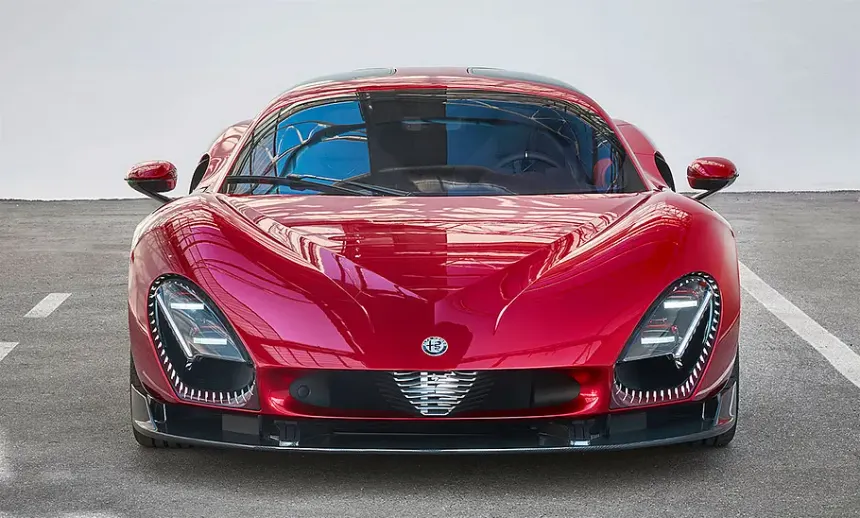
The new Alfa Romeo 33 Stradale: tribute or corporate accounting?
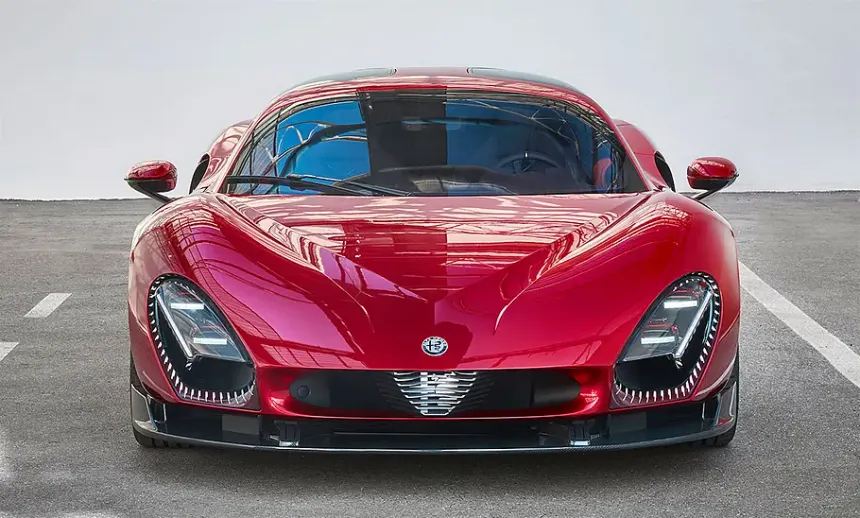
When the new 33 Stradale was unveiled at Monza in September 2023, most of the motoring press did what the motoring press is paid to do: it gushed. Top Gear talked about a return to form. Carscoops called it a stunning flagship. The Goodwood crowd nodded along when one rolled up the hill at the 2024 Festival of Speed. And every review since has carefully sandwiched the criticism between paragraphs of reverence — the criticism that the car shares its underpinnings with a Maserati, that the engine is a Maserati engine, that the development brief is, in essence, an exercise in derivative platform engineering with a coachbuilt body on top.
This article is not interested in being polite about that criticism. The car is good — by every account from the journalists who have actually driven it, the 33 Stradale of 2024 is a fast, capable, well-resolved supercar with genuine handling pedigree thanks to active suspension and rear-wheel steering that the Maserati MC20 doesn’t have. That’s not in dispute. The question, and the only question that matters editorially, is whether this car deserves to carry the name “33 Stradale”. And the answer stings, especially for anyone who loves what Alfa Romeo was once capable of doing.
The project nobody wanted
To understand the new 33 Stradale, you have to understand the corporate plumbing that produced it. At some point during Sergio Marchionne’s tenure as CEO of FCA — that is, before his death in 2018 and before the FCA-PSA merger that created Stellantis — Alfa Romeo had a supercar project in development. Mid-engined, carbon monocoque, range-topping. It was going to be the halo car the brand had been missing since the 8C Competizione of 2007.
That project was never built as an Alfa. As FCA’s finances reshuffled and Maserati’s product portfolio thinned out into nothing but ageing sedans and an SUV, the decision was made to reassign the supercar project to Maserati. It became the MC20, unveiled in 2020. Daniel Guzzafame, Alfa’s head of product, has been refreshingly open about this corporate history: the project started as an Alfa, then a shift was decided at a point in the development. That’s the polite way of saying that Maserati needed a halo car more urgently than Alfa did, and the bean counters approved the transfer.
Fast-forward to June 2022. Jean-Philippe Imparato, now CEO of Alfa Romeo within Stellantis, brings the idea back. He wants a supercar for Alfa, using whatever development work can be salvaged or shared from the MC20 programme that was originally Alfa’s own work. He presents the plan to the Stellantis board. According to Cristiano Fiorio, who runs Alfa Romeo’s global marketing and was involved in the discussions, the board’s response was an almost unanimous chorus of “no”, with one solitary “maybe” from then-CEO Carlos Tavares, who saw it as a chance to demonstrate Stellantis’s ability to execute a low-volume, high-tech, start-up-style project.
The green light came with one condition: find 33 customers willing to buy the car before construction began.
Read that line again. The board approved this car on the condition that it be sold before it existed. This isn’t a company building a car because it has to. This isn’t even a company building a car because it can. This is a company building a car because thirty-three wealthy individuals have already wired the deposit.
What it shares with the MC20
The lower portion of the carbon-fibre monocoque is shared with the Maserati MC20. That’s the structural reality of this car. The eight-speed dual-clutch ZF transaxle is the same. The twin-turbo 3.0-litre Nettuno V6 engine in the combustion variant is the MC20’s, producing a quoted 620 bhp (some sources have measured 630). The fundamental architecture — mid-engine, rear-wheel drive, carbon tub — is the MC20’s blueprint with Alfa-specific tweaks bolted to it.
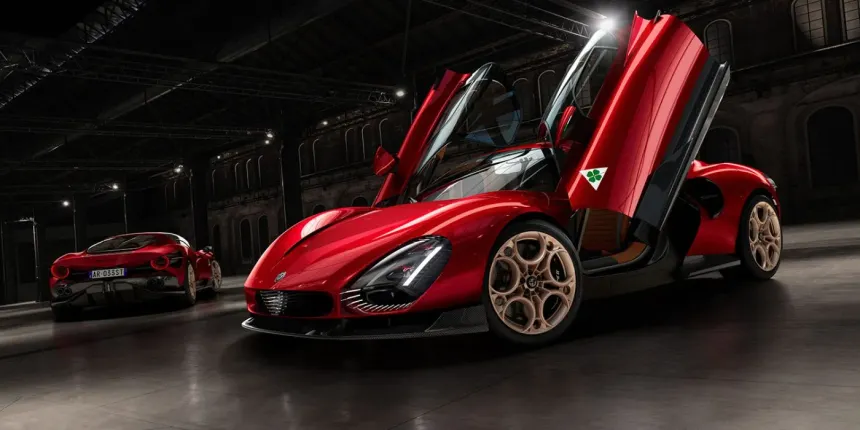
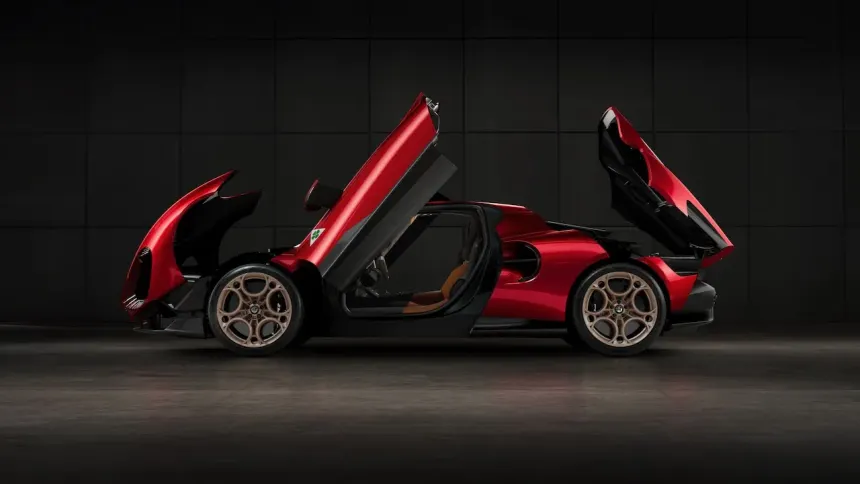
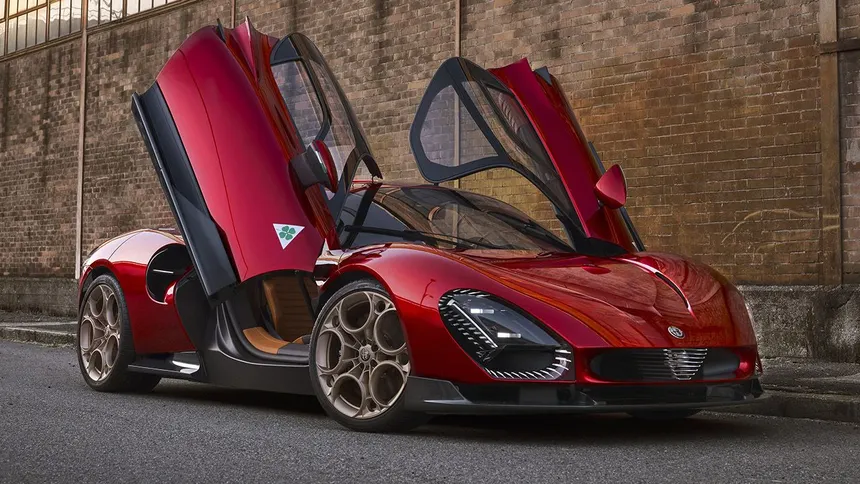
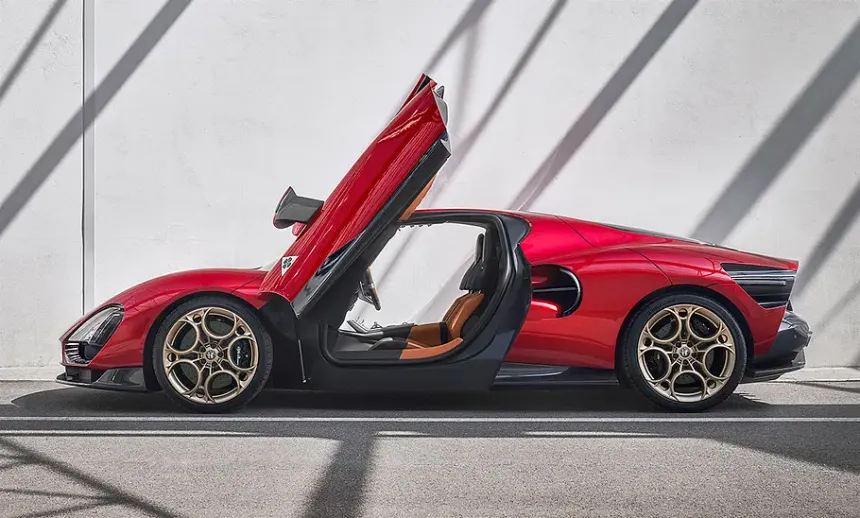
What Alfa Romeo did differently is genuine and worth listing. The front H-frame is aluminium and unique to this car. The double-arm active suspension is Alfa-specific. Rear-wheel steering, not offered on the MC20, is standard on the 33 Stradale. The butterfly doors have a different opening mechanism and different hinge geometry. The body is entirely new, designed by César Barreau at Centro Stile Alfa Romeo under Alejandro Mesonero-Romanos. The kerb weight of the V6 version, around 1,500 kg, is roughly 200 kg lower than the MC20’s. That is meaningful engineering work.
But here’s the thing. None of those changes alter the fundamental DNA of the car. The structural skeleton is shared. The engine is shared. The transmission is shared. The basic dynamic philosophy is shared. This is what platform engineering looks like in 2024 across every major OEM, and it produces capable cars. McLaren does it. Lamborghini does it (the Huracán is a Gallardo evolution sharing bones with the Audi R8). Aston Martin does it. There’s no shame in it. But there is shame in pretending it isn’t happening.
The engine with the convoluted bloodline
The Nettuno V6 deserves its own paragraph because its lineage is genuinely strange. The Nettuno derives from the V6 in the Alfa Romeo Giulia Quadrifoglio. The Giulia Quadrifoglio V6 was, in turn, developed with input from Ferrari engineers when Ferrari was still part of the Fiat group. The leap from Giulia to MC20 was the introduction of a Maserati-developed pre-chamber combustion system, which is the Nettuno’s main technical claim.
Trace the line. A V6 architecture is designed with Ferrari input for a four-door Alfa Romeo sedan. Maserati develops a pre-chamber variant for its supercar. Alfa Romeo then takes that Maserati pre-chamber V6 and puts it back into an Alfa Romeo supercar. It is, mechanically, a coherent piece of engineering. But it is also a motor whose identity has bounced between three of the four brands inside the same corporate group across multiple ownership structures. Whatever this engine is, it isn’t an Alfa Romeo engine the way Carlo Chiti’s 1967 V8 was an Alfa Romeo engine. The 1967 unit was designed by Autodelta specifically for the Tipo 33 racing programme and detuned slightly for the road. It belonged to no one else. It powered no other car. It was built by hand for that purpose alone.
Comparing the two engines isn’t unfair. Alfa Romeo invited the comparison the moment it called this car “33 Stradale”.
The electric problem
The 33 Stradale is offered with an alternative powertrain: a full-electric version using three permanent-magnet synchronous motors (two on the rear axle, with an optional third on the front for all-wheel drive). Quoted output is 750 bhp in WLTP terms. Top speed is around 310 km/h.
Here’s the figure that nobody quotes in the press materials: the BEV version weighs over 2,000 kg. The V6 version weighs about 1,500 kg. That’s a 500 kg difference. Five hundred kilograms. To put that in perspective, that’s the entire dry weight of a Lotus Elise. Take a Lotus Elise, throw it into the back of your supercar, and you’ve gone from “fast hand-built coupé” to “fast hand-built coupé with a small sports car in the boot, permanently”.
You can spin this however you want, and Alfa Romeo has done some genuine spinning. The BEV variant is described as an exploration of the electric supercar idea, a hedge against the future, a piece of brand positioning. Fine. But when the 1967 33 Stradale weighed 700 kg in total — less than a third of the BEV’s mass — and the entire ethos of that car was lightness as a design value, building an electric version that weighs nearly three times what the original did and still calling it “33 Stradale” is the kind of decision that doesn’t pass a sniff test if you care about what the name means.
Touring Superleggera and the coachbuilt myth
Production was contracted to Carrozzeria Touring Superleggera, the historic Milanese coachbuilder. This is the genuinely commendable part of the project. Each of the 33 cars is hand-assembled at Touring’s facility, with significant customer input into the trim, colour, and detail specification. There are two main configuration paths, called Tributo (the more classically styled approach) and Alfa Corse (with track-oriented details). Each car carries a numbered plaque inspired by the 1960s original, mounted near the central tunnel.
The drag coefficient is 0.375, achieved without fixed wings or active aero — a real design accomplishment. Valtteri Bottas was involved in dynamic development at Alfa’s Balocco test track. Strada and Pista driving modes manage the suspension, throttle response, and exhaust valves. Reviewers who have driven it — Evo’s Adam Towler in particular — describe the car as cohesive, accomplished, and genuinely satisfying to drive. The combustion variant, light and balanced, has been described as one of the most engaging mid-engined cars of its generation.
None of this is fake. The craftsmanship is real. The engineering work is real. The performance is real.
The framing, however, is exhausting.
The “fuoriserie” pitch
Alfa Romeo describes the 33 Stradale as a “fuoriserie” — a custom-built, beyond-series production model — and points to the historical precedent of early-20th-century Italian coachbuilders working with major manufacturers. The comparison is meant to connect the new car to the long Italian tradition of one-offs and short-run bespoke creations. It’s an effective marketing frame.
It’s also, on close inspection, a bit of a stretch. When Alfa Romeo and Pinin Farina, or Touring, or Zagato collaborated in the 1930s and 1950s, the result was a coachbuilt body on a chassis Alfa had designed itself, often unique to that car or that small run. The new 33 Stradale is a coachbuilt body on a chassis that Alfa Romeo developed jointly with Maserati and that another car already uses as its primary production model. The body is bespoke. The structure beneath it is not.
This is not a coachbuilt car in the historical sense. It is a series-production supercar architecture with a hand-finished body and bespoke customer touches. The vocabulary matters. Pininfarina’s Battista is a coachbuilt EV. The Ferrari SP-series One-Offs are coachbuilt. The 33 Stradale is something in between — closer to a special-edition McLaren than to a true bespoke commission.
What it gets right
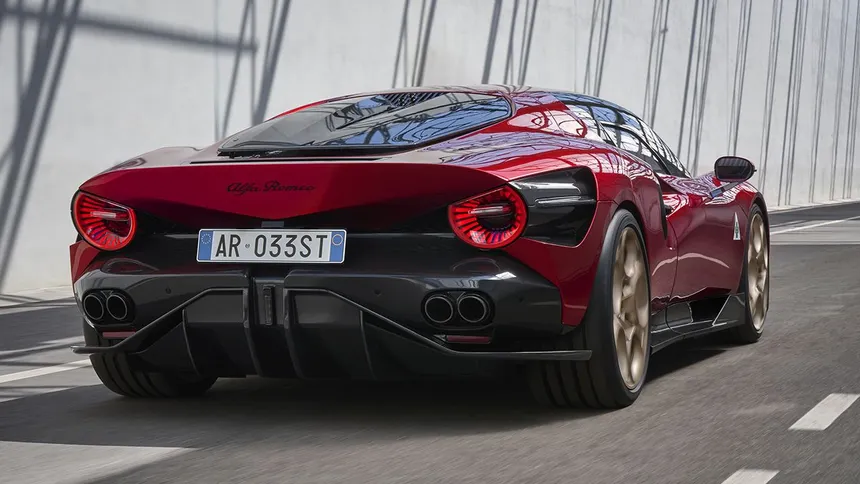
The new 33 Stradale exists. That’s worth acknowledging. Inside a Stellantis group with fourteen brands and limited appetite for low-volume luxury, getting a carbon-tubbed supercar to production line at all is a corporate achievement. The car is genuinely good to drive. The active suspension and rear-steer work as advertised. The shape, designed by César Barreau, has presence — particularly in the rear three-quarter, where the haunches and the slim taillights manage to evoke the 1967 car without resorting to obvious pastiche. The Tributo specification, in particular, looks coherent and grown-up rather than nostalgic.
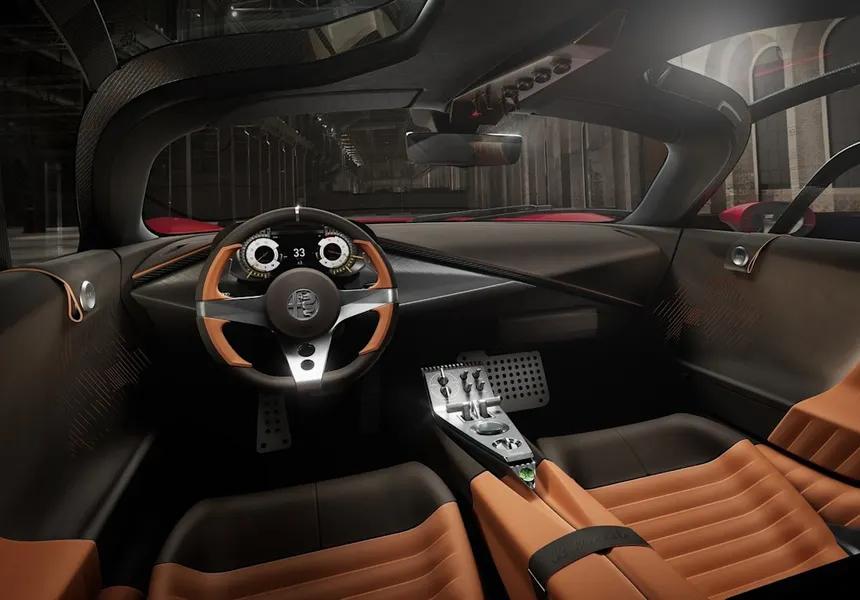
The use of Touring Superleggera as the assembler connects to real Italian heritage. Bottas’s involvement at Balocco isn’t a publicity stunt — he actually drove development laps. The cabin, deliberately analogue-feeling in its main controls, is a refreshing contrast to the touchscreen-driven dashboards proliferating elsewhere in the segment.
For the 33 customers paying somewhere around 1.7 million euros pre-tax, the car will likely deliver everything they expected. It will appreciate. It will be invited to concours events. It will be driven sparingly and admired often. The transaction makes sense.
The argument
The argument is not that the new 33 Stradale is a bad car. The argument is that calling it “33 Stradale” was a mistake that the marketing department made and the engineering department had to live with.
Because the moment you put that name on the badge, you’re inviting a comparison the car cannot win. Not because it’s slower — it’s faster than the original ever was — but because the two cars come from incompatible philosophies. The 1967 Stradale was a refusal to compromise, executed by people who didn’t have to ask permission. The 2024 Stradale is a derivative platform exercise approved by a board on the condition that the customers were lined up first. One was a manifesto. The other is a business plan. Both can produce good cars. Only one of them produces 33 Stradales.
Imagine if Alfa Romeo had called this car something else. Alfa Romeo 8C 2024. Alfa Romeo Carrera. Anything that didn’t drag the ghost of 1967 into the conversation. The reviews would have been about whether the new Alfa supercar lives up to the brand’s recent ambitions, and the answer would have been a clear yes. Instead, the reviews have to navigate the comparison with the most beautiful car ever made, and the car ends up smaller than it should.
That’s the cost of carrying a name that comes with that much historical baggage. The 33 Stradale of 2024 is a competent, modern, hand-finished hypercar with a Maserati core and an Alfa Romeo skin. There’s nothing wrong with that. There is something wrong with pretending it’s something else.
Look at the photos slowly. Read the spec sheet carefully. Look at photos of the 1967 car next to it. Then check you’re still alive.
2 thoughts on “Alfa Romeo 33 Stradale 2023”