
Rat Style & Sleeper Cars: The Art of Deception
Not Enough Cylinders — Unfiltered Automotive Opinion
We live in an era where everything has to shine. Polished lips, ceramic coatings, wraps in impossible colors. Every modified car seems to be competing for the same prize: a desperate cry for attention.
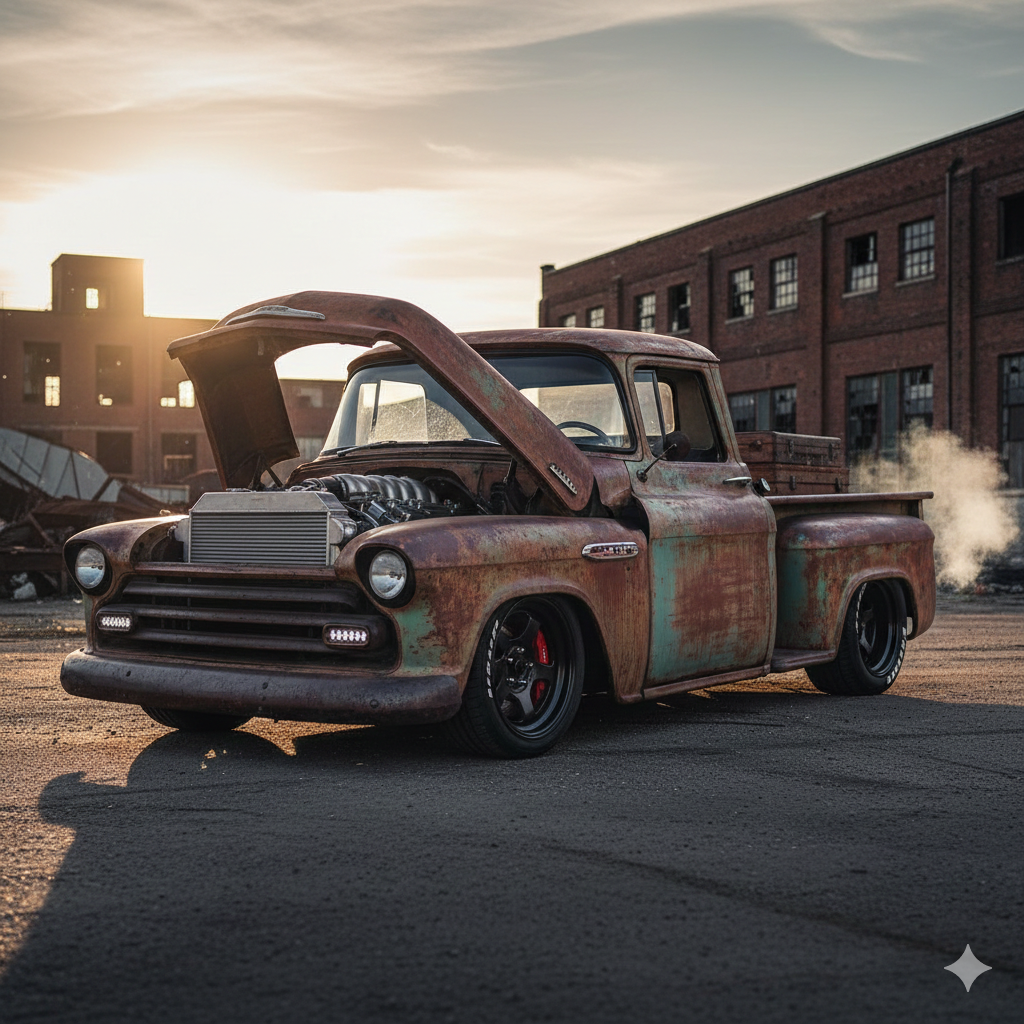
And then there’s the other side. The guys who pull up to the stoplight in a rig that looks like it was dragged out of a junkyard—real rust on the body, peeling clear coat, and an interior that smells like gasoline and stories. They look at you. They smile. And when the light hits green, they leave you gapped on the asphalt while their exhaust sounds like the literal Apocalypse.
Welcome to the world of Rat Style and Sleeper Cars. Two philosophies sharing one uncomfortable truth: appearances are deceiving. And in the car world, that’s a declaration of war.
What is Rat Style: Beauty in Imperfection

Rat Style—also known as Rat Look or Rat Rod—is a visual and philosophical movement that rejects cosmetic perfection. Its roots trace back to the American hot rods of the ’40s and ’50s, when working-class kids couldn’t afford a candy-apple paint job but damn sure knew how to make an engine fly.
The idea was simple: put your money where it counts. Engine, suspension, brakes. The bodywork could wait. Or better yet, it could stay exactly as it was: with its rust, its dents, and its decades of patina. Over time, what started as a necessity became an aesthetic. And that aesthetic became a lifestyle.
In Europe, the movement found fertile ground in the Volkswagen scene of the ’80s and ’90s. Beetles, T1/T2 Transporters, and later Golfs and Passats became the perfect canvases. But make no mistake, the heart of this movement is pure Americana.
The Rules of Rat Style (Because there are almost no rules):
- Patina is Sacred: No repaints. You stabilize the rust; you don’t remove it.
- Scars Tell Stories: Every mark, every dent, every layer of peeling paint represents a past.
- Mechanical Priority: Beneath that “abandoned” look, the car must run. Preferably, it must run like a bat out of hell.
- Originality Over Everything: No two Rat Rods are the same. Each car is a raw expression of its owner.
Sleeper Cars: Wolves in Sheep’s Clothing
If Rat Style is a visual statement, the Sleeper Car is a mechanical ambush.
A Sleeper—literally a car that is “sleeping”—is a vehicle that looks completely stock, bland, or even boring on the outside. It’s the kind of car you wouldn’t look at twice in a grocery store parking lot. But under the hood, it hides a modified monster capable of humiliating supercars that cost five times as much.
The Sleeper tradition has deep roots. In the ’60s, Detroit was already playing this game. Models like the Chevrolet Biscayne or the Plymouth Belvedere offered the option to swap massive big-blocks into plain-jane, four-door family bodies. From the outside, it was a librarian’s car. From the inside, it was a quarter-mile king.
The Legends of the Sleeper World:
- Volvo 240 with a Turbo 2JZ: The ultimate “brick.” Sweden’s most boring car paired with Japan’s most legendary engine. There are documented builds pushing over 800 HP.
- Volkswagen Phaeton W12: A factory sleeper. It looked like a bloated Passat but hid a 450 HP W12 engine. Ferdinand Piëch knew exactly what he was doing.
- BMW E30 with an S54 Swap: Visually an ’80s 325i. Mechanically, an E46 M3 on steroids.
- Audi RS2 Avant: A ’90s family wagon that, thanks to Porsche, packed a five-cylinder turbo capable of shaming Ferraris of its time up to 100 mph.
- GMC Syclone: Looks like a basic black Sonoma pickup. In reality, it was faster to 60 mph than a Ferrari 348.
Where Rat Style and Sleepers Collide
This is where the magic happens. When you combine the Rat aesthetic with Sleeper mechanics, you create something beyond a modified car. You create an experience.
Imagine a Mk2 Golf with faded matte paint, rusted steelies, and pitted chrome bumpers. It looks like it sat in a barn for twenty years. You pop the hood and find a 1.8T from an Audi S3, big turbo, Motec management, pushing 400 HP to the front wheels. That is a Rat Sleeper.
It’s not just a car. It’s a middle finger to the status quo. It says: “I don’t need your approval. I don’t need your attention. But if you want to find out, start yours up.”
There is something deeply honest about this. In a world where tuning has often become an Instagram beauty pageant—who has the flashiest wrap, the most expensive wheels, the most aggressive body kit—the Rat Sleeper reminds us of a fundamental truth: a car is defined by what it does, not what it looks like.
Why It Matters
Rat Style and the Sleeper philosophy represent a rebellion against superficiality. In a world obsessed with appearances and projecting a “perfect” image, these cars say the opposite.
They say that substance matters more than form. That the history of a car is worth more than its shine. That speed doesn’t need an advertising budget. That what you carry under the hood defines you more than what you wear on top.
And honestly, shouldn’t we apply that to life?
The next time you see a rusty bucket at a stoplight, think twice before you laugh. That rust might be hiding more horses than you can handle. And the owner is probably smiling because they know something you don’t.
Do you know of a brutal Rat Sleeper? Got a secret project in your garage? Tell me about it in the comments. At Not Enough Cylinders, the best stories always come with grease under the fingernails.
— Not Enough Cylinders