A War Ace Designed It. He Made It of Plastic. It Ran 20 Years.
Citroën Méhari: how a Normandie-Niemen fighter pilot, a shampoo sachet and the presidency of Citroën put one of the first thermoformed-ABS-bodied production cars on the road
Deauville, 16 May 1968. Golf course. France is on fire. Paris is shut down. Students on general strike, factory workers paralysed, gendarmes swinging truncheons. And in the middle of that historic mess, Citroën has decided to launch a brand-new vehicle in the middle of a Normandy golf course.
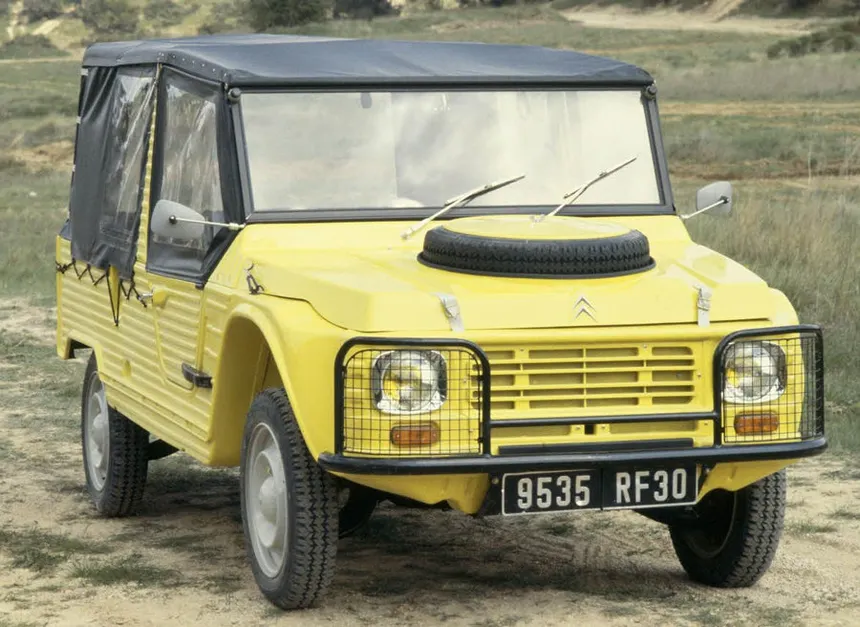
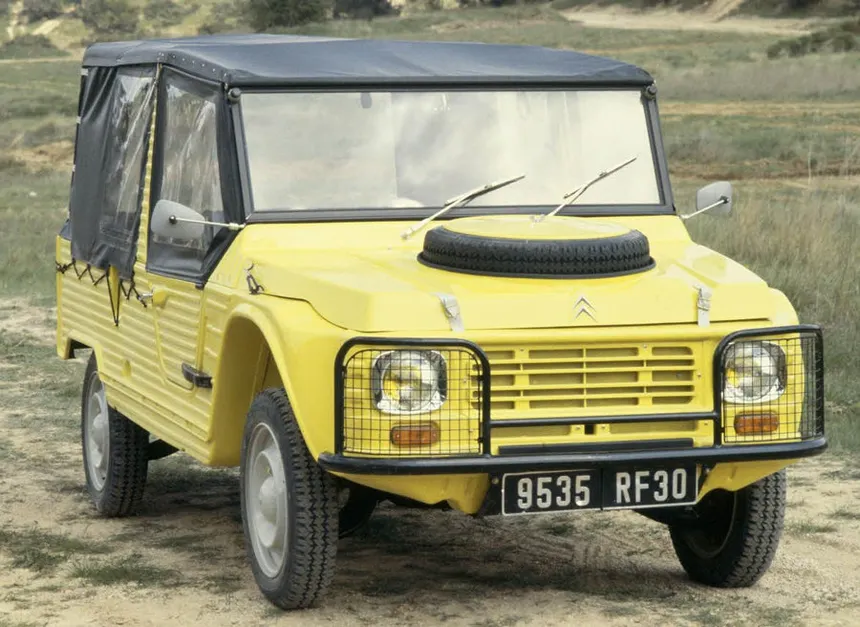
The car is a yellow plastic box with no doors, no roof, four wheels, and the appearance of something a Japanese toy company would have rejected for being too simple. It’s called the Dyane 6 Méhari. The press, busy covering the social inferno engulfing the country, gives it minimal attention. The launch is a media disaster.
Twenty years later, that little plastic car will have sold 144,953 units. The French Army will have bought over 7,000 of them. It will have crossed the Paris-Dakar Rally as a medical assistance vehicle. And it will have become one of the most instantly recognisable visual icons of late-20th-century Mediterranean culture.
Behind the car there is a fighter pilot. Behind the fighter pilot, a shampoo sachet. And behind it all, a technical idea the auto industry would take forty years to copy properly.
Count Roland Paulze d’Ivoy de la Poype
To understand the Méhari, you first have to understand the man who dreamed it up. And he is unlike anyone else in European automotive history.
Roland Paulze d’Ivoy de la Poype was born on 28 July 1920 at Les Pradeaux, in Puy-de-Dôme. Aristocratic family. His father was a reserve colonel and agricultural engineer. When World War II broke out, Roland was nineteen years old and a cadet at the École Principale d’Aviation in Étampes. In May 1940, the Germans rolled across France. His father was killed at the front. Roland, with a group of fellow cadets, heard Charles de Gaulle’s BBC broadcast of 18 June calling on Free French to keep fighting. They made their way to Saint-Jean-de-Luz, boarded a ship to England, and reported to the Royal Air Force.
He flew Spitfires with No. 602 Squadron, where the Irish ace Paddy Finucane picked him as wingman. When the Free French fighter group “Normandie” was formed to fight alongside the Soviets on the Eastern Front, De la Poype volunteered. He flew Yak-1s, then Yak-9s, and finally the Yak-3 that Stalin would gift to the regiment at the end of the war.
He finished the war with sixteen confirmed aerial victories. He was a Compagnon de la Libération (Free France’s highest honour, awarded by De Gaulle to just 1,038 people in total) and a Hero of the Soviet Union, one of only four French people to receive that medal. He was 25 years old.
Here’s where the story turns interesting. De la Poype, instead of staying in the military and making a career of it, left the air force in 1947 and walked into the plastics industry. In 1952 he founded SEAB (Société d’Études et d’Applications des Plastiques) in Bezons. That same year, he sold L’Oréal an invention of his own design: the DOP berlingot, the first single-use pyramid-shaped shampoo sachet in industrial history. That little transparent thing your grandmother used to buy in bags of six or twelve.
The fighter ace, the aristocrat, the man Stalin and De Gaulle had both decorated, had decided his second act would be reinventing how plastic gets shaped.
The Méhari concept: a car you can hose down
By the mid-sixties, De la Poype was watching the European market and spotted something interesting. The Mini Moke, presented by Issigonis in 1964 as a military vehicle and rejected by the British Army, had found a second life among hippies, surfers and Côte d’Azur hoteliers. A doorless convertible, Mini mechanicals, steel bodywork, ridiculously cheap. Issigonis had accidentally invented Mediterranean motorised leisure.
De la Poype thought the Moke had one fundamental problem: it was steel. And steel by the sea rusts. If, instead of steel, you used thermoformed ABS plastic, you’d have a car that would never rust. That weighed less. That could be hosed down. That could be coloured in the mass so it wouldn’t need painting. And, above all, that could be built using machinery far cheaper than the steel stamping presses everyone else needed.
The original plan was to sell the car as a DIY self-assembly kit called “Donkey”. But De la Poype, a man with connections, preferred to go straight to the manufacturer that was already buying plastic from SEAB for other applications: Citroën. He arranged a meeting with Pierre Bercot, president of Citroën from 1958 to 1970. Showed him the prototype. Bercot, against all expectations, came back with something better than a kit deal: integrate the car into the official Citroën catalogue.
In early 1968, SEAB was commissioned to build twelve pre-production units. Citroën supplied the chassis (2CV Fourgonnette platforms for the first prototypes), and SEAB moulded the ABS bodywork. Eight of those twelve units were the cars unveiled at Deauville on that fateful May day. The full production version would use the Dyane 6 chassis, not the 2CV Fourgonnette directly, though the Dyane is itself a 2CV derivative. That’s why the launch nameplate read “Dyane 6 Méhari”: because it shared its platform with the Dyane, not with the pure 2CV.
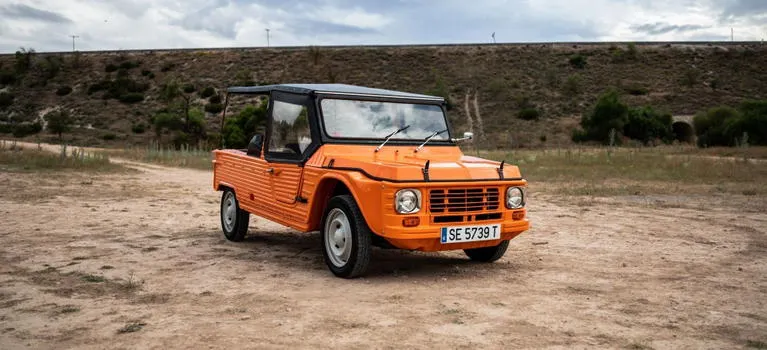
The engineering: what makes the Méhari unique
This is the technical core that other Méhari articles either skim past or describe wrongly.
Bodywork: the Méhari is one of the first series-production passenger cars in history with an entirely thermoformed ABS plastic body. The claim needs a footnote, because there’s an earlier car often miscited in the same breath: the East German Trabant, built from 1957 with a body made of Duroplast. But it isn’t the same concept. Duroplast is a thermoset — phenol-formaldehyde resin reinforced with recycled cotton fibres, compression-moulded in heavy presses, essentially reinforced Bakelite. The Méhari’s ABS is a true thermoplastic, meltable and reformable by heat, thermoformed over a mould at moderate temperature. Materially and process-wise they’re different worlds. If the question is “first mass-produced car with a plastic body”, the Trabant wins. If the question is “first series-production car with a thermoformed thermoplastic body”, the Méhari is the reasonable answer (Citroën officially describes it as “a bold innovation in car bodies at the time”, carefully avoiding any claim to absolute world primacy — and we’ll follow their lead here).
ABS stands for acrylonitrile butadiene styrene, a thermoplastic combining the hardness of styrene, the elasticity of butadiene, and the chemical resistance of acrylonitrile. The same material used today in Lego bricks, appliance casings, and 3D-printer panels.
The Méhari body is made of eleven ABS panels bolted to a welded tubular subframe, which is itself fixed to the Dyane 6 platform chassis. The distinction with fibreglass is important. Fibreglass (used in cars like the Lotus Elite and the Chevrolet Corvette since the fifties) is an artisanal composite: layered fibre soaked in resin, hand-cured, hand-finished. Slow, expensive, not really scalable. Thermoformed ABS, by contrast, is true industrial production: a flat plastic sheet is heated to plasticity, formed over a mould under pressure or vacuum, cooled, trimmed, and drilled. Fast, repeatable, cheap.
Why did the auto industry take forty years to repeat the idea? Because until the Smart of the late nineties (plastic panels over a steel Tridion cell), Saturn at General Motors (thermoplastic panels over a steel space frame), or the Renault Espace I (reinforced polyester over a Matra tubular structure), nobody else built a series-production car with an integrated plastic body. The Méhari got there, apparently without effort, in 1968.
Dyed in the mass: Méhari panels are not painted. They are coloured during the plastic’s own manufacture, before thermoforming. In French this is called teinté dans la masse. The practical consequence: when you scrape or dent a panel, you don’t see metal underneath (because there isn’t any), you see the same colour as the panel itself. Scratches don’t show, or polish out with solvent and a rag. It’s the dream of a car designed for real-world use.
Colour palette: the launch model offered 8 shades, each intended for a specific application. Atacama yellow for leisure use, khaki green for military/forestry use, Hopi red, beige, orange, white. Buyers chose colours by function, not by fashion. The Méhari was the tool-car taken to its most literal form.
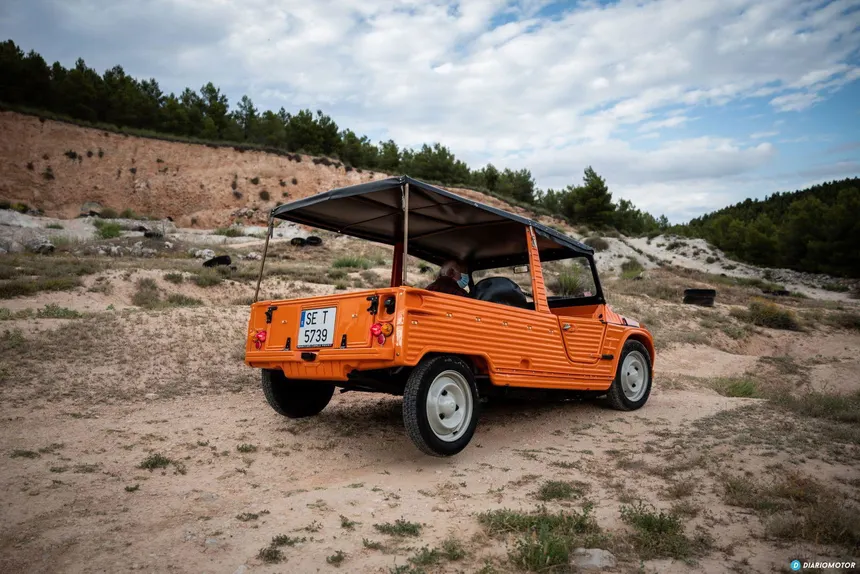
Weight: 535 kg in running order. For a vehicle 3.52 m long and 1.53 m wide, with four real seats and enough capacity for 400 kg of payload, that’s the weight of a motorised bicycle with a body. The reason is obvious: no structural steel, no paintwork, no upholstery, no real windows (the “windows” are clear plastic curtains that roll up), no carpets, no trim. What doesn’t exist doesn’t weigh anything.
Mechanicals: no surprises here, because Citroën applied its usual industrial cannibalism. 602 cc flat-twin engine from the Ami 6, initially 26 hp, later 29 hp at 5,750 rpm. Four-speed manual gearbox. Front-wheel drive. Fully independent suspension with coil springs and telescopic dampers, inherited from the A-Series family (2CV/Dyane). Drum brakes on all four wheels. Top speed: around 100 km/h downhill with a tailwind.
Cabin: four PVC bench seats, no regulatory seat belts at launch (mandated by European regulation from 1972), plastic steering wheel, flat dash with little more than a speedometer, flat windscreen that folds forward for “full air” driving (with the motorcycling goggles Citroën sold as an official accessory). The doors are zip-up canvas panels. The roof is a folding fabric top. The whole point is: what doesn’t exist can’t break.
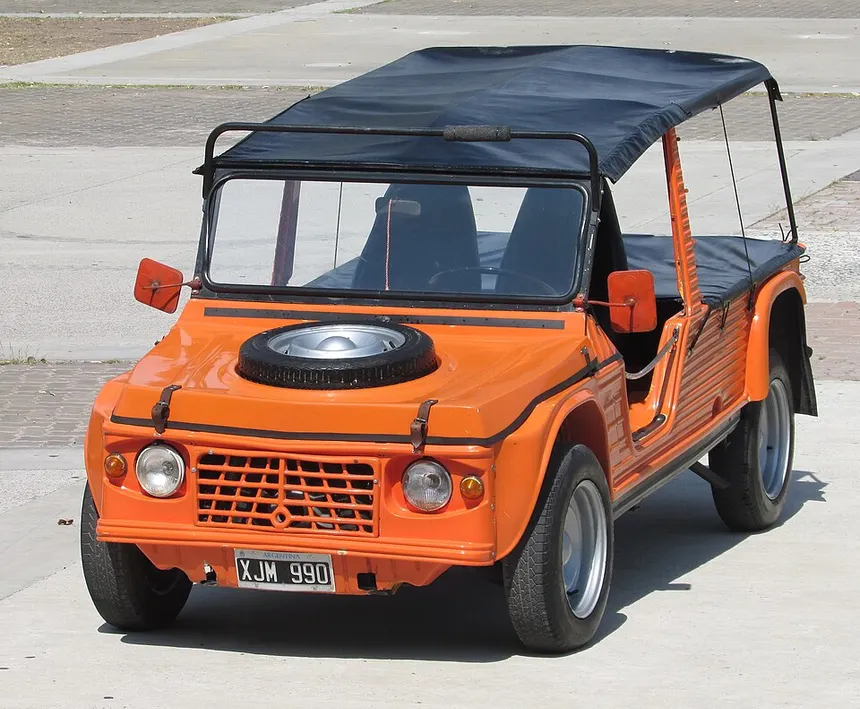
Real-world applications: from hippies to gendarmes
This is where the Méhari’s story turns genuinely odd for a car originally conceived as a summer toy.
Civilian market: the Côte d’Azur, the Balearics, the Greek islands, the Costa del Sol, Sardinia, Corsica. Hoteliers buying fleets to rent to guests who wanted to head to the beach without rusting a Citroën Pallas. Families using them as weekend second cars. European dealers shifting them right through the late eighties in southern markets.
French police and gendarmerie: adopted in special versions for rural and coastal patrolling. Cheap vehicle, indestructible, easy to repair in any village garage, ideal for chasing smugglers down tracks where a steel-bodied car would have got stuck or rusted within a season.
Civil protection, forest firefighters, rural ambulances: the Méhari slotted into every niche where a light, weatherproof-but-not-dustproof vehicle was more useful than a Jeep Willys or a Land Rover Series. Airfields, fairgrounds, racecourses, golf-course maintenance teams. The Méhari solved the “closed-circuit utility vehicle” problem better than anything more sophisticated, because it needed no serious paperwork, consumed almost nothing, and required no specialist mechanic.
Paris-Dakar 1980: ten Méhari 4×4s accompanied the rally as medical assistance vehicles. They covered thousands of kilometres across Algeria, Niger, Mali and Senegal, over sand, rock and mud. Some finished, some didn’t. But the data point is striking: a plastic car, originally conceived so a French notary’s wife could drive to the Antibes market, was crossing the Sahara as medical support on a 10,000-kilometre raid.
The Méhari 4×4: military variant and rally support
In 1979, Citroën launched the Méhari 4×4. And there’s a fascinating conceptual difference here compared with the 2CV Sahara we covered in the previous article.
The 2CV Sahara, remember, solved the 4×4 problem by bolting a second engine in the boot. The Méhari 4×4 went the conventional route: a single front-mounted engine (the same 602 cc flat-twin), but coupled to a four-speed synchromesh gearbox plus a three-speed transfer box, with a propshaft to the rear axle and a lockable rear differential. Claimed gradient capability: 60 per cent.
Méhari 4×4 production ran from 1979 to 1983. 1,213 total units (figures vary between 1,213 and 1,313 depending on source; the Conservatoire Citroën and Stellantis numbers give 1,213). A tiny output compared to the front-drive Méhari (around 143,000 of the civilian version). But enough to interest the French military.
The French Army eventually bought 7,064 Méharis between 1972 and 1987, according to official records (some sources push the figure above 11,000 if you include 24 V variants for radio communications). It’s a staggering number for a plastic car from the late sixties. They were used for base patrolling, light transport, reconnaissance, and even paratrooper deployment — yes, they could be air-dropped from transport aircraft.
A derivative military project, the Citroën A 4×4, used a steel-bodied version of the reinforced Méhari 4×4 mechanicals. The French Army considered an order of 5,000 units in 1981, but the project never reached production at that scale.
The 1977 facelift and the final years
In 1977, for the 1978 model year, the Méhari received its only major facelift: revised grille, simplified front fascia, lightly retouched nose. Otherwise, the car ran twenty years of production with no structural changes. The Boulanger philosophy applied by another hand: don’t touch what works.
Production was concentrated mainly at the Belgian Citroën plant at Forest (Brussels), but also at auxiliary Citroën plants in France (Levallois, Rennes-La Janais), Spain (Vigo), Portugal (Mangualde), Argentina, Uruguay and the former Yugoslavia. The Méhari is one of the most internationally produced Citroëns in the brand’s history.
Production ended in 1987 in Europe, with the very last unit leaving the line in 1988 according to some sources. By then, the cumulative total stood at 144,953 units. Not bad for a car that, on the day of its unveiling, nobody looked at because France was busy burning cars in the streets.
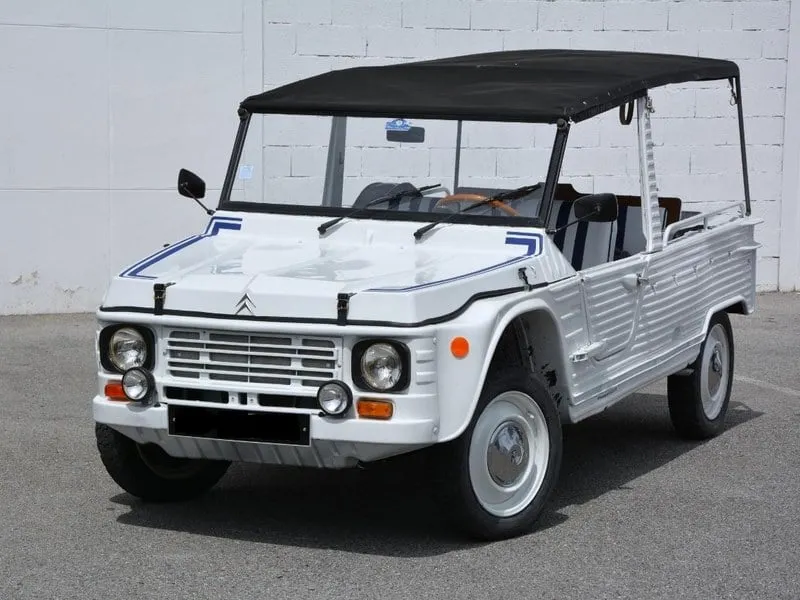
Why the Méhari still matters
A plastic car from 1968 could look like a footnote. It isn’t.
The Méhari proved three technical things the auto industry took decades to accept.
First, that a fully plastic body is industrially viable for series production, provided you accept the rigidity comes from the chassis and not the outer panel. That idea now lives in every Smart ForTwo, every nineties Saturn, every original Renault Espace. But the Méhari got there first.
Second, that light weight doesn’t require exotic materials. The Méhari weighed 535 kg using a cheap industrial thermoplastic, not carbon fibre or aerospace aluminium. What weighs little is what isn’t there. That lesson is the same one Colin Chapman was teaching at Lotus, but applied to a utility vehicle rather than a sports car.
Third, that a car can be designed around a material rather than around a market. De la Poype didn’t sit down to think “what car is Citroën missing?” He sat down to think “what can I do with thermoformed ABS that’s never been done?” The answer sold 144,953 times.
And it proved one philosophical thing: the line between leisure and real utility is far thinner than the auto industry likes to admit. The same car that drove a woman in a sun hat to Saint-Tropez beach also chased smugglers through Corsican pine forests, carried medics across the Sahara, and patrolled a French air base in Djibouti. When the design is honest enough, the end uses appear on their own.
The Méhari is the only time in automotive history that a Second World War fighter ace, decorated by both Stalin and De Gaulle, invented a car in his spare time. And it wasn’t a Bugatti or a supercar. It was a yellow plastic box you could hose down. That’s the difference between a fighter pilot and a marketing director.
Check you’re still alive.