Giuseppe Merosi: The Engineer Who Drew Alfa Before Jano, and Whom Nobody Mentions
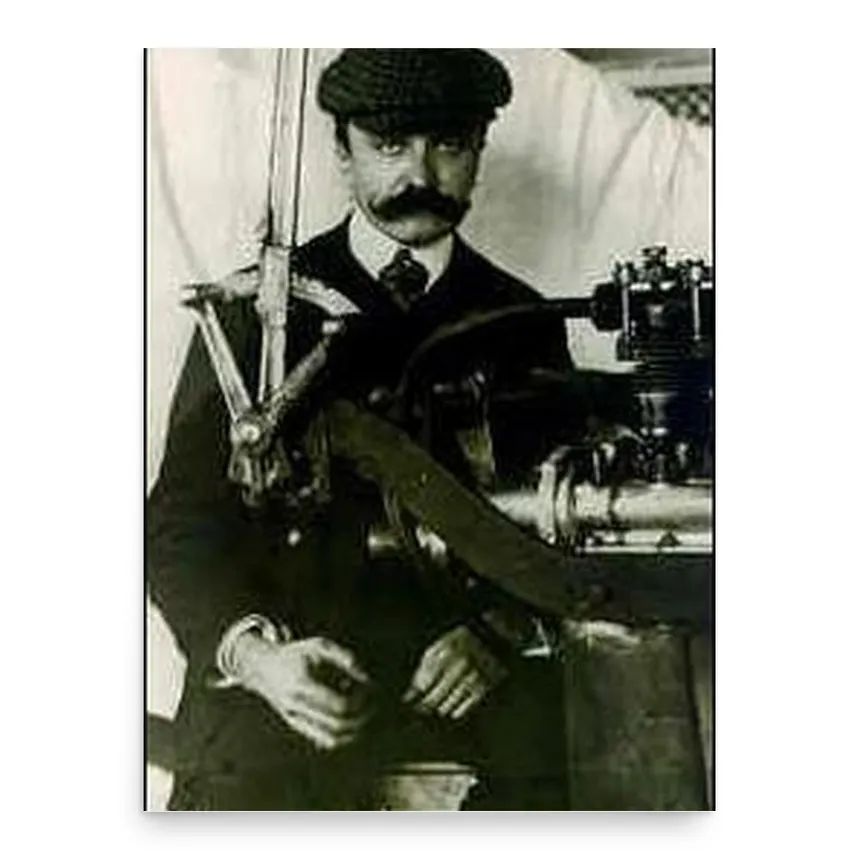
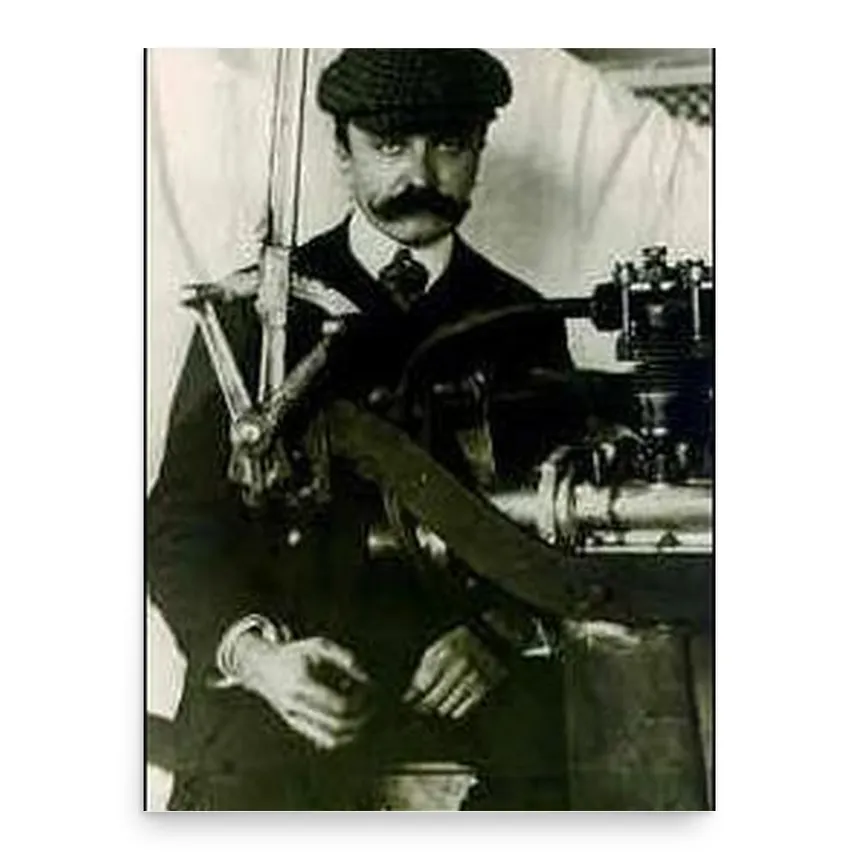
Ask any motoring enthusiast for the key engineer in Alfa Romeo’s history and they’ll say Vittorio Jano. Press them for the next generation and you’ll get Orazio Satta Puliga or Giuseppe Busso. Press harder, you might get Carlo Chiti of Autodelta. What almost nobody will say is Giuseppe Merosi. And that is an injustice the size of a Lombard cathedral.
Before Jano arrived at Portello in September 1923, the marque had already lived through thirteen years of Merosi. Thirteen years of a quantity surveyor from Piacenza who, on his own, designed the first car that wore the A.L.F.A. badge, the engine that the Italian Army picked as its officers’ transport in the First World War, and — this is the bit nobody puts in the heritage brochures — the first DOHC, sixteen-valve, twin-spark four-cylinder racing engine ever built in Europe. In 1914. Before Bugatti tried it. Before Mercedes tried it. Before any name you’d recognise tried it. By a man who never held a proper engineering degree.
Merosi should be on the engraved wall of any serious motoring hall of fame. He isn’t. He died in his hometown of Piacenza in March 1956, aged eighty-four, with no significant tribute from the marque to which he had given the best decade of his career. This is the story of what he designed, what he signed off, and why some careers don’t get the cultural reward they have earned. The engineers history remembers and the engineers history forgets aren’t separated by talent. They’re separated by the timing of their best work.
Piacenza, December 1872
Giuseppe Merosi was born on 8 December 1872 in Piacenza, a minor Lombard city around 70 kilometres south-east of Milan, in an Italy that had been unified for barely a decade. Working-class family. Practical education. He studied at the local technical institute and qualified as a perito edilizio — in British terms, closest to a building surveyor or master technician of construction. Not a degree-holding engineer in the academic sense. A practical technician who had learned how to calculate loads, dimension materials, and solve problems with what was actually available rather than what was theoretically optimal.
That training is the foundation of everything that followed. When Merosi later designed cars, he designed them with the head of a man who knew what happens to a beam under load, what happens to a weld under vibration, what happens to a casting when it gets hot for the hundredth time. He was not the academic engineer drawing the perfect motor on paper. He was the man on site drawing the motor that would survive an Italian provincial road in February.
After military service Merosi went into the booming bicycle business — which in the 1890s in northern Italy was something like the software business in 1990s California. He founded his own firm in Piacenza, Ing. Bassi & Merosi, then joined Orio & Marchand, a Franco-Piacentine bicycle and motorcycle maker that was retooling itself to build cars. He worked there from 1899 to 1904 and learned in earnest how to design light frames and compact engines.
In 1904 he made the move that legitimised him professionally. He went to Turin to join the technical department of Fiat, then already the largest Italian carmaker. He worked on some of the firm’s successful racing cars, but Turin wasn’t for him: too hierarchical, too Piedmontese, too political. He moved on to Bianchi in Milan, where he became head of the car-engineering department. Bianchi at the time built well-engineered, slightly understated cars with a serious reputation among Milanese buyers, and there Merosi made his name.
In autumn 1909, a Milanese aristocrat called Ugo Stella offered him the job that would define his life. A new company, A.L.F.A., recently rescued from the wreckage of the failed Italian Darracq operation (see the first piece in this series), needed a chief engineer who could replace French mechanical culture with an Italian one. Stella asked Merosi for two new cars, one of 12 HP and one of 24 HP — more powerful than the Darracqs, dimensioned for Italian tastes, with a chassis ready for premium coachbuilders. Merosi accepted. They put him up in lodgings on Via Cappuccio 17 and he started drawing.
The 24 HP: surveyor logic applied to a motor
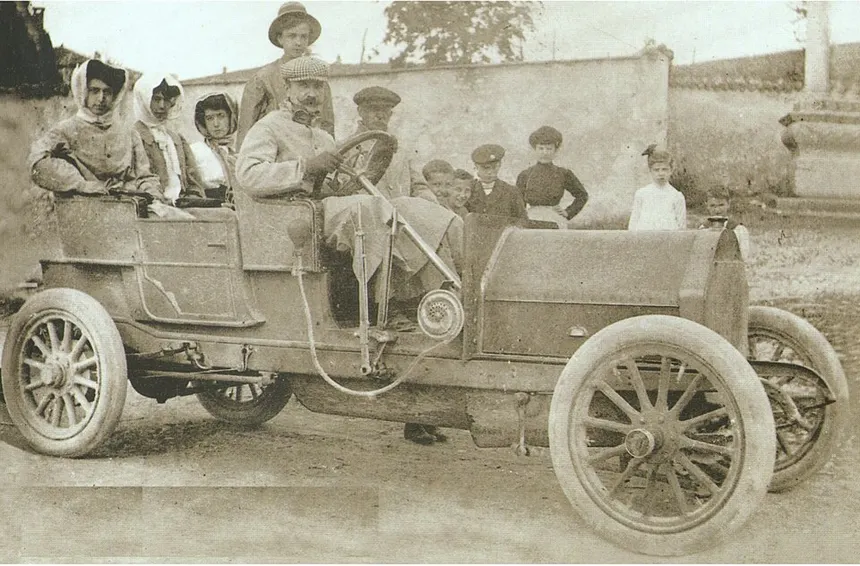
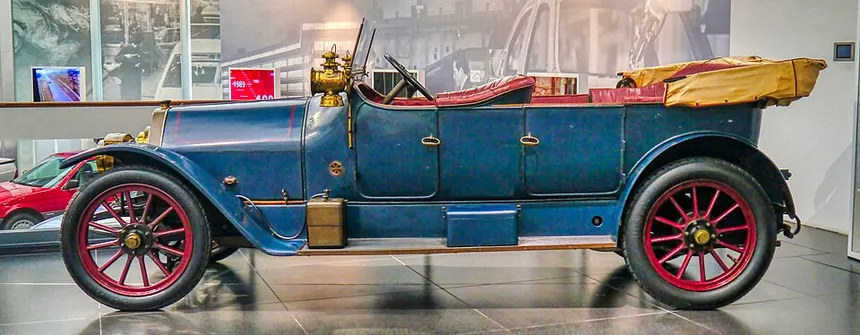
On 1 January 1910 Merosi delivered the technical drawings of the first car. On 24 June 1910 A.L.F.A. was legally founded and the 24 HP started production. The full technical story of the car was in the founding article of this series, but one decision deserves attention here because it tells you exactly what kind of engineer Merosi was.
The 24 HP engine was a four-cylinder of 4,084 cc cast as a single block. Monobloc. In 1910 this was uncommon. Most European manufacturers were still casting cylinders in pairs and bolting them to a separate crankcase. It was easier, cheaper, and let foundries correct casting defects one pair at a time. Merosi chose monobloc construction knowing the cost: harder foundry work, more rejected castings, more expensive tooling. In exchange he reduced vibration, improved head-gasket sealing, and gave the engine a structural rigidity that made it last.
How do we know it lasted? Three pieces of evidence. The Italian Army’s high command picked the 24 HP as its general-officer transport during the First World War — armies don’t choose fragile chassis for the men whose decisions win or lose wars. The model and its 20-30 HP evolution stayed in production from 1910 to 1922, with roughly 680 units built across twelve continuous years — keeping a single chassis architecture in production for that long is its own quiet certificate. And the very first car you see when you cross the turnstile at the Museo Storico Alfa Romeo in Arese, before any P2, before any 33 Stradale, before any Giulia Quadrifoglio, is a 1910 24 HP. Still complete. Still on its wheels. Still able to run.
That is surveyor logic transferred to engine design. Not the brilliant flash of the theoretical engineer. The patient overdimensioning of the man on site who knows what fails first when something works for a thousand hours. Merosi made decisions the way I make decisions when I’m fitting a component on an assembly line: by thinking about what’s going to happen to the part when it’s been working for ten years.
A range built in four years
After the 24 HP, Merosi moved fast. The 12 HP, a smaller and cheaper variant, opened the upper-middle-class market. The 15 HP sat between them. The 20-30 HP, a direct evolution of the 24, became the standard reference model for the next decade. And then a more ambitious project: the 40-60 HP, a six-litre engine with overhead valves. By 1913, most road-car engines in the world still used side valves because they were simpler to make. Merosi went straight to OHV on the top model. Better breathing, more power per litre, more potential for development. Two steps ahead.
Five years after A.L.F.A. was founded, Merosi had personally signed a coherent range running from 12 to 60 horsepower, with a standard monobloc architecture, overhead valves on the senior models, and a reputation for reliability earned in actual conditions on actual Italian roads. All of this was done by a building surveyor from Piacenza, working in a factory that five years earlier had been bankrupt. And he was already thinking about the next step.
The 1914 motor history has misattributed
In 1914 Merosi finished what would be, for decades, the most advanced engine ever drawn at Portello: the powerplant for the ALFA Grand Prix car. Four cylinders, 4,490 cc, double overhead camshafts (DOHC), sixteen valves (four per cylinder), twin-spark ignition with two plugs per cylinder fed by two independent magnetos. Output: 88-102 horsepower at 2,750-3,000 rpm. Vehicle weight: 870 kg.
Put this in 1914 context. The DOHC architecture was so radical that it remains associated in popular memory with Vittorio Jano and the Alfa engines of the 1920s and 1930s. The historical truth is that the first DOHC engine ever built at Alfa was Merosi’s, a decade before Jano arrived in Milan. The conceptual debt goes back to the Peugeot Grand Prix engines of 1912-1913 designed by the Swiss Ernest Henry, but taking a pure-racing idea and applying it correctly to a chassis dimensioned for 870 kg, with sixteen valves that have to live with serious camshaft profiles, was serious work.
Then the twin-spark. Two plugs per cylinder, two independent ignition systems. The physics is straightforward: the flame front advances from two points instead of one, combustion is faster and more complete, the motor tolerates higher compression without knock. Bugatti wasn’t doing it in 1914. Mercedes wasn’t doing it. Even Peugeot, then at the racing-engine frontier, wasn’t doing it. Merosi was.
When you see the “Twin Spark” badge on the tail of an Alfa 75 or a 155 from the 1990s, it isn’t marketing. It is a signature Merosi drew in 1914 that the brand has been spending ever since.
The 1914 GP car never raced its intended season. War broke out. The world closed down. Only one chassis was built and modified in 1921 for a brief second life. But the engine existed. It ran. It worked. The architectural template was set.
The war and the unpaid wages nobody mentions
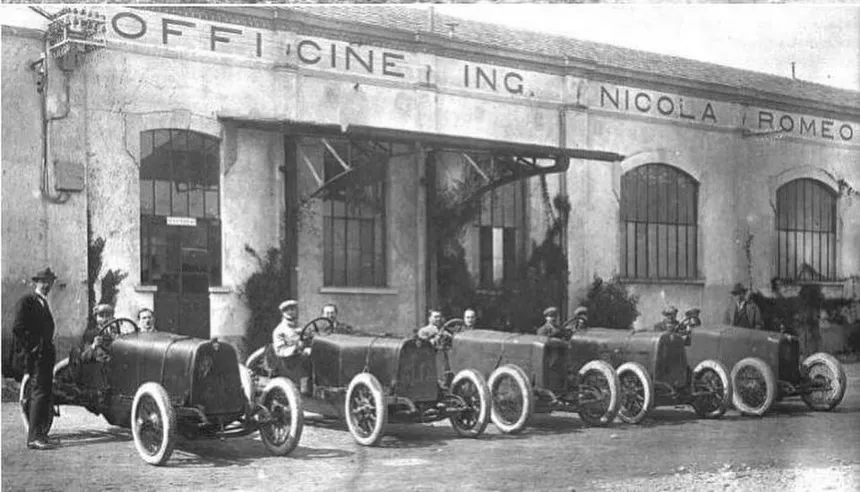
When A.L.F.A. collapsed financially in 1915 and Nicola Romeo bought the wreckage to convert Portello into a munitions plant (covered in the second piece of this series), Merosi was left in a difficult position. Portello started making artillery shells, aero engines and compressors. Civil-car design stopped. Merosi remained employed, but he wasn’t designing much. Hands tied, drawing board cold.
Here something happened that most accounts dispatch in a line and deserves more attention. During the financial chaos of the early war years, A.L.F.A. failed to pay Merosi part of the remuneration he was owed for his earlier designs. A pay dispute that dragged on for years. When the war ended and Romeo decided to restart car production in 1919, Merosi was back at the drawing board, but the unpaid bills hadn’t been settled.
This matters because the polite version of history says Merosi was eased out by Jano because he wasn’t good enough any more. That isn’t true. The truer version is that Merosi had been carrying a financial grievance against the company since 1915, and when Jano arrived in 1923, that grievance became the lever that produced a clean exit. He wasn’t dismissed for poor work. He left with accounts still open.
The RL: the car that should have written him into history
Before he left, Merosi signed off two more cars that need their paragraph. The first was the G1 of 1921, a luxury car with a six-litre engine aimed at Italy’s upper class — handsome, modest commercial impact. The second was the RL of 1922, his post-war masterpiece. Six cylinders in line, overhead valves, a modular architecture that allowed both a touring and a racing version to be built on the same base.
The figure that matters: in its first year, the touring RL sold 924 units. For a marque that had spent seven years almost dormant, that was a commercial resurrection. And the sports version, the RL TF (Targa Florio), prepared specifically for the 1923 Targa, did exactly what it was built to do. Drivers: Antonio Ascari, Enzo Ferrari, Giulio Masetti and Ugo Sivocci. Result on 15 April 1923: Sivocci won, Ascari second, Masetti fourth. Historic triple finish.
That victory was what made the Alfa Romeo name international. And the technical signature of the car was Merosi’s. The driver who painted the green four-leaf clover on the bonnet for the first time was Sivocci. But the chassis, the engine, the geometry, the dimensions, were Merosi’s. The Targa Florio triumph of 1923 belongs to him as much as to any of the men in the cockpits.
The trouble was, the next car he drew never had the chance to race.
The P1: the car that died before it ran
In late 1923 Merosi finished the P1, the first Grand Prix single-seater ever built by Alfa Romeo. Inline six, two litres, DOHC, 95 horsepower at 5,000 rpm, 850 kg. Originally called GPR (Gran Premio Romeo), shortened to P1. Three cars entered for the Italian Grand Prix at Monza for Antonio Ascari, Giuseppe Campari and Ugo Sivocci.
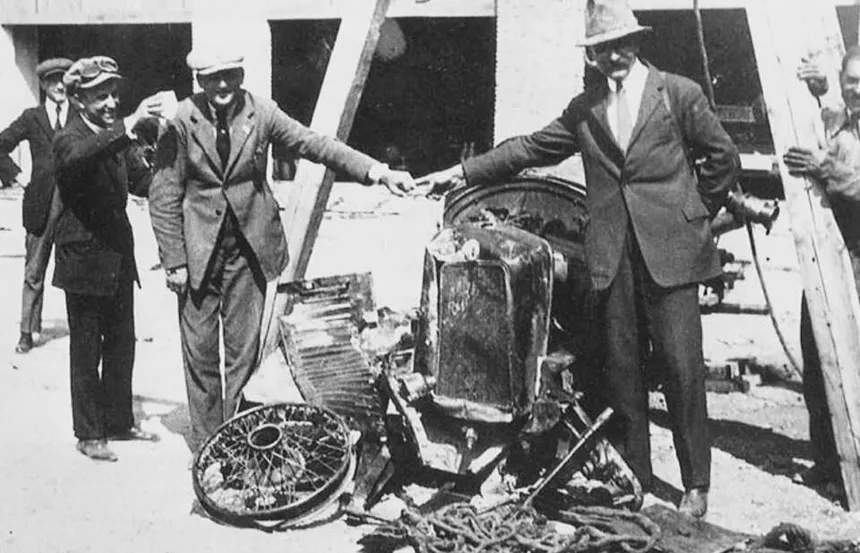
On 8 September 1923, during practice, Sivocci lost control of his P1 on the Curva del Vialone (today called Curva Ascari, in memory of Antonio, who would die in his own racing accident in France two years later). The car left the track. Sivocci was killed instantly. He was thirty-eight.
Alfa Romeo immediately withdrew the other two P1s from the race. The P1 never officially raced. A 1924 supercharged version with a Roots blower made 115 horsepower, but it too was kept out of competition.
This matters for two reasons. First, symbolically: the last serious car Merosi designed for Alfa Romeo didn’t fail in racing, didn’t lose to Fiat, didn’t prove slow. It was robbed of its chance. That isn’t engineering defeat. That is the worst possible luck. Second, personally: Merosi had just lost his chief test driver, the man who had painted the cloverleaf on the RL TF before the Targa Florio in April. According to people who were at Portello at the time, Merosi was never quite the same in the workshop after Sivocci’s death.
This is where Romeo stepped in with the cold decision documented in the previous article. Modern Grand Prix racing needed a different head. Romeo brought Vittorio Jano from Fiat. The approach was largely piloted by Enzo Ferrari, but Luigi Bazzi, an engineer who had worked with Jano in Turin, also helped. Jano arrived at Portello in September 1923, virtually the day after Sivocci’s death. He started drawing the P2 from scratch. That car would win the inaugural World Manufacturers’ Championship in 1925.
Merosi, meanwhile, walked out of Alfa Romeo somewhere between late 1923 and early 1924, depending on the source. Wikipedia gives 1924. VeloceToday suggests an earlier formal departure with brief consultancy returns. Other sources record 1926 as the real cut-off. The likeliest sequence: formal departure 1923-24, occasional consultancy work through 1924-25 while financial disputes were resolved, definitive break in 1926.
Twenty years at Isotta Fraschini
In 1926 Merosi joined Isotta Fraschini, Milan’s other great premium marque. Isotta was a different animal from Alfa. Its clientele was richer, more international, more stable: Rudolph Valentino owned an Isotta. So did several European royal houses. The firm had launched in 1919 the Tipo 8, the world’s first production road car with a straight-eight engine, designed by Giustino Cattaneo, chief engineer since 1905.
Merosi didn’t arrive at Isotta to replace Cattaneo. He came in as a senior technician and rose to become director of truck manufacturing. When Isotta stopped making passenger cars in 1934 (the Depression killed the market for $20,000 luxury saloons), Merosi shifted to trucks, marine engines and aero engines. Whatever the market would buy.
During the Second World War, while Isotta officially produced military engines for the Mussolini regime, Merosi worked in secret on a project that, viewed from a workshop floor today, is almost surreal. Together with a young engineer called Fabio Rapi, he designed what was meant to be Isotta’s post-war resurrection car: the Tipo 8C Monterosa. A 3.0 (later 3.4) litre V8 with water cooling, mounted at the rear, aluminium crankcase, hemispherical combustion chambers, four-speed transaxle with cable-actuated shifter.
Think about what this means. Merosi was seventy years old in 1942. He had been out of the front line of premium-car design for ten years. And in a back room of the Isotta factory, during a war, he and Rapi drew a rear-engined V8 with hemi heads — a configuration that wouldn’t become mainstream in luxury performance cars until the 1960s and 1970s. The Monterosa was built in 1947-1949 in three to six prototypes. It failed commercially because Isotta no longer had a dealer network or working capital. But the engineering was serious. It was the same Merosi who had drawn the 24 HP forty years earlier, still designing with margin.
When Isotta Fraschini suspended operations at the end of the 1940s, Merosi retired. He returned to Piacenza, his hometown. He died there on 27 March 1956, aged eighty-four.
What this story leaves on the workshop floor
Industrial-assembly work teaches you one thing about engineers. The good ones aren’t the ones who sign the car that wins. They’re the ones who sign the car that lasts. Jano signed the P2 that won the 1925 World Championship. Merosi signed the 24 HP that the Italian Army used in trench-front general transport and the RL TF that took 1-2-4 at the 1923 Targa Florio. Both are serious engineering. The difference is what the public celebrates.
The public celebrates visible victory. The workshop celebrates the part that survives. Merosi belonged to the second category. That’s why Alfa’s marketing department tends to surface Jano, Satta Puliga, Busso, Chiti — engineers whose work won races whose results made the front page. Merosi is the one whose engineering survived a century without ever earning that kind of headline.
There’s a second lesson here. Merosi’s career has accumulated bad luck of timing in a way that’s almost statistically improbable. The 1914 GP engine never raced because of the war. The P1 never raced because Sivocci died first. The Monterosa failed because Isotta was already a corpse as a brand. Three times he signed the right component in the wrong moment. That isn’t technical incompetence, that’s industrial misfortune. But history doesn’t separate the engineer who fails through bad work from the engineer who fails through bad timing. It lumps them together.
And a third. Merosi doesn’t survive in collective memory because he never fought to survive there. He left Alfa without scandal, without giving interviews, without writing a book. He went to Isotta quietly. He retired to Piacenza without publicly claiming his place in the industrial history of his country. In modern personal-brand terms, that is professional suicide. Today any engineer with half his CV would have a documentary, a TED talk, a premium LinkedIn profile and a ghostwritten memoir. Merosi had none of that. He died the way he had lived: working, quietly, without noise.
The detail I keep coming back to. When Merosi walked out of Alfa Romeo in 1923-24, he left behind a factory whose technical DNA he had personally written: a monobloc engine architecture established as house standard. A DOHC tradition inherited from the 1914 GP engine. A twin-spark signature that would last for eight decades. A Targa Florio winning chassis playbook. A culture of Italian, not French, engineering thinking, planted and rooted.
When Jano arrived, he didn’t build the marque. He inherited it. And what he inherited was a brand whose technical genetic code had spent fifteen years being shaped in the head of a building surveyor from Piacenza nobody bothers to mention.
Next time you see a 1990s Alfa with “Twin Spark” lettering on the boot, tell whoever’s with you that no marketing director invented that phrase in 1985. A man called Giuseppe Merosi drew that engine architecture in 1914, in a factory that had nearly gone bankrupt, in a city that barely had its own automotive industry, during a Grand Prix season that war prevented from ever taking place. And since then nobody at the brand has had the nerve to take his signature off the metal.
Check you’re still alive.