
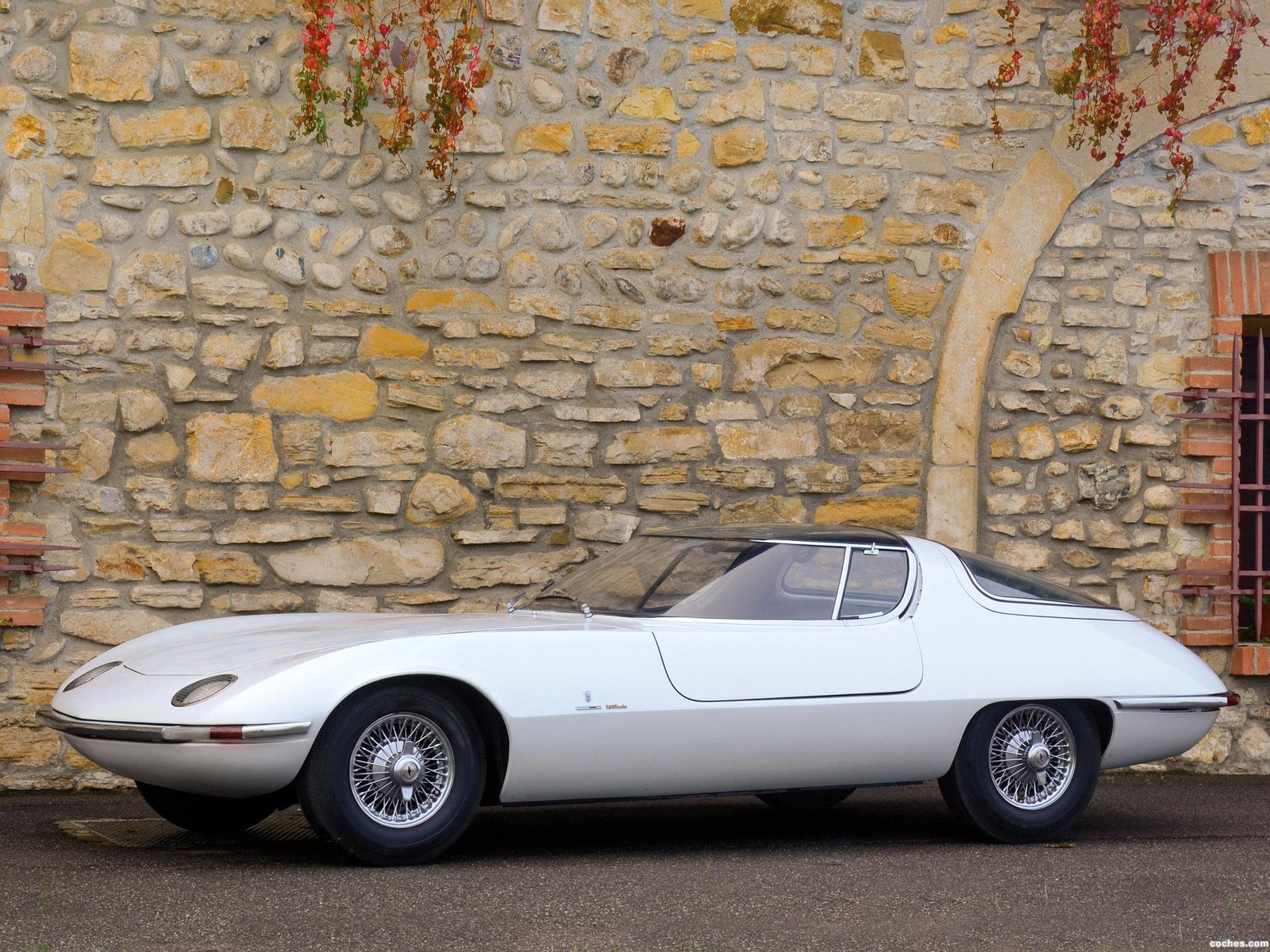
Bertone Testudo: Two Months and a Kid
Every enthusiast knows the Chevrolet Corvair as America’s cautionary tale — the rear-engined oddball that ended up as the poster child for automotive controversy, the car that became shorthand for Detroit getting it wrong. What almost nobody knows is that the same car, in the hands of a 25-year-old in Turin, produced one of the most influential shapes in the history of the automobile.
Picture March 1963. A man is crossing the Alps at the wheel of a machine that looks like it landed from another planet. There is no Mont Blanc tunnel yet. No Saint Bernard tunnel. Those don’t exist. So he goes over the top, through the mountain passes, in the depths of an Alpine winter, in a barely-finished prototype of glass and aluminium that has never turned a wheel on a real road.
That man is Nuccio Bertone. He’s driving to the Geneva Motor Show to show the world what his workshop has produced. The car is called Testudo. And it is about to shape how sports cars look for the next twenty years.
The car America wanted to bury
Start with the foundations, because that’s the first thing that throws people.
The Testudo doesn’t grow out of a Ferrari, or a Maserati, or anything exotic. It grows out of a Chevrolet Corvair. And in those years, the Corvair was a car in trouble. Strange for the American market: a six-cylinder air-cooled flat engine hung out the back. A configuration far closer to a Porsche than a Chevrolet — Europeans called it “the American Porsche,” not always kindly.
And that layout came with a real flaw. The early Corvair used a rear swing-axle setup — a suspension design that, pushed hard, let the back wheel tuck under and change camber abruptly. Combine that with the engine’s mass slung behind the rear axle and you had a car with a reputation for snapping into oversteer, catching out the average American driver who’d never met a rear-engined car in his life. By the early 1960s, that reputation was already doing the rounds. The car was under suspicion on its home turf.
Any reader who knows their history knows where this goes. In 1965 — two years after the Testudo — a young lawyer named Ralph Nader published “Unsafe at Any Speed,” whose opening chapter was a systematic demolition of the Corvair and of a General Motors that had, Nader argued, put styling and cost ahead of keeping people alive. That book turned the Corvair into the definitive symbol of the dangerous car and helped rewrite the rules of the entire industry. But all of that came later. In the winter of 1962, when the chassis crosses the Atlantic bound for Italy, the Corvair is still just an odd, suspect little car — not yet the national villain Nader would make of it.
So what does General Motors do? Something rather shrewd. Bill Mitchell, GM’s styling chief, reckons that if the Corvair can’t win at home, perhaps it can be sold in Europe — and for that, it needs European clothes. So he ships Corvair chassis to Italy, to the great coachbuilders. One to Pininfarina. One to Bertone. The brief, essentially: show us what you can do with this.
Nuccio Bertone, who had long fancied making a name for himself across the Atlantic, understood instantly what this meant. A golden opportunity. But there was a catch. The chassis arrived in the winter of 1962, and the Geneva show was in March 1963. Two months. Two months to design a car from nothing, build it entirely by hand, and drive it to Switzerland.
And he handed it to the kid
Two months on the clock, the firm’s reputation at stake, GM watching — and Nuccio Bertone didn’t give the job to a veteran. He gave it to a twenty-five-year-old on his staff.
His name was Giorgetto Giugiaro.
And he didn’t just hand him the job. He gave him a completely free hand. No limits, no conditions. Giugiaro has said it many times since: the Testudo was the first car in his life where he was allowed to do exactly as he pleased. Not just the styling. Everything. The form, the architecture, how it opened, how you got in, how it looked at you.
If you know your car history, the hairs on your arm should be standing up. Because that twenty-five-year-old would go on to found Italdesign and sign the Volkswagen Golf, the DeLorean, the Fiat Panda, the Lotus Esprit and half a library of cars that define how a modern automobile looks. One of the greatest designers who ever lived. And the Testudo is the car where he first became himself.
The tortoise
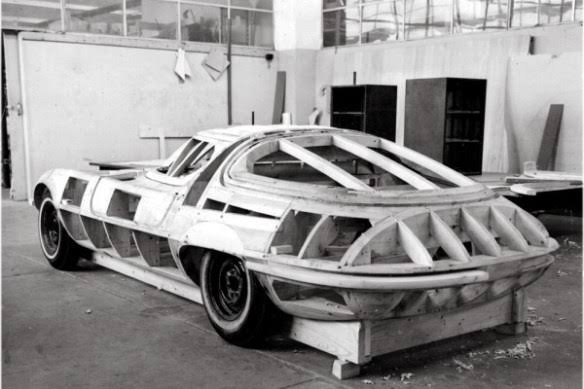
Giugiaro took that Corvair and pulled it apart conceptually. He shortened the chassis, cutting the wheelbase by more than a foot to sharpen it up. He reinforced it. He dropped the centre of gravity, lightened the nose to shift the weight balance rearward and find grip. The mechanicals he left alone: the air-cooled flat-six stayed where it was, hung out behind, with its four-speed manual.
And then he drew something over the top of it that nobody had seen before.
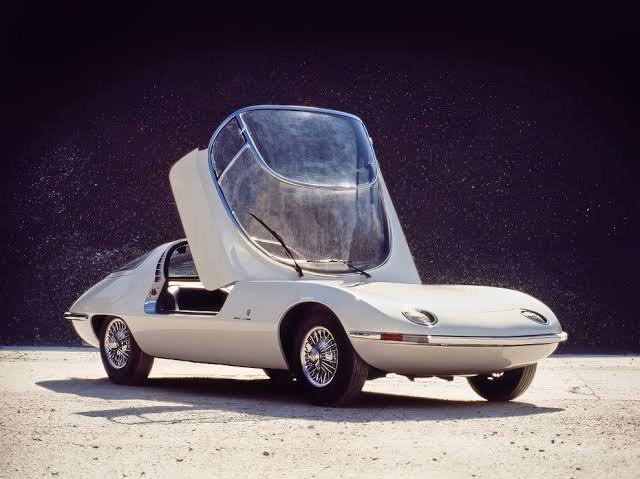
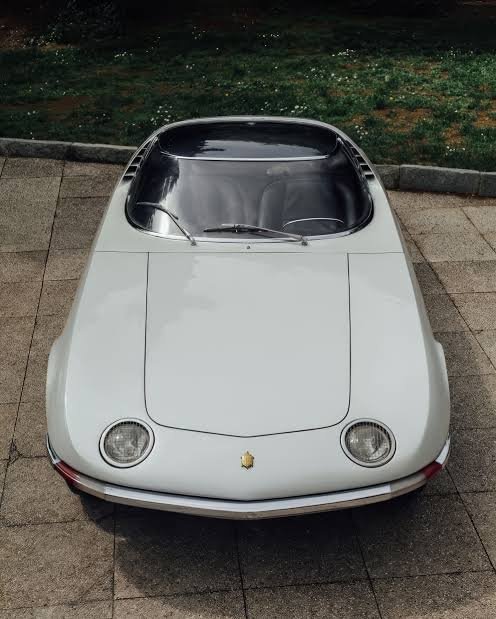
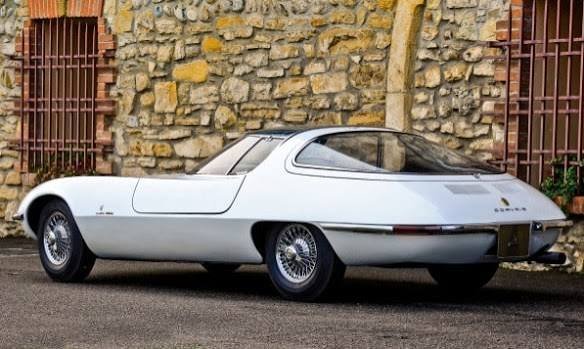
A car barely 106 centimetres tall. Impossibly low. A line split in two by a crease running the length of the flank: below it, the lower body; above it, a rounded dome that looked, precisely, like a tortoise shell. Hence the name. Testudo — Latin for tortoise.
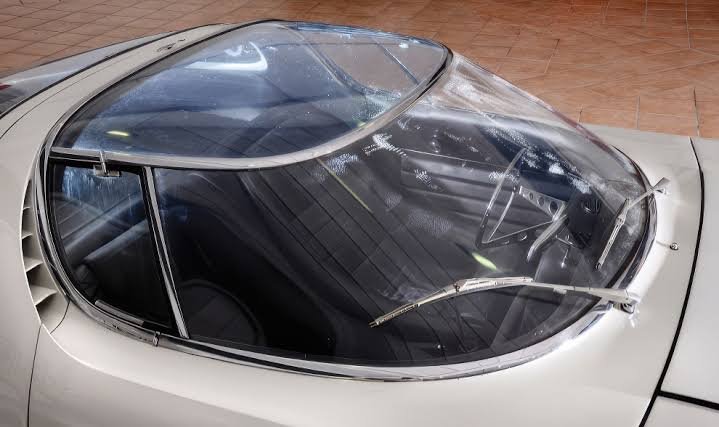
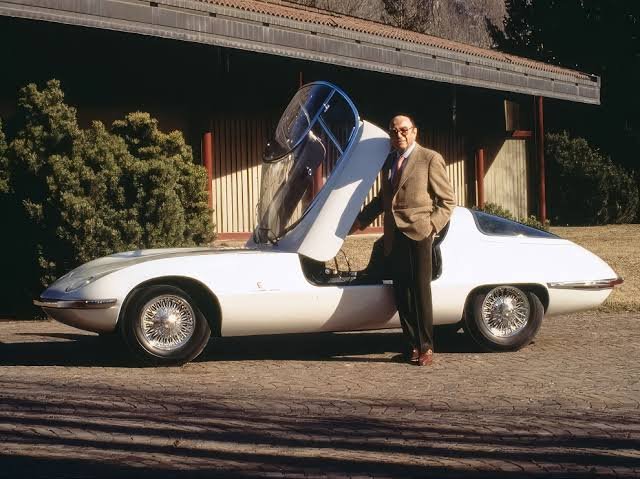
But the shape wasn’t even the best part. The best part was how you got in. The Testudo had no doors. None. The entire glass canopy — windscreen and roof as a single piece — hinged forward like a fighter cockpit, laying the whole cabin bare. The curved rear window lifted upward for access to the engine. The headlights sat flush, hidden until you switched them on.
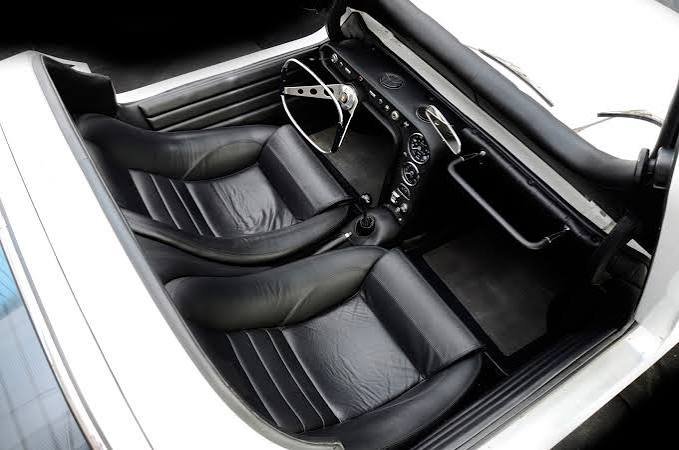
Inside, a masterclass in mid-century Italian modernism: wrap-around bucket seats, a boomerang-shaped dashboard, a rectangular steering wheel. Nothing about it is conventional. Nothing.
Giugiaro later explained what the Testudo unlocked in his head, and it’s the most interesting part of the whole thing. Until then, designers thought of a car in two separate pieces: the side elevation on one hand, the plan view on the other. Two different drawings, married up afterwards as best you could. The Testudo taught him to think of the car as a single continuous piece, one flowing volume. That sounds like studio philosophy, but it’s a genuine paradigm shift. It is, in effect, the modern way of designing cars.
Geneva, and the man whose head exploded
Nuccio Bertone was so proud of the car that he did something unusual: rather than send it by truck, he drove it himself from Turin to Geneva. Over the Alps. In March. In a prototype fresh off the workshop floor. And he made it.
On 3 March 1963, the Testudo was unveiled at the Geneva Motor Show and became the outright star of the event. The verdict was unanimous. That this impossibly low, futuristic, perfect thing was hiding the mechanicals of a troubled American compact underneath was almost beyond belief.
And among the people who stopped dead in front of that car was a man who made tractors and had been mulling over an idea for a while. His name was Ferruccio Lamborghini. What he saw in the Testudo blew his mind.
From that moment sprang one of the most fertile relationships in Italian design history: Lamborghini and Bertone. And it’s worth being fair about what followed, rather than inflating it. When the world fell over backwards three years later at the sight of the Miura — the car that reinvented the supercar — it wasn’t because the Testudo had drawn it first. The Miura was penned by another man, Marcello Gandini, and it is his masterpiece. But the Testudo was the calling card that put Bertone on Lamborghini’s radar, and some of the thinking Bertone carried out of that exercise — the cabin shoved forward, the play of volumes, the refusal to look like anything before it — was part of the climate the Miura grew out of. The Miura isn’t the Testudo’s child. It’s that without the Testudo, Lamborghini might never have knocked on that door.
The pop-up headlights deserve the same care, because it’s a claim that gets repeated badly. The Testudo had them, yes — but it didn’t invent them. Hidden headlamps already existed, from the 1930s Cord to the Mercedes 300 SL. What the Testudo did was show them integrated into a spotlessly clean, modern body, and help make them fashionable on the European sports car. Popularised, not invented. The distinction matters.
Something similar gets said about the Porsche 928, sometimes called a distant relative of the Testudo for its rounded tail and that waistline wrapping the whole car. It’s a suggestive link, and one fact feeds it: one of Porsche’s designers, Tony Lapine, had come from working under Bill Mitchell at GM. Take it for what it is — a family resemblance, not a straight line.
And even once you strip the smoke away, something big remains. A twenty-five-year-old, given two months, took the chassis of an American car under suspicion in its own country, and out of it came one of the design pieces that helped point the way for the European sports car of the years that followed.
And consider what that actually demanded. He couldn’t touch the mechanicals — the engine stayed where GM had put it, hanging behind the rear axle, a layout that dictates proportion whether you like it or not. Most designers would have fought that constraint and lost. Giugiaro leaned into it, using the rearward mass to justify a long, low nose that made the car look like it had an engine up front when it didn’t. It’s a magician’s trick performed in sheet metal, and it worked so completely that people still misread the car’s architecture at a glance.
And then they wrecked it
In 1965, two years after the glory of Geneva, the Testudo was taken to Monza to shoot a promotional film for Shell. At the Parabolica — the fastest, most treacherous corner on the circuit — there was an accident. It hit another car. And here’s the cruellest part: the other car was also a Bertone concept, the Alfa Romeo Canguro, another magnificent piece of work. Two jewels of Italian design destroying each other in the same corner.
The Testudo was badly damaged. And what did Bertone do? Nothing. He wasn’t prepared to spend money repairing it. So the most celebrated car of the 1963 Geneva show — the one that had left Lamborghini slack-jawed, the one that would inspire half of Italy — was left broken in a corner. For years.
In 1974 it was put up for sale at ten thousand dollars. Ten thousand. And nobody wanted it. It didn’t sell.
It took until the 1990s for it to finally receive a full restoration. In 1996 it appeared, resplendent once more, at the Pebble Beach Concours d’Elegance. And in 2011, when it went under the hammer at Villa d’Este, it sold for €336,000. From unsellable scrap to museum jewel. As ever.
The refusal that still stings
But there’s one final detail, and it’s the one that truly closes the circle.
When Giugiaro left Bertone to go it alone and found what would become Italdesign, he asked for one thing. Just one. He wanted to keep the Testudo. His first free car. The car where he’d found his own voice.
They said no.
And here’s the beautiful part. Because Giugiaro never forgot. In 2018, with an entire legendary career behind him, he unveiled an electric car in Geneva called the Sibylla, signed with his son under the GFG banner. And what did the Sibylla have? The tilting canopy. The same idea, the same gesture, fifty-five years later. And they displayed them together — the 1963 Testudo and the 2018 Sibylla — at the very show where it had all begun.
He never got to keep the car. But he kept the idea. And he came back for it half a century later.
What remains
The Testudo is one of those pieces that proves greatness doesn’t depend on the raw material you’re handed. Giugiaro was given the chassis of an American car under a cloud, mechanicals he wasn’t allowed to touch, and two months on the clock. Out of that he made a car that helped point the way for the European sports car — and set an unknown kid on the road to becoming one of the great designers of the century.
Next time you find yourself staring at a body that flows as one continuous piece, with no seam between the profile and the plan, spare a thought for the tortoise. For a twenty-five-year-old whose boss had the instinct to say “do it however you like.” And remember, too, that the very same car spent years rotting broken in a corner because nobody would pay for the bodywork.
Good ideas aren’t always treated well in their own moment. They win anyway. Even if it takes them fifty-five years to come back.
Check you’re still alive.
1 thought on “BERTONE TESTUDO”