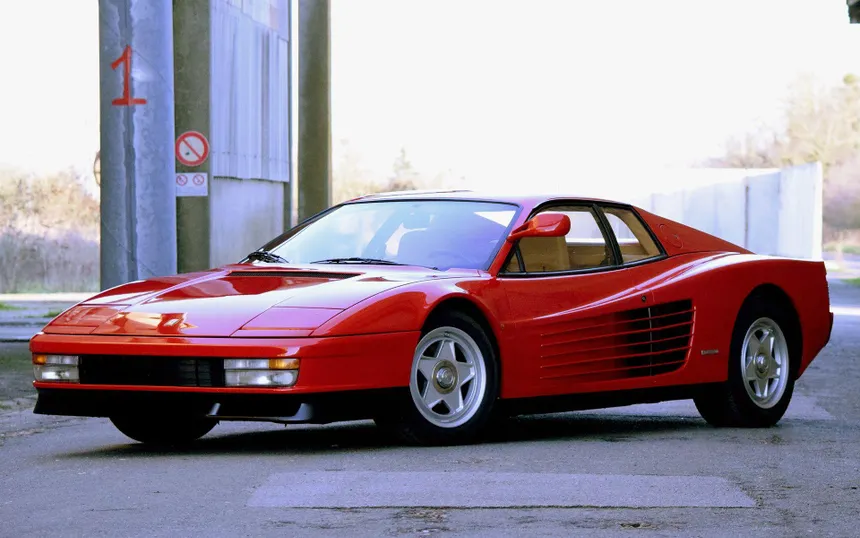
Ferrari Testarossa: The Most American Italian Supercar Ever Built
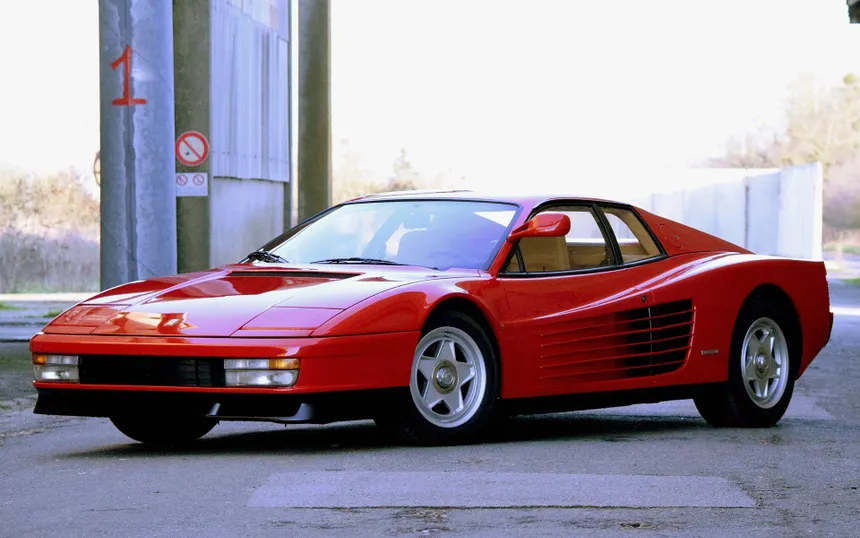
Italy gets the credit. America wrote the rules.
The single most recognizable piece of 1980s car design came out of a US regulation. The car’s fame came from a Miami cop show and a Japanese arcade cabinet. The convertible everyone remembers was cut open in Southern California. And the cars sold on this side of the Atlantic were deliberately strangled.
The Ferrari Testarossa is an Italian legend assembled almost entirely out of foreign parts. Here’s how that happened.
The name came from a car it had nothing to do with
Testarossa means redhead. It refers to the red crackle paint Maranello used on the cam covers of its most powerful racing engines in the 1950s, and it belonged first to the 250 Testa Rossa, spelled as two words, a front-engined V12 sports racer that dominated endurance racing at the end of that decade.
The 1984 car inherited none of that machinery. What sat under the new Pininfarina body was an updated 512 BBi: the same 4,943 cc twelve-cylinder engine lying flat, the same longitudinal mid-engine layout, the same basic architecture that was already a decade old.
The name was the new part. That is worth remembering when you get to the end of this piece.
Washington drew the strakes, not Pininfarina
This is the part that rarely gets told properly in the enthusiast press.
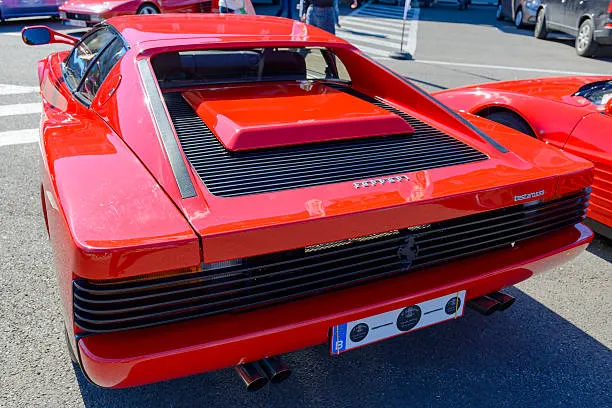
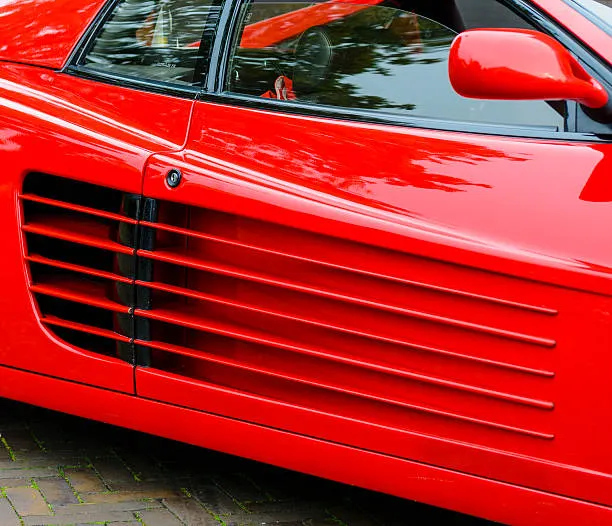
Berlinetta Boxer owners had complained for years about cabin heat. The radiator sat up front and the hot coolant lines ran the entire length of the cockpit to reach it. Pininfarina, with Leonardo Fioravanti leading the project, fixed it by doubling the radiator count and relocating the whole cooling system to the flanks of the engine.
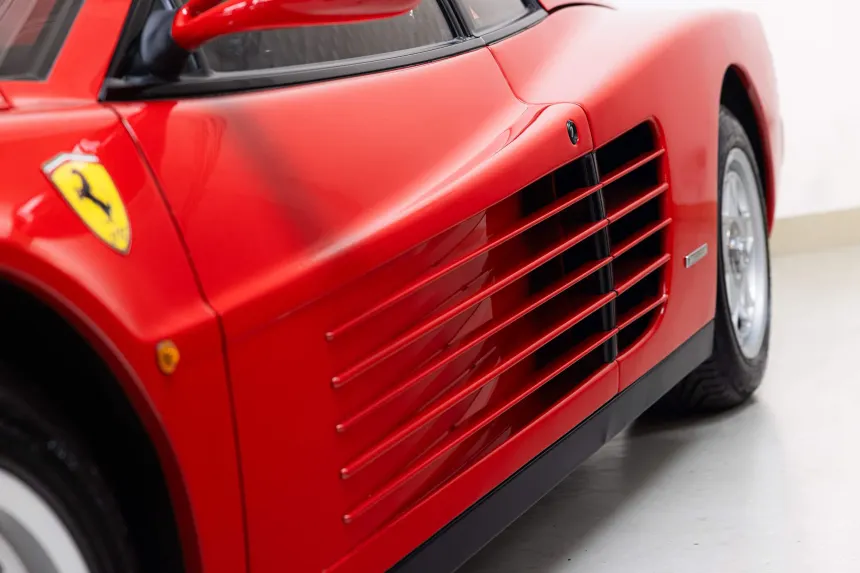
Side-mounted radiators need side-mounted air. A lot of it. And there was a problem: several markets where the car would be sold, the United States most prominently, prohibited large uncovered openings in bodywork. The team’s first instinct was to shrink the intakes as much as possible. When that failed, they turned the restriction into the design.
The cheese graters exist because of American safety legislation. Five horizontal fins per side, splitting one illegal hole into a series of legal ones, and the most copied design cue of the decade was born as regulatory compliance. It even worked aerodynamically: drag came in at 0.36, better than the Countach could manage.
The widest Ferrari ever sold, entirely by accident
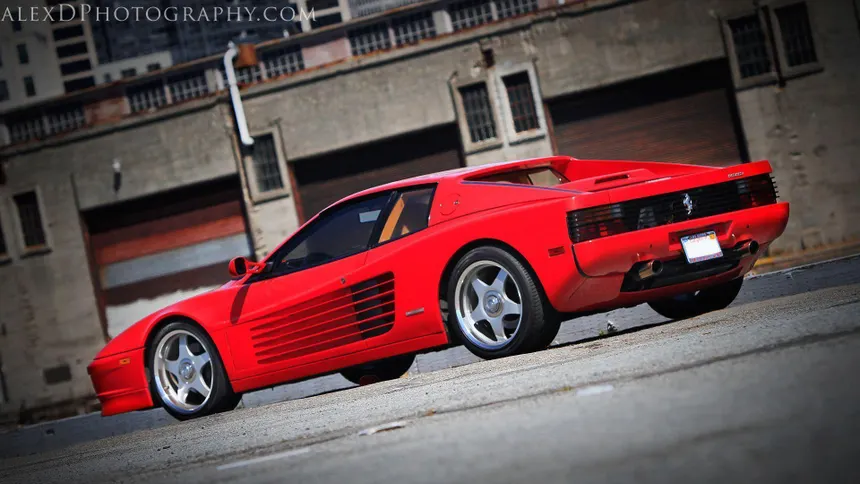
Relocating the radiators had a consequence nobody set out to achieve. Rear track grew 105 mm over the 512 BBi while front track gained only 12, on a 2,550 mm wheelbase. The car became a wedge in plan view rather than in profile.
Overall width landed at 1,976 mm. Roughly 77.8 inches. Four decades on, no Ferrari road car sold since has been wider.
One genuine benefit came with it. Clearing the radiators out of the nose gave the Testarossa usable luggage space, something the Boxer had never offered.
Your American-spec car was down on power, and here’s exactly why
European cars ran the flat-twelve with four valves per cylinder and 390 hp. Cars bound for the US and Japan got the Tipo F113 A 040 engine instead: catalytic converters, Bosch KE-Jetronic injection in place of the K-Jetronic, a different exhaust, an anti-evaporative emissions system, a secondary air pump and a slightly different gearbox. Output dropped to 380 hp at 5,750 rpm.
At 1,506 kg, only seven kilos heavier than the outgoing 512i BB, the car ran to 60 mph in a little over five seconds and topped out just under 180 mph.
Now the context that most retrospectives skip. The Lamborghini Countach LP5000 Quattrovalvole of 1985 made 455 hp in European carbureted form, though the North American version with Bosch KE-Jetronic injection fell to 420. The 288 GTO of 1984 made 400. The Porsche 959 of 1986 made 450.
The Testarossa was the least powerful car in that group. It also outsold all of them combined, by an enormous margin.
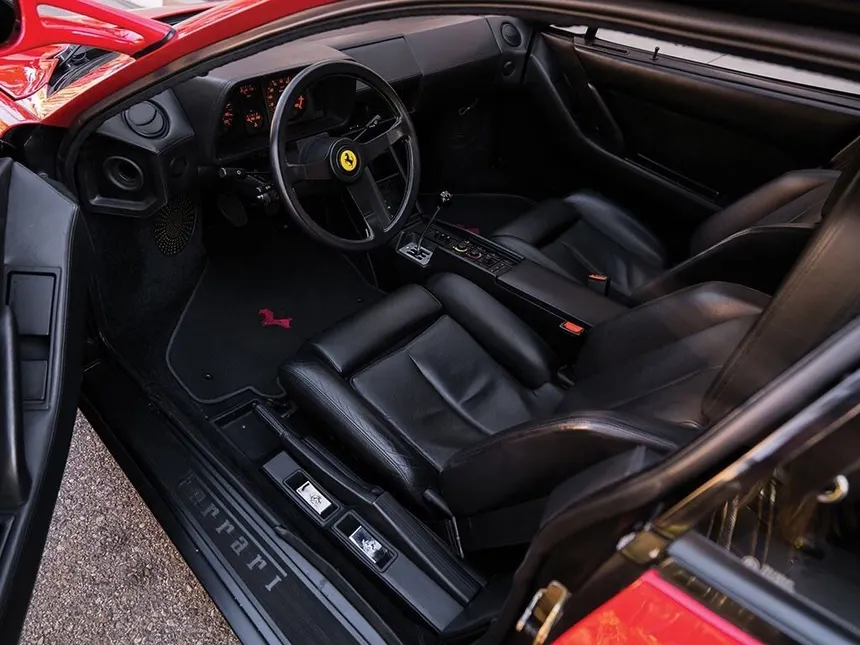
It is not a boxer engine and it never was
Ferrari named the previous family Berlinetta Boxer and the world has been repeating the error ever since.
In a true boxer, every piston gets its own crankpin, so opposing pistons reach top dead center simultaneously and their inertial forces cancel. The Testarossa’s twelve does not work that way. Each opposing pair shares a crankpin, meaning one piston is at top dead center while its partner is at the bottom. That is a 180-degree V12, not a boxer.
The lineage confirms it. The block traces back to the 312B and 312PB racing engines and shares components with the 60-degree Colombo Tipo 251 V12. Flat, yes. Boxer, no.
Miami Vice: a trademark lawsuit that became the greatest product placement in television history
For the first two seasons, Sonny Crockett drove a black Daytona Spyder that was not a Ferrari at all. It was a fiberglass replica body over a Chevrolet Corvette C3 chassis, built by McBurnie Coachcraft, because Ferrari North America had turned down the production’s request for real cars.
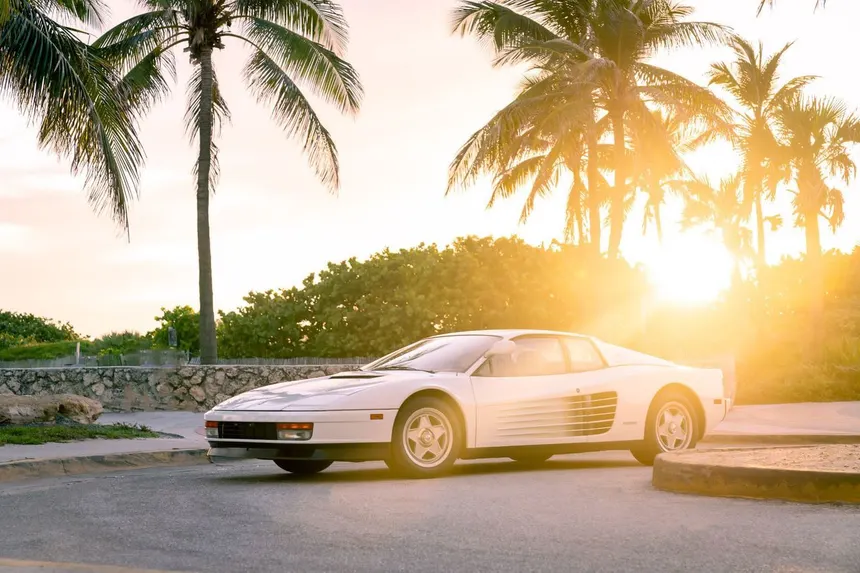
Maranello objected. Ferrari sued the replica builder and four others for trademark infringement. The negotiated exit gave everyone what they wanted: the producers accepted two new Testarossas, and the fake Daytona was written out of the show by way of a rocket launcher at the start of season three. The cars arrived in black and were repainted white, because black disappeared in the night shooting that defined the show’s look.
Here is where nearly every retelling goes wrong. The popular version claims the replicas themselves were blown up as a condition of the settlement. The available evidence points elsewhere: what got destroyed on camera was an empty body shell, chosen for cost and safety, and both screen-used cars survived the show. One of them resurfaced years later.
A trademark dispute Ferrari technically won turned into the most valuable advertising the company never paid for.
The convertible you remember was never built
Ask any American who was a teenager in 1987 to picture a Testarossa and a good share of them will describe a red convertible.
Ferrari never sold one. Coupes only, for the entire production run.
The convertible lives inside Sega’s OutRun, the 1986 arcade machine designed by Yu Suzuki, which put an open red two-seater in front of a generation feeding quarters into cabinets in every mall in the country. Most specialist sources hold that the appearance was unlicensed, which is generally cited as the reason the original game ported freely to nearly every platform ever made while the later officially licensed sequels ended up tangled in rights problems. A minority of sources dispute this. Without a contract on the table, that is where the claim sits: widely reported, not closed.
Southern California built the ones Ferrari refused to
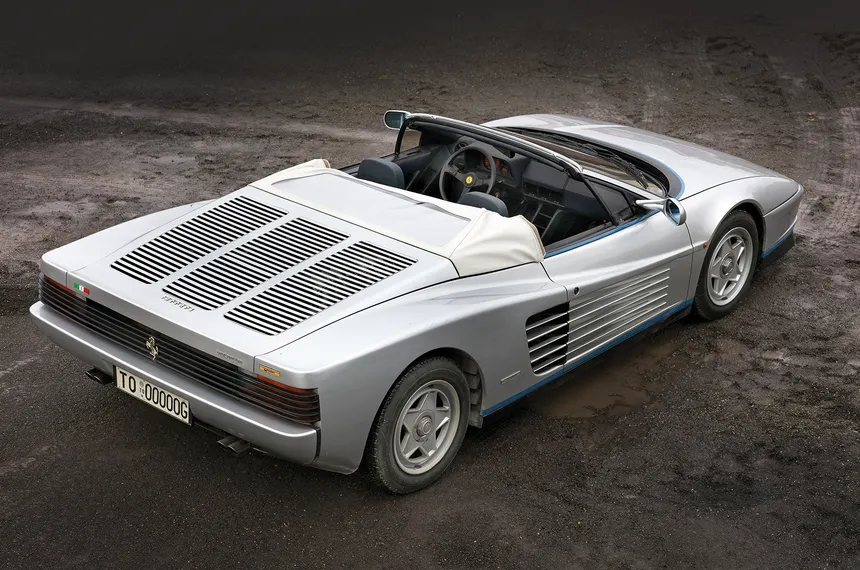
One factory Testarossa Spider exists. Gianni Agnelli commissioned it to mark twenty years running Fiat. Chassis 62897 was begun on February 27, 1986 and delivered that June 16, finished in silver rather than red because Ag is both the first two letters of his surname and the periodic symbol for silver. It carried a switchable Valeo electronic clutch that let him drive without a pedal, a concession to injuries he carried from a car accident.
Everything else came from the aftermarket, and America led it. Richard Straman in Los Angeles cut open several, and one of his cars appeared in the 1988 Pepsi commercial starring Michael Jackson. Carrozzeria Pavesi in Milan converted two, per the Pavesi brothers themselves, leaving the engines alone and fitting an electric top to the second. Lorenz und Rankl in Germany reinforced the sills and floor of theirs. Design+Technik went furthest, engineering a fully retractable hardtop nobody else attempted.
Koenig Specials: 1,000 horsepower and no badges allowed
Willy Koenig ran the maddest operation of the era out of Munich. His shop had already worked the Boxer over when the Testarossa arrived, and the escalation was quick.
The Competition of 1988 combined twin turbos with a supercharger, specifically to mask the lag involved in pulling 800 hp from an engine that left the factory with 390. Later Evolution builds cleared 1,000 hp. Twice what an F40 made.
Ferrari’s answer was legal. The company barred Koenig from leaving any Ferrari badge on a car it had modified.
Why this car was cheap for two decades
Ferrari built 7,177 Testarossas, plus 2,261 512 TRs and 501 F512 Ms. Close to ten thousand cars. For a Maranello twelve-cylinder, that is mass production.
Then the bubble caught it. Entry pricing climbed from roughly $85,000 in 1985 to nearly $150,000 by 1990, with speculators trading cars they never intended to drive. The collapse came in 1990, and the moment it became undeniable has a timestamp: on the evening of January 17, 1991, with Desert Storm going live on television, the Barrett-Jackson sale ran out of bidders because everyone in the room was watching a war start.
Maintenance finished the job. The Testarossa requires the engine to come out for its belt service. The factory manual allots ten hours simply to remove and reinstall the engine, and owners routinely paid for considerably more than that even at independent specialists, with services landing in the $10,000 neighborhood. An abundant car that is expensive to own and not rare enough to forgive it is a car that falls. That is precisely what happened.
The 849, or the same trick forty-one years later
Ferrari brought the name back in Milan on September 9, 2025. The 849 Testarossa replaces the SF90 Stradale, makes 1,050 hp from a plug-in hybrid twin-turbo V8, hits 62 mph in under 2.3 seconds, exceeds 205 mph and laps Fiorano in 1:17.5. European pricing opens at €460,000 for the coupe and €500,000 for the Spider, with production starting in mid-2026 and US deliveries following at higher prices because of tariffs.
It is also, mechanically, a very deep facelift of the car it replaces. Road & Track said it plainly: part of the reason for the name’s return is sleight of hand, drawing attention away from how much the 849 shares with its predecessor.
Which is the 1984 playbook, run again. Take a platform you have already worked, dress it in new sheet metal, and hang the most mythologized name in the archive on the back of it.
The verdict
My problem is not with the car. It is with the myth.
We have spent forty years selling the Testarossa as an act of Italian genius when what it actually was is a masterclass in solving other people’s problems. An engineer fixing a heat complaint. A design studio outmaneuvering a US safety statute. A sales department reaching back to 1957 to disguise the fact that the hardware underneath belonged to the previous decade. That is more impressive than the official story, not less. Very few people can turn a compliance headache into the most copied shape of a decade.
What does not hold up is the reissue. In 1984 the borrowed name covered a reworked Boxer and the result rewrote what a supercar looked like. In 2025 the borrowed name covers a reworked SF90, and the result is a 1,050 hp plug-in hybrid that does everything better and will not end up taped to a single kid’s bedroom wall. Ferrari has learned to repeat the marketing. It has forgotten how to repeat the accident.
Which one do you think gets remembered longer, the cheese grater that a regulation forced into existence, or the vertical light bar on the 849?
Check you’re still alive.