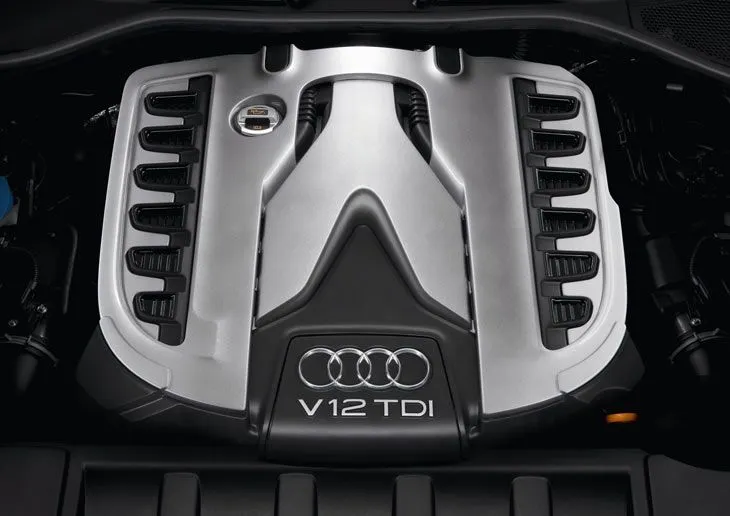
Audi V12 TDI: The Greatest Diesel Ever Built, Killed By Audi
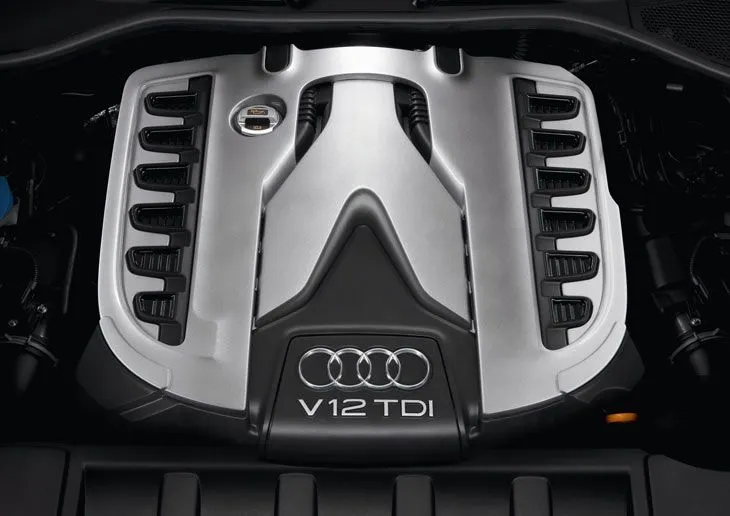
America never got the Audi V12 TDI. That turns out to be the least interesting thing about it.
Here’s the more interesting thing. The V12 TDI is not the Le Mans engine. It doesn’t share the vee angle, the displacement, or the architecture with the R10 race car. What it does share, to the millimeter, is the bore and stroke of the ordinary 3.0 TDI that powered half of Audi’s lineup.
Audi said so itself, in its own launch materials, describing the six-liter as a derivative of the company’s existing V-engine family with a bore of 83 mm and a stroke of 91.4 mm — exactly the same as the 3.0 TDI.
The company put the truth in the spec sheet and something else in the headline. Fifteen years later we’re still quoting the headline.
The equivalency that didn’t equalize anything
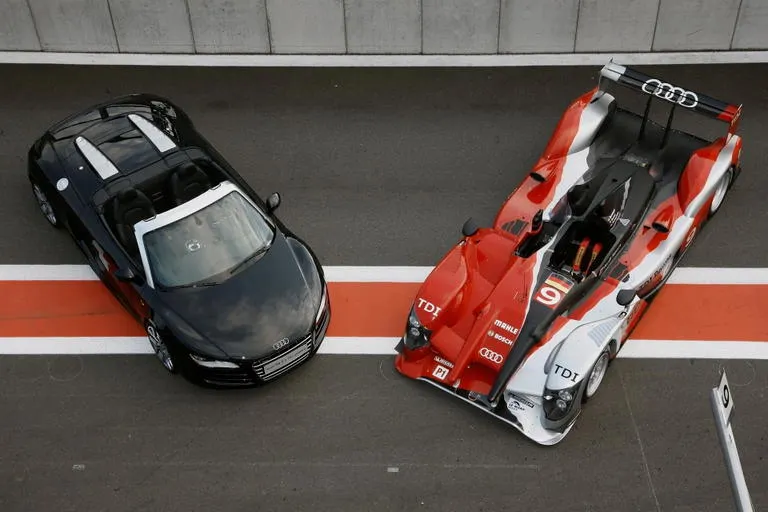
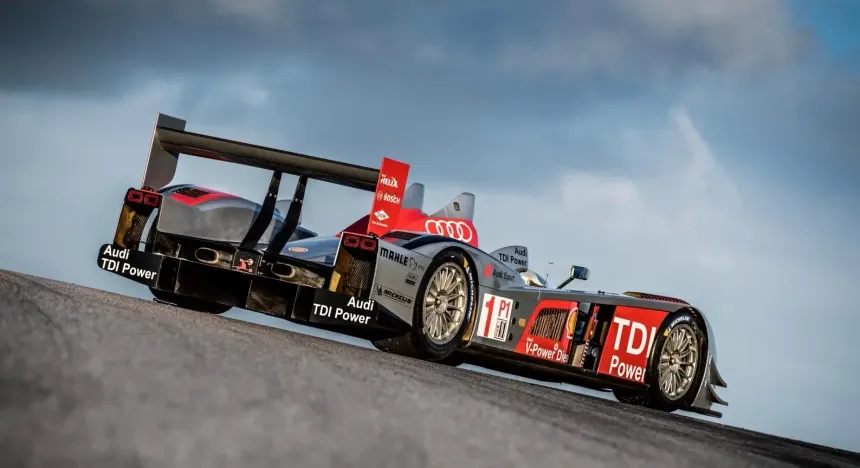
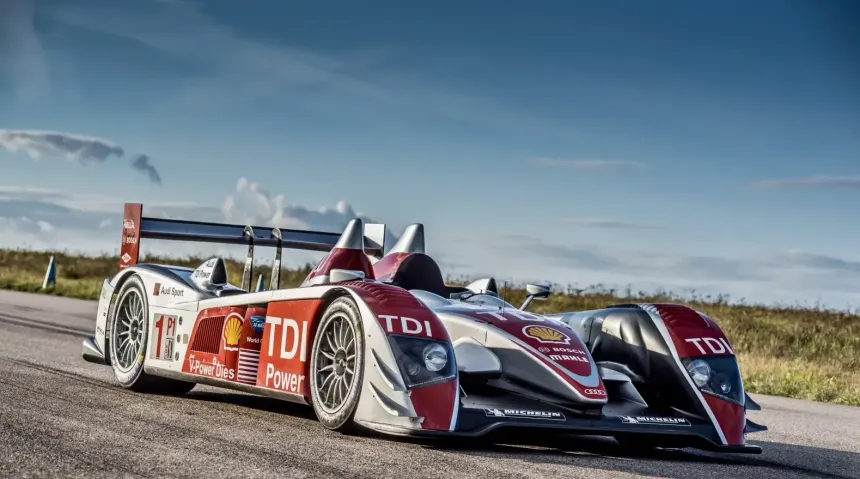
The story starts at Le Mans in 2006, when Audi became the first manufacturer to win the 24 Hours with a diesel. The car was the R10 TDI, developed with Dallara, running a 5.5-liter twin-turbo V12 diesel making 650 hp. It was unveiled in Paris on December 13, 2005, and won Sebring and Le Mans within its first two hundred days.
Now the part the highlight reel skips.
The Automobile Club de l’Ouest opened the door to diesel with an equivalency formula meant to level the two fuels. It didn’t level them. Diesel entries ran a 90-liter tank. Their air restrictors were larger in diameter than the gasoline cars’ — 39.9 mm when two were fitted — precisely because a diesel needs more air. The on-track result followed: Tom Kristensen became the first LMP1 driver to run sixteen laps on a single tank while the gasoline field managed twelve or thirteen. Audi averaged a stop every fourteen laps. Over twenty-four hours, that’s half a victory banked before the flag drops.
You don’t need to call it rigged for it to be damning. Rigged implies a deal cut to benefit a specific party, and no source supports that. What the facts do support is duller and worse: the ACO wrote the equivalency badly and spent years walking it back.
The proof is in the corrections
A properly calibrated rule sits still. This one never sat still for a season.
The ACO throttled diesel in stages, and in 2009 it did the most telling thing of all — it cut the restrictor and capped boost pressure at 2.75 bar, stating openly that the point was to bring diesel into line with gasoline. That’s a confession in plain sight. If diesel needed limiting in 2009 to match gasoline, then from 2006 to 2008 it wasn’t matched.
And the real problem underneath was never the fuel. It was the money. Developing a clean-sheet racing diesel cost a fortune: the R10 program ran Audi roughly $15 million a year, the most expensive project Audi Sport had ever undertaken. When you write a rule only a manufacturer with that budget can exploit, you haven’t opened a door to everyone. You’ve installed a financial filter at the entrance. “The rules were there for anybody — build a diesel if you want one” sounds fair until you price out building one.
What Audi actually deserves credit for
Here’s where the easy version of this story falls apart. If the rulebook decided the races, Audi would have won every time. It didn’t.
From 2007 onward, Audi wasn’t racing gasoline cars. It was racing the Peugeot 908 HDi FAP — a 100-degree diesel V12 in a closed cockpit with a particulate filter. And the Peugeot was blindingly fast over one lap. Stéphane Sarrazin took three straight Le Mans poles in 2007, 2008, and 2009, and Sébastien Bourdais added a fourth in 2010. Four consecutive poles for the other guy.
Audi won anyway in 2007, by ten laps, and again in 2008 by four minutes, with Kristensen pulling as much as eight seconds a lap on the lead Peugeot in the rain. A big fuel tank doesn’t do that. A driver and a crew do that.
Then in 2009 Peugeot won, one-two, with Alexander Wurz, Marc Gené, and David Brabham — Audi’s first Le Mans defeat since 2003. In 2010 Peugeot locked out the top four grid slots and failed to finish a single car.
The accurate conclusion is more nuanced than the easy headline, and harder on the ACO for it. Diesel didn’t win races. Whoever could afford diesel won races. The advantage wasn’t in the fuel, it was in the entry fee. And once two manufacturers with comparable budgets were fighting each other, victory went back to being settled by reliability, strategy, and execution — the way it’s supposed to be.
Wrong once: selling a lineage that never existed
With the wins banked, Audi needed to move them into showrooms. This is where the official story detaches from the engineering.
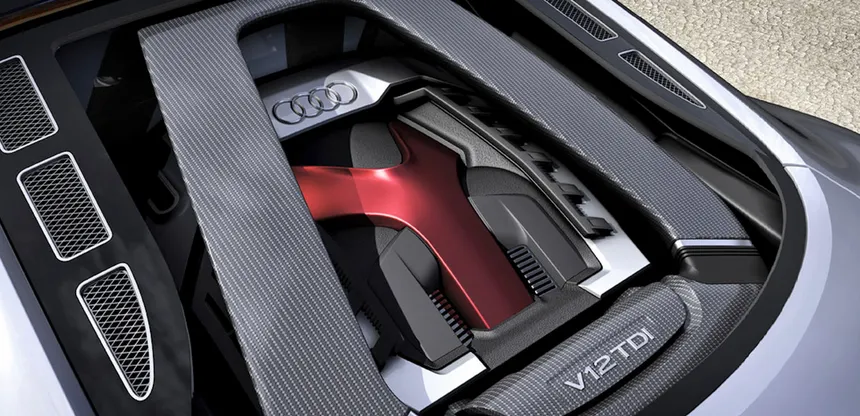
The road-going V12 TDI was launched as the Le Mans hero’s descendant. It isn’t. The R10’s engine displaced 5.5 liters — the Le Mans maximum — with banks at 90 degrees. The road engine displaces 5,934 cc with banks at 60 degrees, a 90 mm cylinder bore spacing shared with the rest of Audi’s V family, and that 83 x 91.4 mm bore and stroke lifted straight from the 3.0 TDI. It was built in Győr, Hungary.
The 60-degree angle isn’t arbitrary. In a V12, that spacing cancels free inertial forces, so the engine runs smooth without counterweights or balance shafts. That’s a decision made for a luxury car, not an endurance prototype.
What traveled from Le Mans to Ingolstadt wasn’t hardware. It was knowledge, and more importantly internal permission: proof that a diesel under extreme load survives twenty-four hours flat out. Which, in fairness, is a harder thing to earn than detuning a race engine. Audi designed a new one from a different starting point, and what it built was monstrous.
The monster, in numbers
Two variable-geometry turbochargers. Bosch common-rail injection at 2,000 bar — the world’s first at that pressure — with eight-hole piezo injectors and EDC17 management. A 16.0:1 compression ratio. A compacted graphite iron crankcase around fifteen percent lighter than conventional grey iron. Two particulate filters.
Five hundred PS at 3,750 rpm. One thousand newton-meters between 1,750 and 3,250 rpm, a specific torque of 169 Nm per liter. All of it inside a block 684 mm long, only 166 mm more than the V8 TDI. Packaging twelve cylinders into that length is the quiet miracle of the whole program.
For period context: the 2008 BMW X6 xDrive50i, with a twin-turbo gasoline V8 making 407 hp and 600 Nm, ran 0-100 km/h in 5.4 seconds on a rated 12.5 l/100 km. The Q7 V12 TDI, hauling over two and a half tons, ran 5.5 seconds on 11.9. Effectively the same number, four hundred more newton-meters, and less fuel burned.
One underreported detail: peak power at 3,750 rpm with torque cut off at 3,250 tells you plenty about the gearbox. That six-speed Tiptronic was working at the edge of what it could transmit. When the transmission is the engine’s bottleneck, you’ve built something excessive.
Wrong twice: the packaging
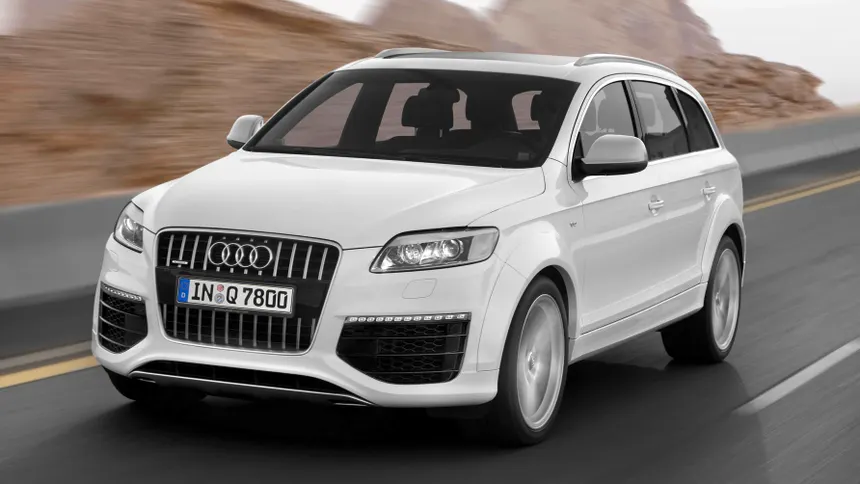
All that engineering landed in a Q7. A five-meter, seven-seat SUV weighing 2.7 tonnes empty.
The Q7 wasn’t a bad car. It was the worst possible container. Ferocious in a straight line, clumsy everywhere else, spectacular on paper and flat on the road. And expensive: £96,290 in Britain when Top Gear tested it, more than double the Q7 V8 TDI. American buyers, who would have understood a monster diesel SUV better than anyone, never got the chance — Audi never brought it over.
The detail that finishes the scene is almost scripted. Top Gear’s test of that hundred-thousand-pound Q7 fell on the day Lehman Brothers collapsed. Audi launched the most powerful and most expensive diesel SUV on earth at the exact moment the world stopped buying expensive SUVs. You cannot time it worse than that.
Wrong three times: the car that deserved it
Audi knew what car this engine was asking for. It built it. Then it didn’t build it.
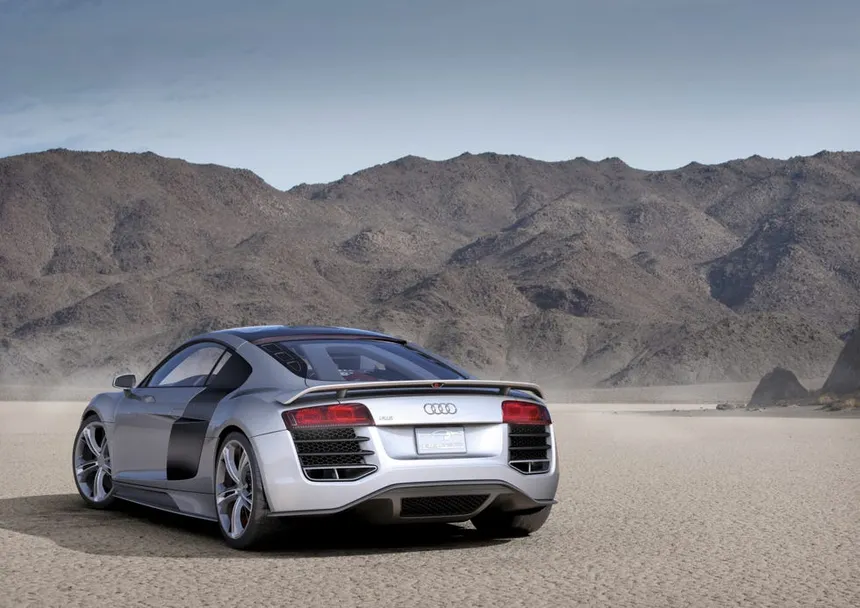
At the Detroit auto show in January 2008, and again in Geneva that March, Audi showed the R8 V12 TDI. Mid-engined, quattro, six-speed manual, 500 PS at 4,000 rpm, the same 1,000 Nm from 1,750, 1,860 kg, 0-100 km/h in 4.2 seconds and a top speed past 300 km/h. It already met the Euro 6 standard that wouldn’t take effect until 2014.
In May 2009 Audi killed it. And the real reason deserves stating rather than the one that sounds better: the company said re-engineering the gasoline R8 to accommodate the twin-turbo V12 was simply too expensive and the investment couldn’t be recovered through sales.
That’s a legitimate reason. It’s also an admission that there was never a serious production plan. If you drop the engine into the car, show it at two motor shows, and only then discover the industrialization doesn’t pencil out, you didn’t run the numbers before you switched the lights on. The R8 V12 TDI was an image exercise that worked too well and that nobody wanted to fund.
Wrong four times: killed by its own catalog
The V12 TDI was dropped after the 2012 model year. The sales figures are a disaster with some variance depending on the source: somewhere between 44 and 50 units in the UK across the entire commercial run, against a British target of forty per year. German sales reportedly also came in under plan.
The financial crisis explains part of it. The price explains more. But the finishing blow came from inside the building.
The Q7 V8 TDI — 4.2 liters, twin-turbo, 326 hp and 760 Nm — cost half as much, and for ninety percent of buyers that was plenty. On top of that, Audi introduced a V6 TDI biturbo in those years intended to take over much of the V8 diesel’s territory. Worth being precise here: that V6 came nowhere near the V12 on power or torque. What it did was worse for the twelve-cylinder. It moved the bar of what a customer considered “enough” to a point where paying triple for six more cylinders had no possible justification.
The V12 didn’t die because something better arrived. It died because something considerably worse arrived and turned out to be sufficient.
What’s left
A few hundred Q7 V12 TDIs are still running around Europe. UK registration records show a peak of around thirty-six on the road in 2013, and barely twenty still taxed today. Nobody looks at them twice, and underneath sits the most ambitious production diesel ever built.
There won’t be another. In 2015, three years after the engine was withdrawn, Dieselgate destroyed diesel’s reputation. The V12 was already dead when the scandal broke — what the scandal did was brick up the door so nobody would try again.
The financial crisis didn’t kill this engine. Dieselgate didn’t either — it arrived three years late, with the body already buried. And the ACO, which wrote a crooked equivalency and rewarded budget over stopwatch, at most handed Audi an alibi.
Audi killed it, with four decisions that belonged to Audi and nobody else. It sold a lineage its own spec sheet contradicted. It put the engine in a seven-seat SUV. It paraded the supercar that deserved it through two motor shows without first costing out whether it could be built. And it let its own catalog strip away the commercial argument. Not one of those four is insane taken alone. All four together took the finest diesel ever built and turned it into a footnote.
The engine failed at nothing. The people deciding what to do with it failed. And that strikes me as sadder than a bad engine would have been — bad engines die on their own, this one had to be killed. How many other pieces of work have we buried like this, with a flawless spreadsheet in hand?
Check you’re still alive.