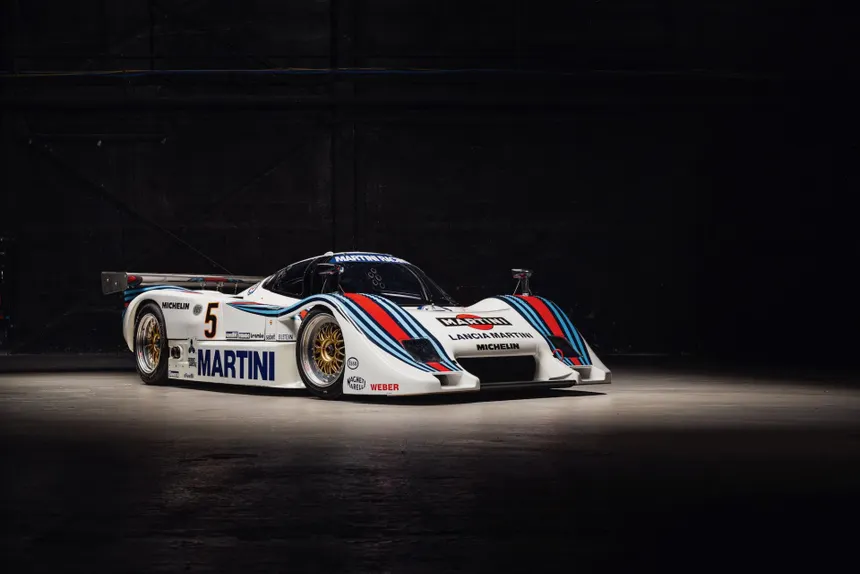
Lancia LC2: the Ferrari-powered Italian that almost embarrassed Porsche at Le Mans
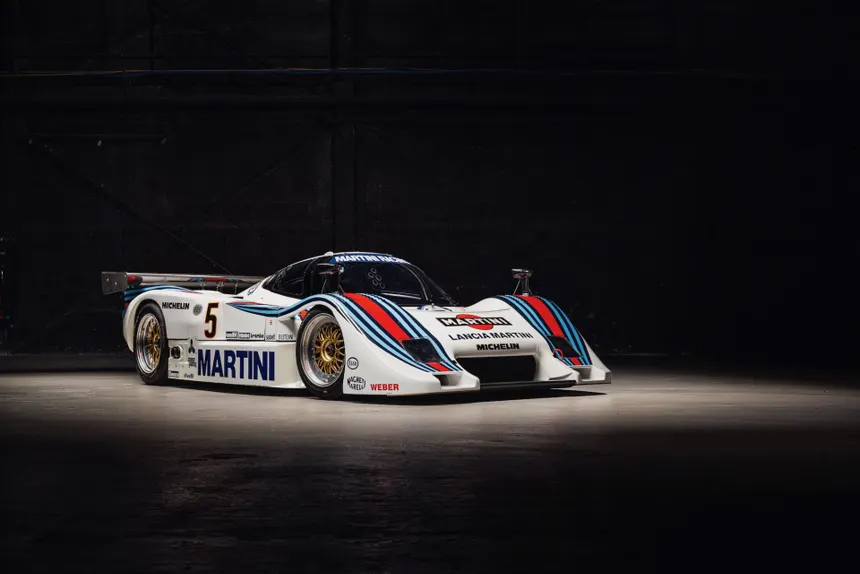
June 1984. Le Mans. Saturday afternoon, final qualifying session. Bob Wollek climbs into a prototype wearing Martini Racing colours, heads out onto the Sarthe, and pulls a lap of 3:17.11. Eleven seconds faster than the quickest Porsche 956 from Joest Racing. Eleven. Seconds.
To grasp the scale of that gap: eleven seconds a lap around a track under 14 kilometres long. In an endurance racer. Against the prototype that had won Le Mans in 1982 and in 1983 and that was, effectively, the gold standard of the entire Group C category worldwide.
The car doing the pole was the Lancia LC2. That single lap by the pole-sitter, paired with teammate Alessandro Nannini in second on the grid, locked out the front row in Martini livery. The works Rothmans Porsche team wasn’t there that weekend due to a regulatory dispute, but the privateer Porsches got obliterated. The Italians owned the circuit.
Nineteen hours later, neither LC2 was still in the race. Broken gearboxes. Again.
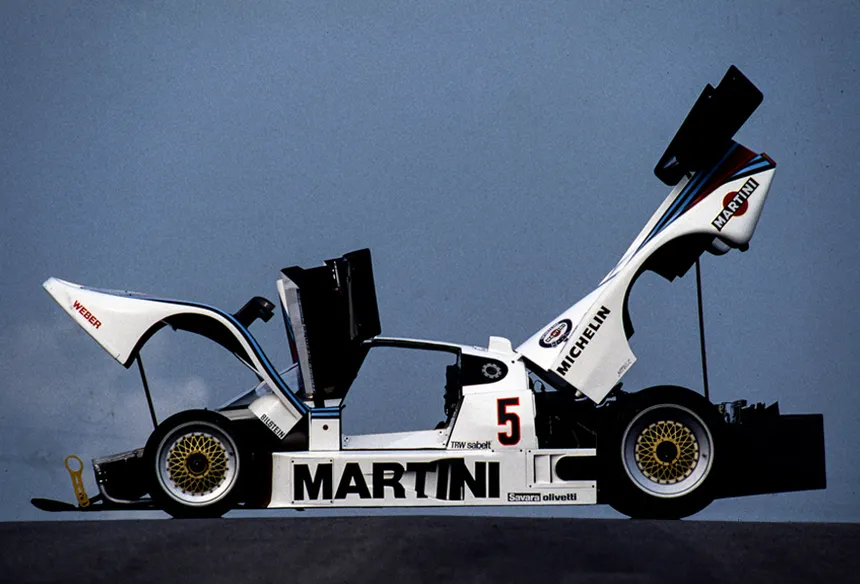
This is the story of the car that came within a whisker of embarrassing Porsche in its own house. The only serious Italian challenger to the 956 across the entire Group C era. A prototype built around a Dallara monocoque, a twin-turbo Ferrari V8, and Lancia Martini colours, capable of hitting 398 kilometres per hour down the Mulsanne straight, and yet a car that managed only three race wins across four seasons of world-championship racing.
It’s also, and hardly anyone tells you this, the B-side of the Lancia legacy. The brand that has won ten manufacturers’ World Rally titles has never won Le Mans outright. Never won Sebring. Never won Daytona. Endurance was always a wall. And the LC2 is the sharpest illustration of why.
The context: 1982, the LC1 dies and Group C is born
To understand the LC2 you need to know why it exists. And for that you need to rewind to 1982, the year the FIA rewrote the rulebook for the World Sportscar Championship.
Up until that point, the headline category had been Group 6: open-cockpit prototypes, no fuel consumption limit, engine architecture largely free. Lancia had competed through 1982 with the LC1, an open-cockpit prototype with a four-cylinder turbo engine. Good car. Fast. But in one clean administrative stroke, the FIA declared that from 1983 the World Championship would be run exclusively to Group C rules, with two non-negotiable requirements: closed coupé bodywork, and a fuel consumption cap of 60 litres per 100 kilometres.
The LC1 met neither. Open cockpit. Four-cylinder turbo engine that drank fuel like a Texas oilman on a night out. If Lancia wanted to stay in the World Championship for 1983, they had to build a new car from scratch.
The project landed on the desk of a man NEC readers already know: Cesare Fiorio. Sporting director of Lancia Corse, the same man who had fought Enzo Ferrari internally over the Stratos project back in the early 70s, the same man running the parallel rally programme with the 037 that would go on to win the 1983 WRC. Fiorio was the man for difficult decisions inside Lancia Corse. And this one was proper difficult.
The Fiorio call: if Fiat owns Ferrari, get Ferrari to lend us an engine
The technical problem was clear-cut: Lancia had nothing in its road car lineup that could serve as a base for a competitive Group C engine. The LC1’s four-cylinder turbo failed the fuel test. The Gamma flat-fours weren’t in the ballpark power-wise. There was no in-house engine.
But Fiorio had a card up his sleeve. Lancia had been owned by the Fiat group since 1969. And since 1969, Fiat had also owned Ferrari’s road-car business. Which meant that technically Ferrari and Lancia were sisters inside the same holding. If Lancia needed a big engine, Fiat could tell Ferrari to hand one over.
And that’s exactly what happened. Fiorio pulled the strings that got Ferrari to develop a purpose-built V8 racing engine for the LC2, taking the block of the Ferrari 308 QV — the same engine that powered the road-going 308 GTB — but redesigned from the ground up by Maranello’s competition department, drawing on architectural ideas from Ferrari’s Formula 1 V6 turbo engines of the same era (the Tipo 126C).
The result was the Ferrari Tipo 268. Ninety-degree V8, twin overhead cams per bank, four valves per cylinder, aluminium block and heads, twin KKK turbochargers with BEHR intercoolers, Weber-Marelli electronic fuel injection. Initial displacement of 2,599cc, later enlarged to 3,014cc for the 1984 season onwards. In race trim in 1983 it made between 520 and 650 horsepower depending on the boost setting dialled in for the fuel-consumption regs. In full qualifying trim, with the turbos turned up and fuel consumption off the table, it could push past 800 horsepower. Some sources quote as high as 850 by 1985.
Stop and appreciate how strange that arrangement was. The Fiat Group was fitting a Ferrari engine, with Formula 1 DNA, into a car that was going to wear the Lancia shield and race in a championship where Porsche was the direct opponent. Ferrari — the marque that defined Italian sports-car identity to the world — was handing over its engineering so a sister badge could take the credit in international competition. And it gets stranger: Group C rules gave the engine supplier priority in the car’s official name. For the first months of its life, the car was officially registered as “Ferrari-Lancia” before Lancia lobbied hard enough to flip that around.
The chassis: Dallara out of Varano
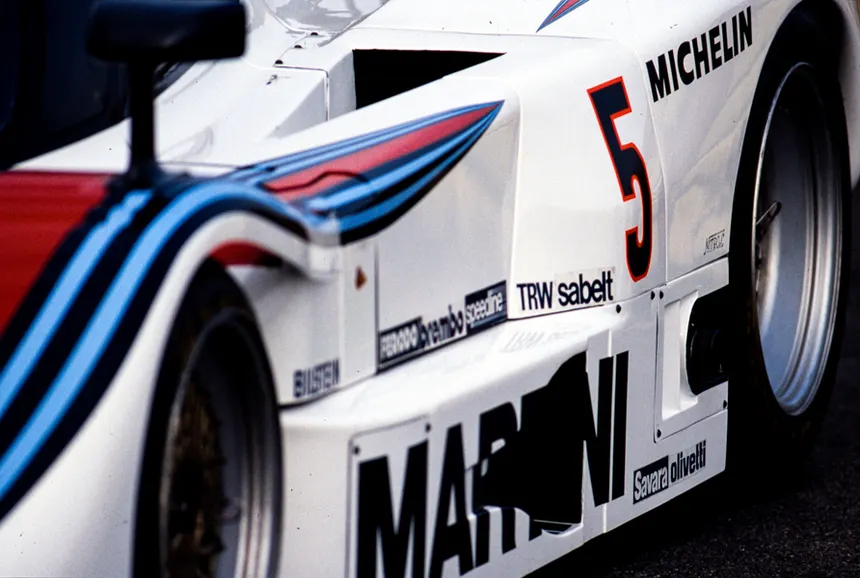
The engine was Ferrari. The chassis was Dallara.
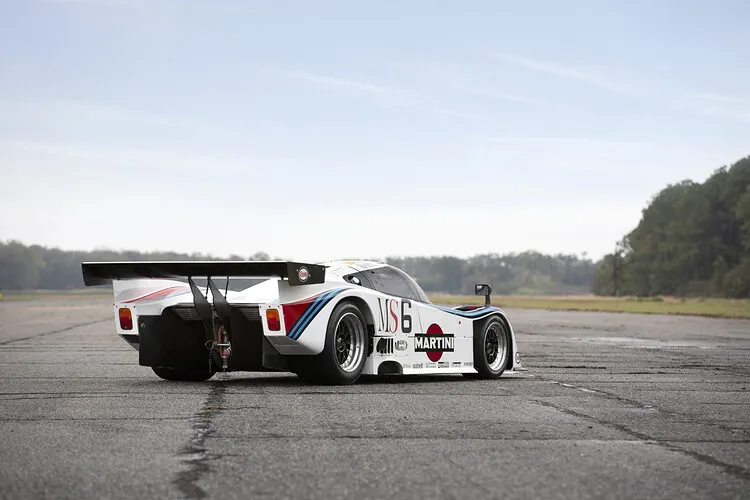
Gianpaolo Dallara, former Ferrari engineer and former technical chief at Lamborghini (where he was responsible for the Miura’s chassis), had founded his own operation in Varano de’ Melegari, near Parma, in 1972. By 1982-83, Dallara Automobili was already one of the European references in racing monocoque design. Lancia hired Dallara to build the LC2’s full chassis: an aluminium monocoque with the engine integrated as a stressed structural member, pushrod suspension, and ground-effect aerodynamics developed in the wind tunnel at the Fiat Research Centre in Orbassano.
This detail rarely gets told and it matters. The ground-effect package on the LC2 wasn’t developed by Dallara alone. It was done at the CRF — Fiat’s Centro Ricerche — where the group had also tested Formula 1 aerodynamics in previous years. Meaning the LC2 pulled on the full industrial muscle of the Fiat empire: Dallara for the monocoque, Ferrari for the engine, CRF for the wind tunnel, Abarth for the build, Lancia Corse for the race team. Four blue-chip Italian outfits in a single project.
Only seven works chassis were built, numbered LC2-0001 through LC2-0007. Plus two more for privateer teams. Nine cars total. That’s it. Kerb weight was around 800 kilograms.
The debut: Monza 1983, pole without a win
The LC2 was officially unveiled in February 1983 at a press conference at the Martini Museum, alongside the 037 Rally that would go on to win that year’s WRC. Two cars, two programmes, one Martini Racing operation.
Its first track outing was at the 1000 km of Monza, in April. Piercarlo Ghinzani drove chassis 0001 in free practice, but crashed and damaged the car. The race entries went to chassis 0002 and 0003.
In qualifying, the LC2 grabbed pole nearly a second clear of the fastest Joest Racing Porsche 956. That was the signal that the project had legs. Pure straight-line speed was there from day one.
The race was another story. The Pirelli radials fitted to the LC2 couldn’t handle the pace. The leading car dropped out with tyre issues. The second LC2 finished twelve laps down on the winning 956. Bittersweet debut.
The rest of the 1983 season was a running battle with two demons: tyres and reliability. Lancia switched from Pirelli to British Dunlop crossply tyres, but the suspension had been calibrated for the Italian rubber. No LC2 finished a World Championship race until round five, the 1000 km of Spa, where the three entered LC2s (two works plus one privateer) all made it home but well down the order.
The LC2’s first race win came at Imola in September 1983, with Teo Fabi and Hans Heyer at the wheel. That was a European Endurance Championship round, not a World Sportscar round. But it was the first. And it proved the car could finish — and win — when it held together.
1984: the year of almost-everything
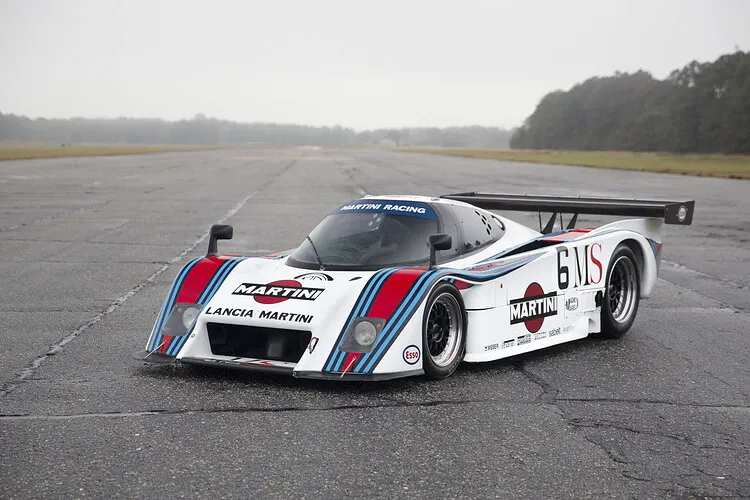
Coming into 1984, Lancia Corse showed up with a much more mature LC2. The Ferrari Tipo 268 engine had grown to 3 litres, the Magneti Marelli electronics let the bigger engine sip roughly the same fuel as the previous 2.6L unit, and the suspension had been redesigned around the Dunlop tyres.
The results started coming. Podium at the season-opening 1000 km of Monza. Pole and fourth at Silverstone. Pole and third for Nannini/Barilla at the Nürburgring 1000 km.
And then Le Mans happened.
With no Rothmans Porsche present that weekend, Wollek and Nannini walked qualifying. Wollek’s 3:17.11 pole was eleven seconds ahead of the best privateer Porsche 956. Nannini took second on the grid. Lancia locked out the Le Mans front row.
In the race, the LC2s led up to the halfway mark. Wollek and Nannini fought back and forth with the Kremer Porsche of Vern Schuppan (the 1983 winner) and Alan Jones. Then, mid-race, both LC2 gearboxes started giving trouble. They broke. Lancia lost the lead. Wollek and Nannini’s car did make it to the flag — completing the full 24-hour distance — but classified eighth. Nannini set the fastest lap of the race at 3:28.90, so the LC2s were still the outright quickest thing on track. But they didn’t win.
The LC2’s first World Championship victory came at the 1000 km of Kyalami, in South Africa, in November 1984. Wollek and Paolo Barilla, in chassis 0001, took pole at an average of over 202 km/h, nearly a second clear of the sister LC2 and almost three seconds ahead of the third-placed Porsche 956. In the race, the two LC2s lapped the field in just nine tours. Cesare Fiorio, from the pit wall, ordered his drivers to cross the line side by side. They did — first and second, almost wheel-to-wheel. The LC2’s second World Championship win.
1985: the year of almost-nothing
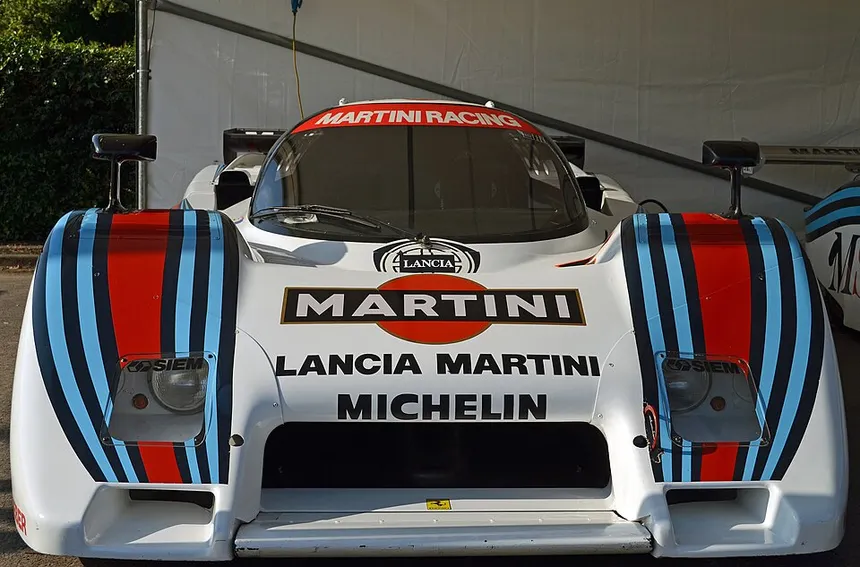
For 1985, the LC2 arrived with even more power and better electronics, but Porsche had also moved on. The 956 was giving way to the 962, which would prove even faster. And the LC2 started collecting the worst kind of bad luck.
At Mugello, an LC2 took pole. Then broke its engine. At Monza, an LC2 was heading for outright victory when race officials stopped the race after a tree fell across the circuit. At Silverstone, one of the LC2s lost a wheel nut while leading. At Le Mans, the two LC2s finished sixth (Wollek/Nannini) and seventh (Pescarolo/Baldi), but during qualifying one of them clocked 398 kilometres per hour down the Mulsanne straight, before the chicanes that would be added in 1990 to cut speeds. Three hundred and ninety-eight kilometres per hour. In an endurance car, with 800 horsepower, Bob Wollek at the wheel, and over six kilometres of open road ahead.
The LC2’s third and final World Championship win came at Spa-Francorchamps in September 1985. And that was that.
1986: the programme ends
For 1986, Lancia entered the World Championship with just one LC2. The results didn’t come. Mid-season, the marque officially pulled the plug on the Group C programme.
The final tally: three World Championship wins (Imola 1983 in the European title, plus Kyalami 1984 and Spa 1985 in the World Championship proper, depending on how you count), thirteen pole positions, and eleven fastest laps across roughly sixty starts.
For context: over the same 1983-1986 stretch, the Porsche 956 and its successor 962 won four consecutive Le Mans, three manufacturers’ World Championships, and dominated most seasons outright. The LC2 was the only serious Italian rival Porsche faced in that entire era. But Porsche won.
Why it didn’t win: fuel, gearbox, and Porsche
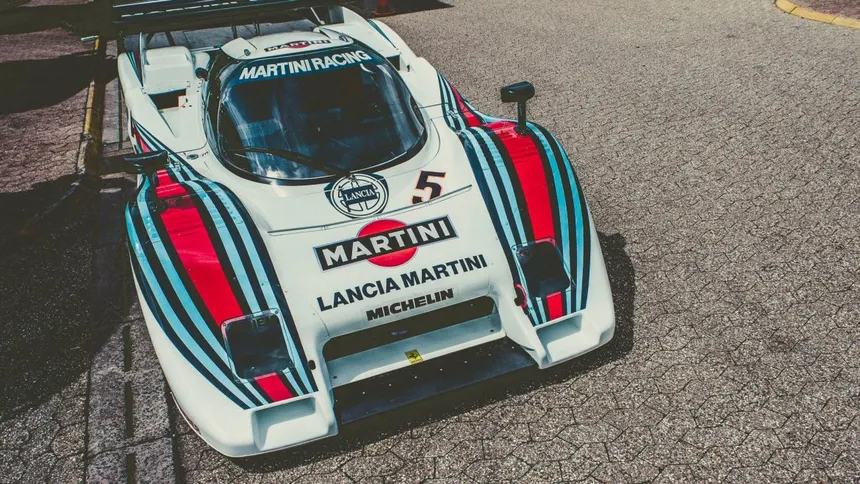
Worth pinning down properly, because the LC2 didn’t lose because it was slow. It lost for three specific reasons.
One, fuel consumption. Group C rules capped fuel use at 60 litres per 100 kilometres. The Ferrari V8 twin-turbo, even with all the Magneti Marelli electronic wizardry, struggled to respect that consumption in race trim without dropping power noticeably. The Porsche 956’s flat-six turbo was naturally more efficient. Over 24 hours, that difference translated into either extra pit stops or having to run detuned. Porsche was always more efficient. Lancia was always faster, but only when it could afford to push.
Two, the gearbox. Le Mans 1984 was the most brutal example, but not the only one. The LC2’s gearbox couldn’t handle the Ferrari V8’s torque cleanly. Synchros, shafts, gears — parts kept letting go. In a race that meant changing gear thousands of times over 24 hours, that fragility was fatal.
Three, Porsche. Never underestimate this. Through the 1980s, the 956/962 was arguably the best endurance racing machine ever built up to that point. Reliable as a Swiss watch, efficient as a diesel, and quick when it needed to be. Beating them wasn’t just a matter of having a better car. You needed a much better car, for 24 hours straight, with zero mistakes. The LC2 had the car. It didn’t have the margin.
The B-side of the Lancia legacy
This is the angle that hardly anyone tells and that in NEC deserves naming out loud.
Lancia holds the all-time record for manufacturers’ World Rally Championship titles: ten WRC constructors’ titles between 1974 and 1992. When Lancia’s sporting story gets told, it’s always the rally story. Stratos, 037, Delta S4, Integrale. Ten trophies.
What almost nobody mentions is the other side. Lancia tried repeatedly to win Le Mans and the endurance championship. With the Aurelia B20 GT in the 50s (second outright at the 1951 Mille Miglia, class win at Le Mans 1951). With the D24 in 1953 (Fangio’s outright win at the Carrera Panamericana). With the LC1 prototypes in 1982. With the LC2 from 1983 to 1986. Never an outright Le Mans win. Never a Sportscar / Endurance world title. Endurance was the wall that never came down.
The LC2 was the last serious fight Lancia ever picked in that category. And it was the closest they came. A gearbox failure and a better fuel calculation away from winning Le Mans 1984 outright. If that had come off, Lancia’s sporting record would be complete: rally, Formula 1 (indirectly via the D50 rebranded as Ferrari), and endurance. With the LC2’s near-miss, that triple crown stays incomplete forever.
It’s like a boxer who wins every lightweight belt on the planet but never lands the heavyweight one. He gets respected. He gets applauded. But the trophy cabinet has a hole in it.
Current value and collectability
An authentic LC2 today is one of the rarest pieces in the entire Group C collector market. Only nine exist worldwide (seven works chassis plus two privateer originals), almost all identified by chassis number with documented race history.
Chassis 0001 — the very first LC2 built — changed hands in 2020 through Girardo & Co in London to a California-based collector. Chassis 0007, the last works car, sold recently to another West Coast collector. Auction figures aren’t always public, but the whisper numbers among Group C collectors range from four to six million euros depending on condition and race history, with some chassis pushing higher if they have documented Le Mans podium history.
These cars still run in the historic Group C series organised by Peter Auto and similar outfits. Watching one on track in 2025, with that twin-turbo Ferrari V8 howling under Martini livery, still produces the emotional charge that only comes from cars that represented something bigger than their trophy count. When the LC2 fires up at Spa, Monza, or the Nürburgring, it still sounds like the whole of Italy up against the world. Even though it never won.
There’s the editorial lesson of the LC2. Cars that almost win sometimes get remembered better than cars that do win. Because the almost-win has poetry, and the win has only data. Bob Wollek nailing that pole eleven seconds clear at Le Mans 1984. Nannini setting the outright fastest lap before the gearbox let go. Three hundred and ninety-eight kilometres per hour down Mulsanne. Fiorio’s call to bring the cars over the line side-by-side at Kyalami. Those moments have survived in European petrolhead memory far better than most of the Porsche wins from the same seasons.
Because the Porsche 956 won on routine. The LC2 raced on legend. And legends, even when they don’t end with a trophy, always end up in a book. Or in an article.
This one’s yours. The Italian car that came within a gearbox of embarrassing Porsche at Le Mans. The only Group C prototype ever powered by a purpose-built Ferrari engine. Lancia’s last serious swing at endurance racing. And the missing piece Cesare Fiorio needed to make his career complete.
Check you’re still alive.