Alfa Romeo 33/2 Coupé Speciale: The Ferrari Show Car That Became an Alfa
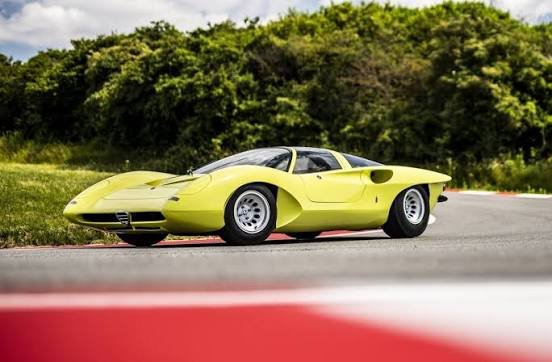
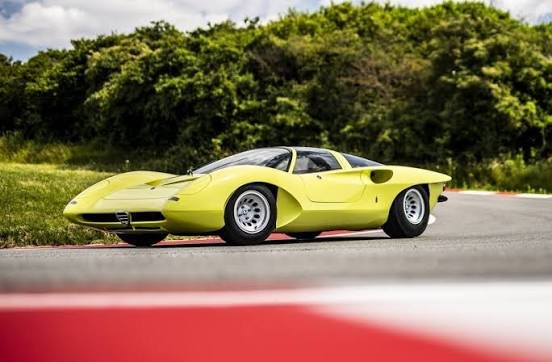
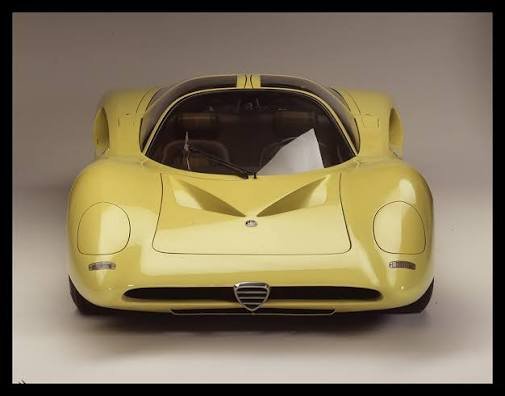
The man who designed the Ferrari F40 also designed a bright yellow Alfa Romeo. Almost nobody knows that. What even fewer people know is that the Alfa was not really designed as an Alfa at all. It was a Ferrari show car that got a haircut, a new set of headlights, a pair of BMW tail lights and an Alfa Romeo shield on the nose before being wheeled onto Alfa’s stand at the Paris Motor Show on October 1, 1969.
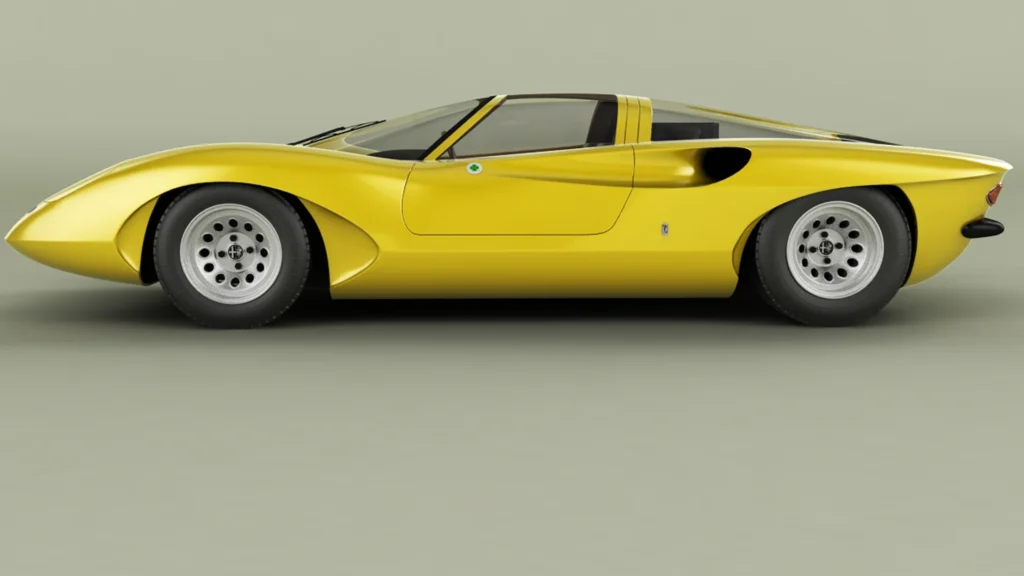
The car is the Alfa Romeo 33/2 Coupé Speciale. It is routinely called the most beautiful of the concepts built on the Tipo 33 Stradale chassis. It may well be. It is also the one with the most awkward paperwork, and to this day there is no agreement on whether the body sitting in Alfa Romeo’s museum is an original creation or a recycled one.
Start with the Ferrari
In March 1968, at the Geneva Motor Show, Pininfarina unveiled the Ferrari 250 P5. The designer was Leonardo Fioravanti, then in his early thirties and only four years into the job.
The P5 belonged to a run of Pininfarina show cars built between 1965 and 1970 on Ferrari racing chassis that had outlived their usefulness. The lineage started with a long-wheelbase 250 LM Stradale in early 1965 and ran through the Dino 206 Berlinetta Speciale, the Dino 206 Competizione and the wild 365 P Tre-Posti.
What everybody remembers about the P5 is the bank of full-width headlights sitting under a clear plastic panel. Seven months later the 365 GTB/4 Daytona borrowed that Plexiglas treatment and turned it into one of the most recognizable faces in automotive history. Same designer, same idea, one of them sold 1,284 units and the other one was a one-off.
Here is the part that gets left out of the coffee-table books. The P5 could not move under its own power. Ferrari handed Pininfarina a Formula 1 dummy engine to fill the hole. The real 1967-spec 312 units were all-alloy 60-degree V12s of 2,989 cc, 77 mm bore by 53.5 mm stroke, three valves per cylinder, twin-plug ignition, Lucas fuel injection, 11.8:1 compression, and 390 bhp at 10,500 rpm. On paper that would have made the P5 one of the fastest cars on earth. In practice it was a gorgeous piece of furniture being pushed around the hall by show staff.
The chassis under it is disputed too. Supercar Nostalgia says it began life as Dino 206 S number 020, adapted by Pininfarina to take a fake V12, and elsewhere describes it as a frame prepared for the 1968 European Hillclimb Championship and modified for a flat-12. A large share of the spec sheets floating around the internet call it a P4 chassis, some of them citing number 0862, and conceptcarz hedges with the word “probably.” Nobody has closed that question. Anyone stating it flatly is picking a favorite.
Ten millimeters made it possible
After Geneva, the P5 was repainted white with blue wheels and fitted with more conventional seats with blue ribbed centers. In that trim it appeared at the Turin Motor Show in November 1968. Straight afterward it went back to Pininfarina, and what came out the other side wore an Alfa badge.
The Alfa chassis Pininfarina received was number 750.33.115. The Stradale wheelbase measured 2,350 mm, just 10 mm longer than the modified Ferrari frame. That is the entire engineering reason this swap happened. Ten millimeters. Two more inches of difference and the whole idea would have died on a drawing board in Turin.
The surgery was extensive but selective.
Deleted: the central bank of covered headlights, replaced by cutouts for pop-up units on each pontoon fender. Deleted: the tail fascia with its five horizontal slats wrapping around toward the rear wheel arches, which had been the single most futuristic thing about the Ferrari. Deleted: the slatted grilles inside the cooling intakes carved into each flank.
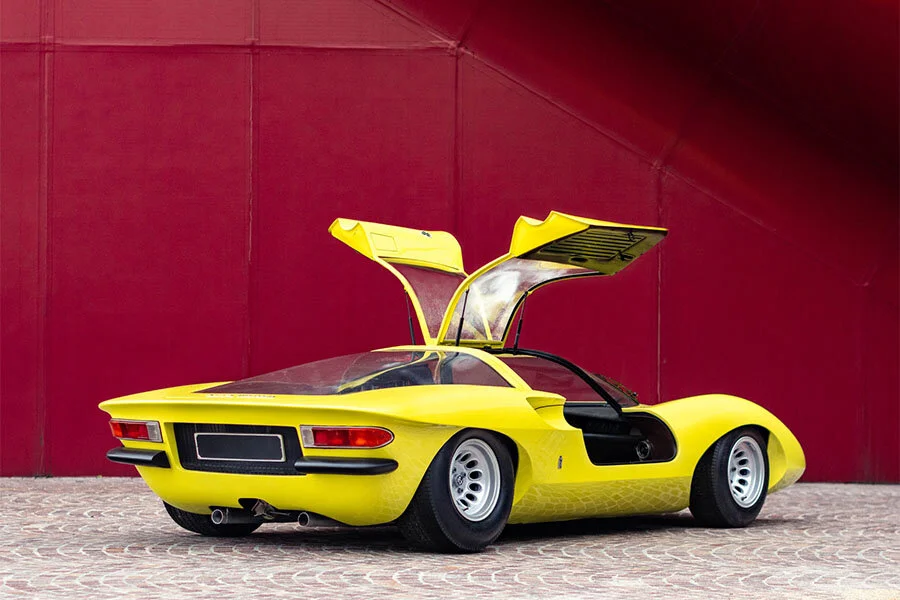
Kept: the pontoon fenders, the cutaway body sections behind the wheels, and the gullwing doors with their one-piece glass.
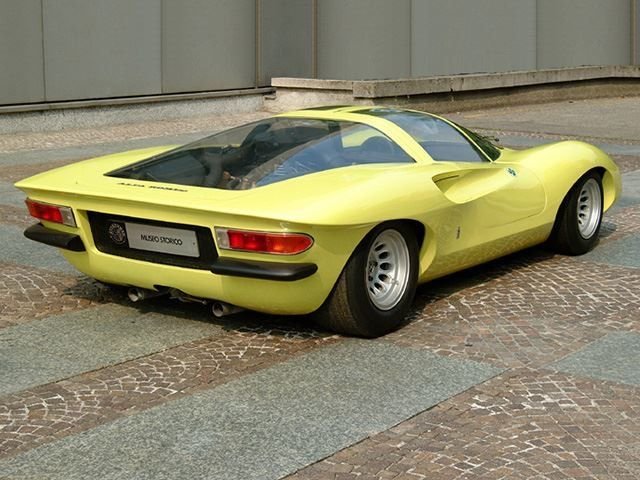
Added: a removable front lid with access hatch, the Alfa Romeo shield, a rectangular rear air vent, a reprofiled lower apron, satin black bumperettes, and tail light clusters lifted from the BMW E9 coupe. That last detail is my favorite thing about the car. The most elegant prototype Alfa Romeo showed in the sixties was wearing production German tail lights. I have found that documented in a single source, so treat it as unconfirmed, but it matches the photographs.
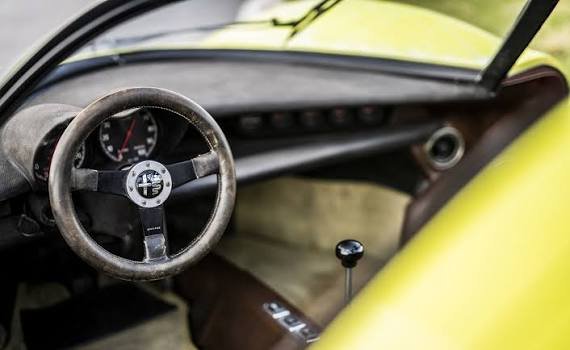
The cabin was rebuilt from scratch. The P5 was right-hand drive like all the Dino P cars; the Alfa went left-hand drive. A full-width Alcantara dash carried a twin-gauge binnacle for speedometer and tach, with supplementary instruments laid out horizontally between the dash top and the knee roll. Seats got brown leather bolsters and green tartan velour centers matching the headrests, with brown leather on the sills, side walls, transmission tunnel and rear bulkhead, over pale green carpet. The Ferrari’s interior had been plain black vinyl with red-and-black striped seat centers. Nothing carried over.
Outside, it was painted a loud yellow.
The question nobody has answered
Same body or new body? That is the whole argument, and it is unresolved.
Supercar Nostalgia states it plainly: the P5 returned to Pininfarina from Turin and its body was modified to sit on the Alfa chassis. Same skin, heavily reworked. Coachbuild.com tells it differently: it was long believed to be the same fiberglass body, but after a recent restoration by Pininfarina the conclusion was that it is in fact a new body.
Both are credible outlets. Both cannot be right.
My problem with the second version is not that it is implausible. New mold, new laminate, done. My problem is that I have not found the restoration report published anywhere, nor the criteria used to reach that conclusion, nor a name attached to it. We are asked to accept it on authority. And the conclusion happens to flatter everyone involved: Pininfarina gets credit for two designs rather than one plus a rerun, Alfa Romeo owns an original rather than a hand-me-down, and the museum has an original in the display case.
Until that report is on the table, this is open. Presenting it as settled is not journalism, it is public relations.
The engine, at least, was real
The joke writes itself. The Ferrari had a fake engine. The Alfa had a real one.
Behind the rear glass sat Autodelta‘s 90-degree V8: 1,995 cc from a bore and stroke of 78 mm by 52.2 mm, two chain-driven overhead camshafts per bank, four ignition coils, sixteen spark plugs, SPICA mechanical fuel injection, and a 10.0:1 compression ratio. Peak output was 230 bhp at 8,800 rpm.
To understand what that meant in 1969, put it next to an exact contemporary. The Ferrari Dino 206 GT, built between 1967 and 1969 in roughly 152 units, ran a 1,986.60 cc V6 producing 180 PS at 8,000 rpm and topped out around 235 km/h. Same country, same years, effectively the same displacement, same mid-engine layout, and a 50-horsepower gap.
The reason is that these are not the same species of engine. The Dino’s V6 was ultimately built in Turin by Fiat workers on a production line, breathing through Weber carburetors with wet-sump lubrication, designed to be sold in volume. The Alfa V8 came out of Autodelta as a direct derivative of a racing prototype, with mechanical injection and competition architecture. One is a racing engine with a driver’s license. The other is a very good road engine. The gap shows up on the spec sheet and again on the maintenance invoice.
Gearbox, frame, and figures that don’t line up
The transmission came from Colotti, and that decision deserves a sentence of explanation. In 1969 Alfa Romeo had nothing in its production parts bin that could handle a mid-mounted engine spinning to nearly 9,000 rpm. Colotti was an outside specialist in competition gearboxes. Buying from them was cheaper and faster than engineering an in-house unit for a handful of cars. A ZF limited-slip differential and a single-plate hydraulic clutch completed the package.
Now the number that refuses to settle. Supercar Nostalgia gives five speeds for this car. Carrozzieri-italiani gives six. Most general documentation on the 33 Stradale says six. I cannot close that with a primary source, so it stays flagged as unverified: five or six, depending on who you ask.
Underneath, the 33/2 Coupé Speciale was mechanically identical to a standard Stradale, which itself used the large-tube perimeter frame of the 1967 Tipo 33 racer. Two light-alloy side members doubled as fuel tanks, with front and rear subframes carrying suspension, engine, gearbox and differential.
The fuel-tank side members are worth pausing on, because that is a racing solution with a specific purpose. Putting the fuel between the axles and low along the car’s spine means the weight distribution barely shifts as the tank empties. An endurance prototype spends an entire race losing weight; this is how you stop it from changing character while it does.
Suspension used wishbones, coil springs and anti-roll bars, with radius rods added at the rear. Fully adjustable telescopic dampers sat at all four corners, with ventilated disc brakes mounted inboard at the back.
Wheels were 13-inch magnesium, 10 inches wide up front and 12 at the rear, originally on Dunlops. A caution: those widths are considerably greater than what is normally documented for a road-going 33 Stradale. Either this car ran bespoke rims or a source is wrong. I am not calling it either way.
Fioravanti, the man Americans have been looking at for fifty years
Leonardo Fioravanti was born in Milan on January 31, 1938. He studied mechanical engineering at the Politecnico di Milano, specializing in aerodynamics and body design under Antonio Fessia, the engineer behind the Lancia Flaminia, Flavia and Fulvia. Pininfarina hired him as a stylist in 1964, at 26. He stayed 24 years.
His first assignment was reworking the roof of the Ferrari 250 LM for aerodynamic efficiency. Then the Dino 206, developed from earlier concepts. Then the P5 and P6 show cars. Then the Daytona, which he drew on his own initiative because Ferrari had not asked for a new model and was perfectly happy with the 275 GTB. He walked through the factory, saw bare chassis already fitted with V12s, and went off to build a full-size model of his own idea.
The rest of the list is the reason his work is on more American bedroom walls than he will ever know: the Dino 246, the 512 Berlinetta Boxer, the 365 GT4 2+2, the 308 GTB, the 288 GTO and the F40.
And a final twist. Years later, Fioravanti served as design director at Alfa Romeo’s Centro Stile. The man who dressed an Alfa in Ferrari’s clothes in 1969 ended up running Alfa’s wardrobe.
The only one that predicted nothing
Alfa Romeo distributed surplus Stradale chassis to Italy’s leading design houses, and the results arrived in stages. Bertone’s Carabo, drawn by Marcello Gandini, came first at Paris in October 1968. Pininfarina’s P33 Roadster followed four weeks later at Turin. The 33/2 Coupé Speciale was third, at Paris on October 1, 1969. Later came Paolo Martin’s Cuneo in 1971, built on the same chassis as the P33 Roadster, and Bertone’s Navajo in 1976. Italdesign’s Iguana, by Giorgetto Giugiaro, rounds out the group.
Every one of those cars reached for straight lines and sharp angles. Every one of them was pointing at the wedge that would define the seventies and eighties. The Carabo is essentially the first draft of the Lamborghini Countach.
The 33/2 Coupé Speciale was the exception. It is curved, organic, full of radii, carrying the pontoon fenders and cutaway rear sections of the mid-sixties endurance prototype school. In a group of cars all looking forward, this one was looking back.
That is not a failure. It is a closing statement. It is the last time anyone built one of these shapes before the straightedge took over Italian design for two decades.
After Paris it made a couple more show appearances and then retired into Alfa Romeo’s Museo Storico, where it has lived since. It surfaced again at Rétromobile in Paris in 2005.
The verdict
Plenty of people will tell you this is the most beautiful of the Tipo 33 concepts. They may be right. It is also the only one of them that Alfa Romeo never commissioned as an original design.
Bertone got a chassis and Gandini drew the Carabo. Italdesign got a chassis and Giugiaro drew the Iguana. Alfa Romeo got an exercise that Pininfarina had already built for Maranello, with the headlights moved, the tail cut down, and a set of BMW lenses fitted at the back. Alfa put its shield on the nose, painted it yellow and took it to Paris as new.
That is not a knock on the car. It is a knock on Alfa Romeo. This is the company that two years earlier had spent serious money building the 33 Stradale for no commercial reason whatsoever, the company whose president told Carlo Chiti the road car could not give up more than five percent to the racer. In 1969 that same company put a secondhand suit on its main stand and called it a debut. The car is not the symptom. The decision is.
So the next time someone shows you a yellow photograph and calls it the crown jewel of Arese, you are entitled to ask for the body’s provenance, not just the chassis number.
Check you’re still alive.