Alfa Romeo 75: The Last Real Alfa Romeo, the Car That Closed a Century of Independent Marque
There are three things any serious Alfisti will tell you about the Alfa Romeo 75 before you’ve finished saying hello:
One: the 75 is the last Alfa Romeo with transaxle architecture in the marque’s history. After the 75, in 1992, no production Alfa Romeo has carried gearbox and clutch at the rear integrated with the differential. None. Not the 155, not the 156, not the 159, not the modern Giulia. That kind of engineering ended with the 75.
Two: the 2.0 Twin Spark engine introduced in the 1987 Alfa 75 was the world’s first production engine with a variable valve timing (VVT) system. Before Honda VTEC (1989). Before any Japanese VVT system. Before any German one. Alfa Romeo, two years before Honda. And nobody in the global press recognised it at the time, because the marque had been in financial crisis for fifteen years and nobody expected technical innovation from Portello any more.
Three: the 75 is the last car Alfa Romeo launched as an independent marque before being bought by Fiat in 1986. It was unveiled in May 1985 to celebrate the 75th anniversary of Alfa Romeo’s founding (the “A” in ALFA stands for Anonima Lombarda Fabbrica Automobili, founded in 1910). The “75” name isn’t an arbitrary number. It is simultaneously the commercial signature of an anniversary and the headstone of an industrial era.
These three things, taken together, explain why the 75 has the most densely passionate fan base in all of modern Alfa Romeo history. More than the 156. More than the 4C. More than any model after 1992. Owners of the 75 are the last generation of buyers who purchased an Alfa Romeo built entirely under independent Italian management, with the technical architecture the marque had been refining since the Tipo 158 Alfetta of 1950 Formula 1, and which hasn’t been used in forty years since.
This is the car. And it’s worth telling the story slowly, because it’s one of the few cases in which the car is exactly what its name says it is: a technical tribute to 75 years of brand history, and a symbolic closure of those 75 years. A double reading running simultaneously.
May 1985: the 75th anniversary and the latent bankruptcy
To understand the 75 you need to understand what was happening to Alfa Romeo in 1985. The marque had been losing money throughout the decade. The Alfasud, which I covered in the previous pack, had sold over a million units but none of those units had turned a profit. The Pomigliano d’Arco plant was structurally expensive. Corrosion warranties drained the books year after year. The sporting range (GTV6, Alfetta, Giulietta) was ageing without replacement. The IRI, the Italian state holding company that had controlled Alfa Romeo since 1933, had been quietly looking for a buyer for years.
The internal industrial plan called for two new cars to reorganise the mid-upper range: a K2 project led by Marcello Gandini at Bertone that would produce the Alfa Romeo 90 (a more conservative executive saloon), and an in-house project led by Ermanno Cressoni at Centro Stile Alfa Romeo that would produce the direct successor to the Giulietta. That second car is the 75.
The financial constraints on the project were brutal. Alfa Romeo had no money to build a completely new car from chassis to body. The board required Cressoni and the engineering team to recycle as many Giulietta and Alfetta components as possible. The 75’s doors are literally Giulietta doors. The platform is the 1972 Alfetta platform, itself derived from the Tipo 158 Alfetta Formula 1 car of the 1950s. Cressoni had to design a modern car using structural components fifteen years older.
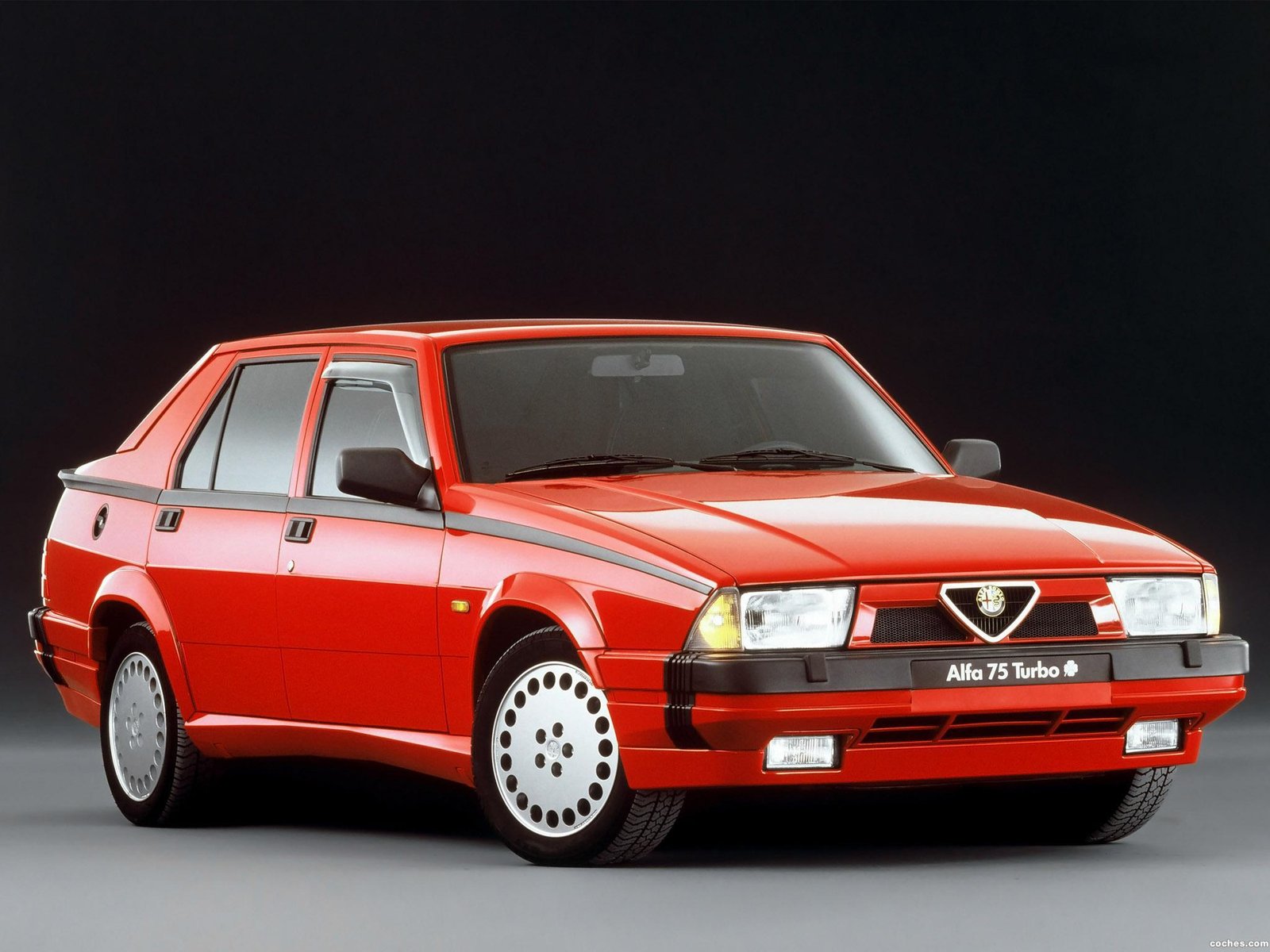
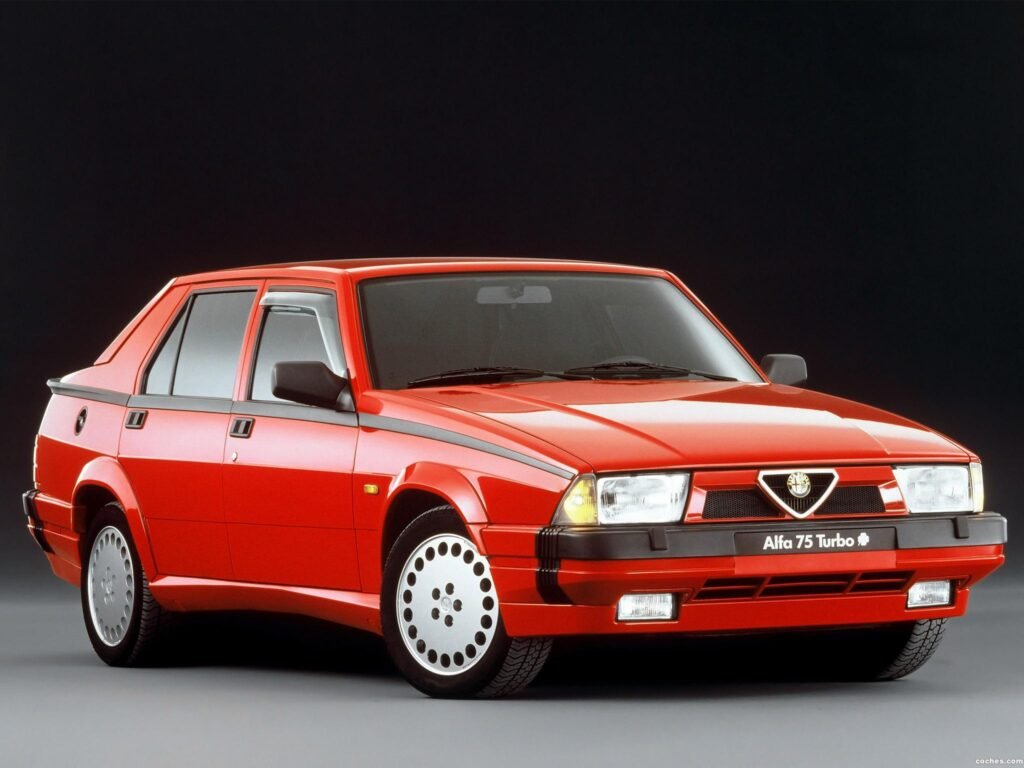
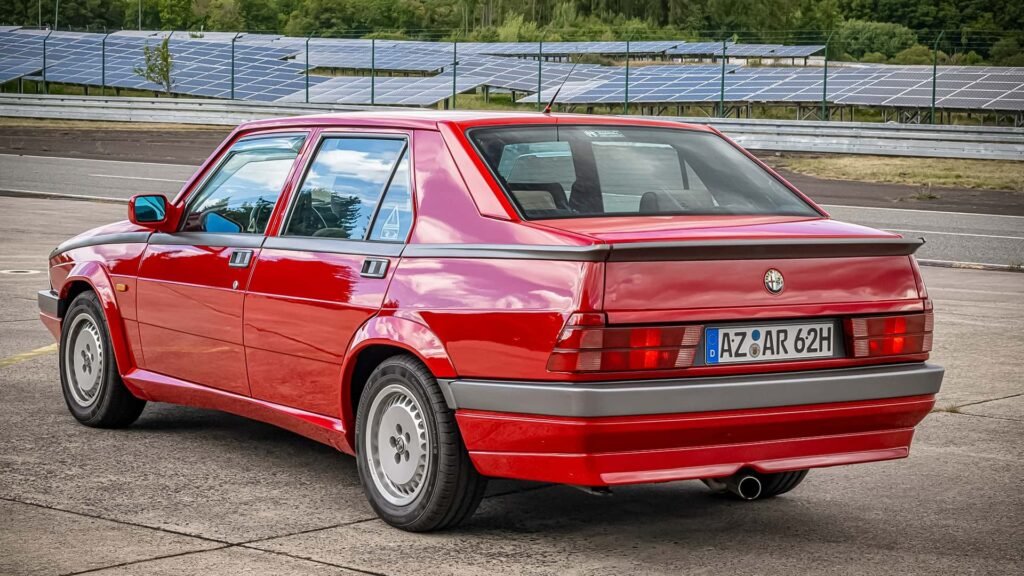
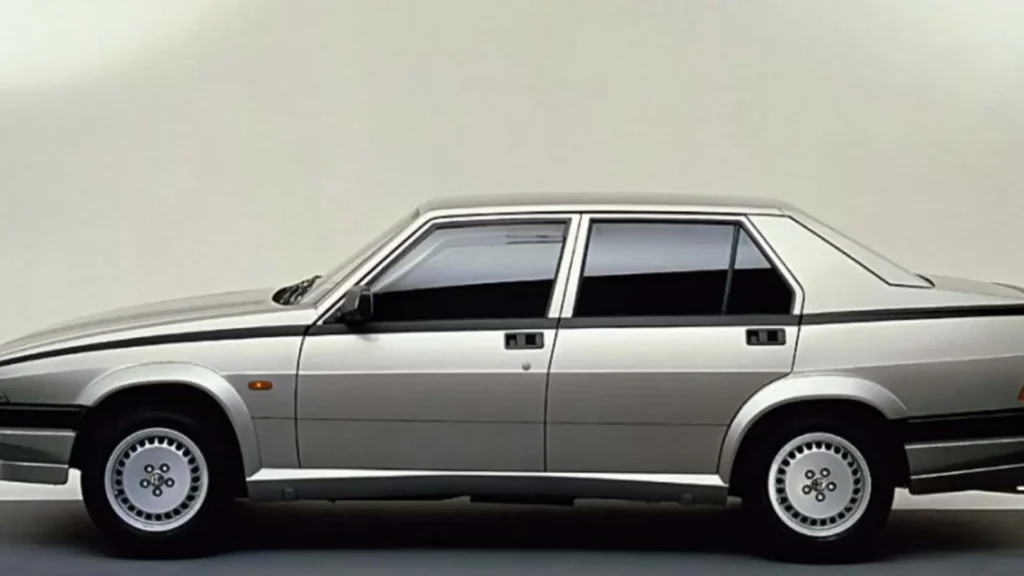
And he pulled it off. The 75 emerged in May 1985 with an aggressive wedge silhouette, square headlights (the same stylistic signature Cressoni had used on the Alfa 33 of 1983), a characteristic raised rear quarter that has become the car’s most recognisable visual feature, and proportions that completely disguise its Giulietta origin. If you’re not an Alfa Romeo mechanic, you cannot tell the doors are old.
The name was fixed for a dual commercial and symbolic reason: Alfa Romeo turned 75 years old in 1985 (the founding company, ALFA, Anonima Lombarda Fabbrica Automobili, was constituted in 1910 at Portello, Milan, as I told you in the origins article). Naming the car “75” was a homage to the anniversary. But it was also, without anyone on the board wanting to acknowledge it openly, the implicit recognition that this was the last car the marque would be able to develop autonomously. In August 1986, fifteen months after the 75’s launch, Fiat bought Alfa Romeo from the IRI for a reduced sum. The 75 had arrived on the market as an independent Alfa Romeo and continued in production as an Alfa Romeo-Fiat.
Transaxle architecture: the inheritance of the Tipo 158 Alfetta Formula 1
Here comes the car’s most important technical piece, the one that has to be examined slowly because it’s what defines the 75 as a mechanical object different from any other modern Alfa Romeo.
The concept of transaxle (gearbox and clutch mounted at the rear of the car, integrated with the rear differential, connected to the front-mounted engine by a driveshaft) is not a 75 invention. Alfa Romeo invented it in 1950 with the Tipo 158 Alfetta Formula 1 single-seater, the car with which Giuseppe Farina won the first Formula 1 World Championship in history in 1950 and Juan Manuel Fangio the second in 1951. That architecture, in F1, allowed better weight distribution in a single-seater. Alfa Romeo transferred the same idea to a road car for the first time with the 1972 Alfetta. From there it passed to the 1977 Giulietta, the 1981 GTV6, and finally to the 1985 75. The 75 is the last commercial iteration of a 1950 F1 engineering concept.
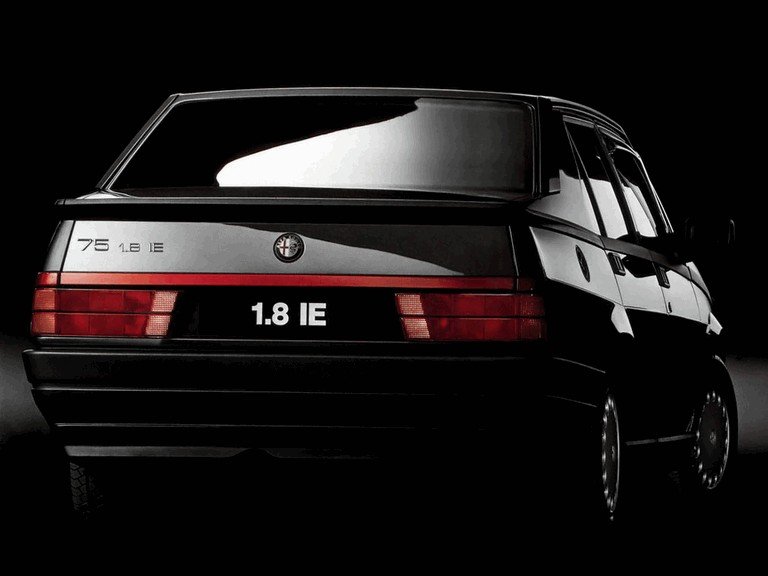
How does it work in the 75? The engine is up front, where you’d expect it. But the clutch, gearbox housing, five-speed gear set and differential are at the rear, integrated into a single compact unit beside the rear axle. That housing is called the transaxle. It’s connected to the engine by a two-segment driveshaft running the full length of the underside of the car. The shaft turns at engine speed, not wheel speed.
A technical detail worth highlighting: the engine crankshaft is bolted directly to the driveshaft with no flywheel in between. There is no conventional flywheel. The rotating inertia of the engine-shaft-gearbox system is distributed along the full length of the car. This reduces the mass concentrated at the front and improves overall weight distribution. The 75 has near-perfect 50:50 weight distribution in four-cylinder versions (the V6 cars are marginally more nose-heavy because the Busso V6 weighs around 30 kg more than the four-cylinder unit).
The two segments of the driveshaft are joined by elastomeric ring-shaped damper rings (the famous “doughnuts” of the 75) that absorb longitudinal vibrations and prevent torsional damage to engine and gearbox. Those doughnuts are a characteristic 75-and-Alfetta service item: after 80,000 or 100,000 km, they typically degrade and need replacement. Any mechanic who has worked on an Alfetta or a 75 will tell you the same thing: the doughnuts are a recognisable Alfa Romeo trait and almost nobody else’s in mass production.
Inboard rear brakes and torsion bar front suspension
The 75’s technical package brings in more components inherited from competition use. The rear disc brakes are mounted inboard. That means they are not at the rear wheels, as in any normal car. They are next to the transaxle, in the centre of the rear axle. The reason is the same as on the Alfasud (covered in the previous pack): to reduce unsprung mass. By taking the discs off the wheels and putting them next to the transaxle, the wheels weigh less, the suspension works faster, the car responds better to road imperfections.
The front brakes are on the wheels in the conventional position. The asymmetry (inboard at the rear, conventional at the front) is a cost decision: putting all four discs inboard would have been mechanically better but more expensive to build.
The 75’s handbrake acts mechanically, by cable, on dedicated rear callipers mounted at the output of the transaxle differential unit. It is not hydraulic, though it is sometimes wrongly described that way through confusion with the main brake circuit. It is a cable system that activates dedicated callipers for the parking brake, located next to the transaxle at the rear axle, rather than working through the main inboard discs. The choice is coherent with the transaxle architecture: since the gearbox and differential sit at the rear, concentrating the handbrake callipers in the same module simplifies the routing of the cable from the cabin lever. It is also a classical Alfetta-era Alfa Romeo engineering decision that the 75 inherited unchanged.
The 75’s front suspension uses torsion bars, not coil springs. This matters. In 1985, almost every European car used coil springs at the front for simplicity of manufacture. Torsion bars (a system in which a metal bar twists along its length to absorb compression loads) are more sophisticated, more compact, and allow very fine ride-height adjustmentsimply by turning the bar at the chassis end. Porsche used torsion bars in its sports cars (the 911 until the late 1980s). Citroën used them on certain models. Alfa Romeo used them on the 75 to maintain platform compatibility with the Alfetta and to achieve a more sophisticated chassis behaviour than the average 1980s European saloon.
The 75’s rear suspension is a De Dion axle. Another inheritance. Invented at the end of the nineteenth century by Count de Dion in France, the De Dion axle combines a rigid rear axle (which keeps the two rear wheels always parallel to each other) with independent elastic elements (coil springs in the 75’s case) and a differential fixed to the chassis rather than to the axle. It’s the best of both worlds: the robustness of a rigid axle with the vibration isolation of independent suspension. Alfa Romeo had used it on the Alfetta since 1972 and kept it on the 75 until 1992. It’s a mechanical system the modern industry has completely abandoned for cost reasons. The last European production car with a De Dion axle was probably the Smart Roadster Brabus of 2003.
The 2.0 Twin Spark: the world’s first VVT
Here comes the most underrated technical piece of the 75 and of all of 1980s Alfa Romeo history. In 1987, two years after the launch, Alfa Romeo introduced a new version of the 2.0-litre four-cylinder. They called it Twin Spark. The designation came from the fact that the new engine had two spark plugs per cylinder, a technical solution you already know from the Merosi (1914) and Giulia GTA (1965) packs.
But the real novelty of the 75 Twin Spark wasn’t the twin spark. It was the variable valve timing system.
The 2.0 Twin Spark engine of the 1987 Alfa Romeo 75 was the world’s first production engine to incorporate a variable valve timing (VVT) system optimising valve opening and closing depending on engine revs. The system was patented by Alfa Romeo. It worked through a hydraulic actuator that modified the phase of the intake camshaftdepending on engine speed and load. At low revs, the valves opened later to improve fuel economy. At high revs, the valves opened earlier to maximise power.
This technology would become universal across the industry twenty years later with systems like Honda VTEC (1989), Toyota VVT-i (1996), BMW VANOS (1992), Ford Twin Independent Variable Cam Timing (Ti-VCT, 2000s). But the first was the Alfa Romeo 75 Twin Spark of 1987. Two years before Honda VTEC. Five years before BMW VANOS.
The Twin Spark engine in the 75 produced 148 horsepower at 5,800 rpm with 186 Nm of torque. For a 1987 naturally aspirated 2.0-litre four-cylinder, that’s an excellent figure. But the figure isn’t the point. The point is that VVT was in the engine. If the global automotive industry had been paying more attention to Alfa Romeo in 1987 instead of to Honda in 1989, we’d be telling the story of VVT as an Italian story, not a Japanese one. But Alfa Romeo didn’t have the global marketing muscle to sell the innovation, and Honda’s VTEC took all the media credit.
It’s one of the clearest cases of Italian technical innovation that the official history of motoring barely remembers.
The Busso V6: the Quadrifoglio Verde symphony
Alongside the Twin Spark, the other engine that defines the 75 emotionally is the Busso V6. Designed by Giuseppe Busso, an Alfa Romeo engineer born in 1913 and with the company since the late 1930s (with a brief stint at Ferrari in 1946-1947 before returning to Portello), the Busso V6 entered production in 1979 with the Alfa 6 and remained on sale until 2005, a 26-year commercial career across multiple models: Alfa 6, GTV6, 90, 75, 164, 155, 156, GTV (Type 916), Spider 916, 166.
The Busso V6 in the 75 was offered in two main displacements:
- 2.5 litres / 156 hp (2.5 6V Iniezione or 2.5 QV): initial version 1985-1987
- 3.0 litres / 188 hp (3.0 America): introduced in 1987 with bore increased to 2,959 cc, originally developed for the US market under the Milano Verde name and later imported into Europe
Technical features of the 75’s Busso V6:
- 60-degree bank angle (not 90 degrees like many American V6s)
- SOHC per bank (single overhead camshaft per cylinder bank, two in total)
- Aluminium block and heads
- Bosch L-Jetronic electronic injection (analogue) initially, later Bosch Motronic (digital) from 1990
- Limited-slip differential standard
- Acoustic signature considered one of the finest among production atmospheric V6s
That last point deserves emphasis. Any Alfisti will tell you that the Busso V6 sound is the marque’s most recognisable acoustic signature. The engine has a mid-bass tone with high harmonics that climb into the treble at high revs. It’s a sound the Italian motoring press of the 1980s and 90s dedicated almost as much column inch to as the Ferrari V12s. No exaggeration. If you enter any active Alfisti forum today and ask which Alfa Romeo engine they prefer, probably more than 70% will name the Busso V6 of the 75 or the GTV6.
The 1.8 Turbo: the first Alfa Romeo production turbo
In 1986, Alfa Romeo introduced into the 75 range a turbocharged variant of the four-cylinder: the 1.8 Turbo. It was the first series-production turbocharged engine in Alfa Romeo’s 76-year history. The marque had done Roots-type superchargers on the 1930s 8Cs (covered in the 8C 2300 pack), and supercharging on the GTA-SA (Giulia GTA pack), but a real production turbo, never before 1986.
Technical specifications:
- 1,779 cc displacement (the same Twin Cam block, unstretched)
- Garrett T3 turbo (one of the most popular turbos of the era, also used by Saab and Ford)
- Air-to-air intercooler in front of the radiator
- Water cooling for the turbo housing in addition to oil cooling (rare for the period)
- Sodium-chloride-filled exhaust valves for better thermal dissipation
- 155 horsepower at 5,800 rpm
The 1.8 Turbo was faster than the 2.5 V6 in its initial form and cheaper to manufacture. In some European markets, it cost less in road tax because of its lower nominal displacement. That’s why it outsold the V6 in its early years. It is considered today the most interesting engine of the 75 from a tuning perspective because the block accepts much higher boost pressures without failing.
The 75 Turbo Evoluzione: 500 units for Group A
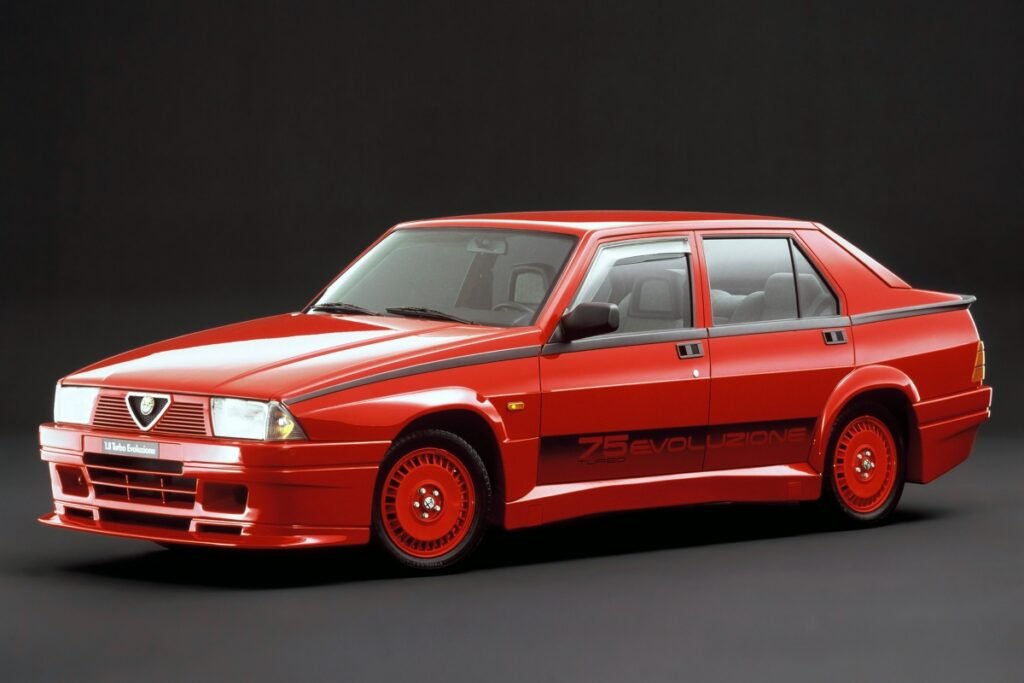
In the spring of 1987, Alfa Romeo built 500 units of a special homologation version of the 75 Turbo: the Turbo Evoluzione. It was Alfa Romeo’s response to the BMW M3 (1986), the Ford Sierra Cosworth RS (1986), the Mercedes 190E 2.3-16 (1984), and the rest of the wave of homologation specials for Group A of the World Touring Car Championship (WTCC).
Group A regulations required at least 500 units built within twelve months to homologate the aerodynamic modifications of the race car. The technical modifications of the Turbo Evoluzione:
- 1,762 cc engine (the standard 1.8 Turbo was 1,779 cc; the Evoluzione had the block slightly de-stroked to comply with the Group A formula that multiplied turbocharged displacement by 1.4 to place it in the 2.5-litre class)
- Same Garrett T3 with controlled boost pressure
- 155 official horsepower (the same as the standard Turbo, for marketing/regulatory reasons), but the engine was built to sustain regimes and pressures far above the official figure
- Revised aerodynamics: more aggressive front spoiler, side skirts, carbon fibre rear wing, new rear bumper
- Reinforced suspension
- Widened wheel arches
- Specific Speedline alloy wheels
The 500 Turbo Evoluzione cars are today one of the most sought-after Alfa Romeo collectibles of the 1980s. A properly restored Turbo Evoluzione sells comfortably above £35,000 in the British market (Octane data), and similar or higher figures on the Continent.
The racing beast: 75 Turbo Evoluzione IMSA and the Giro d’Italia
From the Turbo Evoluzione, Alfa Romeo built a pure racing version called the 75 Turbo Evoluzione IMSA with engine developed to deliver over 300 horsepower depending on tune, suspension fully reinforced, roll cage, and full race-prep mechanicals. This car raced in two consecutive editions of the Giro d’Italia automobilistico with a team of three simultaneous elite figures:
- Riccardo Patrese: active Formula 1 driver at Williams at the time, future winner of six F1 GPs and for years holder of the record for most F1 GP starts before Schumacher took it.
- Miki Biasion: double World Rally Champion (1988 and 1989) with the Lancia Delta Integrale. He was the most complete Italian rally driver of his generation on rough surfaces.
- Tiziano Siviero: Biasion’s regular co-driver at Lancia. A specialist in fast navigation.
That trio won the 9th Giro d’Italia automobilistico of 1988 with the 75 Turbo Evoluzione IMSA. They won the 10th Giro d’Italia in 1989 with the same car. An active F1 driver, an active world rally champion and his co-driver, winning an Italian classic with an Alfa Romeo 75. The combination of talent is probably unique in 1980s European motorsport. And it was done with a road-homologated car, not a dedicated prototype.
Other 75 racing achievements:
- 1988 ITC (Italian Touring Championship): champion Gianfranco Brancatelli with the 75 Turbo
- 1991 ITC: Giorgio Francia finished second
- British Alfa Romeo Dealer Team (1986-87): pair of cars run by Rob Kirby and John Dooley in Class B, fighting Ford Escort RS Turbo and Frank Sytner’s BMW M3
The American Milano: the 75 by another name
In 1986, Alfa Romeo decided to relaunch itself in the North American market with an adapted version of the 75. The US commercial name was Milano, in honour of the marque’s founding city. It sold in the US between 1986 and 1989, approximately 9,500 units exported.
The Milano was offered only with the Busso V6 engine (first 2.5L, then 3.0L) and in three trim levels named with a clover-leaf (Quadrifoglio) theme:
- Quadrifoglio Argento (silver): base trim
- Quadrifoglio Oro (gold): mid trim with vinyl roof and alternative steering wheels
- Quadrifoglio Platino (platinum): top trim with standard ABS, air conditioning, cruise control, power steering, electric windows front and rear, electric mirrors
The technical differences from the European 75 were significant:
- Federal impact bumpers required by US safety regulations (larger and more separated from the bodywork than the European bumpers)
- Fuel tank relocated to the boot for federal safety, reducing luggage volume from 500 to 390 litres
- Standard catalytic converter (not standard in Europe until the late 1980s)
- ZF 3-speed automatic gearbox as a factory option for the V6 (most US Milanos had the automatic; European cars had the 5-speed manual)
- Different seats and additional structural reinforcement in doors, bonnet and boot
Today, an original-condition Milano in the US is a rare and beautiful car. Few examples have survived.
The eccentric ergonomics: the roof console, the handbrake, the dashboard
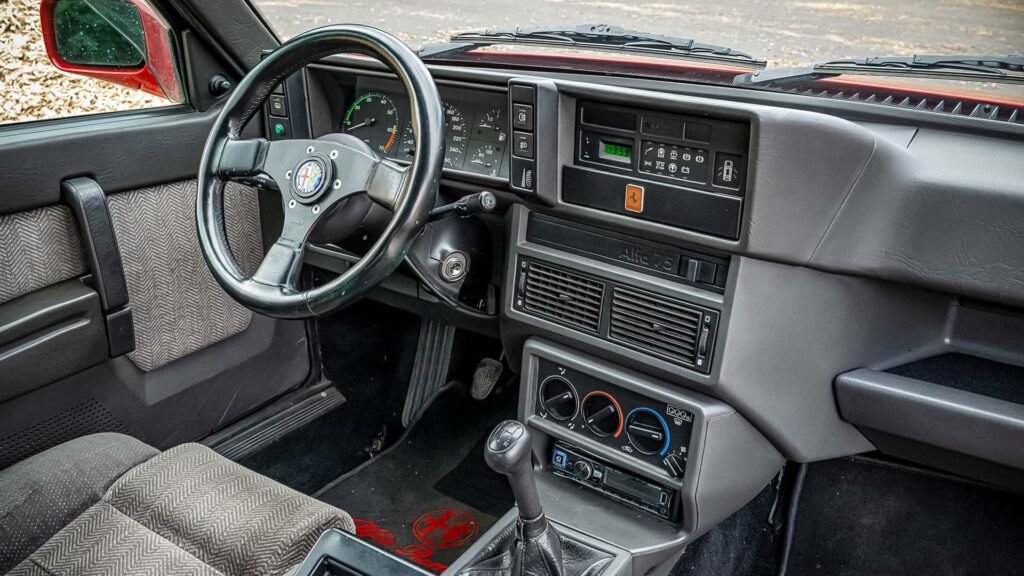
Any Alfisti who has driven a 75 will tell you the same thing: the 75’s interior ergonomics are famously eccentric. Three details that the European motoring press of the 1980s singled out as unprecedented:
One: the controls in the roof console. The 75 has an overhead console, above the central rear-view mirror, where Alfa Romeo placed reading lights and secondary controls. The industrial logic was simple: use the vertical cabin space when the dashboard was already busy with main instrumentation. The emotional logic was different: turn the cabin into something like an aircraft cockpit, where secondary controls are overhead and operated by looking up rather than down at the dashboard. It is a solution very few cars have used since (some modern premium SUVs have come back to it).
Two: the hydraulic handbrake that releases when you press the foot brake. I told you about it earlier. When you pull the 75’s handbrake, the hydraulic circuit applies pressure to the inboard rear discs. But the same circuit is connected to the foot brake pedal. If you press the pedal after pulling the handbrake, the system automatically releases the handbrake. It was designed for hill starts without needing to manually release the lever: press foot brake, the handbrake releases itself, move to the accelerator, engage clutch, drive away. A unique system in the European market.
Three: the high dashboard and the steering wheel close to your chest. The 75’s driving position is deliberately high, with the steering wheel close to the driver and the dashboard above sternum height. It’s the opposite of the classic sports posture of Porsche or BMW, which places the driver low, arms extended, dashboard at a distance. The 75 forces the driver to sit upright, arms bent, hands at chest height. Some drivers take weeks to acclimate. Once they do, they love it.
The end of an era: the last car of independent Alfa Romeo
In August 1986, fifteen months after the 75’s launch, the IRI sold Alfa Romeo to Fiat. The car remained in production until 1992 under Fiat-Alfa Romeo management, but its development was independent. The 164 (launched in 1987) was the last car developed entirely under independent direction, but the 75 was the last car launched by Alfa Romeo as a marque still independent of Fiat.
Its successor, the Alfa Romeo 155 (1992-1998), was the first Alfa Romeo developed entirely under Fiat direction. Platform shared with the Fiat Tempra and Lancia Dedra. Front-wheel drive, not rear. Front-mounted gearbox, not transaxle. A completely different architecture from the 75. The 155 was a good car in its own right (covered in the already-published 155 V6 TI DTM pack), but it broke with the direct technical heritage of the 1972 Alfetta + the 1950 Tipo 158 Alfetta F1. The 75 is the last commercial iteration of that heritage.
For Alfisti, this matters more than any other detail of the car. When a 75 fan talks about the car, they’re not just talking about a 1980s saloon. They’re talking about the symbolic closure of forty years of independent Alfa Romeo. That emotional weight is not carried by any other production Alfa Romeo afterwards.
ASN special edition, the SZ platform, and the mechanical legacy
In 1992, to mark the end of production, Alfa Romeo built the special ASN edition of the 75: 3,500 Twin Spark units + 1,000 1.8 Turbo units. ASN probably stood for something like “Alfa Romeo Special” or similar (sources don’t quite agree). They are today among the most sought-after variants of the 75 in the European collector market.
The 75 platform also formed the base for one of the rarest cars in the modern Alfa Romeo catalogue: the Alfa Romeo SZ “Il Mostro” (1989-1991, 1,036 units) and its convertible variant RZ (1992-1994, 278 units). Zagato design. Modified 75 chassis. Busso V6 3.0L 210 horsepower. The SZ shares with the 75 its suspension, transaxle, inboard brakes, steering and architecture. A natural next NEC pack if Toni wants.
What I take from the 75 on the workshop floor
There’s a workshop-floor lesson the 75 illustrates better than almost any other European car of the 1980s: sometimes, the best car a company has ever built is the last car the company was able to build before changing hands. Not coincidence. Industrial logic. When a company has spent decades refining a single technical architecture (in this case, transaxle + torsion bars + De Dion + inboard brakes + Busso V6 + Twin Spark with VVT), the moment of maximum integration of that architecture arrives just before the company commercially gives up.
This is why 75 fans are so passionate. They’re not just defending a car. They’re defending a complete system of Italian engineering that the global industry abandoned after 1992. The 75 has no modern equivalent. No subsequent Alfa Romeo has reassembled those elements. No European rival has implemented them the same way. It is an intelligent technical dinosaur, bred over four decades, that became extinct just at its peak because the company that built it couldn’t financially sustain that way of making cars.
When you see a properly restored 75 at an Italian classic car meeting today, you’re not just looking at a 1980s saloon. You’re looking at the end of an era. The last car in which Alfa Romeo built itself without needing to ask Fiat’s permission. The last car with the marque’s complete technical signature from the 1950 Tipo 158 Alfetta. The last car with torsion bars + De Dion + transaxle + Busso V6 + Twin Spark with the world’s first VVT. And, on top of all that, the car that won two consecutive Giros d’Italia with Patrese and Biasion at the wheel.
Forty-one years after its launch, the 75 is still the most densely passionate car in Alfa Romeo’s modern catalogue. There are fan clubs in Italy, the UK, Germany, the United States. There are annual gatherings dedicated exclusively to the model. There are independent specialists who make a living maintaining them. That emotional intensity is not blind nostalgia. It is recognition of what the car was technically, what is no longer done, and what probably will not be done again in a European industry increasingly standardised around shared platforms and converging electric architectures.
The 75 is the end of independent Alfa Romeo. Full stop. And after it, everything else has been something different.
Check you’re still alive.