Alfa Romeo Matta: The Alfa 4×4 Born From a Land Rover, Not a Jeep
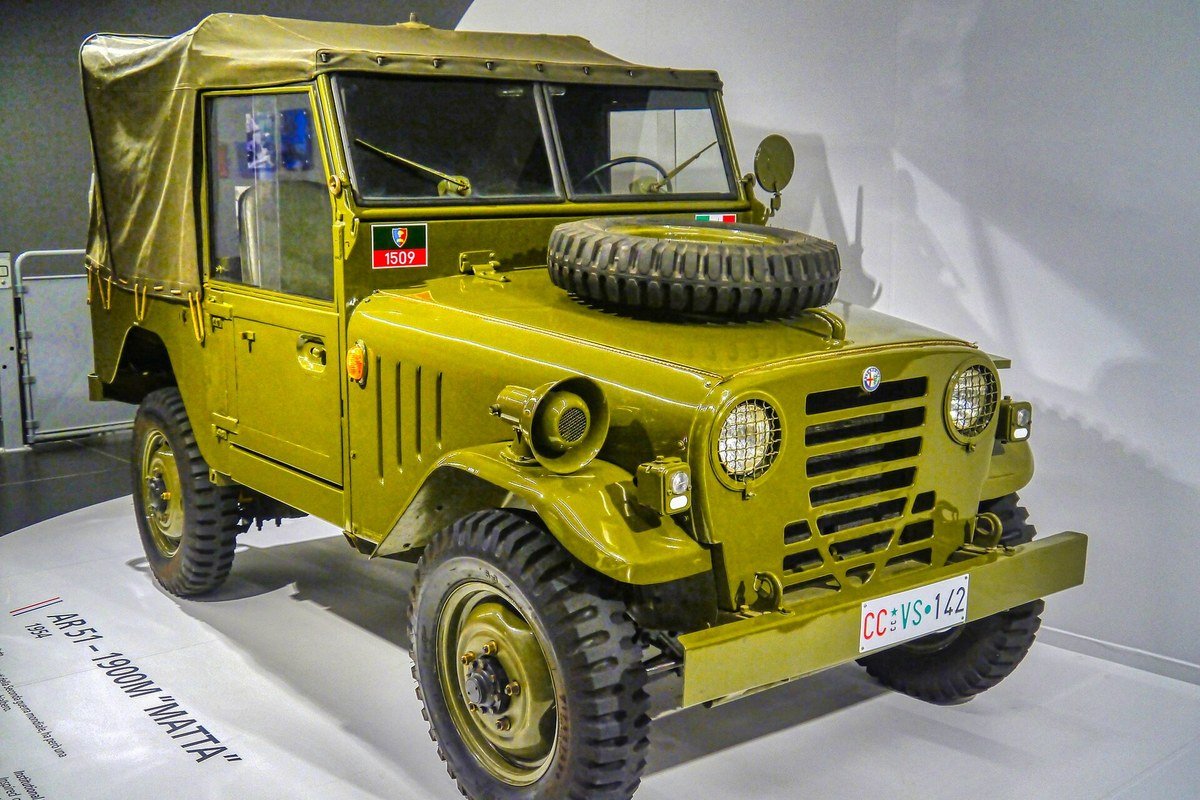
Monterey Car Week, 2017. Gooding & Company rolls an olive-drab Italian Army truck across the block at Pebble Beach, the same weekend millionaires bid on Ferraris, and it sells for $67,100. The estimate had topped out at $55,000. Lot 55, chassis AR51*00408, a 1952 Alfa Romeo 1900 M from the collection of Donald Osborne, delivered new to the Italian Army. Under the hood: a twin-cam engine with an aluminum head and a dry sump, the kind of hardware you’d expect in a race car, not in a vehicle built to haul lieutenants up a goat track.
Collectors call it the Matta. Car magazines like to call it Alfa’s Jeep. That second name is wrong, and the reason it’s wrong is the best part of the story. When Alfa Romeo set out to build a military 4×4, it didn’t buy a Jeep to study. It bought a Land Rover.
The Lot Card
Gooding’s listing reads like a spec sheet: 1,884 cc four-cylinder, 65 hp at 4,400 rpm, four-speed manual, engine number AR1307*00575. The car holds the ASI Targa d’Oro certification from the Automotoclub Storico Italiano, Italy’s historic vehicle club, and is eligible for the modern Mille Miglia retrospective. A saleroom note corrected the catalog: the car came with the original Italian registration booklet, the libretto, not a copy.
For an Army truck, that’s a lot of paperwork, and on these cars the paperwork moves the price. A year earlier, RM Sotheby’s had offered another one in London, chassis 01739, at £28,000 to £32,000. Its libretto showed a first registration in 1975, more than two decades after it left the factory. Army trucks often spend their first life off the civilian books, and the Matta’s resale history starts whenever the military let go of it.
Italy Wants a Scout Car
In November 1950, Italy’s Ministry of Defense went public with a program for a light reconnaissance vehicle, according to Hagerty. The Army called the class AR, for Autovettura da Ricognizione, “reconnaissance car,” and both bidders’ vehicles would carry the same initials. The Alfa became the AR 51. So did the Fiat. Same two letters, same tender, two very different machines.
How Alfa got into the fight depends on who’s telling it. The Museo Fratelli Cozzi, an Alfa museum near Milan, credits Orazio Satta Puliga, Alfa’s head of design and testing, with the idea in late November 1950. Hagerty has general manager Iginio Alessio ordering engineer Giuseppe Busso, in December 1950, to design a competitor from scratch.
Why a Land Rover
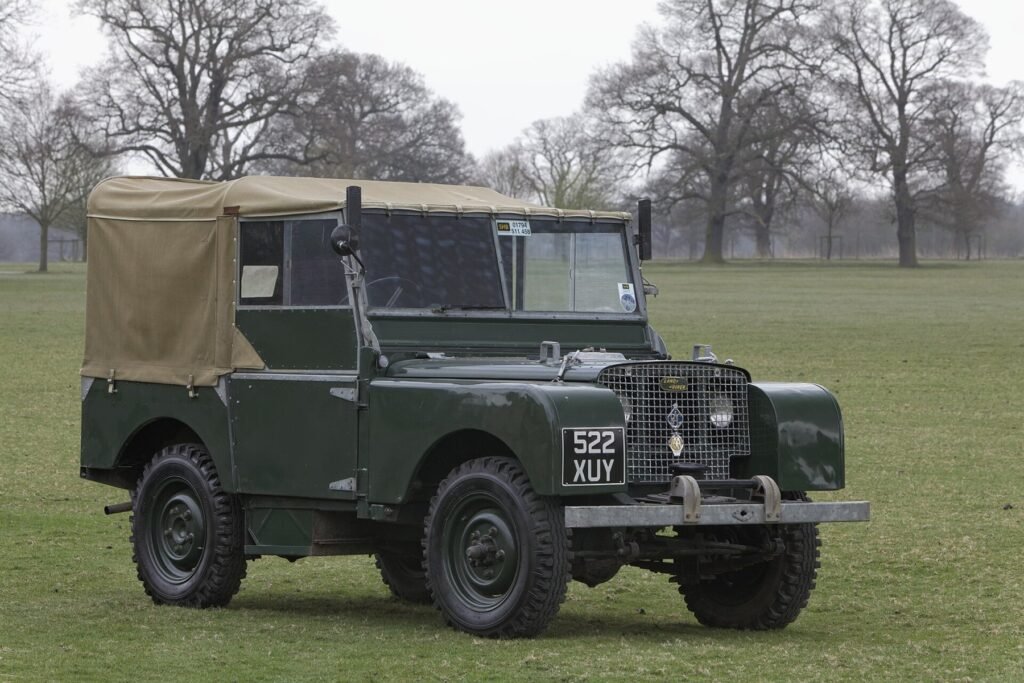
“From scratch” is generous. RM Sotheby’s says the first move by Busso’s design team was to acquire a Land Rover, a vehicle the design chief considered superior to the American Jeep. Silodrome says the prototype that followed mixed Land Rover and Alfa Romeo parts, Alfa’s twin-cam four among them. Hagerty goes further and says the solid rear axle was a copy of the early Land Rover’s. Only Hagerty makes that claim, so it stays attached to Hagerty.
Think about what that meant in 1950. The Willys MB had just helped win a world war, and Willys alone had built 359,489 of them between 1941 and 1945, per Classic & Sports Car. Armies everywhere wanted Jeeps or copies of Jeeps. Alfa’s engineers looked at the most famous 4×4 on earth and went with the British one.
They also went past it. According to Hagerty, the Matta’s driver could lock the rear differential with a lever on the transmission tunnel, something Land Rovers of the day didn’t offer. A differential lets the two wheels on an axle turn at different speeds through a corner. The catch is off-road: lift one wheel or sink it in mud and all the power spins away through that wheel. A locker ties both wheels together so the one with grip keeps pulling. Today it’s a selling point on every Wrangler Rubicon. Alfa had a lever for it in 1951.
Test driver Consalvo Sanesi had the first prototype running by April 1951, and a revised version followed on October 5 after the Army’s feedback, RM Sotheby’s says.
A Sedan Engine Goes to Boot Camp
Alfa’s answer to a scout-car tender was the engine from the 1900, its sporty four-door. Dual overhead cams mean two camshafts sitting right on top of the valves instead of pushrods working them from below, which lets an engine rev freely. The head was aluminum. And it ran a dry sump: instead of oil sitting in a pan under the crank, it lives in a separate tank and a pump feeds it in. Race cars use dry sumps so the oil doesn’t slosh away from the pickup in hard corners. Hagerty says Alfa used one so the engine wouldn’t starve of oil with the truck nose-up on a steep grade.
Then Alfa detuned it. Power fell from the sedan’s 80 hp to 65, compression came down so it would run on lower-octane fuel and burn less of it, and the tune moved toward low-end torque. Classic & Sports Car lists 64 bhp; Gooding and the Alfa sources say 65. That isn’t a dispute. Europe rates in metric horsepower, which is slightly smaller than the imperial horsepower Americans and Brits use, and 65 metric works out to 64 imperial.
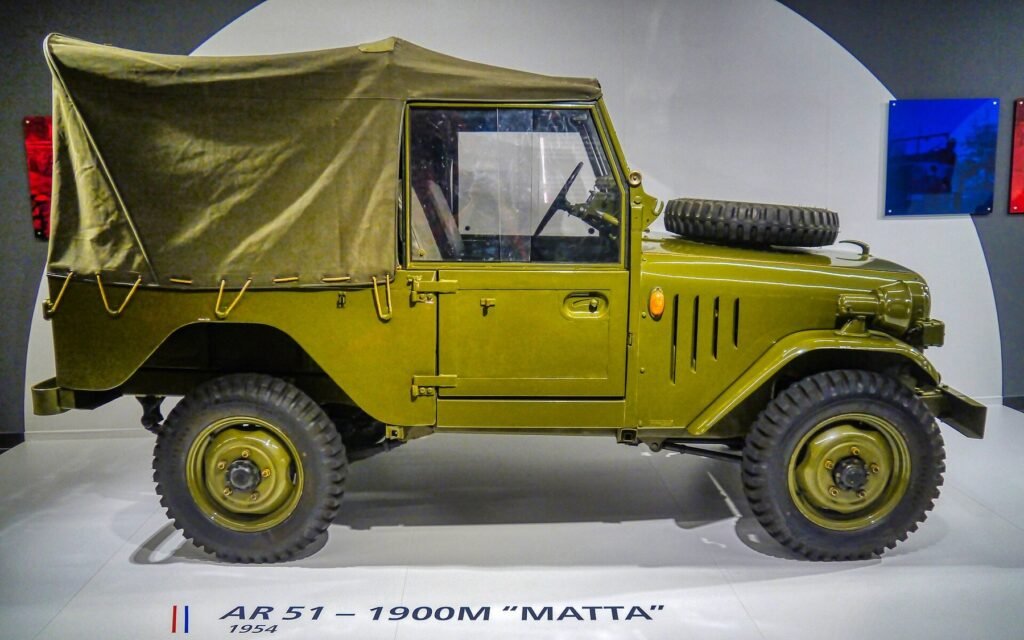
The front suspension was independent, sprung by longitudinal torsion bars, steel bars that twist as the wheel rises and untwist as it drops. The rotary dampers were Houdaille-type, the same kind Alfa ran on its Formula 1 cars at the time. ClubAlfa, the Italian owners’ club whose registry tracks surviving cars, lists a dry weight of 1,250 kg, about 2,756 lb, a wheelbase of 86.6 inches and a top speed of 105 km/h, or 65 mph, on pavement.
Against the Willys and the Fiat
Classic & Sports Car tested all three side by side, and the numbers explain the Matta in one table:
- Willys MB (1941-45): 2,199 cc flathead four, 60 bhp, 2,453 lb, 60 mph
- Fiat 1101 Campagnola (1951): 1,901 cc overhead-valve four, 53 bhp, 2,844 lb, 62 mph
- Alfa Romeo 1900 M AR 51 (1952): 1,884 cc twin-cam four, 64 bhp, 2,756 lb, 65 mph
The Alfa had the smallest engine and the most power, and it was faster than both. It was about 300 pounds heavier than the Jeep and about 90 pounds lighter than the Fiat. The Willys was a tool built by the hundreds of thousands. The Fiat Campagnola was a truck that would stay in production until 1973, 39,086 of them. The Alfa was an Alfa that happened to have four-wheel drive.
The Price Tag Lost the War
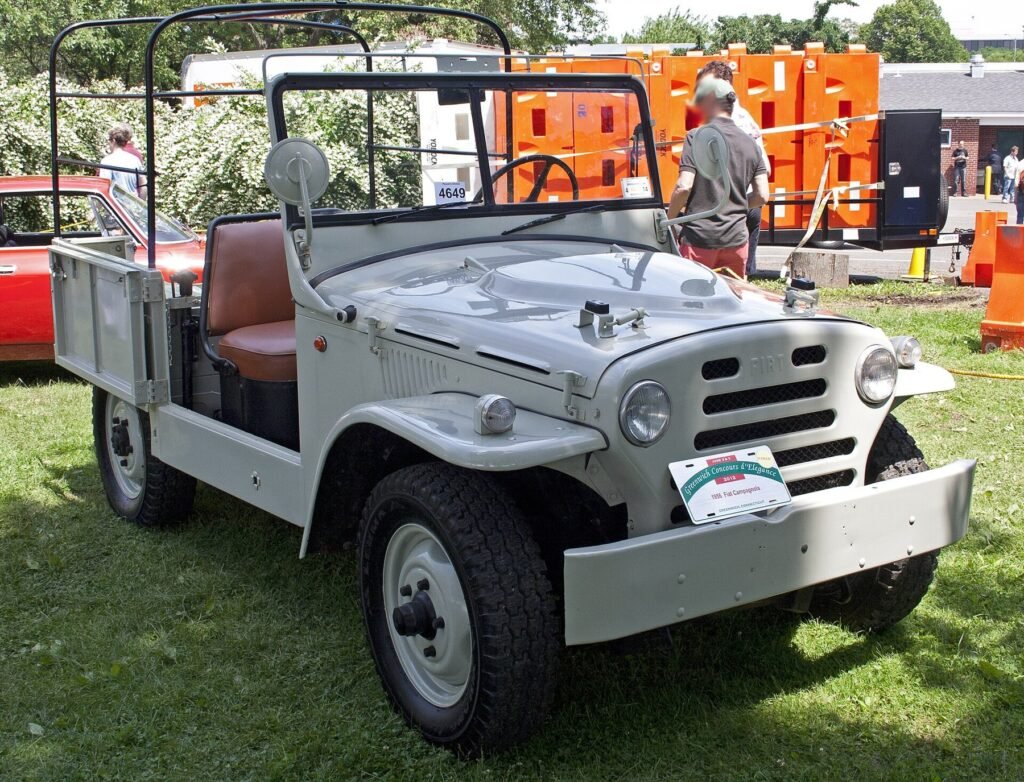
The Museo Cozzi puts the Matta at 1,950,000 lire against 1,600,000 for the Fiat. ClubAlfa lists a 1951 price of 1,935,000. Either way, Alfa was asking 21 or 22 percent more, close to a fifth, from an Army that had lost a war six years earlier and was rebuilding on a budget.
The Ministry’s order went to Fiat, says RM Sotheby’s. Classic & Sports Car spells out why: cost played a significant part with a cash-strapped Esercito Italiano. Hagerty says Alfa got only token orders. Which is how a better truck ends up as a footnote.
Revenge at the Mille Miglia
On May 4, 1952, the Mille Miglia, Italy’s thousand-mile road race, ran a class for military vehicles for the first time. Two Fiat Campagnolas and two Alfa 1900 Ms started, driven by active-duty personnel, Hagerty reports. One Alfa crashed out. The other, crewed by Captain Costa and Lieutenant Verga per the Museo Cozzi, won the class.
By how much depends on where you look. Cozzi and Silodrome say 42 minutes ahead of the Campagnola. Hagerty gives the Alfa’s finishing time, 16 hours and 54 minutes, and a margin of 41 minutes over the first Fiat. One minute across a thousand miles isn’t going to change anybody’s mind. What matters is that the truck the Army passed on beat the truck it bought, in public, on Italy’s most famous road race.
How Many Did Alfa Build? Five Answers
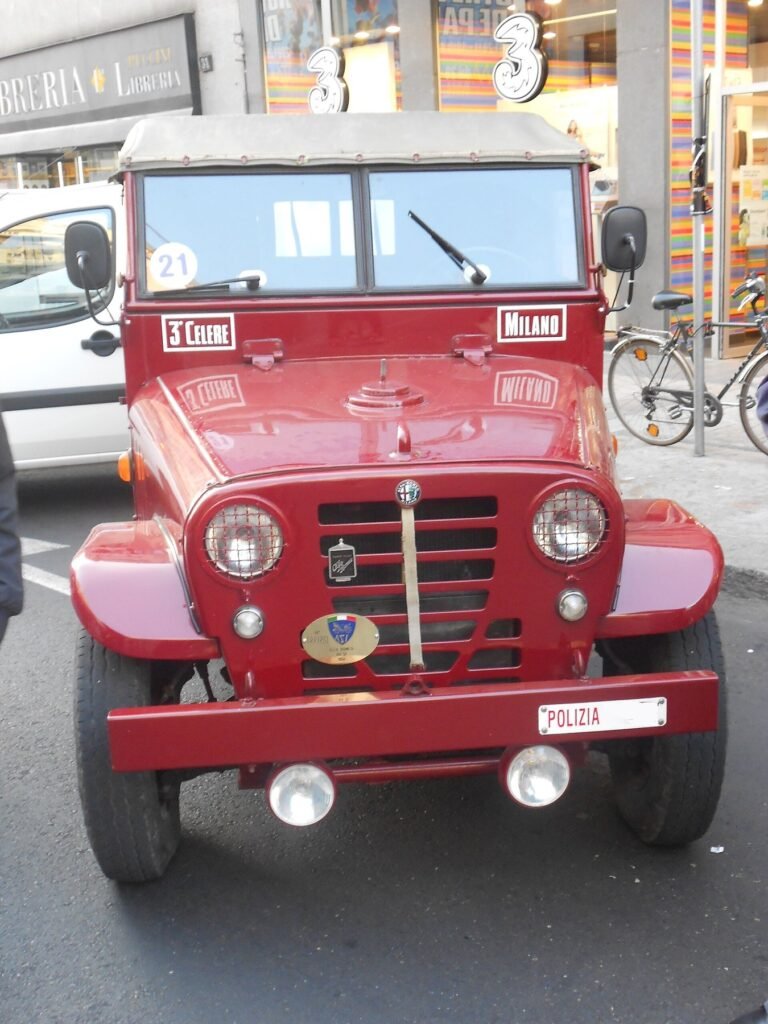
There’s no agreed production figure. Here’s every one the sources give:
- Museo Cozzi: 2,264 total, including 154 civilian AR 52s
- ClubAlfa registry: 1,899 military AR 51s from 1952-53 plus 154 AR 52s from 1953-55, 2,059 counting prototypes
- RM Sotheby’s: 2,000 to the Italian government plus 50 for civilian use
- Classic & Sports Car: 2,007 military plus 154 civilian, 2,161, built 1952-54
- Stellantis’ Spanish press office: 2,000 total, military and civilian together
Silodrome adds its own rounder version: about 2,000 AR 51s for the military and police, and just over 150 AR 52s. RM’s 50 civilians is the outlier, since everyone else lands on 154 or close to it. ClubAlfa’s registry also breaks down where the military cars went: most to the Defense Ministry, a smaller share to the Interior Ministry for police use, and 116 sold to private buyers.
Survivors are just as fuzzy. Cozzi says a little over 200 remain. ClubAlfa has documented about 100 AR 51s and about 10 AR 52s, in the United States, Japan, England, Germany, Finland, South Africa and the Netherlands.
What “Matta” Means
Matta is Italian for crazy, feminine form. The museum and Hagerty both credit Iginio Alessio: he watched the prototype claw up impossible ground in testing, with test driver Guido Moroni at the wheel per Cozzi, and supposedly said “roba da matti,” roughly “that’s insane.” Hagerty flags it as “reportedly.” Classic & Sports Car translates the nickname with more bite, “the mad old woman.” One Spanish outlet, Diariomotor, calls the general manager Antonio Alessio. Cozzi, Hagerty and Silodrome all say Iginio, so Iginio it is, but nobody quotes a period document.
The Count’s Expedition
Not every Matta stayed in uniform. ClubAlfa’s registry records that Count Leonardo Bonzi of Milan took two AR 51s on a South American expedition of about 4,000 km, roughly 2,500 miles, through swamps and mountains between April and July 1952. Silodrome puts a Matta on a Bonzi expedition to Indonesia instead. ClubAlfa is the only one with dates and distances, so South America has the stronger paper trail.
Bringing One Home
For US buyers, the import question is easy. Under federal rules, a vehicle 25 years old or older is exempt from the safety and emissions standards that block newer foreign cars, and a Matta built in the early 1950s cleared that bar decades ago. Duties and state titling still apply, but the cars are legal to bring in, and ClubAlfa’s registry already counts examples in the US.
Prices run all over the map. Beyond the $67,100 at Pebble Beach, Artcurial sold one in Paris on February 4, 2023, for £32,168, according to The Classic Valuer’s sales record. The same record shows another sold in the UK on March 30, 2026, for £21,000. Classic & Sports Car pegged the value at £50,000 in 2022.
Look closely at those two sales, though. The Artcurial car is listed as a 1951 AR 51 and the 2026 car as a 1955 AR 51. ClubAlfa says military production ran 1952-53; Classic & Sports Car says through 1954. Neither date fits, which suggests registration years or catalog shorthand rather than build dates. If you’re bidding, ask for the chassis number and check it against the registry, not the year on the lot card.
The Land Rover Comes Back as a Fiat
There’s a Spanish postscript most American readers will never have heard. Land Rover licensed its design to Santana Motor in Linares, in southern Spain, which built and kept reworking it for decades, through the Santana Ligero and on to the Santana Aníbal. Iveco, Fiat’s truck arm, turned the Aníbal into its Massif, and in 2008 it unveiled a new Campagnola at the Bologna Motor Show, built in Linares by Santana: 3.0-liter turbodiesel, 176 hp, six-speed manual with low range, €35,000, and 499 made, according to Motorpasión.
So Alfa studied a Land Rover in 1950 to beat the Campagnola, lost, and 58 years later the Campagnola name came back on something descended from a Land Rover and built in Spain.
NEC Verdict
Busso’s team bought the truck they thought was best and then refused to leave it alone. Dry sump, aluminum head, Formula 1 dampers, a rear locker the British didn’t have yet. The same engineer would later give Alfa the Busso V6, and you can hear the same stubbornness in it.
The Army did the math and bought the cheaper Fiat. Alfa never did the math, so the Fiat went to work and the Alfa went to auction, and seventy years on one of them sells at Pebble Beach.
Would you copy the best and then drop in a racing engine?
Check you’re still alive.
Photos: Alfa Romeo Matta at the Museo Storico Alfa Romeo, Zairon (CC BY-SA 4.0); Land Rover Series I, Land Rover MENA (CC BY 2.0); Fiat Campagnola, Mr.choppers (CC BY-SA 3.0); Polizia Matta, Pava (CC BY-SA 3.0 IT). Via Wikimedia Commons.