
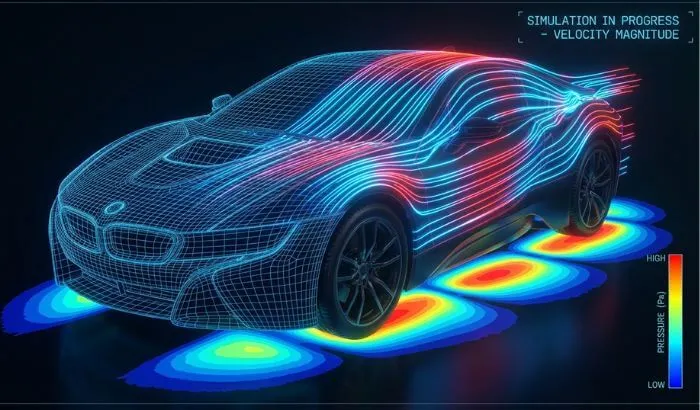
CFD in Car Design: Engineering Against an Enemy Nobody Can See
With the collaboration of Yousef Hassanpour, aerospace and chemical engineer (Sharif University of Technology). The CFD study, simulations and images accompanying this article are his own work.
Here is something that ought to unsettle anyone who trusts modern engineering: the equations governing how air moves — the same ones used to design cars, aircraft, and even to forecast the weather — have never been solved.
They are the Navier-Stokes equations. Navier derived them in 1822; Stokes gave them their modern form in 1845. In 2000 the Clay Mathematics Institute placed them among its seven Millennium Prize Problems, with a million dollars waiting for anyone who can answer a deceptively simple question: do they always produce clean, predictable solutions, or can they break down?
Nobody has collected. The problem is still open today. Of the seven Millennium Problems only one has been solved, and the mathematician who cracked it, Grigori Perelman, turned down the money.
Meanwhile, in Maranello, in Woking, at Mercedes headquarters, and on the laptop of any engineer with the right license, those equations get solved approximately millions of times a day to decide the shape of a hood. It works. The cars that come out of it work. What doesn’t exist is the mathematical proof that they always will. We use a tool every day that mathematics still hasn’t finished understanding.
That is CFD — Computational Fluid Dynamics. It is arguably what has reshaped car design more than anything else in recent decades, and most enthusiasts have never been told what it actually does.
So we asked someone who does it. Yousef Hassanpour is an aerospace and chemical engineer trained at Sharif University of Technology, Iran’s leading technical institution. He reached out to NEC after our AeroNEC series, sharing his own simulation work, and he handed us his full workflow along with a study he ran on one very specific car: a Ford Taurus. Why that car, and not a supercar, is a story we’ll get to. There’s more to it than you’d think.
The invisible opponent
When a car moves, it shoves air out of the way. Air looks like nothing, but it behaves like a fluid and it pushes back. That push is drag.
At low speeds, what slows a car most is the tires fighting the road. As speed climbs, air takes over — and it does so in a way that fools your intuition. Drag doesn’t grow in proportion to speed; it grows far faster. Going 25% faster doesn’t cost 25% more energy. It costs quite a bit more.
That’s why the U.S. Department of Energy notes fuel economy drops off sharply above 50 mph, and why its own assessment is that a further 20% to 30% of drag can still be cut from current body shapes. The same source makes the point bluntly: on a passenger car, even a big improvement in tires nudges efficiency up by just 1%. Aerodynamics has vastly more to give.
The city-versus-highway split drives it home. In town, air takes a small share of the car’s energy. On the highway it becomes the single biggest consumer, ahead of every other loss. Same car, same engine — and air goes from bit player to lead role purely by going faster.
Cutting drag pays across the board: lower fuel bills, more range in EVs, higher top speed, better stability, less noise, fewer emissions. Aerodynamics stopped being a garnish and became a core engineering discipline.
So how do you measure how aerodynamic a car actually is? Raw drag force is useless for comparison, because it depends on speed, air density and other variables: the same car gives a different number depending on the day and the gear. So engineers use a clean, unitless figure, the drag coefficient or Cd, which isolates what really matters: the shape. The lower the Cd, the better the car gets along with the air, and that “better” translates into everything above: less fuel, more range, higher top speed. It’s the grade you give a body shape in its fight against the wind. We won’t dwell on it here, because we broke the Cd down in full in another article; the idea is enough: low number, car that cuts cleanly through the air.
One figure grounds this better than any other. Mercedes-Benz, which has chased drag records for over three decades, puts it plainly: cutting the drag coefficient by a single hundredth increases long-distance range by roughly 2.5%. Over the miles an average driver covers in a year, that one hundredth works out to a few hundred extra kilometers. One hundredth of a point. That’s what teams fight over in wind tunnels and on computers for months.
The company’s own history shows the scale. Back in 1984, its W124 was the first production car under 0.30 Cd. The electric EQS reached 0.20 and claimed the title of most aerodynamic series production car in the world — a figure the company tied directly to its range. Going from 0.30 to 0.20 is a third less resistance, and it took the industry four decades to cover that ground. That’s how expensive every slice of air you take off the car really is.
What a CFD run actually does
Instead of putting every version of the design into a wind tunnel, the engineer builds a digital model of the car and lets the computer work out how air would move around it.
The result is a complete map of something you can’t see in real life: where air speeds up, where it slows, where it presses hardest on the bodywork, and where it turns to chaos. In a wind tunnel that information is measured only where the sensors sit. In CFD you have it at every point on the car and in the air around it. That’s the great advantage.
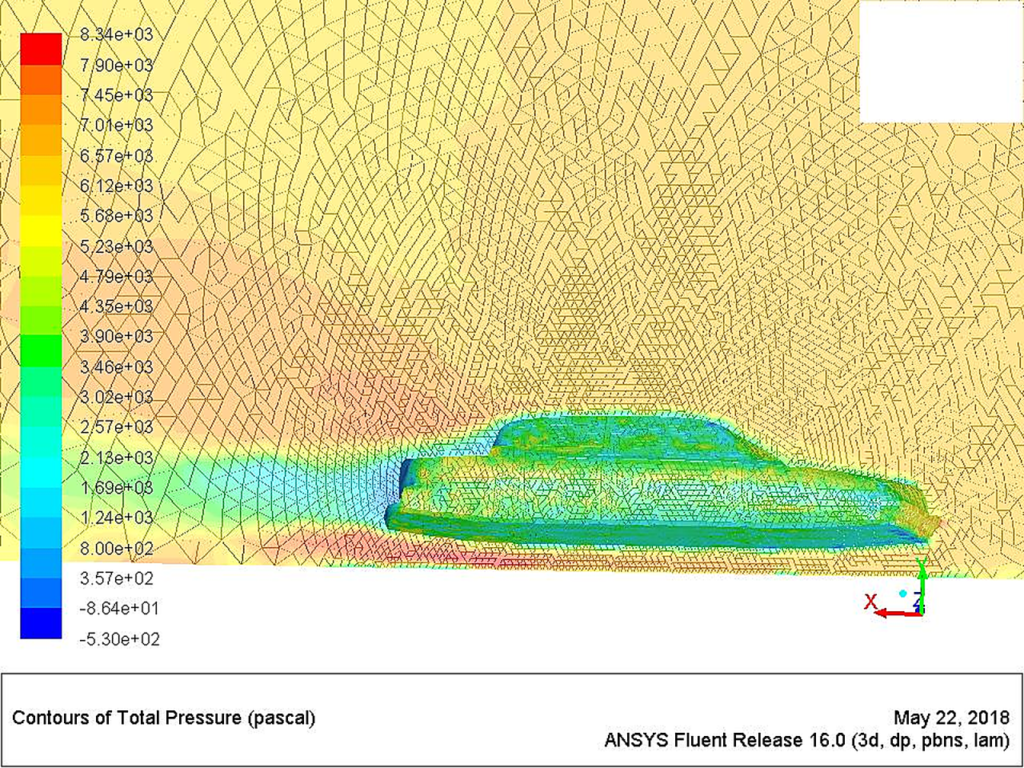
Pressure contours are among the most useful outputs. They show where air presses hardest on the sheet metal. Almost always, peak pressure sits at the nose, where air meets the car head-on for the first time and stops dead. From there, as it travels over hood, windshield, roof and tail, pressure shifts with the shape. Zones where air presses too hard are warnings: they mark where the body is fighting the air instead of guiding it, and that’s where a small change to the bumper, the hood angle or the roof drop can trim resistance.
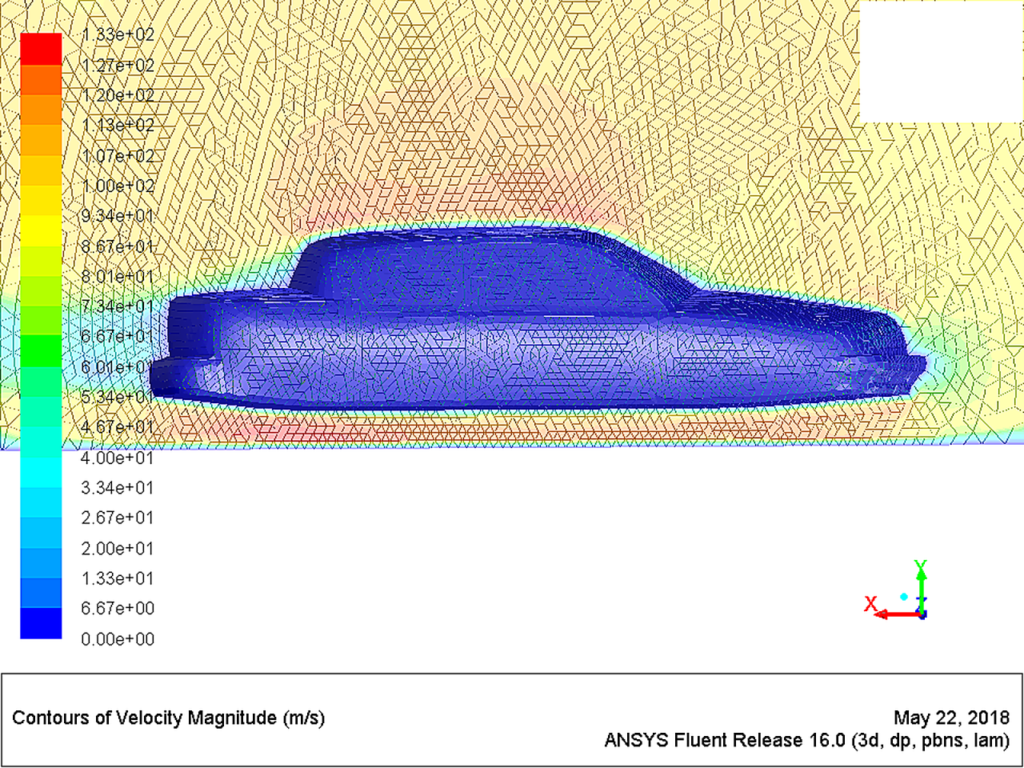
Velocity contours tell the other half. Air slows at the nose, accelerates over hood and roof, and behind the car it peels off the body and forms a churning, slow region: the wake. That wake is one of the largest sources of drag. The car drags a pocket of disordered air behind it that never quite closes up. The bigger and more chaotic it is, the more it slows the car.
Vortices: invisible, and expensive
A vortex is air spinning on itself. It forms when flow that was running clean peels off the body and starts to swirl. In real life it’s invisible. In CFD it shows up with total clarity.
They form around mirrors, pillars, wheel arches, the underbody, and above all behind the car. Each one costs money: more drag, more noise, less stability. In Yousef’s Taurus study, the plots reveal several of these zones of churning air, concentrated in the wake. Identifying them is the first step to reshaping the body to calm them.

Worth clearing up a common misconception: an aerodynamically good car is not a smooth car. It’s a car that controls where the air turns to chaos. Chaos is unavoidable; what separates good design from bad is deciding where it happens and how large a wake it leaves. That’s why sharp trailing edges exist, why some spoilers that look decorative aren’t, and why diffusers matter — they don’t eliminate the chaos, they organize it.
Formula 1: the only sport that rations simulation
Every modern car benefits from CFD, but there’s one arena where it became so decisive it had to be capped by rule. And this, to us, is the most revealing part of the whole story.
In 2020 the FIA introduced restrictions on aerodynamic development in Formula 1. Since 2021 they’ve worked as an inverted handicap: the better a team performs, the less it may simulate. The championship leader gets considerably less wind tunnel and computer time than the last-placed team. The point is to stop the rich getting infinitely richer and to keep the championship from turning into a supercomputing budget contest.
The regulation’s level of detail is from another planet. The FIA counts the hours of computation, forces teams to declare exactly which computers they use, bans tricks to squeeze more power than declared, and has even folded any use of artificial intelligence on the simulation results into the restricted budget. It shut that door before anyone thought to open it. There’s even a date on the future: the rule allowing a more powerful class of hardware doesn’t take effect until 2028.
Think about that for a second. No other sport regulates how many calculations a computer may perform. Formula 1 does, because simulation has become so decisive that leaving it unchecked would break the competition. The FIA didn’t limit CFD for being inaccurate. It limited it for being too effective.
In this world the goal isn’t only cutting drag but generating downforce, which presses the car into the track and lets it corner at speeds that would otherwise send it into the gravel. Wings, diffusers, the floor of the car, brake ducts — all developed through CFD and then validated in the wind tunnel. Many of those solutions filter down into road cars years later.
Why a Ford Taurus and not a Ferrari
Here’s the good part. Yousef didn’t simulate a hypercar. He simulated a Ford Taurus, and the choice makes more sense than it first appears.
The first-generation Taurus, launched in late 1985, was the car that literally saved Ford from bankruptcy. Its rounded “jellybean” body broke completely with the boxy American styling of the era. It took its cues from the Audi sedans of the day, wore headlights flush with the bodywork and an almost grille-less nose to keep from disturbing the air, and achieved a drag coefficient of 0.32 in sedan form. Worth pinning down, because the wrong number gets thrown around a lot: that 0.32 is the original Taurus. The lower figures sometimes attributed to it belong to later generations, not this one.
There’s a nice symmetry, then, in the fact that Yousef’s workflow reference was an Audi — the very brand Ford looked to when it made the leap. The circle closes on its own.
A 0.32 doesn’t impress today, when a modern EV runs around 0.20. But in 1986, on an American family sedan, it was a small revolution, and it sold millions. And that’s exactly the argument for choosing it: aerodynamics isn’t only about Formula 1 and million-dollar cars. It’s also about the most ordinary car in the lot, the sedan hauling kids to school. They all fight the same invisible enemy. Simulating a Taurus isn’t simulating less — it’s a reminder of where this battle actually lives.
The real workflow, from paper to computer
What makes Yousef’s approach worth studying is that CFD doesn’t appear at the end, like an exam the design passes or fails. It’s built in from the start.
It begins on paper, with hand sketches. Before touching a computer, several ideas get drawn that set the car’s proportions, styling and aerodynamic direction. Once the concept gels, blueprints follow with the dimensions and reference curves. Then comes 3D modeling, where the car is built digitally with enough precision to be analyzed. The screenshots of his Audi and his Lamborghini that accompany this piece are examples of that stage: how he works a car’s surface, not the car that was simulated.

[IMAGE 4 — CAD modeling of the Audi R8, an example of Yousef’s workflow, not the simulated model.]
With the model ready comes the step almost nobody sees, and the one that decides everything: preparing the mesh. The computer can’t calculate the air over the whole car at once; it needs to slice the space around it into an enormous number of tiny pieces and solve the air in each one. That grid is the mesh. And here’s the trap: if the mesh is badly made, the result is a gorgeous color map that describes nothing real. There’s no such thing as a good simulation on a bad mesh. It is by far the most delicate part of the process, and the one that separates serious work from a pretty picture.
With a proper mesh, the model goes into the simulation software — in this case ANSYS Fluent — you tell it how fast the air is blowing, and let it calculate.
The most candid decision in the study
And here’s the part we like best about all of Yousef’s work, because it teaches something almost no article ever mentions: CFD is always a balance between the ideal and what you’ve got.
There are two ways to calculate the air. One is simpler, runs fast and asks less of the computer. The other is truer to how air actually behaves at high speed, captures all that chaos and swirl far better, but demands a much finer mesh, vastly more calculation time and a considerably more powerful machine. Yousef ran this study on his personal laptop. And with that tool, he made the sensible call: use the simpler method.
It’s exactly the kind of compromise real engineering makes every day. You don’t always do the ideal thing; you do the best possible thing with the resources at hand. So it’s worth being clear about what these images are and aren’t: they’re an excellent demonstration of what a CFD run looks like and how it works — the contours, the wake, the swirls, the whole process — done on an everyday computer. They are not Ford’s official aerodynamic development of the Taurus, nor a millimeter-precise prediction of its real behavior. And there’s nothing lacking in saying so — quite the opposite. An engineer showing the complete process with the machine on his desk is worth more, as a lesson, than a flawless render from a supercomputer almost nobody can access.
There’s another detail that reinforces it. The air speed in the simulation is very high, far beyond anything a Taurus would ever reach on the highway. It’s an exercise condition, chosen to make the phenomena clearly visible, not to reproduce a real drive. Knowing that doesn’t diminish the images — it gives them their place. They’re a tool for understanding, not a spec sheet.
Where NEC stands
CFD has a trap in it, and it isn’t technical. It’s cultural.
When a tool hands you a color map that looks like absolute truth, it becomes dead easy to mistake the simulation for reality. But CFD doesn’t calculate what the air does. It calculates what the air does according to the method you chose, the mesh you built, and the conditions you wrote. Change one thing and the numbers move. That’s why Formula 1, which commands the finest simulation resources on the planet, still burns fortunes on real wind tunnels and still measures on track: because the only real test is checking the calculation against the world. Simulation proposes; reality disposes.
And that’s the heart of it. For a century, the advantage in car design lived in the workshop: whoever had the better eye and the better hands won. Today an enormous share of that advantage lives inside a computer and in knowing how to prepare a mesh. Not worse, not better. Different — and worth looking at squarely instead of pretending cars are still born where they used to be.
What hasn’t changed is the nature of the opponent. It’s still air. It still can’t be seen. And it still collects its toll on every hundredth of a drag coefficient you fail to take from it — in a Formula 1 car as much as in the Taurus that saved Ford.
How many of the cars you find beautiful look that way because someone drew them that way — and how many because a computer told an engineer where the air was leaking?
Check you’re still alive.