Chevrolet Camaro Z28 SS: Two Philosophies, One Car, and Detroit Killed It Anyway
How Chevrolet spent 30 years keeping its two best ideas apart — then buried them together
In 1966, General Motors had a problem with a name and a sales figure attached to it: Ford Mustang. Half a million units sold in its first full year. A sporty, affordable coupe that had invented an entire market segment — the pony car — and GM had nothing in showrooms to match it.
The answer was the Chevrolet Camaro. It debuted on September 29, 1966, as a 1967 model. And from day one, Chevrolet offered two distinct paths for buyers who wanted more than a pretty coupe with a small engine: the SS and the Z/28.
Two badges. Two fundamentally different performance philosophies. And an internal rivalry that would last decades before it resolved.
SS: the straight line. Z/28: the corner.
The Camaro SS (Super Sport) was the brute force approach. Big block 396 cubic inch (6.5L) V8 with up to 375 hp, upgraded suspension, high-performance exhaust, and aggressive aesthetics. The SS was built to dominate the quarter mile. Raw acceleration. Unapologetic power.
The Z/28 was something else entirely. It was born as a homologation package to make the Camaro eligible for the SCCA’s Trans-Am Series, which capped displacement at 305 cubic inches (5.0L). Chevrolet engineers built a specific engine: a 302 cubic inch (4.9L) small block V8 with a cross-ram intake manifold, high-lift cam, and transistorized ignition. Official output: 290 hp. Real output: considerably more. The Z/28 came with upgraded suspension and front disc brakes as standard. It was lighter than the SS. It turned better. It stopped better.
The SS was the drag racer. The Z/28 was the road racer. And for years, Chevrolet kept both lines separate.
In that first year alone, Chevrolet produced nearly 221,000 Camaros. Just under 65,000 customers opted for the RS (Rally Sport) appearance package. The SS brought big block thunder. The Z/28 brought road course precision. Buyers had to choose. You couldn’t have both.
The wilderness years: 1972-1996
The SS disappeared after 1972. The final year produced only 970 SS 396 units, and the big block was discontinued in the Camaro entirely. Emissions regulations, the 1973 oil crisis, and new safety standards crushed the classic muscle car era.
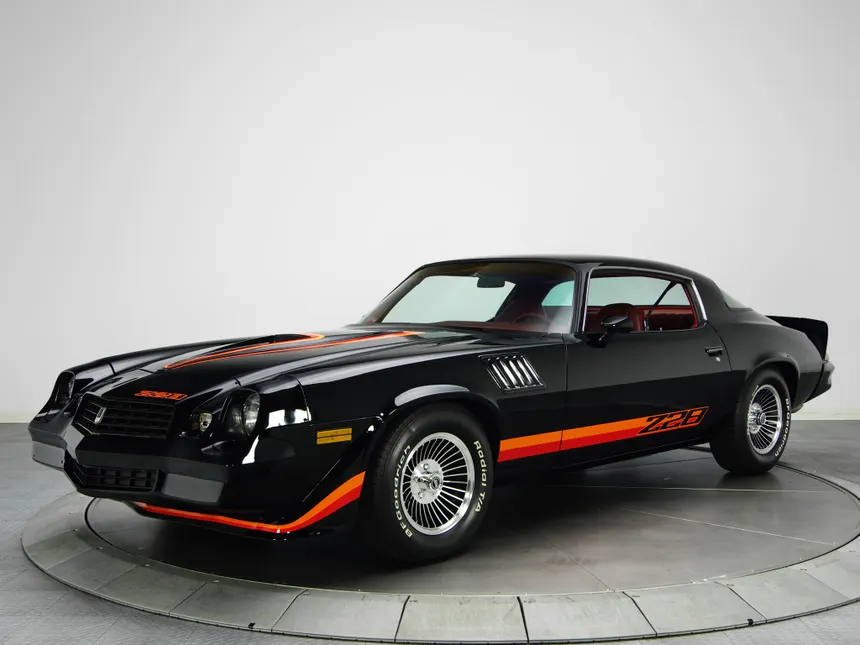
The Z28 survived, but it mutated. In the second generation (1970-1981), it went from a competition package to a standalone model with bold aesthetics but diminishing power. The 1977 Z28 — reintroduced in response to the Pontiac Trans Am’s surging sales — packed a 350 (5.7L) V8 with 185 hp. Strong for the era. Pathetic compared to the original 302.
The third generation (1982-1992) brought the IROC-Z (International Race Of Champions) package, which by 1988 had replaced the Z28 entirely. The IROC-Z ran a 5.7L TPI engine with up to 245 hp. This generation also introduced the 1LE track package — a serious competition option with full road-racing suspension, Corvette brakes, and upgraded sway bars. The Z28 didn’t return until 1991, after Chevrolet let the IROC contract lapse.
Through all of this, the SS badge was dormant. But enthusiasts hadn’t forgotten it.
Fourth generation: the reunion (1993-2002)
The fourth-generation Camaro debuted in 1993 on an updated F-body platform. Two doors, rear-wheel drive, front engine. The Z28 returned as its own model with the Corvette’s LT1 5.7L V8: 275 hp and an optional T56 6-speed manual transmission.
But 1996 was the year it happened. Chevrolet brought back the SS badge — not as a standalone model, but as a package on top of the Z28. For the first time in Camaro history, the two philosophies merged into a single car.
SLP Engineering (Street Legal Performance), based in New Jersey, handled the conversions. The Z28 SS didn’t roll off the Sainte-Thérèse, Quebec assembly line as an SS. It left as a Z28 and was transformed by SLP before reaching the dealer. But it could be ordered directly at any Chevrolet dealership as a new car with full factory warranty.
Z28 SS specs (1996-1997, LT1 engine):
- Engine: 5.7L LT1 V8, OHV, sequential fuel injection
- Power: 285 hp (1996) / 305 hp with SLP modifications
- Torque: 325 lb·ft (440 Nm)
- Transmission: T56 6-speed manual or 4L60E 4-speed automatic
- Differential: limited-slip
- Weight: ~3,400 lbs
The 1997 30th Anniversary Edition was special: white paint with orange stripes, available on Z28, SS, and RS models. But the 108 units fitted with the Corvette’s LT4 engine (330 hp / 340 lb·ft) are the real collectibles. 100 for the US market, 6 for Canada. All converted by SLP.
1998: the LS1 changes everything
1998 was the watershed year. The fourth generation received an exterior refresh and, far more importantly, a new engine: the LS1.
The LS1 was the first all-aluminum engine in a Camaro since the legendary ZL-1 of 1969. Aluminum block and heads. 5.7L (346 ci) V8. Shared with the Corvette C5. It represented a generational leap in GM engine engineering — lighter, more compact, more powerful, more efficient, and more reliable than any small block before it.
Z28 SS specs (1998-2002, LS1 engine):
- Engine: 5.7L LS1 V8, all-aluminum block and heads
- Power (Z28): 305 hp (1998-2000) / 310 hp (2001-2002, LS6 intake manifold)
- Power (SS): 320 hp (1998-2000) / 325 hp (2001-2002)
- Torque: 335 lb·ft (454 Nm) / 350 lb·ft (475 Nm) in final versions
- Transmission: Borg-Warner T56 6-speed manual (no-cost option) or 4L60E automatic
- Differential: Torsen limited-slip (from 1999)
- 0-60 mph: ~5.0 seconds
- Top speed: 158 mph (electronically limited)
- Tires: 275/40ZR17 on 17-inch five-spoke aluminum wheels
The SS package over the Z28 added a functional hood air intake (SLP-designed), improved exhaust with better flow, lowered suspension with Performance Ride and Handling calibration, integrated rear spoiler on the hatch, model-specific 17-inch wheels, and shorter final-drive ratios for better acceleration.
The SLP exhaust was one of the keys: better flow equals more power up top. The gap between a standard Z28 and an SS wasn’t just 15-20 hp on paper. It was the power delivery, engine response, and the sound — that aluminum-block LS1 V8 with open exhaust is one of the most recognizable sounds in modern American muscle.
The LS1: the engine that changed everything
The LS1 deserves its own section. Gen III small block. Aluminum block, 346 cubic inches. Aluminum heads with revised combustion chambers. Sequential fuel injection. Coil-on-plug ignition. Chain-driven valvetrain. Deep-skirt crankcase with windage control.
It was not an evolution of the LT1. It was an entirely new engine that shared the V8 90-degree configuration and cross-plane crank with its predecessor and virtually nothing else. The LS1 was lighter, smaller, more powerful, more efficient, and more durable than any previous small block.
And what the LS1 did for the aftermarket is incalculable. It became the most popular engine swap platform in automotive history. Light, cheap, powerful, with infinite parts support. A junkyard LS1 with 100,000 miles on it makes more power than 90% of factory engines on the market today.
In the Z28 SS, the LS1 found a car that made sense: light for its class, rear-wheel drive, six-speed manual. No intrusive electronics. No drive modes. No touchscreen. Steering wheel, pedals, engine.
The Camaro vs. Firebird rivalry
The Z28 SS didn’t exist in isolation. Its platform twin — the Pontiac Firebird Trans Am with the WS6 package — shared the same F-body bones, the same LS1 engine, and competed for the same buyers. But the differences were real.
The Trans Am WS6 had a larger functional hood scoop, differently calibrated suspension, and a completely different exterior design with pop-up headlights and a more aggressive visual presence. Pontiac positioned the Trans Am as the wild brother. Chevrolet positioned the Camaro as the technical one.
In practice, performance differences were negligible. Same powertrain, similar weight, nearly identical acceleration. The choice between them was emotional, not rational. It had been that way since 1967.
The irony is that both died at the same time, for the same reasons, at the same plant in Sainte-Thérèse. But the Camaro was resurrected in 2010. The Firebird never came back. Pontiac disappeared as a brand in 2010, liquidated during GM’s bankruptcy. The Camaro survived. The Trans Am didn’t.
The end of the F-body
In 2001, Camaro production hit its lowest point: 29,009 units. For 2002, Chevrolet launched the 35th Anniversary Edition as a farewell. The 2001-2002 Z28 and SS models received the LS6 intake manifold (from the Corvette Z06), a revised camshaft profile, removal of the EGR system, an improved clutch slave cylinder, and the LS6 clutch in manual models.
General Motors discontinued the F-body platform in 2002. Official reasons: declining sales, a deteriorating market for sports coupes, and overcapacity at the Sainte-Thérèse plant.
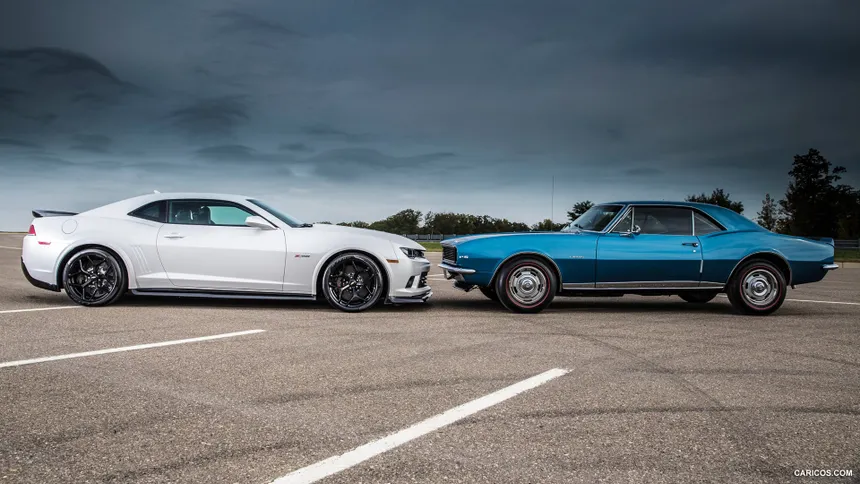
The Camaro wouldn’t return until 2010, with a fifth generation on an entirely new platform (Zeta, developed by Holden in Australia). And when it came back, it came back without the Z28 — at least initially. The Z/28 eventually returned for 2014 with a naturally aspirated 7.0L LS7 making 505 hp, no air conditioning, and a laser focus on track performance. The SS continued as the volume performance model. They were never combined again.
What the Z28 SS represented
The Z28 and the SS were never just option packages. They were philosophies. The Z28 was born on the circuit: low weight, precise suspension, high-revving engine. The SS was born on the drag strip: maximum power, massive torque, quarter-mile dominance.
When Chevrolet merged them in 1996, it created something that satisfied both camps. A car with a Corvette engine, track suspension, limited-slip differential, six-speed manual, and an exhaust note that announced it was not a rental-spec V6 automatic.
But the industry was changing. SUVs sold. Coupes didn’t. And GM, with the chronic financial problems that would culminate in bankruptcy in 2009, couldn’t afford to maintain niche platforms.
That’s how Detroit works. You spend 30 years keeping two great ideas apart. You finally put them in the same car. It works. And then you kill the car.
The Z28 SS by the numbers
For those who need the full picture across six generations:
- First generation (1967-1969): SS and Z/28 as separate packages. SS with big block 396. Z/28 with small block 302 for Trans-Am homologation.
- Second generation (1970-1981): SS eliminated in 1972. Z28 discontinued in 1975, reintroduced in 1977 to counter Trans Am sales.
- Third generation (1982-1992): Z28 replaced by IROC-Z (1985-1990). Z28 returns in 1991. No SS available.
- Fourth generation (1993-2002): Z28 with LT1/LS1. SS as Z28 package from 1996. The definitive F-body combination.
- Fifth generation (2010-2015): SS as standalone model. Z/28 returns in 2014 with 7.0L LS7 and 505 hp — track-focused, no A/C.
- Sixth generation (2016-2024): SS with 6.2L LT1 and 455 hp. No Z/28 offered. ZL1 with supercharged 650 hp LT4 as range-topper.
Total production of fourth-generation Z28 SS units (1996-2002) was never officially broken out by GM separately from standard Z28 figures. SLP Engineering processed thousands of conversions over those seven years, but exact numbers vary by source.
What is a fact: every Z28 SS that comes up for sale today trades above its original MSRP. Especially units with the T56 manual and low miles. The market has spoken. It always does.
The collector perspective
The fourth-gen Z28 SS sits at an interesting inflection point in the collector market. For years, these were cheap used cars — plentiful, accessible, often beaten up by second and third owners who didn’t understand what they had. Automatic-transmission V6 Camaros and base Z28s with high mileage flooded the used market and dragged the entire generation’s reputation down.
But the Z28 SS with a T56 manual, low miles, and documented history is a different animal. These cars are appreciating steadily. The LS1 engine is bulletproof and responds to modifications like nothing else in its price range. The T56 gearbox is one of the best manual transmissions GM ever produced. And the SLP-specific SS equipment — the hood scoop, the exhaust, the suspension calibration — makes these cars genuinely special within the fourth-gen range.
The 1997 30th Anniversary models with the LT4 are already firmly in collector territory. The 2002 35th Anniversary SS models are following. And as the generation that grew up watching fourth-gen Camaros on the road enters peak earning years, demand will continue to climb.
If you find a clean T56 SS with under 50,000 miles, buy it. Don’t think about it. Just buy it.
Check you’re still alive.