
Dodge Viper: 8 Liters of Pure Malice
Not Enough Cylinders — Unfiltered Automotive Opinion
Born of a Cobra and a Fever Dream
Some cars are dangerous. Some cars are fast. Some cars will kill you if you don’t respect them. And then there’s the Dodge Viper.
The Viper isn’t just a dangerous car; it’s an attempted murder with a license plate. It’s what happens when a group of Detroit engineers decides that safety electronics are for cowards, that eight cylinders aren’t enough, and that the best answer to European supercars is an 8-liter V10 derived from a truck engine—bolted to a chassis that weighs less than a crossover driver’s excuses. It is, without a doubt, one of the most important machines America has ever built.
The Genesis
The Viper’s story begins in 1988 with Bob Lutz, Chrysler’s President of Operations. Lutz drove an AC Cobra replica and believed Detroit had lost its nerve. He wanted something brutal. No compromises. No filters. A modern Shelby Cobra: a massive engine up front, rear-wheel drive, two seats, and nothing between you and the afterlife except your own skill behind the wheel.
Carroll Shelby himself gave his blessing. Lee Iacocca, Chrysler’s CEO, heard the pitch and said the words that changed history: “Go build it.”
Designer Tom Gale sculpted the clay model. Chrysler needed an engine, and they happened to have a heavy-duty V10 in development for the Ram. They took the block architecture, called Lamborghini (which Chrysler owned at the time), and told them: “Build us an aluminum block for this.” Mauro Forghieri, the genius who designed Formula 1 engines for Ferrari, oversaw the block’s design.
Read that again: An American V8 architecture, with two extra cylinders, cast in aluminum by Lamborghini under the eye of an ex-Ferrari engineer. If that isn’t the origin of a monster, nothing is.
The RT/10: The Car That Wanted You Dead
In 1992, the production Viper RT/10 arrived. It was exactly what Lutz promised: an undomesticated animal.
- Engine: 8.0L V10
- Output: 400 HP / 450 lb-ft of torque
- Transmission: 6-speed manual
- The “Safety” Tech: None. No ABS. No traction control. No stability control. No airbags.
It didn’t even have glass windows—just clip-on canvas curtains. No exterior door handles. No air conditioning. The side-exit exhausts got so hot that if you brushed your leg against the sill while getting out, you’d get a third-degree burn. Chrysler actually had to put a warning in the owner’s manual.
The RT/10 was a 1960s car built with ’90s tech. It was loud, hot, and uncomfortable. If you floored it in second gear on damp pavement, there was a high probability you’d end up facing oncoming traffic. No electronics to save you. No net. Just you, the steering wheel, and 8 liters of displacement responding to your inputs with the subtlety of a jackhammer.
The GTS: The Beast in a Tuxedo
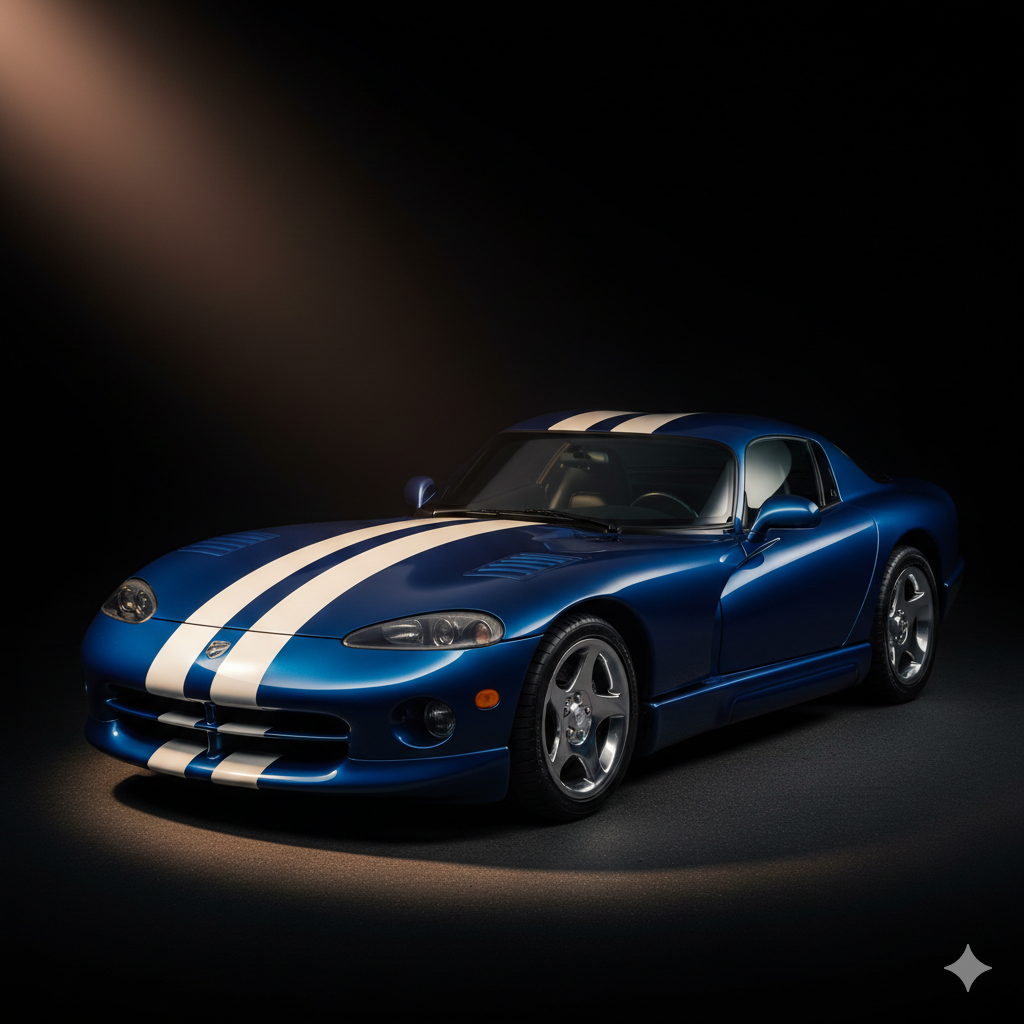
In 1996, the car that defined a generation arrived: the Dodge Viper GTS.
If the RT/10 was the Cobra, the GTS was the Shelby Daytona Coupe. A fixed-roof version inspired by the legendary ’65 GT world champion. Dodge had the arrogance—or the genius—to paint it in Viper Blue with twin white racing stripes. It is one of the most iconic designs in automotive history. Period.
The GTS bumped power to 450 HP and 490 lb-ft. It added “luxuries” like AC, power windows, and airbags. But more importantly, the roof added torsional rigidity. For the first time, the Viper didn’t just win on the drag strip—it could actually handle a corner.
The GTS-R: When America Humiliated Europe at Home
Chrysler wasn’t content with just a street car. They wanted to prove the Viper could run with Europe’s best on their own turf. They developed the GTS-R race car alongside Oreca and Reynard.
What the GTS-R did in the late ’90s is one of the most brutal winning streaks in GT racing history:
- 3 Consecutive FIA GT Championships (1997, 1998, 1999).
- 3 Consecutive Class Wins at the 24 Hours of Le Mans (1998, 1999, 2000).
- Overall Win at the 2000 24 Hours of Daytona (The first American production-based car to do it).
- Overall Win at the 24 Hours of Nürburgring.
The Viper didn’t just participate; it dominated so thoroughly that officials imposed “Balance of Performance” restrictions to slow it down. Oreca engineers actually had to tell their drivers not to break lap records during Le Mans practice to avoid further penalties. A truck-based American V10 went to Europe and crushed Porsche and Ferrari in the most prestigious GT race in the world. Three years in a row.
The Five Generations of the Snake
- Gen I (1992-1995): The raw RT/10. 400 HP. No windows, no roof, no mercy.
- Gen II (1996-2002): The GTS Coupe. 450 HP. The racing era. The blue-and-white icon.
- Gen III (2003-2006): Rebranded as SRT-10. 8.3L V10, 500 HP. Sharper lines. Chrysler also stuffed this engine into the Ram SRT-10, making it the world’s fastest production pickup at the time.
- Gen IV (2008-2010): 8.4L V10, 600 HP. Variable Valve Timing—a first for a pushrod engine. The ACR version of this car shattered the Nürburgring production car record.
- Gen V (2013-2017): The farewell. 645 HP, 600 lb-ft. Carbon fiber and aluminum. It finally got stability control—though you could turn it completely off to relive the ’92 “near-death” experience. Side-airbag regulations finally killed the snake in 2017.
Why the Viper Matters
The Viper matters because it is the last honest car. No turbos. No superchargers. No hybrid motors. No dual-clutch flappy paddles. No 15-inch touchscreen. No “Eco” mode. Just a massive naturally aspirated V10, a manual box, and your right foot.
Modern supercars make you feel like a better driver than you actually are. The Viper did the opposite. It made it clear, in every corner and every pull, that the car was better than you. And if you weren’t up to the task, it would punish you.
While the Corvette was the “smart” American sports car—calculating, evolving, high-tech—the Viper was the psychopath in an expensive suit. It was a monument to what Detroit could do when it stopped asking for permission.
The Numbers (2026 Estimates)
- Gen I RT/10: $50,000 – $80,000
- Gen II GTS (Blue/White): $80,000 – $120,000
- Gen V ACR: $200,000+ and climbing.
Total production over 25 years was roughly 31,000 units. To put that in perspective: Porsche builds more 911s than that in a single year.
Rest in peace, snake. There will never be another one like you. If you’ve ever felt the roar of a Viper V10 in person and didn’t get goosebumps, check your pulse. You might be dead.
What do you think? Was the Viper the pinnacle of American performance, or was it just too much car for the real world? Let’s hear it in the comments.
— Not Enough Cylinders
Pingback: The Spanish Phoenix: Domingo Ochoa and the GTA Spano Story
Pingback: Carroll Shelby: The Chicken Farmer with a Borrowed Heart Who Humiliated Ferrari