
The Dual Mass Flywheel — The Part That Sent More Cars to the Junkyard Than Actual Accidents
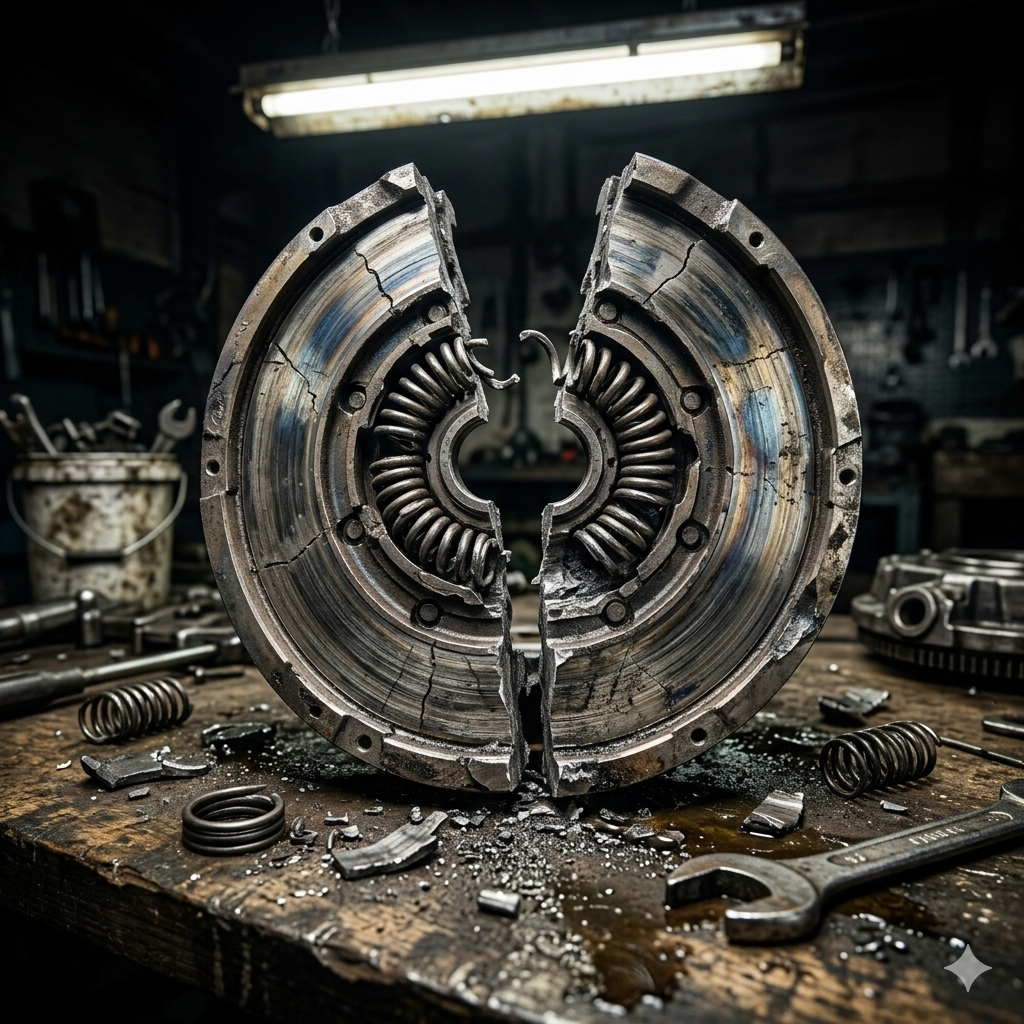
There’s a moment every diesel car owner dreads. Not the moment the check engine light flickers on. Not the moment you hear something weird from the suspension. No. It’s the moment your mechanic looks you dead in the eye, takes a breath, and delivers the sentence:
“It’s the dual mass flywheel.”
And just like that, your savings account takes a bullet. Your weekend plans evaporate. Your relationship with your car enters its darkest chapter.
Welcome to the most expensive rotating disc you never knew existed — until it blew up your budget.
What Exactly Is a Dual Mass Flywheel?
Let’s start at the beginning, because most people have absolutely no idea this thing exists until they’re staring at a four-figure repair quote.
A flywheel is a heavy metal disc bolted to the crankshaft of your engine. Its purpose is straightforward: store rotational energy and keep the engine spinning smoothly between combustion cycles. In the old days, this was a single solid chunk of cast iron. Simple, robust, damn near indestructible. You could resurface it, bolt on a fresh clutch, and keep driving for another 200,000 kilometers without breaking a sweat. The cost? Negligible.
Then, in 1985, a German company called LuK — now part of the Schaeffler Group — had a bright idea. What if we split the flywheel into two separate masses connected by a set of arc springs? The primary mass would bolt to the crankshaft. The secondary mass would connect to the clutch and transmission. The springs sandwiched in between would absorb the torsional vibrations that modern engines — particularly high-compression diesels — were increasingly pumping out.
The first vehicle to receive this engineering marvel was the BMW 525e. And on paper, it was brilliant. Smoother gear shifts. Quieter transmission. Vastly improved NVH (Noise, Vibration, Harshness) characteristics. The driving experience got dramatically better, especially at low RPMs where diesel engines produce their most aggressive vibrations.
The catch? LuK had essentially created a wear item wearing a structural component’s disguise. And nobody bothered to tell the people buying the cars.
The Silent Epidemic
Here’s where the story gets properly ugly.
By the mid-1990s, the dual mass flywheel had swept through the European automotive industry like a virus. Every major manufacturer jumped on board. Volkswagen shoved them into their legendary 1.9 TDI. BMW fitted them across their entire diesel lineup. Ford bolted them into the 1.6 TDCi and 1.8 TDCi. PSA Group (Peugeot-Citroën) planted them inside their 1.6 HDi and 2.0 HDi powerplants. Renault, Opel, Fiat, Hyundai, Mercedes — the list reads like a phonebook.
Today, roughly one in three new cars sold in Europe rolls off the lot with a dual mass flywheel. And Schaeffler has churned out more than 200 million units worldwide since 1985.
Two hundred million ticking time bombs sitting between engines and gearboxes across the planet.
The dual mass flywheel was engineered to last the lifetime of the vehicle. In theory. In practice? Many fail between 80,000 and 150,000 kilometers. Some, particularly in stop-and-go urban traffic, give up the ghost as early as 40,000 to 60,000 kilometers. That’s not a lifetime component. That’s barely past the break-in period.
The Hall of Shame: Europe’s Most Affected Models
Time to name names, because these brands banked billions while their customers quietly bled cash.
VAG Group (Volkswagen, Audi, SEAT, Škoda) The 1.9 TDI and 2.0 TDI engines are arguably the most widespread dual mass flywheel casualties in automotive history. The Golf V, Passat B5/B6, Audi A4 B6/B7, SEAT León, and Škoda Octavia have all earned their reputation as DMF killers. The 1.9 TDI with 90 horsepower got a pass — it ran a single mass flywheel. But the 100, 105, 115, 130, and 150 horsepower variants? All dual mass. All counting down.
BMW From the 2.0d to the 3.0d, BMW diesels are notorious for DMF failures. The E46 320d and E90 320d are particularly well-documented victims. BMW also used dual mass flywheels across their petrol range — the 2.0i, 2.5i, and even the beefy 5.0i V8.
Ford The 1.6 TDCi and 1.8 TDCi engines — found in the Focus, C-Max, and Mondeo — are arguably Ford’s most controversial DMF platforms. Owners have reported failures well below the 100,000-kilometer mark, particularly in models used for urban commuting.
PSA Group (Peugeot-Citroën) The 1.6 HDi and 2.0 HDi engines form the backbone of the French car industry — and both carry the dual mass flywheel curse. The Peugeot 307, 308, 407, Citroën C4, and C5 have all racked up their share of wallet-crushing flywheel replacements.
The Economics of Despair
Now let’s talk money. Because this is where the dual mass flywheel stops being just an engineering headache and becomes a social problem.
The part itself — just the flywheel — runs between €250 and €800, depending on the vehicle. Quality brands like LuK, Sachs, or Valeo sit at the top of that range. Cheap alternatives exist, but every mechanic worth their torque wrench will tell you the same thing: don’t even think about it. A bargain DMF will fail faster than the original, and you’ll be paying for the same labor twice.
Speaking of labor: replacing a dual mass flywheel means dropping the entire gearbox. That’s a minimum of 4 to 6 hours of work. On some models, it eats up the entire working day.
The total damage? In Spain, expect to pay between €900 and €1,500 at an independent workshop. At an authorized dealer? Easily €1,500 to €2,000 or beyond.
And here’s the kicker: any mechanic with half a brain will recommend swapping the complete clutch kit at the same time. Because if the flywheel has given up at 120,000 kilometers, the clutch isn’t far behind. And since the gearbox is already sitting on the floor… why wouldn’t you? So tack on another €150 to €400 for the clutch kit.
We’re now looking at a total repair bill that comfortably reaches €1,200 to €2,000 for a car that might only be worth €3,000 to €5,000 on the used market.
This is the calculation that has sent more cars to the scrapyard than any collision. This is the moment when the owner of a 10-year-old Volkswagen Golf TDI — a perfectly functional car in every other respect — has to decide: do I drop half the car’s value on a spinning disc, or do I call the breaker’s yard?
Thousands choose the yard. Every single year.
The Conversion Debate: Single Mass vs. Dual Mass
When faced with DMF failure, many owners stumble across what looks like a miracle: the single mass flywheel conversion kit.
Companies like Valeo offer kits that swap out the dual mass flywheel for a traditional solid flywheel, along with a modified clutch to compensate for the lost vibration damping. Parts alone typically run between €425 and €650, plus installation.
The appeal is obvious. A solid flywheel doesn’t fail the same way. It can be resurfaced. It’s cheaper to service. It eliminates the DMF as a future failure point, permanently.
But there’s a catch — and it’s not a small one.
The dual mass flywheel exists for a reason. It absorbs vibrations that would otherwise hammer directly into the gearbox, the transmission mounts, the cabin, and ultimately into your spine. Remove it, and you’ll notice more vibration at idle, harsher gear changes, and significantly more noise inside the car. In some cases, the added vibration can accelerate wear on gearbox synchromesh rings, input shaft bearings, and transmission mounts.
For a daily commuter trapped in stop-and-go traffic? A single mass conversion might genuinely make the driving experience worse. For a modified vehicle pushing more torque, or a car that tows regularly? It might be the smarter long-term play.
The honest answer: it depends entirely on your situation, your expectations, and how much vibration you can live with. There is no universal right answer — only trade-offs.
Why the DMF Is Really an Obsolescence Problem
Here’s where the gloves come off.
The dual mass flywheel is one of the clearest cases of hidden obsolescence in the automotive industry. Not designed obsolescence in the tinfoil hat sense — the engineers at LuK genuinely solved a real engineering challenge. But the economic model wrapped around it is deeply stacked against the consumer.
Consider the logic. Manufacturers adopted the DMF because it enabled engines that run at lower RPMs with less vibration, boosting fuel economy figures and satisfying ever-tighter emissions regulations. The customer got a smoother ride. The manufacturer got better numbers on the spec sheet.
But who foots the bill when the DMF dies? Not the manufacturer — the failure conveniently lands outside the warranty window. Not the dealer — they actually profit from the repair. The customer pays. Every time.
And the cruelest irony of all: the driving conditions most European car buyers face daily — urban commuting, stop-and-go gridlock, low-speed maneuvering — are precisely the conditions that accelerate DMF wear. The car was sold for city driving. The city is what kills the flywheel.
And as if that cocktail weren’t toxic enough, the industry decided to throw in another ingredient: the Start-Stop system.
Think about what Start-Stop actually does. Every time you stop at a traffic light, the engine shuts off. When you lift your foot off the brake or press the clutch, the starter motor cranks the crankshaft back to life. And every single one of those restarts is a direct mechanical impact on the dual mass flywheel’s arc springs. A torsional punch. A jolt. One more micro-trauma in the chain.
A car without Start-Stop starts once per journey. A car with Start-Stop in urban traffic can rack up 20, 30, 50 additional starts in a single commute. Multiply that by 250 working days a year, and you’re looking at tens of thousands of extra stress cycles that the original DMF was never designed to handle.
Manufacturers sell you Start-Stop as green technology. Saves fuel, they say. Cuts emissions, they say. What they don’t mention is that every automatic restart at a red light is another hammer blow on a component that already has a limited lifespan and a replacement bill north of €1,500. Start-Stop saves pennies in fuel while destroying a part that costs hundreds of euros. The math doesn’t lie.
It’s as if the engineer who designed the DMF and the engineer who designed Start-Stop worked in different buildings and never spoke. Or worse: they spoke perfectly well, but the amortization of failure fell on the customer, not the manufacturer. So nobody cared enough.
Compare all of this to the old single mass flywheel: resurfaceable, rebuildable, and practically immortal if you treated the clutch with a bare minimum of respect. The technology that replaced it is objectively superior at its core job — vibration isolation — but catastrophically inferior as a long-term ownership proposition.
The EGR, AdBlue, and DMF Trinity (With Start-Stop as Accomplice)
If you’ve been following Not Enough Cylinders, you know we’ve already tackled the EGR valve, AdBlue systems, and Start-Stop — technologies that solve one problem while spawning another. The dual mass flywheel rounds out the unholy trinity of modern automotive headaches. And Start-Stop, as we’ve seen, acts as the silent accomplice: a system that directly accelerates the DMF’s death while being marketed to you as an eco-friendly feature.
All four share the same DNA:
Engineered for a legitimate purpose. EGR reduces nitrogen oxides. AdBlue scrubs exhaust gases. The DMF dampens drivetrain vibration. Start-Stop shaves fractions off fuel consumption.
Hidden costs shifted to the owner. All four are expensive to deal with when they fail or cause collateral damage, and all four tend to become problems right around the time the warranty expires.
Zero transparency at the point of sale. How many car buyers have ever been told: “By the way, this car has a €1,500 consumable part between the engine and gearbox — and the eco system we fitted will wear it out faster”?
The pattern is unmistakable: the industry solves an engineering challenge, shifts the long-term cost onto the consumer, and moves on as if nothing happened.
How to Extend the Life of Your Dual Mass Flywheel
If you’re stuck with a DMF — and statistically, you probably are — here are some practical steps to squeeze the most life out of it:
Start with the clutch depressed. Most modern cars already require this, but it reduces shock loading on the flywheel during cranking.
Don’t ride the clutch. This is the single biggest killer of both clutches and flywheels. If your foot is resting on the clutch pedal while driving, you’re slowly cooking both components alive.
Don’t lug the engine. Driving at very low RPMs under heavy load sends brutal torsional vibrations straight through the flywheel. If the engine is laboring, downshift. The momentary inconvenience is cheaper than a new DMF.
Shift smoothly but decisively. The DMF hates hesitation. A clean, deliberate gear change is far gentler than a lazy, half-engaged transition.
Check your battery. A weak battery causes the starter motor to crank more slowly, ramping up mechanical stress on the flywheel’s ring gear and internal springs. A €100 battery swap today could save you €1,000 down the road.
Consider disabling Start-Stop. If your car allows it, switch off the Start-Stop system — especially in urban driving. Every automatic engine shutdown and restart at a traffic light is an additional stress cycle on the DMF. That button the manufacturer tucked into the console isn’t decorative. The fuel savings from Start-Stop amount to pennies; the flywheel bill runs to hundreds of euros. Do the math.
Don’t ignore early symptoms. Rattling at idle, vibrations through the clutch pedal, difficulty selecting gears, or a metallic knocking sound with the engine running — these are all red flags. Catch them early and you might save the gearbox. Ignore them, and fragments from a disintegrating DMF can shatter the transmission housing. That’s a repair bill starting at €3,000.
The Verdict
The dual mass flywheel is not inherently evil. It solved a genuine engineering problem, and from a pure NVH standpoint, it does its job brilliantly. Every modern diesel engine — and increasingly, downsized petrol units — would be noticeably rougher and louder without one.
But the economic model surrounding it is fundamentally broken. A component that costs €1,000 or more to replace, that cannot be repaired, that has a finite and often unpredictable lifespan, and that is installed in millions of vehicles without the buyer’s knowledge or understanding — that’s a failure of transparency, not engineering.
The dual mass flywheel has sent more perfectly good cars to the scrapyard than rust, collisions, and failed inspections combined. It has turned affordable diesel motoring into a game of financial Russian roulette. And until the industry finds a better solution — or at least starts being honest about the true cost of ownership — it will keep doing exactly that.
Keep those springs tight. And maybe start a savings fund.
Because the flywheel always collects.
Not Enough Cylinders — Because the real story is always under the hood.