
Oemmedì Fiat 500 V12 Lamborghini: The Cinquecento That Swallowed a Bull
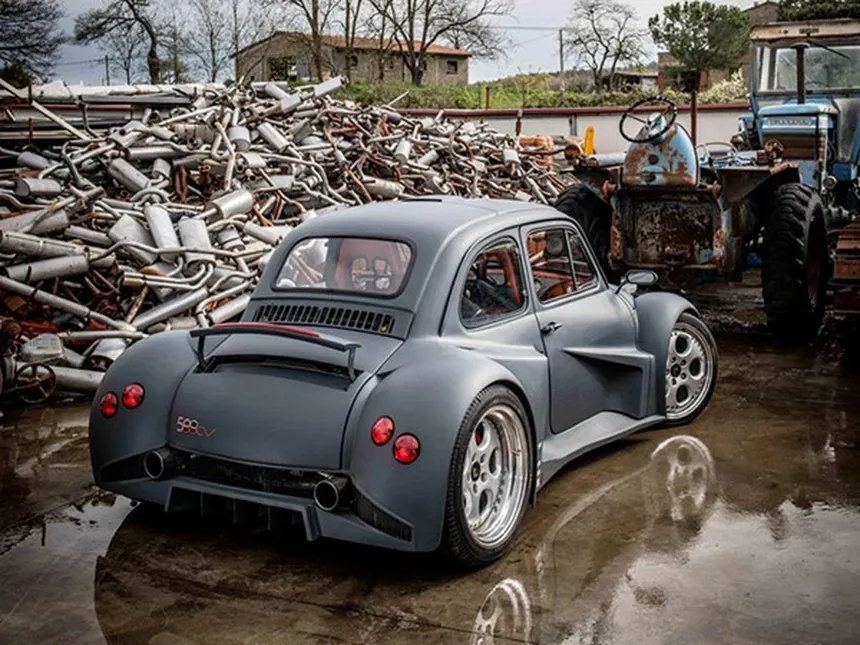
There are engine swaps. There are insane engine swaps. And then there’s what Gianfranco Dini built in an anonymous industrial estate surrounded by olive groves, an hour south of Rome.
A 1971 Fiat 500 with the V12 from a Lamborghini Murciélago. Not a motor “inspired by.” Not a replica. The complete engine block, the all-wheel-drive system, the gearbox, the original electronics, and the brake discs from a 580 hp supercar crammed inside the most iconic and tiny silhouette in European motoring. This is not a render. Not a garage project that stalled at the Instagram stage. It’s real, it roars, and it tops 300 km/h (186 mph).
Oemmedì Meccanica: The Factory of the Impossible in Acquapendente
To understand this car, you first need to understand who built it.
Oemmedì Meccanica is a family-run workshop located in Acquapendente, a small town in the province of Viterbo (Lazio, Italy), in a nondescript industrial area on Via Antonio Meucci. From outside, it looks like any other unit dedicated to servicing agricultural machinery. Step inside, and it’s a secret museum of Italian mechanical madness with over half a century of accumulated history between its walls.
The man behind it is Gianfranco Dini, born around 1957. He started hanging around workshops at nine years old. By twelve, he was pulling cylinder heads off Fiat 600s and Fiat 1100s, machining them, and bolting them back on. Engine machining has always been his specialty: lawnmowers, Caterpillar excavators, buses, cars big and small. He opened his own shop in 1984. Working alongside him is his son Leonardo Dini, an engineer by training, who shares the same obsession with squeezing the impossible out of the possible.
Oemmedì Meccanica’s Facebook page claims over 50 years of experience in mechanical work. It’s not empty marketing. It’s the reality of a family that has spent their entire lives understanding how things work from the inside and, when they get bored of the conventional, asking themselves: “What if we put this inside that?”
The Escalation of Madness: Each Engine Bigger Than the Last
The Fiat 500 V12 didn’t come out of nowhere. It was the result of a methodical escalation, project after project, each one more extreme than the one before. Oemmedì has at least six Fiat 500s in their workshop, and several of them hide secrets beneath their toy-like bodywork.
Phase 1: The Red Fiat 500 — Alfa Romeo Boxer 1,300 cc
It all started over thirty years ago, at the request of Leonardo himself, who as a young man already shared his father’s addiction. Gianfranco pulled the modest 499 cc twin-cylinder out of the Cinquecento and replaced it with the 1,300 cc boxer from an Alfa Romeo 33. The interior stayed true to the original: seats, steering wheel, instruments, and period door panels. Four seats, untouched. The result was a red 500 with triple the original power and a soundtrack that didn’t match its face. It was the first step of an addiction with no cure.
After that conversion, Gianfranco also experimented with the engine from the Autobianchi A112 Abarth. Carl Abarth’s scorpion was already staking out the territory that lay ahead.
Phase 2: The Grey Fiat 500 — Porsche Flat-6 3,200 cc
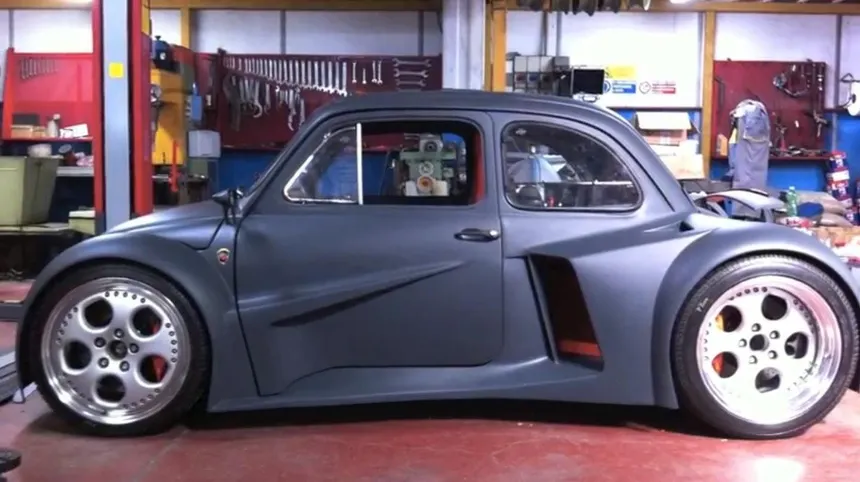
The second leap was on another level entirely. A six-cylinder boxer from a Porsche, 3,200 cc, originally fuel-injected, which Gianfranco converted to carburetors by hand. The rear engine cover became a two-piece electrically operated lid. The widened wheel arches started to become obvious. The air intakes on the front flanks of the fenders made sense for the first time. The grey 500 was the first clear signal that the people in Acquapendente were playing a different game.
Phase 3: The Black Fiat 500 — Ferrari/Lancia V8 3.0L
The third step brought eight cylinders. The chosen engine was the F105 3.0-liter unit — a V8 of Ferrari origin (the same block found in the Ferrari 308 and Mondial) that Lancia adapted for transverse mounting in the legendary Thema 8.32. That transverse configuration was key: it allowed the use of the Lancia’s five-speed manual gearbox directly. The suspension was designed around Fiat Coupé components.
The black body, hand-shaped in metal following the Italian coachbuilding tradition, achieved something extraordinary: the car didn’t look radically different at first glance. Only on closer inspection could you see the fully widened rear quarters, the oversized wheel arches, and the sculpted front lower valance. If the V12 is a scream, the V8 was a controlled growl that turned into a howl at the top of the rev range.
The V12: When Lamborghini Came Knocking

This is where the story most people get wrong.
Most articles say that Oemmedì “dropped a Lamborghini engine” into a Fiat 500. They present it as a one-sided whim, a mad garage project. The reality is different and far more interesting.
According to the Italian source Rombi di Gloria, which visited the workshop in person, it was Lamborghini who contacted Oemmedì. After learning about the success of the Abarth, Porsche, and Ferrari-powered versions, the Sant’Agata Bolognese manufacturer sent a crate engine (a complete powerplant outside a vehicle) directly to Acquapendente: a Lamborghini Murciélago LP640-4 V12, 6,496 cc, with all-wheel drive. A direct challenge. A dare: “Let’s see if you can handle this.”
Gianfranco accepted without hesitation.
There is a minor discrepancy between sources regarding the exact displacement. Oemmedì’s official website and Speedhunters record 6.2 liters (6,192 cc, corresponding to the first-generation Murciélago from 2001). Rombi di Gloria specifies 6,496 cc, the LP640’s displacement. The stated power across all sources is consistent: 580 hp. Regardless of the exact block version, we’re talking about a naturally aspirated 60-degree V12 with DOHC and four valves per cylinder, built to the standards of a supercar that cost over €300,000 new.
For context: the 1971 Fiat 500L, the base car for this project, ran an air-cooled 499 cc inline twin producing 18 hp at 4,400 rpm and a peak torque of 30 Nm. Its curb weight was around 540 kg and its top speed reached 95 km/h (59 mph).
The V12 that now occupies the space where a rear seat and a boot large enough for two grocery bags used to be multiplies that original power output by 32. Thirty-two times. The engine alone weighs more than the entire original car.
3,000 Hours: Anatomy of a Handcrafted Engineering Masterpiece
Building the Fiat 500 V12 consumed 3,000 hours of labor. If one person worked eight hours a day, five days a week, it would take over 14 months. For Gianfranco and Leonardo, who were running this project alongside the workshop’s regular workload, the actual timeline stretched far beyond that.
What makes this build unique from an engineering standpoint is that no aftermarket ECUs were used. No Haltech. No MoTeC. No Link. Nothing. All the electronics are original Lamborghini. The logic behind this decision is brilliant in its simplicity: Oemmedì didn’t build a car with a Lamborghini engine. They built a new body around a complete Lamborghini. They stripped the donor, kept all the vital organs and the original nervous system, laid everything out on a new structure, and fabricated a skin around it.
Between 2001 and 2010, just over 4,000 Murciélagos were built. They’re supercars — they get pampered — but some end up in accidents, and that salvage has to go somewhere. Oemmedì, being in the restoration and repair business, can source just about anything. What they did was strip the donor, preserve the organs and the complete nervous system, lay it all out on a plane, and build a new structure to house it. No aftermarket ECUs. No parts from a dozen different manufacturers requiring spliced wiring looms. Everything original, everything integrated, simply scaled down.
Verified Technical Specifications
Engine:
- Lamborghini Murciélago V12, 6.2L (alternative sources: 6.5L), naturally aspirated
- 580 hp
- Sport exhaust
- Custom-made 18-liter oil and water tanks
- Twin radiators with three rows of elements
- Twin electric fans
- Dedicated oil cooler
Drivetrain:
- All-wheel drive, Lamborghini Murciélago viscous differential, 60-40% (rear-front) split
- Six-speed Lamborghini gearbox
- Driveshafts modified from standard Lamborghini items
- Sintered clutch
Suspension and brakes:
- Front axle: double wishbone, strut bar, and anti-roll bar
- Rear axle: double wishbone, strut bar, and anti-roll bar
- Brake discs and calipers: standard Lamborghini Murciélago (unmodified)
Wheels and tires:
- OZ alloy wheels from the Lamborghini Diablo, 18-inch
- Front tires: 245/35 R18
- Rear tires: 335/30 R18 (Pirelli P Zero)
Dimensions:
- Length: 3,140 mm (123.6 in)
- Front axle width: 1,660 mm (65.4 in)
- Rear axle width: 1,740 mm (68.5 in)
- Wheelbase: 2,220 mm (87.4 in)
Performance (per Pirelli and Italian sources):
- Top speed: in excess of 300 km/h (186 mph), no limiter
- 0-100 km/h: approximately 3 seconds
- The original 500: top speed of 95 km/h (59 mph)
To put those dimensions in perspective: the original Fiat 500 measured 2,970 mm long and 1,320 mm wide. The Oemmedì car is 170 mm longer and, at the rear axle, 420 mm wider. As Speedhunters described it, the car is “almost as wide as it is long.”
Details Nobody Talks About
The rear windows come out for maintenance
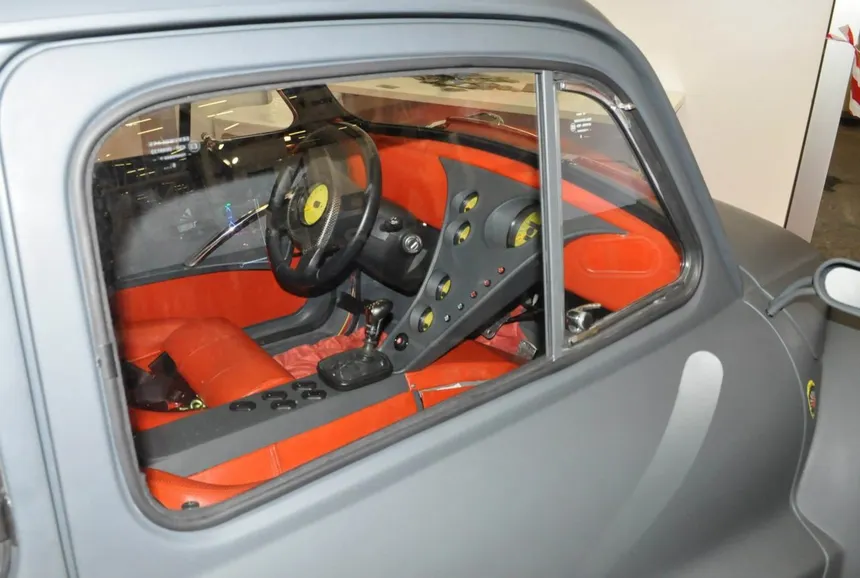
The V12 literally occupies the entire rear cabin space. The top of the engine pokes up like a box between the driver and passenger seats. For any mechanical inspection of the powertrain, the rear windows are physically removed. That’s the only way to access the block. As a Speedhunters journalist put it after seeing it in person: “That engine is never coming out of there.”
The wheels are from the Diablo, not the Murciélago
A detail that slips past most coverage. The 18-inch OZ alloy wheels are not from the Murciélago but from the Lamborghini Diablo, the preceding model. The rest of the drivetrain, transmission, brakes, and all electronics are Murciélago, but Gianfranco chose the Diablo’s wheels — likely for reasons of offset, width, and how they sit on the miniaturized proportions of the 500.
Brian Johnson from AC/DC drove it and signed it
AC/DC frontman Brian Johnson, a well-known car collector and amateur racing driver (he competed in the 2012 Daytona 24 Hours, the first rock musician to race at that level), visited Oemmedì to test the Fiat 500 V12. He did so for his television show Cars That Rock with Brian Johnson, which aired on Quest (UK) and later on Discovery Channel / Velocity Channel from 2016 onwards. Johnson signed the car itself — his autograph is still on the bodywork.
Winner at Tuning World Bodensee
The Fiat 500 V12 won at the Tuning World Bodensee, the flagship annual tuning event held on the shores of Lake Constance (Germany). This show gathers the most extreme and best-executed builds from across the continent every year. It’s the European equivalent of winning a SEMA Award in the United States. It’s not a prize for being wild — it’s a recognition of build quality.
Debuted at the Bologna Motor Show in 2012
The Fiat 500 V12’s public debut was at the 2012 Bologna Motor Show, as confirmed by Oemmedì Meccanica’s own website. Bologna is the capital of Italy’s Motor Valley, the region that is home to Ferrari, Lamborghini, Maserati, Pagani, and Ducati. Presenting a Lambo-powered Fiat 500 in the geographic heart of those brands was no accident. It was a statement.
The car is NOT road-legal
Despite being fully functional, the Oemmedì Fiat 500 V12 lacks road homologation. It’s a show and technical demonstration piece. A fact that is often omitted in coverage.
The Next Level: A Bugatti EB110 V12
In an interview published by Pirelli in 2019, Gianfranco Dini revealed what lay ahead in his escalation of impossible engines: a Bugatti EB110.
The EB110 was the supercar created by Italian entrepreneur Romano Artioli in the early nineties to resurrect the Bugatti brand. Its engine is a 3.5-liter V12 with four turbochargers, producing 560 hp in the GT version and 611 hp in the Super Sport. Approximately 120 units were built between 1991 and 1995 before the company went bankrupt. It is one of the rarest and most exclusive engines ever series-produced.
According to Gianfranco, the EB110 engine was delivered to them with the explicit goal of surpassing the Lamborghini-powered 500’s output. He also mentioned they were developing a front-wheel-drive hybrid concept. As Pirelli put it in their article: “Because the future for Oemmedì is also green.”
As of this publication, there is no public confirmation that the Bugatti EB110 project has been completed. If it exists, it would arguably be the most extreme engine swap ever conceived: a quad-turbo V12 from a Bugatti inside a Fiat 500. If Gianfranco has pulled it off, the automotive world doesn’t know about it yet.
The Power-to-Weight Paradox
One of the most frequently cited — and hardest to accurately verify — figures is the Fiat 500 V12’s weight.
One source (The Awesomer) places it at approximately 500 kg (1,100 lbs). If true, the power-to-weight ratio would be 0.86 kg/hp — more extreme than a Koenigsegg Jesko, a Bugatti Chiron, or any production car in existence.
For context: the original Fiat 500 weighed between 490 and 540 kg. The complete Lamborghini Murciélago weighed around 1,650 kg. Oemmedì clearly stripped all the donor’s bodywork and structure, keeping only engine, drivetrain, brakes, and electronics. The new 500 structure, while reinforced, is infinitely lighter than the Murciélago’s aluminum and steel monocoque.
The real figure likely sits between 900 and 1,100 kg. Even so, with 580 hp pushing that mass, the power-to-weight ratio remains insane. At a conservative estimate of 1,000 kg, we’re looking at 1.72 kg/hp. A Porsche 911 GT3 RS sits at roughly 2.7 kg/hp. A Ferrari 488 Pista, 2.1 kg/hp. The 500 V12 embarrasses both on that metric.
And it does it with 335-section rear tires, all-wheel drive, and supercar brakes. This isn’t an uncontrollable bomb. It’s a bomb that someone took the trouble to make controllable.
What This Car Says About Italy and About Mechanical Craft
The Oemmedì Fiat 500 V12 is not a tuning exercise. It’s a coachbuilder-level feat of handcrafted engineering, executed by a man who started machining cylinder heads at twelve and didn’t stop until he’d stuffed a supercar V12 into Europe’s smallest utility vehicle.
There’s something deeply Italian about all of this. The Fiat 500 was the car that motorized Italy in the 1950s, the transalpine equivalent of the Volkswagen Beetle or the British Mini. It was the symbol of mass mobility, of absolute pragmatism, of doing a lot with very little. Lamborghini, by contrast, represents radical exclusivity, unapologetic power, mechanical luxury reserved for the few. Putting one inside the other is the perfect metaphor for a country that has always understood that the sacred and the profane go hand in hand.
Gianfranco Dini doesn’t have a team of engineers with degrees from the Politecnico di Milano. He has fifty years of calluses on his hands, a son with an engineering degree who shares his vision, and a workshop among olive groves where the boundary between what’s possible and what’s absurd was torn down decades ago.
He didn’t need CAD. He didn’t need CFD simulations. He needed to know how metal behaves when you heat it, how to distribute weight when every kilogram matters, how to make a 1960s body coexist with a 21st-century drivetrain without anything breaking.
And when Speedhunters, the global bible of car culture, published their feature in January 2014, it became their most-read story of the year. Ten years later, in 2024, they pulled it from the archives for a Throwback Thursday. Because some cars don’t age. This is one of them.
When you consider the arc of this project — from a kid pulling heads off Fiat 600s in the 1960s, through four decades of progressively crazier builds, to a workshop that caught the attention of Lamborghini itself, to a feature on Discovery Channel with one of rock’s biggest names behind the wheel — it stops being a story about a car. It becomes a story about what happens when obsession meets competence and neither one runs out.
The Oemmedì Fiat 500 by the Numbers: Before and After
| Spec | Fiat 500L (1971) Original | Oemmedì Fiat 500 V12 |
|---|---|---|
| Engine | Inline-2, 499 cc, air-cooled | V12 60°, 6.2L (6.5L?), liquid-cooled |
| Power | 18 hp (4,400 rpm) | 580 hp |
| Torque | 30 Nm (3,500 rpm) | ~580 Nm (estimated) |
| Drivetrain | Rear-wheel drive | AWD (60/40) |
| Gearbox | 4-speed manual | 6-speed Lamborghini |
| Top speed | 95 km/h (59 mph) | 300+ km/h (186+ mph) |
| 0-100 km/h | Not applicable | ~3 seconds |
| Length | 2,970 mm | 3,140 mm |
| Width | 1,320 mm | 1,740 mm (rear axle) |
| Brakes | Drum | Ventilated discs (Murciélago) |
| Tires | 125 SR 12 | 335/30 R18 (rear) |
| Power multiplier | — | ×32 |
Why This Car Matters More Than You Think
We live in an age where any kid with a laptop and access to Midjourney can render a Fiat 500 with a space shuttle engine. Where every week a new “project” pops up on social media that amounts to three photos of an engine on a stand, a GoFundMe page, and a promise that it’ll be “done soon.” Where the word “build” has been devalued to mean “I bought parts and photographed them.”
The Oemmedì Fiat 500 V12 is the antithesis of all of that.
No renders. No crowdfunding. No sponsors. No marketing team generating hype for a product that doesn’t exist yet. There’s a workshop among olive groves, a father who has spent half a century with his hands inside engines, an engineer son who inherited the same disease, and 3,000 hours of actual work — cutting metal, welding, testing, getting it wrong, starting over — until a Cinquecento that made 18 hp fired up with 580.
Gianfranco Dini didn’t build this car for Instagram. He built it because Lamborghini told him it couldn’t be done. And when someone tells that to an Italian mechanic with five decades of craft behind him, all they’ve done is give him a reason to get up the next morning.
The car isn’t road-legal. It can’t be registered. It’s never going to win a race. It generates no revenue. It serves no practical purpose whatsoever.
And that’s exactly why it’s perfect.
Because the cars that changed the rules were never practical. The Shelby Cobra wasn’t practical. The Lancia Stratos wasn’t practical. The first 911 Turbo wasn’t practical. They were statements of intent from people who understood something that market analysis will never capture: that engineering, when pushed to the edge of the absurd by the hands of someone who knows what they’re doing, stops being engineering and becomes art.
Gianfranco and Leonardo Dini are artists. Their canvas weighs 580 hp and sounds like the end of the world.
And somewhere in that workshop in Acquapendente, a Bugatti EB110 engine is still waiting for its turn.
Check you’re still alive.