
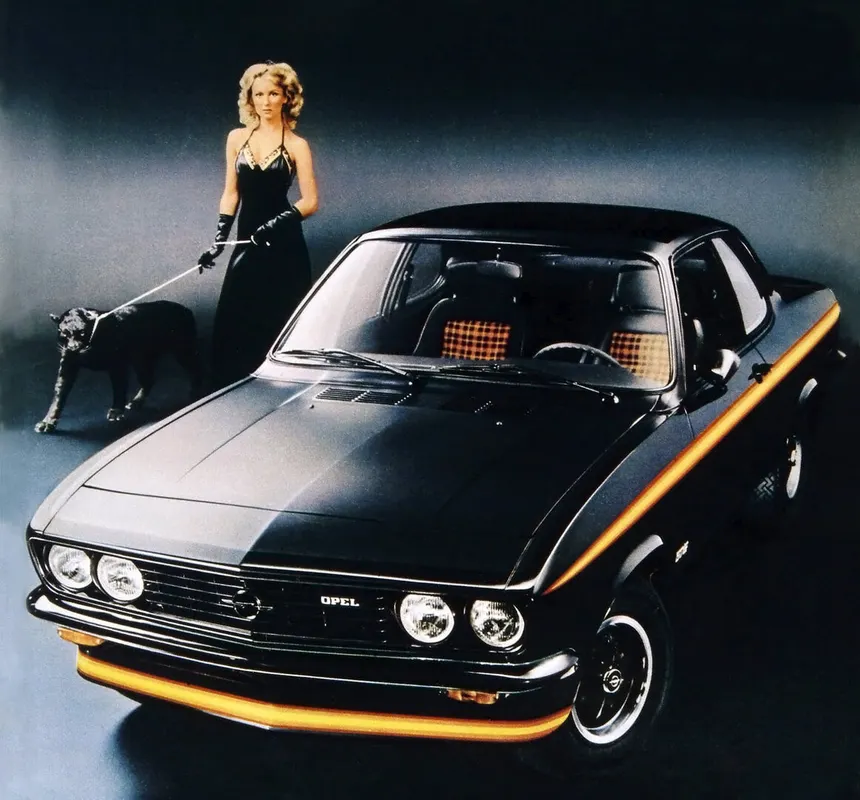
Opel Manta: sketched in six weeks, still standing fifteen years later
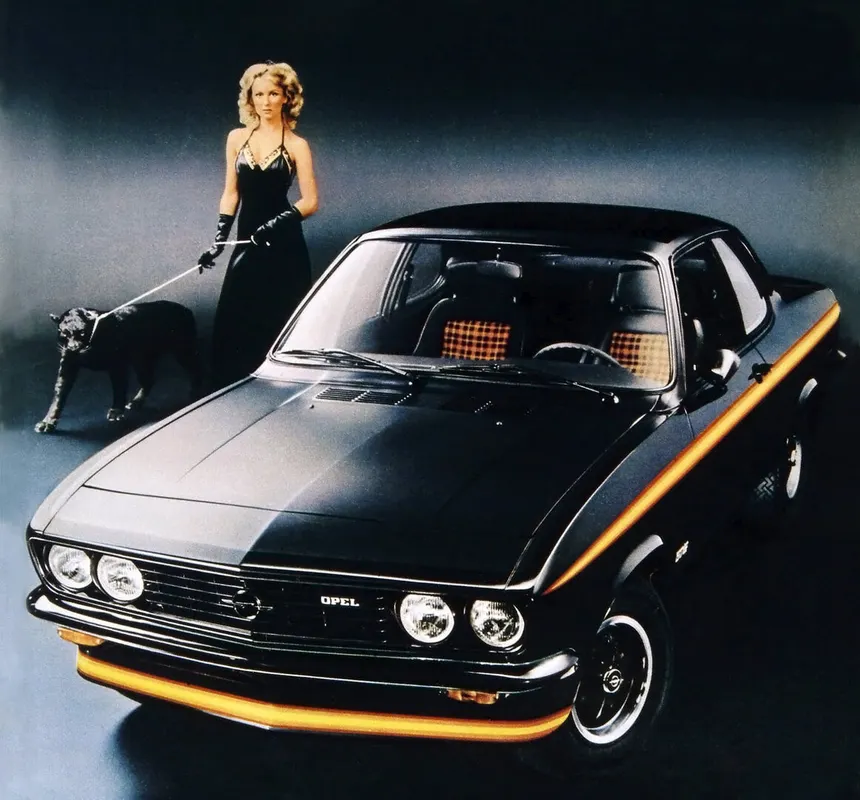
Ask any British enthusiast about affordable seventies coupés and the conversation starts and ends with the Ford Capri. The car you always promised yourself. Fair enough. But cross the Channel and there was another one playing the exact same game, built by people who watched the Capri clean up and quietly decided to do it better. That car was the Opel Manta, and its story is far stranger and far better than its reputation as a hairdresser’s runabout ever let on.
Here’s the bit nobody tells you: the Manta was sketched in six weeks flat, on a dare, and four decades later it finished fourth overall in the Paris-Dakar. Let me explain how a saloon-based coupé ended up doing that.
A six-week answer to Dearborn
Rewind to the back end of the sixties. Ford launches the Capri in 1969, lifts the Mustang playbook wholesale, and Europe goes mad for it. Pretty fastback, four seats, humble Cortina mechanicals underneath, a price that flatters. The recipe writes itself, and Ford got there first.
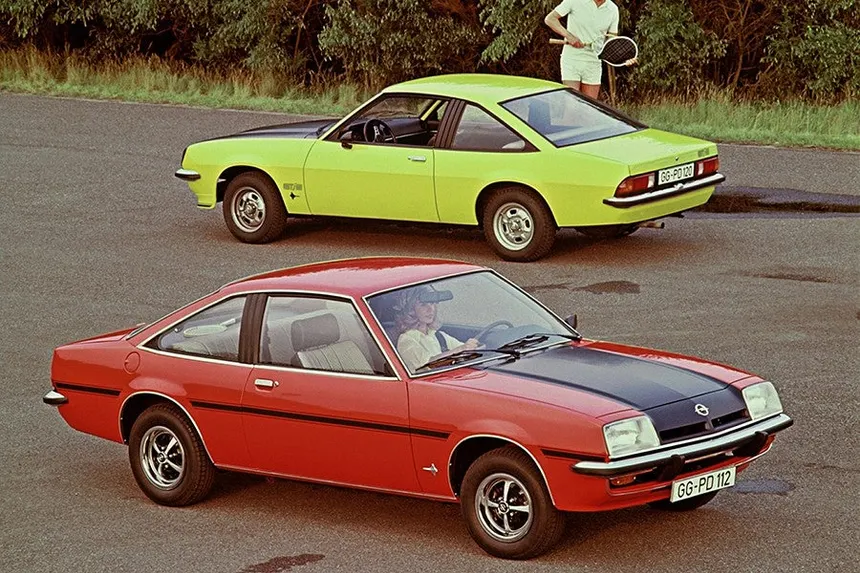
Over at Opel’s Rüsselsheim HQ, design chief Chuck Jordan handed his American deputy George Gallion the brief from hell: build me a Capri killer, and have it done by the time I’m back from holiday. Six weeks. Gallion later admitted the rear-end styling was largely settled, which let the team obsess over the front. There wasn’t even time to design bespoke lights, so they raided the parts bin. Those distinctive round rear lamps would later end up on the Opel GT in its final year.
The name was already locked in. Manta, after the ray, riding the contemporary fashion for christening coupés after fierce creatures of land and sea, the same instinct that gave us Stingray and Mustang. Gallion actually travelled to Paris to meet Jacques Cousteau, chasing inspiration for the badge. The most working-class Opel of its era wears an emblem blessed by the world’s most famous oceanographer. You couldn’t make it up.
When the Manta broke cover in September 1970, Opel trotted out the corporate line: this isn’t a Capri rival, we’ve been developing it since 1966. Of course they had. The Capri’s 1969 arrival lit a fire under the programme, and everyone knew it. This was a Capri-beater down to its bones.
An Ascona in a sharp suit
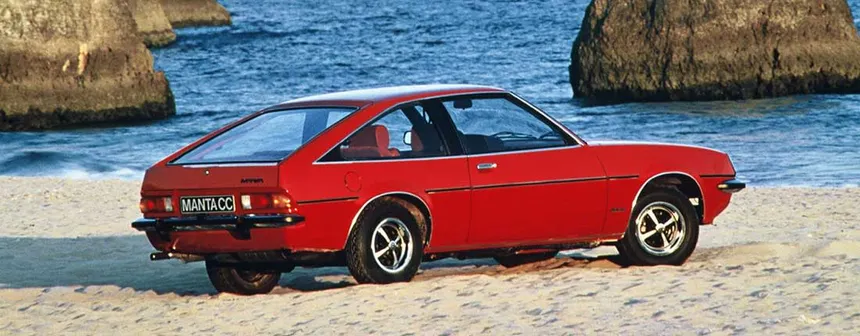
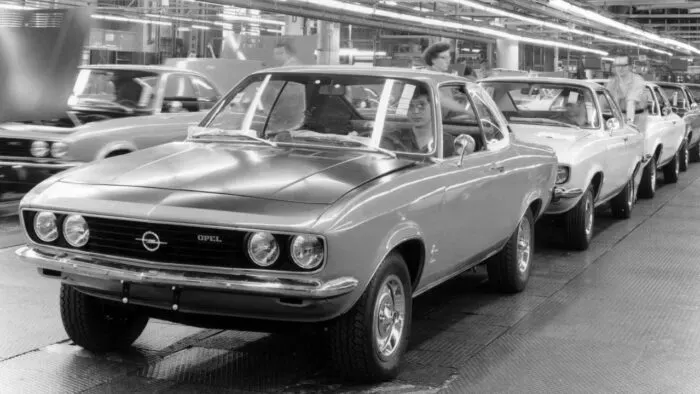
Anyone who’s ever turned a spanner gets this next part instantly. The Manta wasn’t engineered from scratch. It shared its platform with the Ascona, Opel’s mid-size family saloon that landed at almost the same moment. Same floorpan, same running gear, same dashboard, even the same front seats.
And that’s not a criticism, it’s the masterstroke. It’s precisely what Ford did, spinning the Capri off the Cortina. Take an ordinary car, drape a handsome body over it, charge more because it feels special, even though it costs you next to nothing extra to build. The Manta was what the trade calls a “parts-bin coupé”: sporting bodywork over saloon underpinnings, no fireworks, sensible money.
But Gallion’s lot didn’t just slap a frock on an Ascona. Not a single body panel was shared with any other Opel. The wheelbase ran slightly longer than the Kadett’s yet a full five inches shorter than the Capri’s. Mechanically it was period-correct but properly done: rear-wheel drive, a live rear axle located by trailing arms and a long Panhard rod, progressive-rate dampers mounted vertically, rack-and-pinion steering, front discs and rear drums on a split circuit, anti-dive built into the double-wishbone front end. Thoughtfully conventional, not cynically crude. That distinction matters.
Power came from Opel’s familiar cam-in-head four. At launch you chose between the 68bhp 1.6 and the twin-choke 90bhp 1.9 S. The 1.9 was good for 105mph and 0-60 in a shade over 12 seconds. In 1970, that was plenty to embarrass people on the motorway.
For an American reader, the context is worth spelling out, because the Manta arrived Stateside at a fascinating moment. Detroit was still selling big-block muscle when the first oil shock hit, and suddenly a light, frugal, good-looking German coupé that returned real fuel economy looked awfully smart. The Manta wasn’t fast by Camaro standards, but it handled with a tautness American iron of the era simply didn’t have, and it sipped fuel while a 350 V8 guzzled it. That combination, European poise plus sensible running costs, is exactly why more than 170,000 found homes in the United States, sold through Buick showrooms to buyers who wanted something sharper than a domestic compact without paying BMW money. It was the thinking driver’s alternative in a market obsessed with cubic inches.
The cleverest marketing trick of the decade
In Britain the Manta cost £1,474, and the adverts promised five seats with a line that drips seventies: “Why should bachelors have all the fun?” In reality everyone knew this was a car for the young couple with a toddler trading up from an MGB GT, not a proper family hauler. But the image did the selling.
This is the bit that defines the Manta. It shared a floorpan with the Ascona, but the two could not have lived more different lives. An Ascona was the respectable Darmstadt insurance man’s saloon. A Manta was the provincial young hedonist’s weapon. Same mechanicals, opposite worlds. Some Manta owners genuinely looked down their noses at Capri drivers, dismissing them as “medallion men” while congratulating themselves on their fine wine and Belgian chocolate. Entire social tribes built on Opel coupés. Magnificent.
One 1973 UK advert summed up the whole game: “From the ruins of World War II, back to No. 1 in Germany.” The Manta wasn’t selling transport, it was selling the pride of the German economic miracle on monthly instalments.
There’s a deeper point buried in that snobbery, and it’s what makes the Manta such a revealing car. It proved that image, not horsepower, was what people were actually buying. A base 1.6 Manta and a range-topping model looked identical from across a car park, and that was the entire trick: the dream was the shape, not the spec sheet. Buyers understood this instinctively. They weren’t paying for lap times, they were paying for the way the car made them feel pulling up outside a bar, and for the tribe it signalled they belonged to. Ford had figured this out first with the Capri, but Opel executed it with a particular Germanic thoroughness, right down to that Cousteau-blessed badge. It’s marketing psychology that would look perfectly at home in a modern boardroom, deployed with total confidence in 1970.
When the Manta A made way for the B in July 1975, Opel had built 498,553 of them, more than 170,000 sold in the States, where they went out through Buick dealerships because Opel had no network of its own there. A German Opel flogged as an exotic import in the land of the Mustang. The world upside down.
Then the 400 arrived and things turned serious
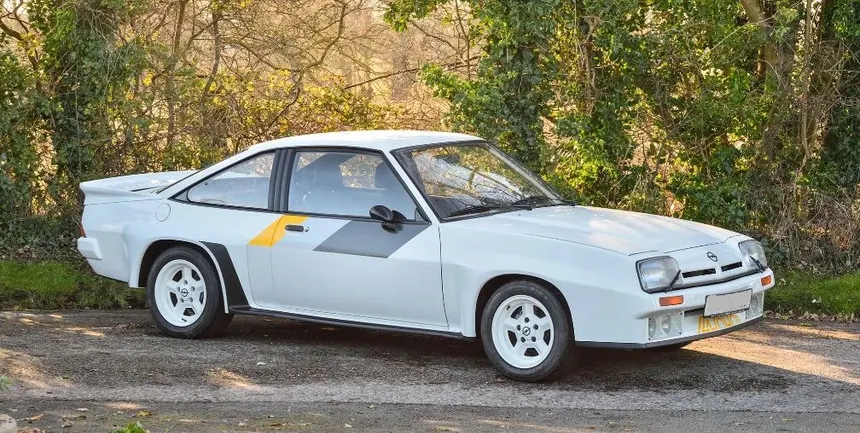
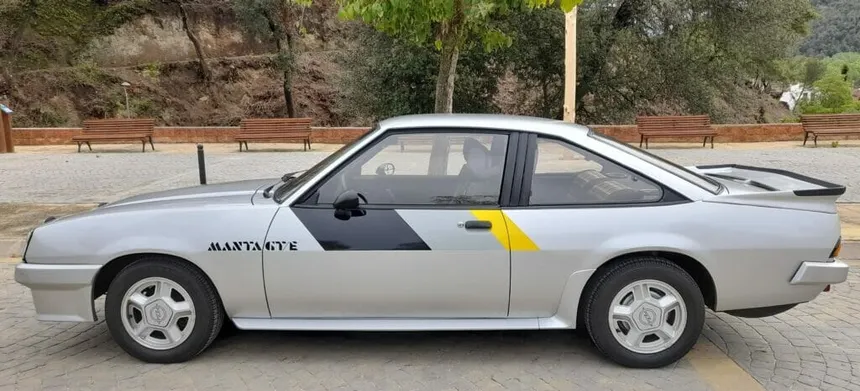
This is where the Manta stops being the friendly neighbourhood coupé and earns its legend. Because the second-generation Manta B spawned a monster: the Manta 400.
By the early eighties the World Rally Championship answered to Group B, that no-limits class that bred the Audi Quattro, the Lancia 037, the Peugeot 205 T16. Homologation demanded 200 road cars. Opel, fresh off Walter Röhrl’s 1982 title in the Ascona 400, fancied a crack with the Manta.
The original plan was a two-litre. Cosworth cooked up new 16-valve crossflow heads, but two litres wouldn’t deliver the numbers. Since the heads were already made, a fresh forged crank stretched capacity to 2.4 litres. The result: 144bhp in road trim, north of 275bhp in phase 3 competition spec on a pair of 50mm Weber carbs. Nought to sixty in under five seconds. Properly quick.
The genius, though, lived elsewhere. Unlike the Ascona 400, the Manta went heavy on Kevlar: front panel, front wings, bonnet, doors, rear arches, bootlid, spoiler, even the headlight holders. Over 80kg saved. The engine sat six centimetres further back for weight distribution. Just 245 road cars were built, only 59 wearing the wide Irmscher kit, the one with the swollen arches and the bootlid spoiler everyone pictures.
That Kevlar obsession deserves a moment, because in the early eighties it was genuinely cutting-edge. Kevlar was aerospace material, the stuff of bulletproof vests, and using it across a car’s outer panels to shave 80 kilos was the kind of trick reserved for the wealthiest works teams. Opel wasn’t the wealthiest works team. It was the underdog trying to claw back the weight penalty that its heavy cast-iron engine imposed, and it turned to exotic composites to do it. The result was a rear-drive rally car lighter than it had any right to be, a machine engineered around the hard truth that it was already technically behind and had to compensate somewhere. Every gram mattered, and Opel’s engineers knew it better than anyone.
The lesson nobody saw coming
Here’s the bittersweet part, and it’s my favourite. By the time the Manta 400 made its competition debut on the 1983 Tour de Corse, it was already dead on arrival. Why? Because the Audi Quattro had turned up with four-wheel drive and rendered every rear-driven rally car obsolete overnight. The Manta was born out of date.
Opel tried. They built a 4×4 prototype with Ferguson, Ari Vatanen drove it, and reports reckoned it was more biddable than the Quattro itself. But the cost of homologating another 200-car run killed it stone dead. A footnote.
And yet the 400 earned respect the hard way, on the dirt. Erwin Weber took the German Rally Championship in 1983. But its finest hour came elsewhere: the 1984 Paris-Dakar, where it won the rear-wheel-drive class and finished fourth overall. Fourth. At Dakar. In a Kevlar-clad neighbourhood coupé with a Cosworth four, scrapping with genuine off-roaders. That’s the story that defines the Manta. Not the fastest, not the most decorated. The one that rolled up its sleeves and raced on after it had already been written off.
Even now, a Manta 400 still turns laps at the Nürburgring’s endurance series, and Chris Harris’s Collecting Cars regularly fields rare examples for buyers who know exactly what they’re looking at.
The Manta bowed out in 1988, Opel’s last factory rear-drive rally weapon. Its replacement, the Calibra, played an entirely different game. But that’s a story for another day.
The Manta was never the quickest or the priciest car of its time. Nor did it ever beat Audi: the Quattro rendered it obsolete from the factory floor, and in world-championship rallying the Manta never laid a glove on four-wheel drive. But it was something better than a winner. It was the car written off before it even started, the one that rolled up its sleeves and raced anyway, clawing its way to fourth at Dakar against genuine off-roaders. Six weeks of design, a saloon platform and the kind of bloody-mindedness you just don’t see any more. That’s working-class dignity cast in steel.
Check you’re still alive.