
Porsche Carrera GT: The Last Supercar That Wanted to Kill You
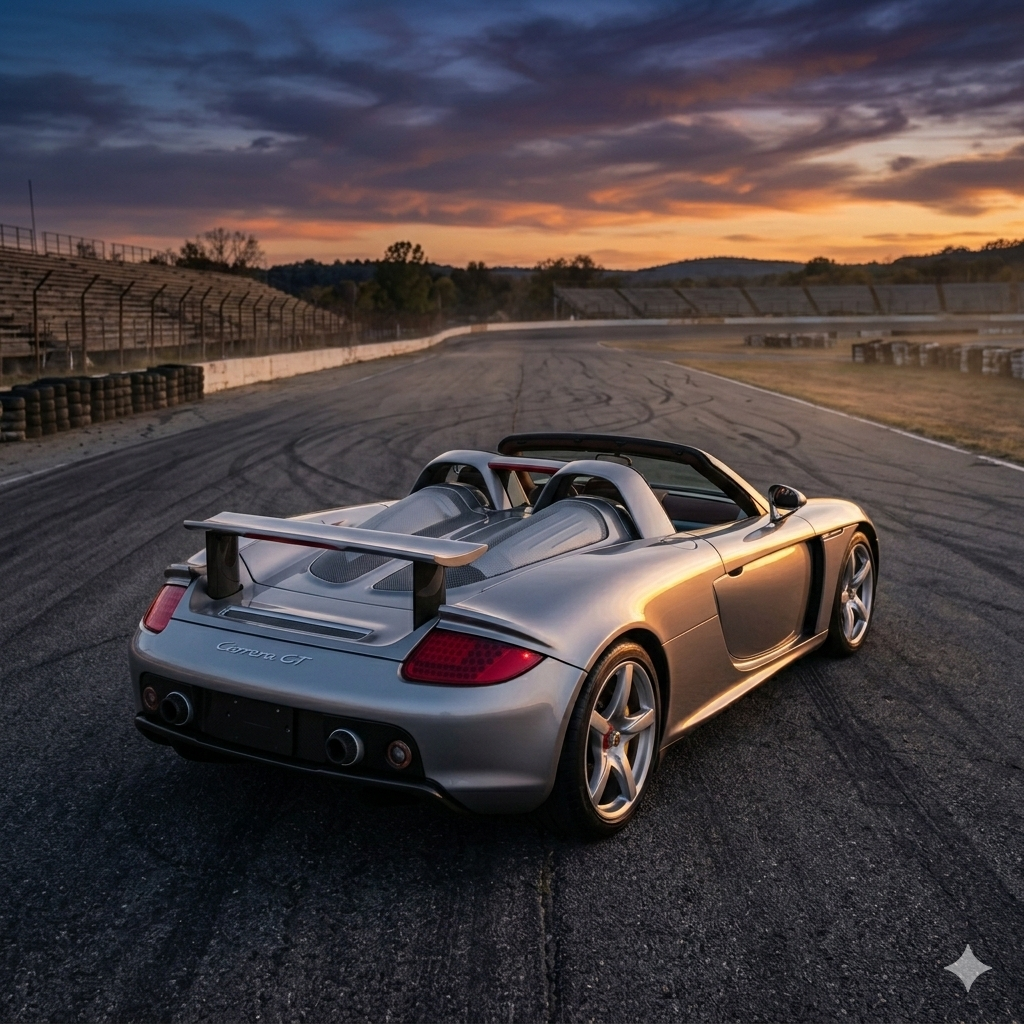
In an era when every supercar comes wrapped in electronic safety nets, the Porsche Carrera GT stands as the last monument to a terrifying philosophy: here’s 612 horsepower. Good luck.
No traction control. No stability control. A clutch so aggressive it earned the nickname “the binary clutch” because it was either engaged or it wasn’t — there was no progressive zone, no gentle takeoff, just a mechanical binary of stationary or moving. A V10 engine derived from a cancelled Le Mans prototype that screams to 8,400 rpm with a sound that makes grown adults emotional in ways they can’t quite explain.
The Carrera GT, produced from 2004 to 2007, is simultaneously the greatest and most dangerous car Porsche has ever built for public roads. It’s the car that proved Porsche could play in the hypercar league against Ferrari and McLaren. It’s also the car that reminded us, sometimes tragically, why electronic driver aids exist.
Born From Cancellation
The Carrera GT’s origin story is one of the most interesting in supercar history, because it begins with a failure — or rather, with a strategic retreat that turned into an unexpected opportunity.
In the late 1990s, Porsche was developing a car for the Le Mans Prototype (LMP) class — the 9R3 project. This was Porsche’s planned return to the top tier of endurance racing, and at its heart was a remarkable engine: a 5.5-litre V10 that combined the compact packaging of a V8 with the power potential of a V12. The engine was a clean-sheet design, using technology that Porsche had developed through decades of racing — lightweight construction, high-revving capability, and an emphasis on power delivery that prioritised usable torque over peak numbers.
When Porsche’s board decided to cancel the LMP programme in favour of focusing resources on the Cayenne SUV development — a decision that was arguably the most financially astute in the company’s history, transforming Porsche from a struggling sports car manufacturer into a goldmine — they were left with a remarkable engine and no car to put it in. The 9R3 engine was too good to shelve, too expensive to have been developed for nothing, and too extraordinary to waste on anything less than a showcase project.
The solution was to build a road-going supercar around the V10. The concept was unveiled at the 2000 Paris Motor Show, and the response was so overwhelmingly positive that Porsche greenlit production almost immediately. The concept became a production car with remarkably few compromises, which was both the Carrera GT’s greatest strength and, depending on your perspective, its most dangerous characteristic.
The production Carrera GT used a 5.7-litre version of the V10, enlarged from the racing specification and modified for road use. Naturally aspirated, it produced 612 horsepower at 8,000 rpm and 590 Nm of torque at 5,750 rpm. It was mated to a six-speed manual gearbox developed specifically for the car — no paddle shift option, no automatic, no dual-clutch. If you wanted a Carrera GT, you were going to row your own gears, and you were going to deal with a clutch that had been designed for racing conditions rather than traffic jams.
The chassis was a carbon fibre monocoque, making it among the first production cars to use this technology outside of Formula One. Total weight was 1,380 kg — extraordinary for a car of this size and power. The engine was mid-mounted for optimal weight distribution. The subframe was made from carbon fibre reinforced silicon carbide — a ceramic composite material that Porsche had literally invented for this application, offering the stiffness of carbon fibre with superior thermal resistance. The suspension used pushrod-operated inboard dampers, a design borrowed directly from racing that offered superior geometry and reduced unsprung mass.
This was not a parts-bin supercar cobbled together from existing components. This was Porsche engineering with the limiters removed, given a budget and a brief that said “build the best car you possibly can.”
The Sound of God
Every owner, every journalist, every person who has ever stood within earshot of a Carrera GT at full throttle says the same thing: the sound.
The V10 produces a wail that starts as a mechanical growl at idle — a low, busy, slightly uneven note that hints at the complexity of ten cylinders finding their rhythm — and builds through a mid-range bark to a stratospheric scream at the 8,400 rpm redline that is unlike anything else on four wheels. It’s not the bassy rumble of an American V8 or the operatic shriek of a Ferrari V12 or the metallic rasp of a Lamborghini V10. It’s something uniquely its own — raw, mechanical, and almost violently intense, as if the engine is physically straining against the laws of physics to spin faster than any road car engine has a right to.
The naturally aspirated delivery is perfectly linear. No turbo lag, no sudden power band, no electronic torque management reshaping the power curve to feel different from what the engine naturally produces — just a relentless, progressive surge of power from 2,000 rpm to the redline. Every increment of throttle produces a proportional increment of response. In an era increasingly dominated by turbocharged engines with artificial power characteristics and electronically managed torque curves, the Carrera GT’s V10 is a reminder of what naturally aspirated perfection feels like — direct, honest, and completely unmediated.
The Killer Reputation
The Carrera GT’s reputation for being dangerous is not marketing mythology designed to create mystique. It’s earned through physics, engineering decisions, and a philosophy that prioritised driving purity over safety margins.
The car’s behaviour at the limit is unforgiving in a way that modern supercars have deliberately engineered out. The mid-engine layout provides enormous grip right up to the point where it doesn’t, and when the rear breaks away, it does so suddenly and violently — the transition from grip to slide is narrow, abrupt, and happens at speeds where the consequences of getting it wrong are severe. Without electronic stability control — which Porsche deliberately omitted because they considered it incompatible with the car’s driving philosophy — recovering from a slide requires reflexes and skill that most owners simply don’t possess. This isn’t elitism. It’s physics.
The ceramic composite clutch is notoriously difficult to modulate. It operates in a narrow engagement window — either gripping or slipping, with minimal progressive zone between the two states. Smooth takeoffs from a standstill require a level of left-foot sensitivity that comes from practice, and many owners never fully master it. The clutch has humiliated experienced drivers in front of valet parking attendants, YouTube cameras, and fellow supercar owners with embarrassing regularity.
Multiple fatal accidents have been attributed to the Carrera GT’s demanding nature, most notably the 2013 crash that killed actor Paul Walker and driver Roger Rodas in Valencia, California. While the specifics of that incident involved excessive speed on a public road, the crash reignited debate about whether a car this powerful should be sold without electronic safety systems. The discussion was uncomfortable because it forced the automotive community to confront a question it preferred to avoid: at what point does a car’s danger become irresponsible rather than characterful?
Porsche’s response, both then and now, is consistent: the Carrera GT was designed for experienced drivers who understand and accept the risks. The absence of electronic aids is not an oversight — it’s the point. The car communicates directly with its driver through the steering, the throttle, and the seat of their pants, and that communication requires the driver to hold up their end of the conversation. If you’re not prepared for that conversation, you shouldn’t be driving this car. Whether that position is admirably principled or recklessly negligent depends entirely on your perspective.
Numbers and Legacy
Porsche produced 1,270 Carrera GTs between 2004 and 2007, against an original plan of 1,500 units. The shortfall was attributed to softening demand as the car’s dangerous reputation became more widely known — a reminder that even in the supercar market, a reputation for killing its owners has commercial consequences.
The car was priced at approximately €450,000 new in Europe, making it one of the most expensive production cars available. It was not a commercial success by volume, but it was never intended to be. It was a statement of capability — proof that Porsche could engineer at the absolute highest level, competing directly with Ferrari’s Enzo and Mercedes’ SLR McLaren for the title of ultimate supercar.
Today, Carrera GT values have exploded beyond anything that seemed plausible when the car was new. Clean, low-mileage examples regularly exceed €1,000,000 at auction. Exceptional cars — low miles, rare colours, complete documentation — have sold for €1.5 million and above. The appreciation has been driven by the same factor that drives all collector car markets at the highest level: the realisation that nothing like this will ever be built again.
And it won’t. The 918 Spyder that followed was faster, more technologically advanced, and more capable in every objective sense. But it was also a hybrid with electronic everything and a dual-clutch gearbox. The Carrera GT was the last Porsche supercar — and possibly the last supercar from any manufacturer — that trusted its driver completely. That trust — dangerous, demanding, and absolute — is what makes it irreplaceable.
The Carrera GT’s value trajectory also makes sense within a broader collector car trend: the final examples of a technological era always appreciate disproportionately. The last air-cooled 911, the last front-engine naturally aspirated V12 Ferrari, the last manual McLaren — these cars all end up commanding enormous premiums because they represent the end of a line. The Carrera GT is the end of several lines simultaneously: the last Porsche supercar with a naturally aspirated engine and manual gearbox, the last with zero electronic driver aids, and the last that absolutely prioritised the driving experience above driver safety.
The type of buyer seeking a Carrera GT today isn’t necessarily a garage collector hoarding cars as assets. More often than you might expect, it’s someone who genuinely wants to drive it — who understands the risks, who has the skill to manage a car without electronic nannies, and who values the direct, unfiltered experience it offers. It’s a car that selects its own owner, and that selectivity is part of its appeal. Not everyone can drive a Carrera GT safely, and that, in a world of supercars democratised by electronics, is precisely what makes it special.
The Honest Supercar
The Carrera GT is, ultimately, the most honest supercar ever built. It doesn’t flatter you. It doesn’t compensate for your mistakes. It doesn’t pretend you’re a better driver than you are. It doesn’t have algorithms adjusting its behaviour to make you feel heroic.
It gives you a V10, a manual gearbox, and a prayer. What happens next is entirely up to you.
In a world where even supercars have become appliances — fast, capable, and fundamentally safe, designed to make their owners feel like racing drivers without requiring any of the skill — the Carrera GT stands as a reminder that the relationship between driver and machine used to be a conversation, not a monologue.
That conversation was sometimes beautiful and sometimes fatal. But it was always real.