Autodelta: the Alfa Romeo race shop that wrote half its story in America
Autodelta was an Italian race shop, but a surprising share of its story was written in America. In 1964 a Giulia TZ won its class at the Sebring 12 Hours. In 1966 a Giulia GTA won the under-two-liter class of the first SCCA Trans-Am. In 1968 a Tipo 33 won its class at the Daytona 24 Hours, and the car has been called “Daytona” ever since. In 1971 Ronnie Peterson and Andrea de Adamich won the Watkins Glen 6 Hours in a 33/3, and in 1968 the street-legal 33 Stradale, at $17,000, was the most expensive car on sale to the public anywhere.
All of it came out of a racing department that started life in a dealer’s workshop in a village outside Udine, in the far northeast of Italy, and ended in 1985 with its archive rotting in buildings with no doors and no windows.
A dealer, an engineer, and a car Alfa couldn’t build
Alfa Romeo won the first two Formula 1 World Championships, in 1950 and 1951, and then walked away from racing for more than a decade to sell sedans. When it wanted back in, the man it trusted was Carlo Chiti, the Tuscan engineer who had designed the Ferrari 156 that carried Phil Hill to America’s first World Championship in 1961 and then walked out of Ferrari in the famous palace revolt at the end of that year.
On March 5, 1963, according to Alfa Romeo, Chiti and the brothers Lodovico and Gianni Chizzola founded Auto-Delta in Feletto Umberto, near Udine. Lodovico Chizzola was the local Alfa dealer. English Wikipedia puts the founding in 1961; Alfa and most Italian sources say 1963.
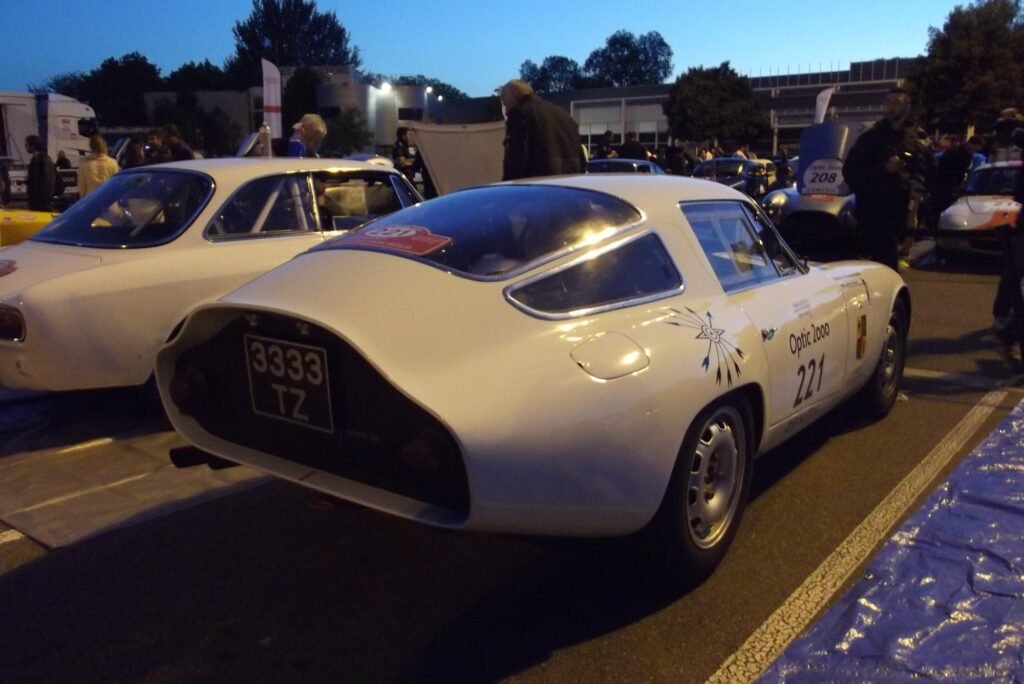
What Alfa needed was someone to build a car its own plant couldn’t be bothered with. The Giulia TZ, for Tubolare Zagato, was a little GT racer: a spaceframe of thin steel tubes under an aluminum skin by Zagato, penned by Ercole Spada. The rulebook said 100 had to exist before it could race as a GT. For a factory geared to churn out Giulia sedans, 100 cars was a rounding error, so Alfa president Giuseppe Luraghi farmed the job out. The supply chain looked like a kit-car operation. SAI Ambrosini welded the frames down near Perugia, Zagato hung the bodies in Milan, Alfa shipped engines and gearboxes in crates, and a handful of guys in Feletto Umberto bolted the whole thing together and made it run.
The idea was older than it looked. In 1958 Alfa had worked with Carlo Abarth on a coupe built on a tube frame by Mario Colucci, styled by Franco Scaglione at Bertone. FIAT objected to Alfa’s relationship with Abarth, and the project was shelved. The only finished prototype ended up in the basement of Alfa’s Portello plant. Four years later Giuseppe Busso of Alfa’s design office reworked that concept into the TZ chassis.
The TZ weighed between 1,411 and 1,455 pounds and made 112 horsepower in road trim, more than 160 once twin-plug ignition arrived in 1965. Its tail was chopped off vertically, a Kamm tail, after the research of German aerodynamicist Wunibald Kamm: cut the tail off abruptly and the air behaves almost as if the car were longer, so drag drops without adding length or weight. Zagato and Spada tested the shape on the public road between Milan and Bergamo with a stopwatch, because they didn’t have a wind tunnel.
The TZ debuted at the Coppa FISA at Monza in November 1963 and took the first four places in its category. In 1964 it won its class at Sebring, at the Targa Florio, where TZs finished third and fourth overall behind two Porsche 904s, and at Le Mans, while privateers Theodoracopulos and Grossman won their class in the Bridgehampton 500 km on Long Island. Production figures vary between 112 and 117 cars depending on the source.
Moving next to Milan
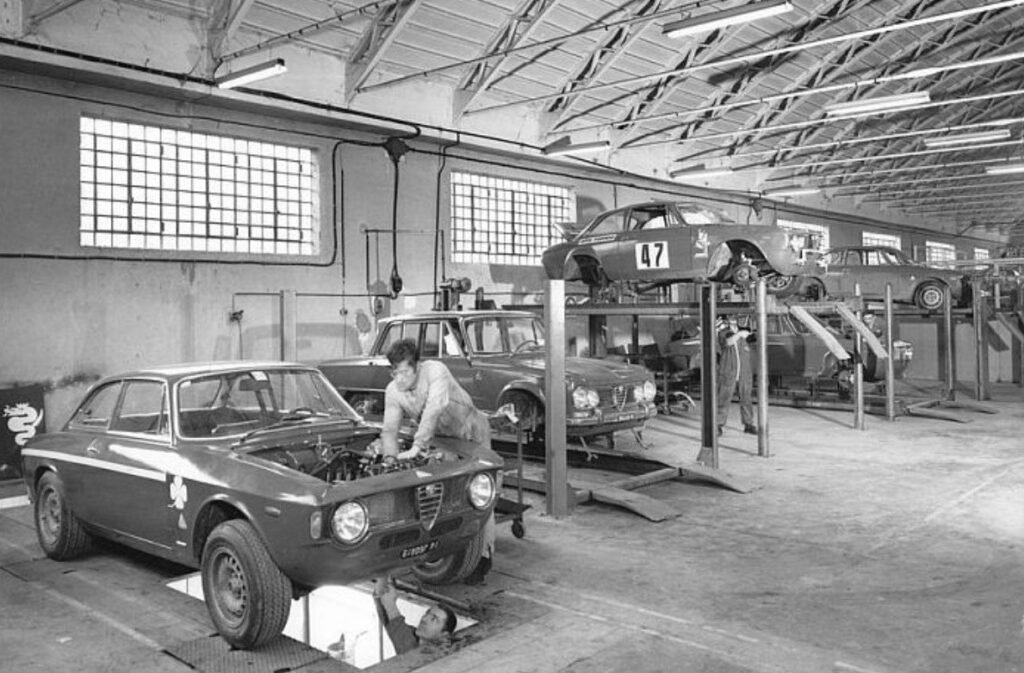
By late 1964, according to Motor Sport, Alfa had absorbed Auto-Delta; Alfa’s own date is 1965. It moved the operation to a set of plain sheds at Settimo Milanese, near the Arese factory and close to the Balocco test track, made it the official racing department, and dropped the hyphen. Chiti ran it as general manager for twenty years.
The model was one Alfa knew well. In the 1930s its racing had been run by an outside company called Scuderia Ferrari. Thirty years later Alfa did the same thing again, with another engineer who had come out of Maranello.
Andrea de Adamich, a works driver for years, said Autodelta raced on circuits, in rallies, in hill climbs and even on water, and that no other manufacturer had anything like it. The water part was real. According to the “Cavalli marini” exhibition at the Alfa Romeo museum in Arese, Autodelta enlarged the Tipo 33 engine to 2.5 liters for the powerboat Popoli-Alfa Romeo, in which Leopoldo Casanova set a world speed record of 225.145 km/h, about 139.9 mph, in the 500 kg KC class. The museum says it still stands.
De Adamich also told the story of the Balocco lap record. Test driver Teodoro Zeccoli was about two seconds a lap faster than everyone else there, and nowhere else. De Adamich, Galli and Giunti were sure he was cutting a corner, so they hid in a hut by the return straight to catch him. He wasn’t cheating. He was shifting into third partway through that bend, which stopped the wheels from spinning, while they stayed in second.
The GTA, and why Americans should care
The TZ stopped developing at the end of 1965. The FIA raised the GT homologation minimum from 100 cars to 500, and Alfa had a new plan for sedan racing.
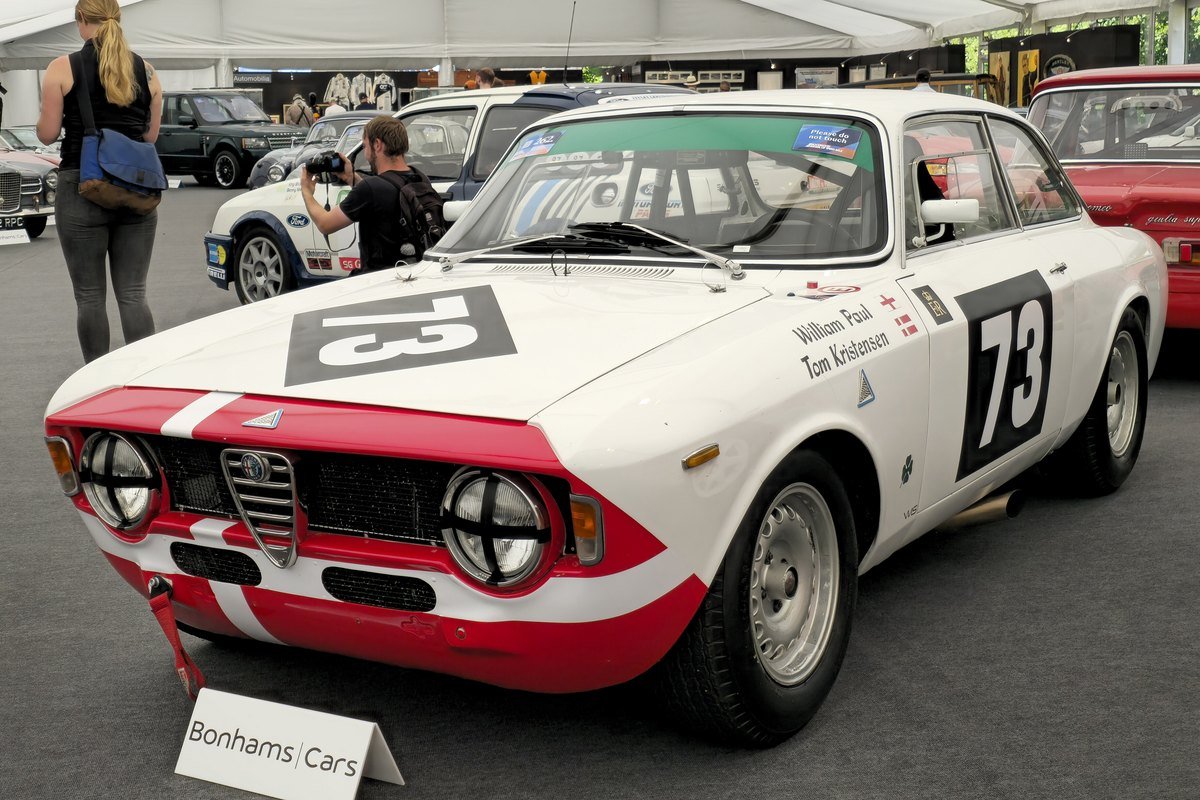
That plan was the Giulia Sprint GTA of 1965. The A stood for alleggerita, lightened. The outer body panels were aluminum, bonded and riveted to thinner steel inner panels. The side windows were plexiglass. The cam cover, sump, bellhousing and wheels were magnesium. A road-going Giulia Sprint GT weighed about 2,094 pounds. The GTA weighed about 1,642. Alfa took more than 440 pounds off a coupe that was already light.
The 1,570cc engine got a twin-plug head: two spark plugs per cylinder instead of one, so the mixture burns faster and more completely and the compression can go up without the engine knocking. On the street it made 115 horsepower. In race trim, built at Settimo Milanese, it made more than 170. Alfa built 500 for homologation, in Stradale and Corsa versions.
At the first race of 1966, at Monza, GTAs took the first seven places. De Adamich won the European Touring Car Championship that year, and the GTA won it again in 1967 and 1968. The same season it reached the United States: its first American win came in 1966 at the Refrigerator Bowl at Marlboro Raceway in Maryland, with Monty Winkler and Pete Van der Vate, and it won the under-two-liter class of the first Trans-Am. Alfa also claims the GTA was the first sedan to lap the Nürburgring Nordschleife in under ten minutes, a claim that appears only in Alfa’s own material.
Then came the GTAm, in 1970. It was built on the American-market 1750 GTV with SPICA mechanical fuel injection, which is why one theory says the m stands for America. The other says maggiorata, enlarged, because the engine grew to almost two liters. Around 40 were built, 19 for Autodelta and 21 for customers according to coches.com. The GTAm won the European title in 1970 and 1971 and held off BMW until 1973.
De Adamich owned a road-going GTA with the Italian plate UD 518119. It was stolen. While he was at the station reporting it, he heard the Carabinieri radio putting out a search for a red Alfa with that exact plate. It had just been used in an armed robbery at a Milan tobacconist.
The supercharger that ran on oil
Settimo also produced some genuine head-scratchers. The strangest was the GTA SA, for sovralimentata, shown at the 1967 Turin show. A turbo spins its compressor with exhaust gas. A supercharger usually takes a belt off the crank. Alfa’s engineers did neither: a chain-driven pump off the crankshaft pushed oil at around 80 kg of pressure into two small turbines, and those spun the two centrifugal compressors at up to 95,000 rpm. The pitch was boost with no turbo lag.
On a good day it made 220 to 240 horsepower, and it did win the Hockenheim 100 km in 1967. On a bad day it cooked itself in slow traffic, drank fuel at around 7.4 mpg, came on boost like a light switch somewhere past 3,000 rpm, and had a nasty habit of catching fire. Nobody had fitted a wastegate, so there was nothing to keep the boost in check. According to Robert Little’s archive, Chiti took the project on without enthusiasm; the design is credited to engineer Gianpaolo Garcea of Alfa’s experimental center. About ten were made, and most were converted back to naturally aspirated engines.
Daytona, Watkins Glen and the 917
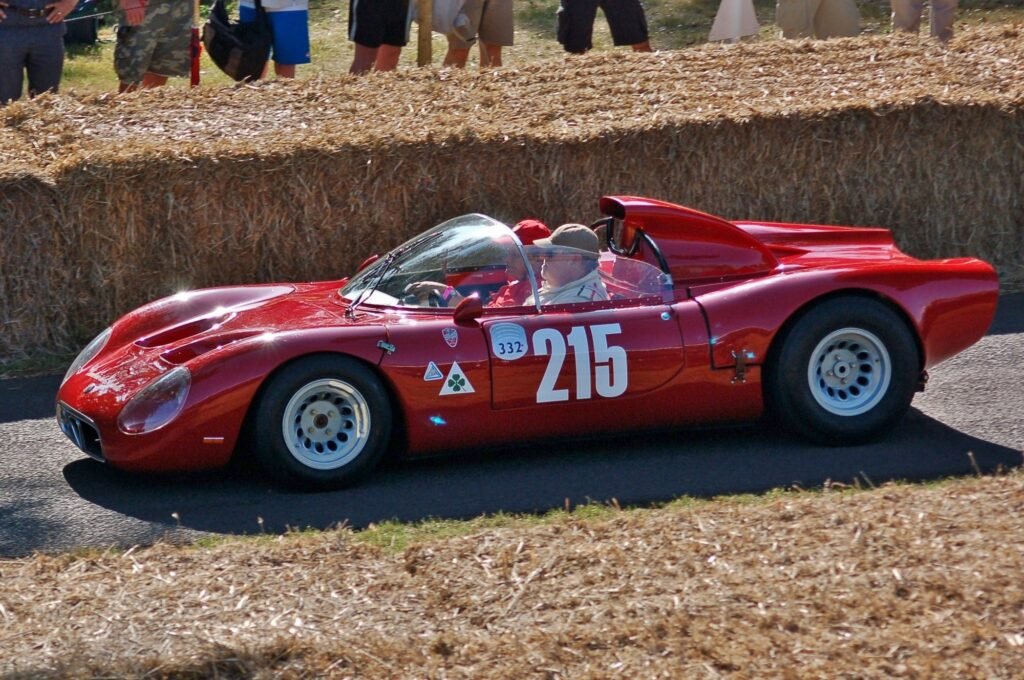
The Tipo 33 prototype debuted on March 12, 1967, at the Fléron hill climb in Belgium and won with Zeccoli. It had a two-liter 90-degree V8 making 270 horsepower at 9,600 rpm, and a roof-mounted air intake that got it the nickname “periscope.” In 1968 the 33/2 went to 2.5 liters and won its class at Daytona, hence the name.
In March 1969 Lucien Bianchi was killed testing a 33 at Le Mans, and Alfa skipped the race that year. According to Little, it turned Chiti toward safety work. In early 1970 he developed, with engineer Garbarino, a foam-filled cellular fuel tank to keep fuel from spilling all at once in a crash, offered it to rival teams and pushed for it to become mandatory. Nobody took it up.
In 1971 the three-liter 33/3 won the Brands Hatch 1000 km, the Targa Florio and the Watkins Glen 6 Hours. Brands Hatch was Alfa’s first world championship race win in 20 years, and it came against five-liter Porsche 917s with twice the displacement. De Adamich admitted the 917 couldn’t be beaten on a fast, dry circuit. At Brands Hatch and at Watkins Glen it rained.
The defeat that hurt most came at the 1972 Targa Florio. Ferrari brought a single 312 P for Arturo Merzario and rally driver Sandro Munari. Merzario later said he told Munari: “I’m here to win, trouble for you if you break my car, go slow and don’t do any nonsense.” Vic Elford’s Alfa broke its oil filter on the first lap and Rolf Stommelen’s V8 failed on the third. Nanni Galli’s car ran out of fuel near Campofelice; according to witness Michelangelo Teresi, it had been refueled while tilted and the tank never filled. That left Helmut Marko. He took over more than two minutes behind, set the race lap record on the final lap in 33 minutes 41 seconds, and lost by 16.8 seconds. Little calls it one of Chiti’s darkest hours.
Two world titles, one with an asterisk
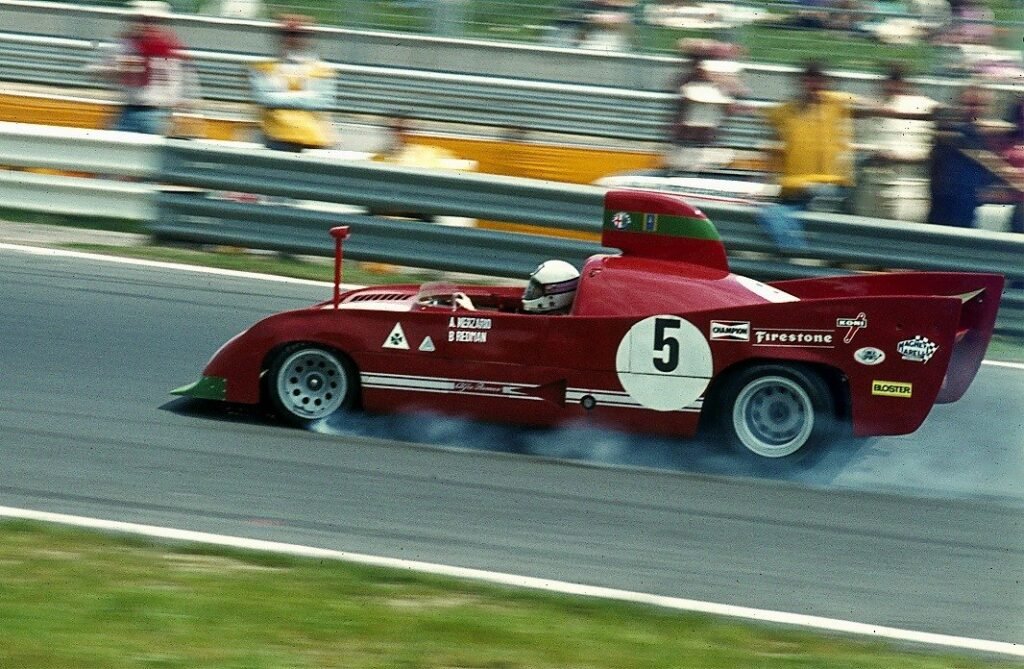
Then came the flat-12, and with it a money problem. Alfa was state-owned, short of cash in the oil crisis, and unsure whether to keep paying for sports car racing. For 1975 the cars ran as the Willi Kauhsen Racing Team, with Campari money that the German driver brought in. Italian sources say it was the same Autodelta team with Kauhsen covering the shortfall. Derek Bell credited Kauhsen with running it.
The 33 TT 12 weighed about 1,477 pounds, and its flat-12, with cylinders lying horizontally in opposed pairs to keep the engine low, made about 500 horsepower at 11,500 rpm. Merzario reportedly revved it to 13,000. Matra had retired and Ferrari had left sports cars after 1973. Renault’s turbo prototype won the opener at Mugello, Alfa skipped Daytona, and then won the next seven rounds. Bell explained the method: “We’d just wait for them to break, which they usually did.” The first time he drove it, he said, “it felt like a tank.”
In 1974 Mario Andretti had already shared the winning 33 TT 12 with Merzario in the Monza 1000 km. In 1977 the 33 SC 12, with about 520 horsepower, won the World Sports Car Championship with Merzario, Vittorio Brambilla and Jean-Pierre Jarier. Motor Sport considers that title devalued by the lack of opposition.
The $17,000 Alfa
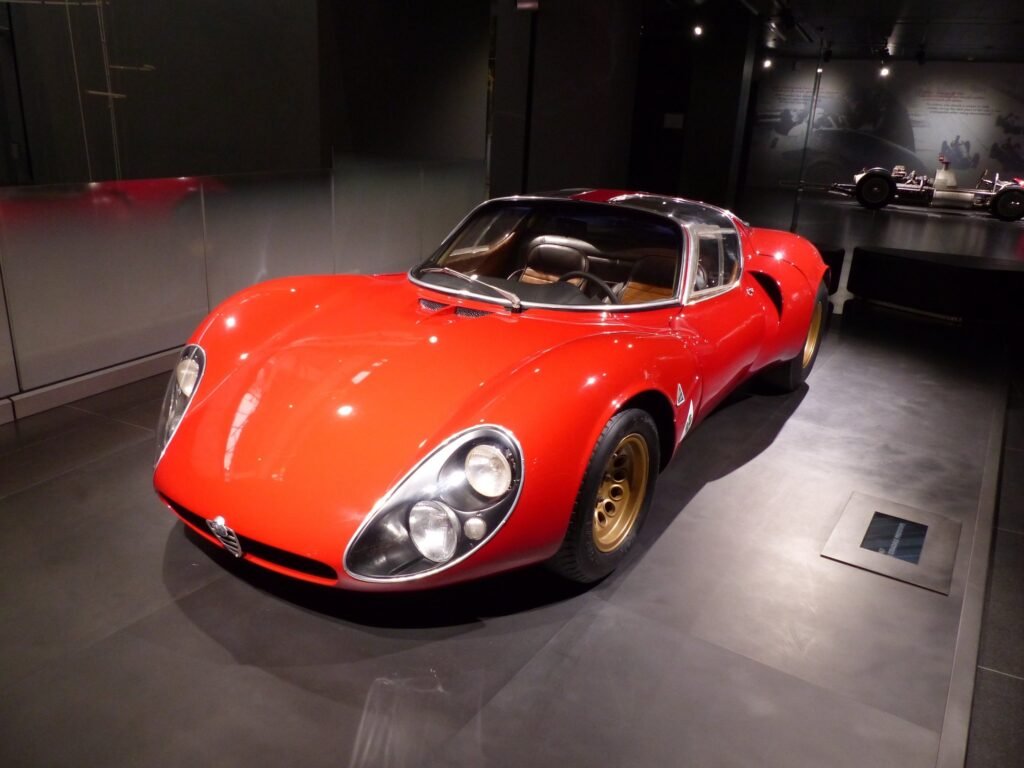
The program produced one road car. The 33 Stradale was styled by Franco Scaglione and bodied by Marazzi in Milan, with the first prototype assembled at Settimo Milanese. It had the two-liter V8 with SPICA injection and dry-sump lubrication, made 230 horsepower at 8,800 rpm and weighed about 1,543 pounds. In 1968 it cost $17,000, the most expensive car on sale to the public that year. Its engine had less than half the displacement of a Lamborghini Miura or a Ferrari Daytona, yet Auto Motor und Sport timed it at 156.6 mph and covered the standing kilometer in 24 seconds, the best of any production car at the time. Eighteen were built between November 1967 and March 1969. Bertone, Pininfarina and Italdesign used its chassis for some of the most famous show cars of the era, including Gandini’s Carabo.
Formula 1, from McLaren to Alfa’s own car
Autodelta tried Formula 1 well before Brabham. In 1970 the three-liter 33 V8 went into a McLaren M14D for De Adamich, and in 1971 into a March 711 for Nanni Galli and Ronnie Peterson, making about 440 horsepower at 10,000 rpm. The McLaren deal died over one remark. According to De Adamich, Bruce McLaren suggested his Can-Am experience could help improve the 33’s chassis. Chiti took it as criticism and gave the engine to March the following year. March had little development money, part of Alfa’s payments went to keep March itself afloat, and after tests at Kyalami with Peterson, the team went back to Cosworth.
From 1976 Autodelta supplied its flat-12 to Bernie Ecclestone’s Brabham team. Niki Lauda won two races with it in 1978, one of them in the BT46B fan car at Anderstorp. In 1979 Alfa came back with its own car, the 177, run by Autodelta. In 1980 Patrick Depailler was killed testing at Hockenheim, and Bruno Giacomelli put the 179 on pole at Watkins Glen and led 32 laps before an electrical failure. In 1981 Mario Andretti joined the team. From 1982 the team was run by Euroracing, and Autodelta kept only the engines.
A Spanish privateer and a works GTAm
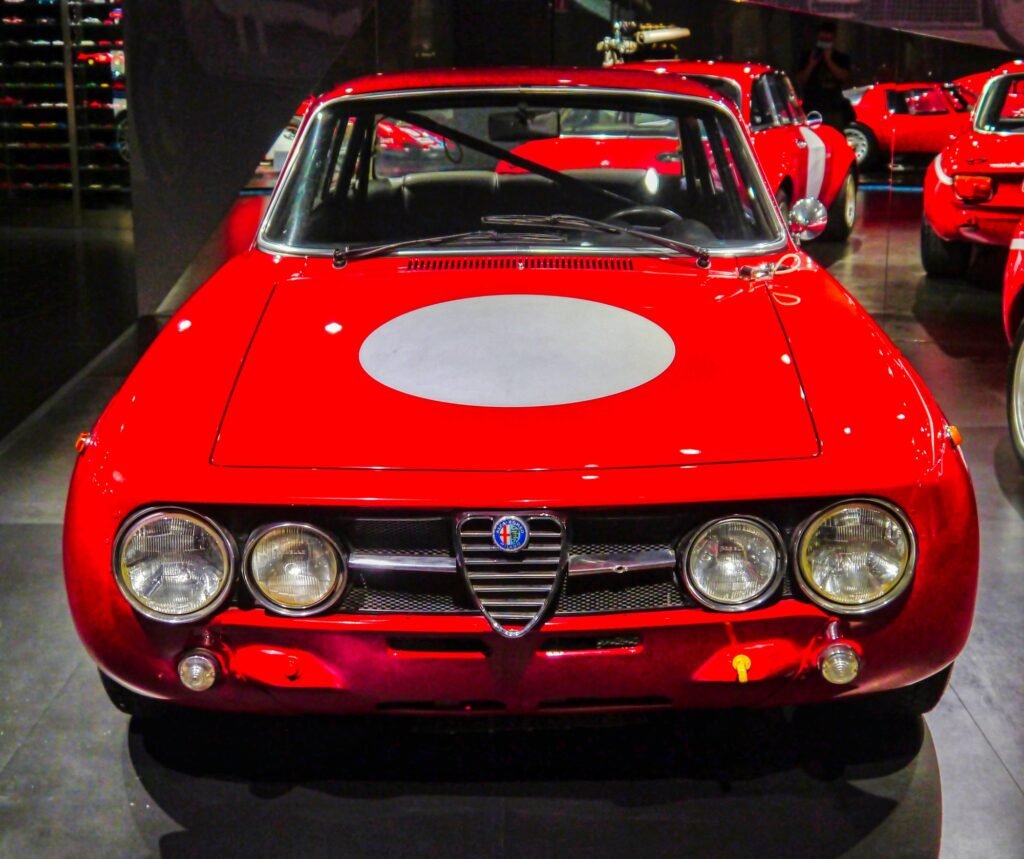
In 1970 a GTAm was almost impossible to buy. There were few, and all were with works teams: Autodelta and Alfa’s branches in Belgium, Germany and France. Spanish driver Rafael Barrios got one through Italy’s Jolly Club, a nearly new Autodelta car that had done only the Trento-Bondone hill climb and factory testing at Balocco. He described it in detail to the Spanish magazine El Automóvil in September 1970: 1,995cc, Lucas injection, twin ignition, about 210 horsepower, 2,028 pounds, front suspension and brakes from the Tipo 33. Autodelta told him the engine would break at 7,200 rpm. At Alcañiz he took it past 8,000. He figured it had only six or seven more horsepower than a BMW 2002 of similar weight, and that it won on braking and stability. He also praised Autodelta’s customer service. In 1972 he finished second in the Spanish touring car championship with it, and twenty years later he raced the same car again.
How it ended
The death of Autodelta had names attached. On May 30, 1978, Ettore Massacesi took over at Alfa Romeo, promising to balance the books in four years. According to Motta, one of the authors collected in Robert Little’s archive, his plan was to take Autodelta out of Formula 1, cut costs and move engine work in-house, which meant removing Chiti. In early 1982 Chiti was made president of Autodelta, a title without real power. That year Autodelta spent 15 billion lire, about 10 percent of Alfa’s total losses.
For 1983 Massacesi handed the Formula 1 team to Giampaolo Pavanello’s Euroracing, on a proposal from Philip Morris executive Nicolò di San Germano. According to Motta, all of Autodelta’s equipment was lent to Euroracing free of charge, along with the turbo engines and technical support. Behind it was IRI, the state holding company that owned Alfa and wanted to sell it, and needed to shed an expensive race department first. In November 1984, after meeting IRI chairman Romano Prodi, Chiti resigned and left to found Motori Moderni.
Autodelta was dissolved in 1985; Motta gives 1986. According to Pajevic, another of Little’s sources, what was left was cleared out of Settimo Milanese and moved to Senago, where the archive sat in buildings without doors or windows, open to the weather. FIAT bought Alfa Romeo in November 1986.
The last production Alfa to carry the Autodelta name was the Giulietta Turbodelta, presented in 1982 and sold in 1983 and 1984. Only 361 were built, with a turbocharged two-liter making 170 horsepower and a top speed above 124 mph. The original Avio turbo wasn’t reliable, so it was swapped for an equivalent KKK unit.
De Adamich, decades later, still wore a jacket to events stained with dust and oil from the 33 he drove. Considering where the paperwork ended up, it may be one of the better-preserved Autodelta records left.
Check you’re still alive.
Photos: Calreyn88 (CC0); unknown photographer (public domain); Handelsgeselschaft (CC BY-SA 4.0); Bahnfrend (CC BY-SA 4.0); azrhey (CC BY-SA 2.0); Lothar Spurzem (CC BY-SA 2.0 de); Zairon (CC BY-SA 4.0). Wikimedia Commons.