
Turbo lag: how variable geometry, twin-scroll and the electric turbo kill it

Every turbocharged engine ever sold has been a negotiation with the same flaw, and the car industry has spent fifty years and a fortune pretending the negotiation is over. It isn’t. It has just gotten very, very good.
The flaw is turbo lag, and in chapter three we split it into its two real pieces. One is lag proper, which is time: the moment between your right foot going down and the turbine spinning fast enough to make boost. The other is boost threshold, which is capacity: the rpm below which the exhaust simply doesn’t carry enough energy to hold the pressure you’re asking for, no matter how long you wait. A 1970s turbo car like the BMW 2002 Turbo suffered from both at full strength. Nothing, nothing, nothing, and then the whole engine arrived at once, usually in the middle of a corner.
Once the turbo beat the supercharger as the default way to cram air into an engine, killing that delay became the only job that mattered. Engineers came at it from five directions, and each one tells you something about how a turbo actually works.
Small turbo or big turbo: the choice nobody could win
Start with the problem every other fix is trying to dodge.
A small turbine has very little mass. It spins up almost instantly on a trickle of exhaust, so boost shows up early and the car feels eager off the line. The catch comes higher in the rev range. A small turbine housing can only swallow so much gas, and at high rpm it turns into a cork in the exhaust, backing up pressure into the cylinders and choking the engine just when it should be pulling hardest.
A big turbine flips the deal. Up top it flows like a fire hose and makes huge power. Down low it’s a heavy wheel sitting in a gentle breeze, and it takes its sweet time getting going. The threshold climbs, the lag stretches, and the car feels like it has two personalities separated by a long pause.
For decades, sizing a turbo meant choosing which half of the tach you were willing to ruin. Everything that follows is an attempt to get a turbine that acts small at 2,000 rpm and big at 6,000.
Variable geometry: moving the walls around the wheel
The cleverest fix doesn’t change the turbine at all. It changes the doorway.
A variable-geometry turbo, which you’ll see called VGT or VNT depending on who built it, has a ring of small pivoting vanes in the turbine housing, surrounding the wheel. The wheel stays the same size and the same weight. What the vanes change is the gap the exhaust has to squeeze through on its way in, and the angle at which it hits the blades. All the vanes swing together on a single ring.
At low rpm the vanes close down. The exhaust gets forced through narrow slots, speeds up, and slams into the turbine blades at a sharp angle. Think of putting your thumb over the end of a garden hose. Same water, much harder spray. The turbine spins up early, on very little gas. At high rpm the vanes open wide, the exhaust flows freely, and the turbo stops strangling the engine. The engine computer moves those vanes constantly, based on load and requested boost, not only on rpm. It doesn’t erase every compromise in turbo sizing, but no other mechanical fix comes close to blurring the line between small and big.
If you’ve owned a diesel pickup, you already know this hardware, and maybe its dark side. The 6.0-liter Power Stroke that Ford put in Super Duty trucks from 2003 used a Garrett variable-geometry turbo, and a sticking vane ring became one of the classic complaints of that engine. Soot builds up on the vanes, they stop moving, and the symptom is exactly what the system was supposed to cure: lag, usually when you’re trying to merge onto the freeway with a trailer behind you. Pull the turbo, clean the vanes, and the truck wakes up again.
That diesel connection isn’t an accident. Diesel exhaust runs much cooler than gasoline exhaust, and a delicate ring of moving vanes sitting in the hottest gas stream of the engine has a far easier life in a diesel. Fiat put a VGT into the direct-injection diesel Croma in 1991, and within a decade almost every European turbodiesel used one. Gasoline was a different fight. The heat warped and seized the mechanism, and for years the only people brave enough to try were building oddities.
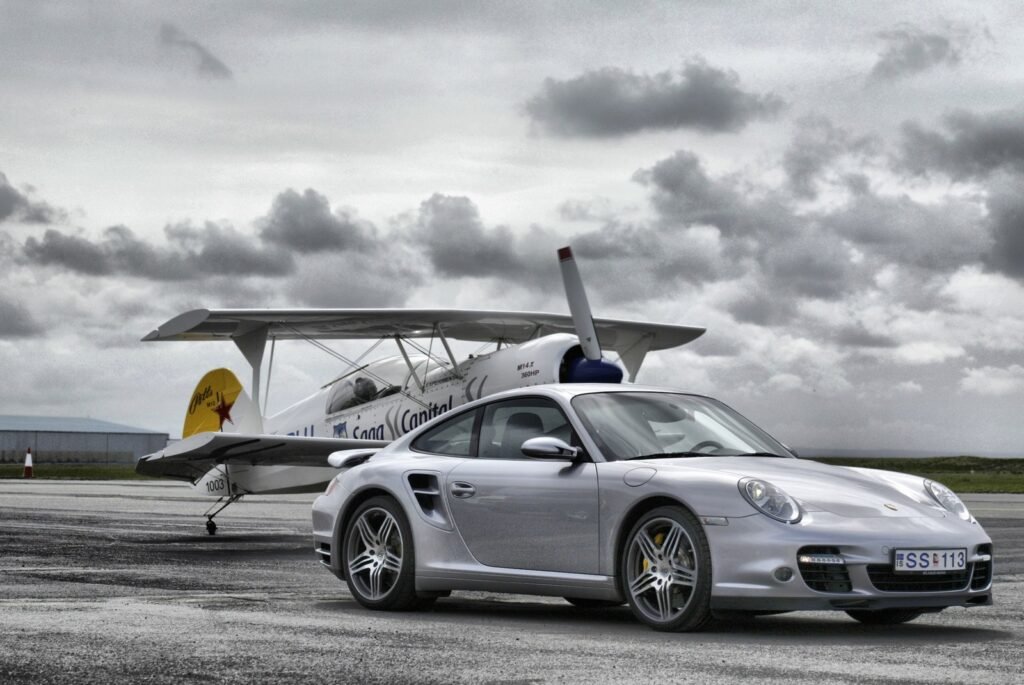
One of them was Carroll Shelby. The 1989 Shelby CSX-VNT took a Dodge Shadow-based compact, bolted a Garrett variable-nozzle turbo onto Chrysler’s 2.2-liter four, and built just 500 of them. Nissan had shown a variable-nozzle turbo on its VG20ET V6 in 1985, Honda had its “Wing Turbo” in Japan in 1988, and Peugeot used a Garrett VAT25 on the 405 T16 in 1992. None of them made the idea stick. Porsche did, with the 997-generation 911 Turbo that went on sale in 2006: twin variable-geometry turbos on the flat-six, enough heat resistance to survive gasoline exhaust, and the drivability of a car you could use every day. Porsche called it a world first, which it wasn’t. What it was is the first time the technology looked normal on a gas engine instead of like a science project.
Twin-scroll: stop the cylinders from stepping on each other
The second fix leaves the turbine alone and works on the plumbing that feeds it.
An engine doesn’t exhale in a steady stream. Each cylinder fires a sharp pulse of exhaust when its valve opens, and in a four-cylinder those pulses come in turn. Dump all four into one passage on the way to the turbo and they interfere. A fresh pulse from one cylinder runs into the tail end of the one before it, energy gets wasted in the collision, and some pressure even pushes back toward the other cylinders while their exhaust valves are open, which hurts how well they empty out.
A twin-scroll turbo splits the turbine housing inlet into two separate spirals feeding the same wheel. The exhaust manifold pairs up cylinders whose pulses don’t overlap, based on the firing order, and sends each pair down its own scroll. On a typical four-cylinder with a 1-3-4-2 firing order, cylinders one and four share a scroll, and two and three share the other. Each scroll now sees cleaner, more widely spaced pulses, and the turbine gets hit with distinct shots of energy instead of a turbulent mess. The gain shows up mostly at low and middle rpm, where the pulses are furthest apart and the interference used to hurt most.

Both scrolls work all the time. People sometimes imagine the turbo switching between them like a sequential twin-turbo, but that’s not how it works. The trick is keeping the pulses from fighting.
American buyers met this in a big way in 2015, when Ford put a twin-scroll turbo on the 2.3-liter EcoBoost four in the Mustang, the first twin-scroll ever used on a Ford engine. It made 310 hp, and Ford pointed at the twin-scroll as the reason a four-cylinder pony car didn’t feel like it was waiting for permission to accelerate.
Anti-lag: setting the exhaust on fire on purpose
Now the violent one.
Picture a rally car at full attack. The driver lifts to brake for a corner, and the instant the throttle closes, the exhaust flow that was driving the turbine drops off. The turbo doesn’t stop dead, it still has momentum, but it slows quickly. By the time the driver gets back on the gas at the exit, the turbo has to spool all over again. That’s lag at the worst possible moment, at the exit of every corner, a hundred times a stage.
Anti-lag keeps the turbo spinning with the driver’s foot off the pedal. There are several ways to do it. The common one plays with ignition timing: with the throttle closed, the system lets some air bypass the throttle and retards the spark massively, so the mixture burns very late, as the exhaust valve is already opening. That late combustion dumps hot, fast-moving gas straight into the turbine and keeps it at speed. Other systems inject air, or air and fuel, directly into the exhaust manifold and let it burn there. Either way, the engine is feeding the turbo energy it would never produce on its own.
That’s where the bangs and the flames come from. If you’ve ever watched Ken Block’s Gymkhana videos or stood at a rallycross event in the US, you’ve heard it: the machine-gun crackle on lift-off. It isn’t a tuning party trick. It’s fuel being burned in the exhaust to keep the turbo alive.
The idea didn’t start in the dirt. The turbo Formula 1 teams of the 1980s were already burning fuel in their exhausts to keep turbines spinning off throttle, and rally borrowed it. Toyota Team Europe, which ran the Celica GT-Four, was one of the first to develop it seriously for Group A, later moving to a “fresh air” version that burned cleaner and cooler. Subaru answered with a system its people called the Rocket Exhaust.
The price is brutal. Running combustion in the exhaust cooks turbos and manifolds, and teams carried spares because parts melted. Fuel use goes through the roof, which means heavier fuel loads. Engine braking mostly disappears because the engine keeps firing when the driver lifts, so the brakes do more work and wear faster. On a street car, all of that is a deal-breaker, which is why real anti-lag stays in competition.
Electric help: two different machines with one goal
The newest answer is to stop relying on exhaust alone. Bring in electricity, and the turbo no longer has to wait for the engine to make enough gas. There are two very different ways to do it, and the press mixes them up all the time.
The first is the electric compressor. It’s a separate small compressor in the intake tract, with its own electric motor and no turbine at all. When you floor it from low rpm, it spins up and pushes air into the engine while the regular turbo is still waking up. The textbook example is the 2016 Audi SQ7 TDI, which Audi billed as the first production car with one. Its electric compressor sat downstream of the intercooler, drew up to 7 kW from a 48-volt system with its own lithium-ion battery under the cargo floor, and reached 70,000 rpm in under a quarter of a second. Americans never got to try it. The SQ7 TDI arrived right after Volkswagen’s diesel emissions scandal, and Audi wasn’t about to sell a big V8 diesel SUV in the United States in 2016.

The second approach puts the motor inside the turbo itself. An electrically assisted turbo has an electric motor on the shaft that connects the turbine and the compressor, so instead of adding a second compressor, it spins up the existing turbo directly. Mercedes-AMG put one into production first, in the 2022 SL 43: a motor about four centimeters thick, about an inch and a half, sitting between the two wheels on a shaft that turns up to 170,000 rpm, running off a 48-volt system. That one did come to America, in a four-cylinder SL that the old SL buyers found very hard to accept. Ferrari followed with the F80, putting an electric motor on the shaft of each of its two turbos, and over at Not Enough Battery we’ve written about the hybrid hypercar that refuses to drive on electricity.

Why did all this arrive with 48-volt systems? It’s about current. A compressor needs a lot of power to spin up fast. At 12 volts, the current needed would call for cables as thick as your thumb and big electrical losses. Quadruple the voltage and you cut the current to a quarter for the same power. Suddenly the wiring is reasonable and the system fits in a car.
The MGU-H: Formula 1’s best idea, thrown away
The top of this family tree is the MGU-H, the motor-generator that Formula 1 bolted to the turbo shaft when the hybrid V6 era began in 2014. It’s the same basic layout as the SL 43’s electric turbo, taken to the limit, and it does two jobs. When the exhaust has more energy than the turbo needs, the MGU-H acts as a generator, braking the shaft and turning that surplus into electricity. When the driver needs instant boost, it reverses and acts as a motor, spinning the turbo up with electrical power so lag basically disappears. If you want one on the street, the only real answer is the Mercedes-AMG ONE, which uses the actual F1 engine.

Honda showed the world what an MGU-H that doesn’t deliver looks like. McLaren went back to Honda power in 2015, and Honda built an extremely compact engine with the turbine, compressor and MGU-H all packed inside the vee to keep the car slim. Honda’s own official history now admits the layout limited the size of the turbine and compressor, and that a shortage of energy recovered by the MGU-H was one of the main problems of the season. On track, the car ran out of electrical deployment halfway down the straights. At Suzuka, Honda’s home race, Fernando Alonso got passed like he was parked and keyed the radio: “GP2 engine.” Years later he said he regretted that the comment went public. It still stands as the cruelest review an electric turbo has ever received.

And for 2026, F1 scrapped the MGU-H entirely. The official reasons were cost and complexity, and the fact that it scared off new engine makers. The Volkswagen Group reportedly wanted it gone before committing Audi, and the series beefed up the MGU-K to 350 kW to make up the difference. American fans will notice who arrived once it was gone: Ford, back in F1 as Red Bull’s engine partner for 2026, and Cadillac with a team of its own. The best piece of turbo technology F1 ever developed was removed not because it failed but because it was too expensive for newcomers to build. That tells you plenty about how the sport makes decisions.
No free lunch, just a cheaper check
Carmakers love to say that modern turbos “have no lag.” They’re half right. Variable geometry, twin-scroll housings and electric assistance really do attack the causes. The turbine spools sooner, gets cleaner pulses, or gets help before the exhaust is even ready. Drive a modern turbo four after a 2002 Turbo, a Renault 5 GT Turbo or a Fiat Uno Turbo, and the difference is night and day.
The other half is the bill. Moving vanes sitting in red-hot exhaust. Extra compressors. A second electrical system at 48 volts. A motor spinning at 170,000 rpm. Every one of those parts is another thing to maintain, and none of them is cheap when it fails, as plenty of 6.0 Power Stroke owners can tell you. Meanwhile, the naturally aspirated engine from chapter one never had turbo lag at all, for the simple reason that it never had a turbo. It has its own delays, but they’re a different animal. Fifty years of brilliant engineering went into paying off a debt that only exists because we chose to force air into engines.
The turbo won anyway, because it delivers more power from less displacement and better numbers on the official fuel economy test. Lag never vanished. It got paid down, piece by expensive piece.
Next chapter: what happens when one turbo isn’t enough. Parallel and sequential twin-turbos, staged setups like Lancia’s Triflux, and twincharging, the heresy of putting a supercharger and a turbo on the same engine, the way Lancia did in the Delta S4.
Chapter five is about refusing to choose: twincharging and twin-turbo setups, from parallel and sequential twins to compound turbos and supercharger-plus-turbo engines.
Chapter six is about the heat pressure leaves behind: intercoolers, air-to-air and water-to-air, and water-methanol injection, from the Buick Grand National to the P-47.
The roads that lost, from the Comprex that boosted with pressure waves to the Leclerc tank’s turbo with its own combustor, are in the pressure wave supercharger, the Hyperbar and other strange roads of forced induction.
What the industry did with all this air once it knew how to force it in is chapter 8: engine downsizing and why a small turbo burns less than a big one, superknock and cracked pistons included.
Check you’re still alive.
Photos: Ton1 (CC BY-SA 3.0), DmitryKo (CC0), Jakob Sigurðsson (CC BY 2.0), Alexandre Prévot (CC BY-SA 2.0), Alexander-93 (CC BY-SA 4.0), Liauzh (CC BY-SA 4.0), Keisuke Kariya (CC BY 2.0).