


The most important engineering claim of 2026 is about a cable. Not a battery, not an algorithm, not a launch mode. A cable that runs straighter than it used to.
It belongs to the Gordon Murray S1, and the man who made that cable a headline is the same man who drew the McLaren F1 on a notepad in an airport lounge after the 1988 Italian Grand Prix. Thirty-odd years later he has built the car again, under his own name, with no McLaren badge, no BMW engine and nobody’s blessing.
Unveiled in California, sold before anyone saw it
Murray pulled the cover off the S1 himself on August 14 at The Quail, the most exclusive lawn of Monterey Car Week, with three-time Indy 500 winner Dario Franchitti hosting alongside him. If you are going to reboot the McLaren F1, you do it twenty minutes from Pebble Beach, in front of the people who can actually write the check.
They had already written it. Top Gear reported that every one of the 64 cars was sold before the reveal, at a price nobody has made public. Sixty-four is not a round number picked by a marketing department. It is exactly how many standard road-going F1s left Woking between 1992 and 1998.
That number tells you how Murray thinks. The F1 program ended up at 106 cars: 64 road cars, 28 GTR racers, five LMs, three GTs and the prototypes. His new Special Vehicles division is rebuilding that list in slices. Five S1 LMs, one per F1 GTR that reached the finish at Le Mans in 1995, where seven started and five came home in first, third, fourth, fifth and thirteenth. Twenty-four Le Mans GTRs, one per hour of the race, all commissioned through Joe Macari’s London dealership. And now 64 S1s for the 64 road cars.
The 1995 F1 LM itself was built in five units for the same reason, the five classified GTRs. So Murray is not just paying homage to that car. He is reusing its math.
What actually changed from the S1 LM
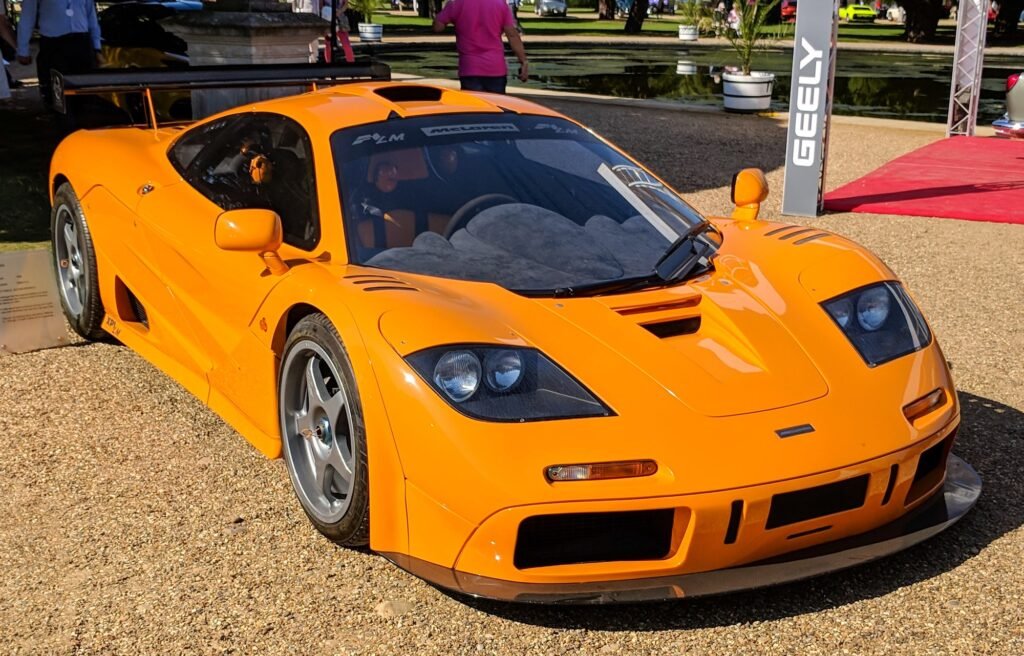
The S1 sits on the S1 LM platform shown on the same lawn in 2025. The LM was the loud one: a big fixed wing, a long front splitter, deep side skirts and a Lexan ticket-window in the door straight off an endurance racer. One customer bought all five.
The S1 throws that stuff out. Every exterior panel is new, according to Gordon Murray Automotive. No fixed wing, no splitter, no skirts. In their place there is an active rear aero system blended into the body that works on high-speed stability and braking. The goal moved from downforce to mechanical grip.
That sounds like a small change. It isn’t. Downforce grows with the square of speed, so a car that lives on it only comes alive when you are going fast enough to lose your license on Highway 1. Mechanical grip comes from tires, suspension geometry and weight distribution, and it works at 45 mph through a canyon just as well as it does at a track day. Murray picked the second one on purpose, which puts him against basically every hypercar released since the Porsche 918.
Ride height is up 10 mm over the LM and the dampers are softer. Track, width and the lightweight suspension layout are unchanged. The new dihedral doors have proper drop glass. The mirrors moved to the A-pillars and carry a rear camera. The wheels are inspired by the show car McLaren used for the F1’s launch in Monaco in 1992: 19 inches up front on 265/35 Michelin Pilot Sport Cup 2s, 21 inches out back on 315/30s, with Brembo cross-drilled rotors behind them. The exhaust is polished Inconel and the heat shield is plated in 24-karat gold, because the original F1 lined its engine bay with gold foil to reflect heat and Murray is not about to change that.
Inside it is the F1 recipe: three seats, the driver in the middle, a passenger slightly behind on each side. Steering assist is adjustable, there’s more sound deadening than in the LM and a bespoke lightweight audio system. GMA says the target weight is below the T.50, which is 986 kg, or about 2,174 pounds. A Mazda MX-5 is heavier. GMA has not published a final number, so ignore anyone who quotes one.

A V12 that was detuned on purpose
The engine is a Cosworth V12, 4.2 liters, naturally aspirated, built for this car, making up to 690 PS (about 681 hp) and revving to 12,100 rpm. Silicon carbide-coated pistons, titanium valves, titanium connecting rods, dry sump. For context, a Chevrolet Corvette Z06’s flat-plane V8 stops at 8,600 rpm, and that is considered a screamer.
The S1 LM used a 4.3-liter version with 720 PS. The S1 has less displacement and less power. In a market where every new hypercar announces a bigger number than the one before, Murray went backwards and told everyone about it.
What he bought with that power is torque where you live: 80 percent of it from 2,500 rpm, and around 500 Nm, roughly 369 lb-ft, at 7,000. That is an engine you can drive to dinner without holding it at 9,000 rpm to keep it awake.

Back to the cable
The gearbox is a six-speed manual with a tall sixth for cruising. In its press release, GMA brags about “new straighter gearbox cable routing”, which it credits for a rifle-bolt shift feel. Read that sentence twice. In 2026, a company at this level chose the geometry of a shift cable as its engineering headline.
Here is why that matters. Every bend in a cable adds friction and slack, and that is what makes a shifter feel vague. Straighten the path and what reaches your hand is the gearbox itself, not a rubbery copy of it. Nothing about it shows up in a spec sheet. All of it shows up in your palm.
Keep that cable in mind for the next part.
Everybody wants a clutch pedal now. Few of them are real.
The manual became the fashionable option this year, and the brands did not all mean the same thing by it.
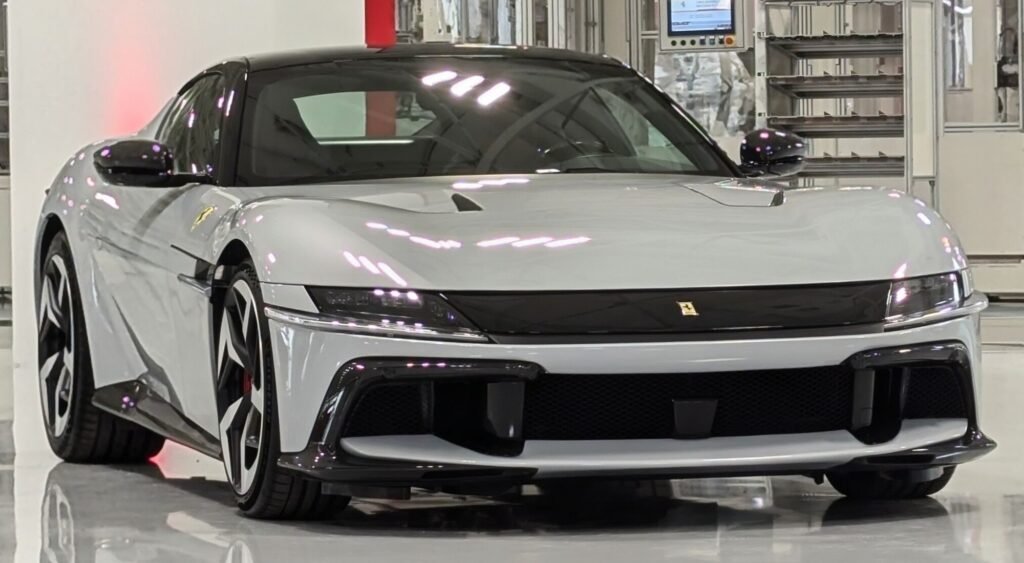
Ferrari launched the 12Cilindri Manuale on July 3: 1,499 cars, an open metal gate, a clutch pedal. Underneath is the same eight-speed dual-clutch as the regular 12Cilindri, and in manual mode it only uses six of those ratios. The lever and pedal have no mechanical link to the transmission. Hall-effect sensors read where they are and a control unit does the shift. The module that creates the clicks, the resistance and the self-centering is machined from billet and weighs under 3.5 kg installed. You can stall it. It will punish a lazy shift. And according to New Atlas, manual mode will not engage above roughly 60 mph. It is a beautiful piece of engineering. It is also a simulator bolted to a DCT.
McLaren saw it and took a shot. At the same Monterey Car Week it showed the McL 6GT, a concept for a 2028 production car with a combustion V8, rear-wheel drive, a carbon monocoque and body, hydraulic steering and the first manual gearbox in a McLaren road car since the F1. McLaren called it “authentic”. When Yahoo Finance asked CEO Nick Collins whether that word was a dig at Ferrari’s setup, he said no, then added that it’s definitely authentic.
Which is what you say when it is a dig.
The rest of the list is long. Pagani sells the Utopia with a seven-speed gated manual developed with Xtrac, mated to a 6.0-liter twin-turbo AMG V12 with 852 hp, and in 2024 said roughly 70 percent of buyers were taking it. Aston Martin has sold three-pedal V12s since the Valour and the Valiant. Porsche sold out the 911 S/T, a lighter, manual-only 911 with the GT3 RS engine, at £231,600 in Britain. And in America the manual still has a cult that keeps the GT3 Touring and the Cadillac CT5-V Blackwing in the conversation.
Koenigsegg got there first with the CC850 in 2022, but its gated shifter and clutch sit on top of the nine-speed, multi-clutch Light Speed Transmission, so it is another clever imitation. And Sasha Selipanov’s Nilu27 built the NILU around a 6.5-liter naturally aspirated V12 from Hartley Engines in New Zealand, more than 1,000 hp, and a seven-speed gated manual that is not pretending.
Go through that list and count how many put a real mechanical link between your hand and a gear. It is a short count. Murray is on it.
Mate Rimac’s Swiss watch theory
The week after Monterey, CNBC published an interview with Mate Rimac on August 25 that every car site picked up. Rimac splits the future in two. Normal cars for normal people go electric, almost all of them. Sports cars and everything above, he says, stay combustion for a very long time.
He calls it the supercar’s Swiss watch phase. His version of the stats: about 5 percent of the world’s watches are made in Switzerland, and that is where roughly 90 percent of the profit is. Those are his numbers, not the Swiss watch federation’s, so treat them as a CEO making a point. The point itself is fair. An Apple Watch does a thousand things a Rolex can’t and nobody is paying six figures for one. Rimac adds that raw performance is turning into a commodity, because a $50,000 Chinese EV can now out-accelerate the hypercars of ten years ago on paper.
He is the right person to say it. He built the Rimac Nevera, and even he has his doubts about the Nevera R, as our sister site Not Enough Battery covered. Today, as CEO of Bugatti Rimac, he builds the Tourbillon’s 8.3-liter naturally aspirated V16, the biggest naturally aspirated engine in any production car on sale. He has admitted the irony himself.

But look at the Tourbillon closely. It is a hybrid: the V16 makes 1,000 hp, three electric motors bring it to 1,800 hp, and an eight-speed dual-clutch handles the shifting. Two hundred fifty cars, all sold, starting around $4.5 million, with the typical buyer adding $600,000 to $700,000 of personalization. That is a combustion car under a very thick layer of software. Combustion, yes. Analog, no.
Rimac knows the difference. Asked by Road & Track at Monterey whether a three-pedal Bugatti could happen, he said yes, he can picture a V16 with a manual, and then he said “real manual”, with weight on the first word. That was aimed at Maranello. It also has some history behind it. The last Bugatti with a clutch pedal was the EB110, built in Campogalliano, Italy, in the early 1990s, the same years the F1 was being built in Woking.
The money, which is the real story
Here is the part that doesn’t fit the romantic V12 story.
On December 17, 2025, Gordon Murray Automotive announced a $120 million strategic investment from Halo Cars Group. Murray stayed as chairman and chief designer. CFO Darren Jukes became interim CEO. Halo’s managing partners, Tarik Ouass and JR Rahn, joined the board. Ouass was the first T.50 customer and has bought one of every car the company has built.
Their statement deserves to be quoted in full: “This is not an investment in scale, but in further scarcity. Our investment mandate is the complete opposite of a conventional growth investment in automotive.”
A month earlier, during the Las Vegas Grand Prix weekend, RM Sotheby’s sold the first S1 LM build slot for $20.63 million, the most anyone has paid at auction for a new car outside of charity sales. The car was flown over the Strip hanging from a helicopter while the bidding was live. And here is the detail nobody pointed out: the auction record for an original McLaren F1 is $20,465,000, set by Gooding & Company at Pebble Beach in 2021. The tribute beat the original by less than $200,000 without having turned a wheel.
To be fair to GMA, the press release says the money goes to normal things: the product plan, new R&D programs and getting already-sold cars delivered faster. What is unusual is the mandate the investors put in writing on top of that. Put it all together. A collector pays $20.63 million for a car that does not exist yet. The founder says 64 units already feels like too many. Scarcity has stopped being a side effect of building cars by hand. It is the thing being sold. The V12 is the box it comes in.
That is Rimac’s Swiss watch phase, described by the people writing the checks.

“This is it”
Murray seems to sense it. Speaking to Top Gear, he said a 64-car run is a big production number, that it is getting too close to the 100 T.50s, and that it was never what Special Vehicles was meant to do. He is making an exception because the car represents something that “is never going to happen again”. Then: “This is it.”
Plenty of people have read that as Murray saying goodbye. He said nothing of the kind. He said a run of this size will not be repeated inside Special Vehicles. Which is still a strange thing to hear: the division built for one-offs just did its longest run, and its founder is already saying never again.
The analog car that isn’t analog
To be precise, the S1 is not an analog car. It is the most analog car you can buy, and that is a different thing.
It has active rear aero, a camera system in the mirrors, power steering with selectable assist and updated infotainment screens. A 1994 F1 had none of that, and a 1994 F1 would not get through federal crash and emissions certification today.
What makes the S1 different is where Murray left electronics out. The steering is assisted, but the wheel is still connected. The car manages its own aero but leaves the shifting to you. Ferrari machines a billet module to fake the feel of a lever that moves nothing. In Surrey, the big engineering news of the year is a straighter cable. A manual gearbox is not a user experience. It is tension, friction and geometry. You can simulate that well. You cannot simulate all of it.
A Madrid company in the middle of it
One more thing almost no American outlet picked up. A Spanish company is working on this program.
Managing Composites, based in Madrid, announced at the end of August a formal partnership with Gordon Murray Special Vehicles covering composite engineering on all three of its cars: the S1, the S1 LM and the Le Mans GTR, with collaboration on vehicle architecture and design. Exactly who makes which part has not been made public, so don’t let anyone tell you they built the tub. CEO Lluc Martí said the project raises the bar on craftsmanship and personalization above anything his team had done.
They have done serious work before. Founded in Madrid in 2018, the firm signed with Denmark’s Zenvo in April 2023 to develop the carbon platform and monocoque of the Zenvo Aurora, crash tests included, with a target stiffness of 63,000 Nm per degree between suspension mounts at under 120 kg. Put simply, it takes that much twisting force to turn the chassis a single degree, and the structure weighs less than two grown men.
Spain makes millions of cars a year, almost all for foreign brands. This is something else: engineering that gets hired because few others can do it. And the country has its own boutique hypercars too. In Barcelona, Hispano-Suiza, a name that once beat Stutz at Indianapolis, now builds the all-electric Carmen, with the Carmen Boulogne claiming 1,114 hp. The company’s roots go back to Emilio de la Cuadra, who tried to build electric cars in Barcelona in 1898. Under Rimac’s theory, that electric bet is the one that loses. There is also the GTA Spano in Valencia, the tandem-seat Tramontana from a Catalan farmhouse and the Ricart Cars project. None of them has a $120 million check with the word scarcity on it.
Lotus took the electric route too, and its Evija weighs close to twice what Murray is aiming for with the S1.
The bill
The S1 is very probably the best driver’s car that will be sold this decade, and nobody knows how many of the 64 will ever get driven hard. They were sold before they existed, and the investors’ written statement is about scarcity, not driving. Murray has built the most resolved driving machine of his career just as the market decided driving is the least important part.
Rimac’s theory has a gap, too. Saying the top of the market stays combustion is not the same as saying it stays analog. His own flagship proves it: sixteen cylinders, three electric motors, a dual-clutch and 1,800 horsepower. His Swiss watch is full of silicon. The people still doing real watchmaking can be counted on one hand, none of them are public companies, and one of them just said he won’t do it again.
When the most wanted new car of 2026 is a rebuild of a car from 1992, that is not a win for purists. It is the bill for thirty-four years of an industry telling us progress meant taking things out of our hands.
How much does a car have to appreciate before it makes sense to never drive it?
Koenigsegg has since turned the CC850 into a track car, the CCGT1, and its white Ghost Fibre body was made in Spain; that story is in Koenigsegg Advanced Manufacturing.
Check you’re still alive.
Photos: MrWalkr (CC BY-SA 4.0), Calreyn88 (CC BY-SA 4.0), Martin Lee (CC BY-SA 2.0), Chelsea Jay (CC BY-SA 4.0), Russell Bray’s Ghost (CC BY-SA 4.0), Prova MO (CC BY-SA 4.0).