
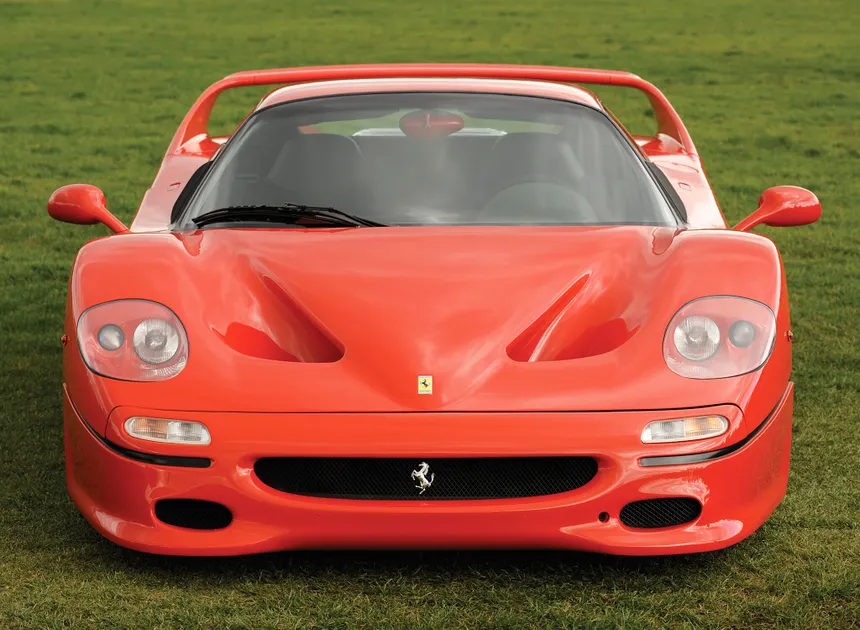
Ferrari F50: The Ferrari The Press Couldn’t Read
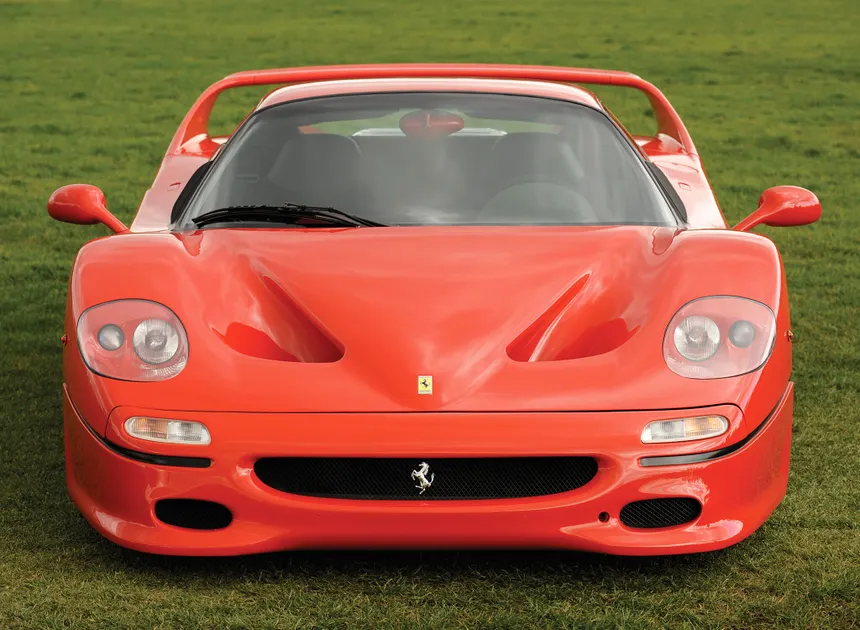
Let’s get one thing straight before we start.
In 1995, when Ferrari launched the F50, the motoring press of the entire planet agreed on one thing: it was a disappointment. They said it in the United States. They said it in England. They said it in Italy. They said it everywhere.
Thirty years later, the same car sells at auction for over five million dollars. And the same press that buried it back then now calls it the purest Ferrari ever built.
What happened in between?
Nothing happened. The car is the same. The press was the one that couldn’t read it.
The F40 Hangover
The F50’s problem started before the engine ever fired up.
The F40 had been a missile. A brutal car, twin-turbo, zero assistance, built by Enzo himself as his last gift before he died. When journalists climbed into the F50, they carried the F40 on their backs like a weight. They expected another missile. They expected more boost, more noise, more violence. They expected Ferrari to hand them the F40 squared.
And Ferrari handed them something else.
Ferrari handed them a Formula 1 car.
But a Formula 1 car isn’t easier to drive than a savage turbo. A Formula 1 car is surgical. Cold. Precise. It asks things of you the F40 never asked. It punishes you if you don’t know what you’re doing. It doesn’t forgive, because it has nothing to forgive with.
The 1995 press climbed into the F50 expecting drama and found discipline. And because they weren’t trained to read discipline, they wrote that it was boring.
That was the crime.
The Engine Nobody Explains Properly
Here’s where most F50 articles will sell you a romantic half-truth. They’ll tell you: “the F50 carries the engine from Prost and Mansell’s 1990 Formula 1 car, the 641.” It sounds beautiful. It hooks the reader. But it isn’t true. Not entirely.
The real story is more interesting, and nobody bothers to tell it.
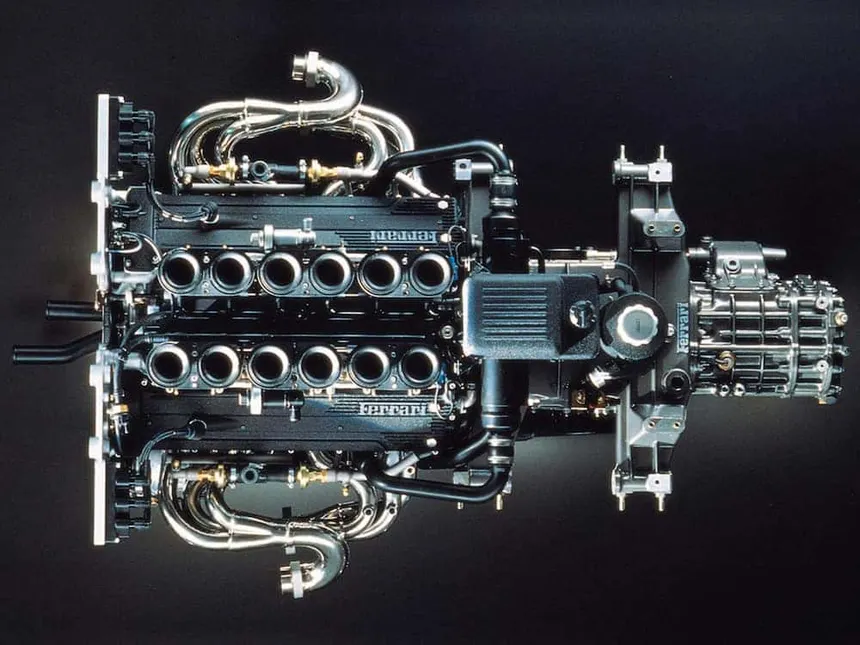
The F50’s engine is called the F130B. It’s a V12 displacing 4,698 cubic centimetres, with a 65-degree bank angle, five valves per cylinder (three intake, two exhaust), four overhead camshafts, dry sump, carbon-fibre intake manifold and Bosch Motronic M2.7 injection. It makes 513 horsepower at 8,000 rpm and 470 Newton metres of torque at 6,500.
Those are the numbers. What’s interesting is where this block actually comes from.
The F130B shares architecture with the engine used by Alain Prost, Nigel Mansell and Jean Alesi in the 1990 Ferrari 641 Formula 1 car. That much is true. But between the 641 and the F50 there’s an intermediate step that almost no one mentions: the Ferrari 333 SP.
What’s the 333 SP?
It’s the prototype Ferrari built in 1994 to race in the IMSA sportscar series in North America. A sports prototype. And for that car, Ferrari took the architecture of the F1 V12, bumped it up from the 3.5-litre regulation displacement of Formula 1 to 4 litres, and re-engineered it for something Formula 1 never asks of any engine: lasting more than two hours without exploding.
That’s the step missing from every F50 article you’ve ever read.
The F50’s engine isn’t the 641 engine dropped into a road car. It’s the 641 architecture that first went through the school of endurance in the 333 SP, and from there came down to the F50 with the adjustments needed so a buyer could start it on a Monday morning in Maranello, drive it a thousand kilometres to Monaco, and not leave it stranded halfway.
The difference matters enormously.
A pure Formula 1 engine is useless in a road car. It lasts two hours. It needs opening up after every race. An endurance engine is another animal. And the F130B is an endurance engine with Formula 1 DNA. That’s not the same thing as calling it an F1 engine for the road.
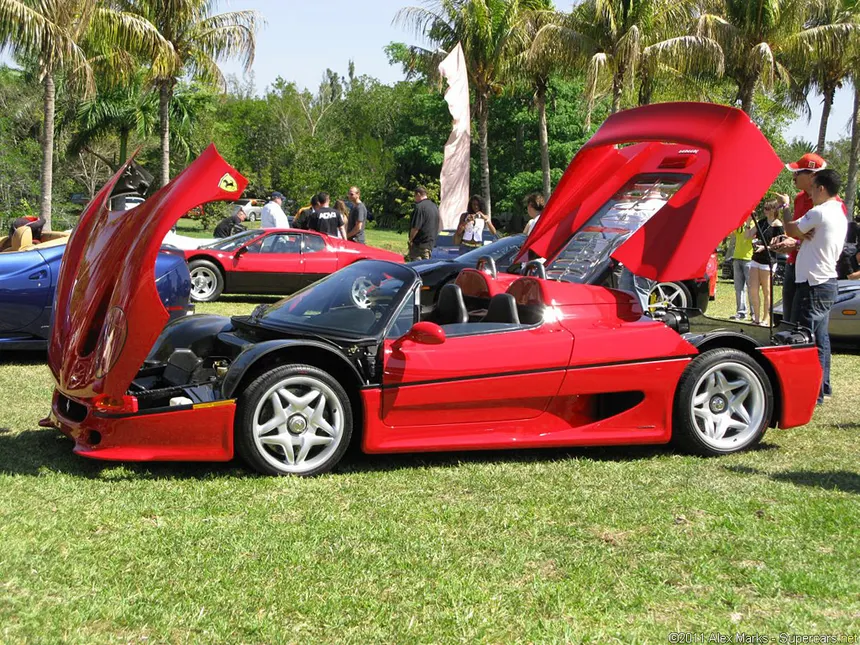
Once you understand that, you understand why the F50 is what it is. It’s the only road-going Ferrari in history where the engine is bolted directly to the chassis as a structural member, exactly like in a Formula 1 car. No silent blocks. No rubber isolation. The engine is the rear chassis. If a major repair requires removing it, the entire rear subframe separates from the monocoque. Just like in F1.
And in 1995, nobody else on the planet was doing that on a car with a number plate.
The Car That Asks You To Know How To Drive
The F50 has no power steering.
No ABS.
No brake servo.
No traction control.
No electronic aids of any kind.
Read that again. This isn’t a 1960s car. This is a 1995 Ferrari built at the same time as the McLaren F1, the Lamborghini Diablo VT and the Bugatti EB110. All three direct rivals had at least ABS. The F50 had nothing.
Why?
Because Enzo had died in 1988, but the team running Maranello in 1995, led by Luca di Montezemolo, wanted to build a Formula 1 car with a number plate. And a 1995 Formula 1 car didn’t have ABS or brake servo either. It wasn’t an oversight. It was a statement.
You need to understand what this means in practice. In a twin-turbo F40, if you brake late, the physics of the car and the later-spec ABS forgive you something. In an F50, if you brake late, you go off. If you can’t modulate pedal pressure on a brake without hydraulic assistance, the nose won’t turn in. If you lift off mid-corner, the rear will throw you off the road. The F50 has no safety net.
The 1995 press got into that car without knowing what they had in their hands, and they got scared.
Because it’s a car that demands. It demands knowledge, it demands feel, it demands work. It gives back double what you put in. But if you put nothing in, it bites.
The F40 was savage on the power curve because of turbo lag and the brutal hit that followed. That made it entertaining at the wheel even for an average driver. The F50 is savage in a different way. Naturally aspirated, linear, no turbo, full power available from 3,000 rpm. What you see is what you get. And what you get, if you can’t read it, is a bomb you’ve accidentally strapped yourself into.
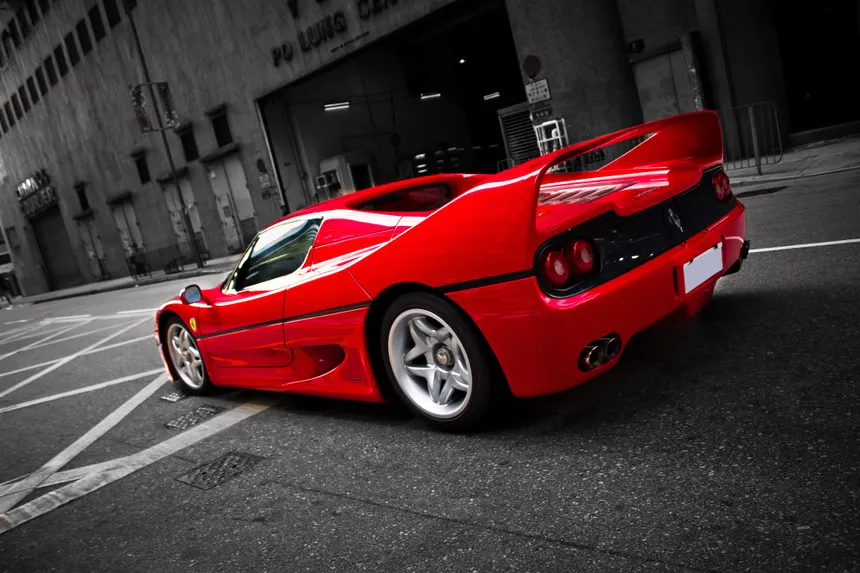
And let’s be clear about something, because we’re not here to sell you the F50 as a perfect car. It isn’t. The cabin is claustrophobic even by 1990s Ferrari standards. Rear visibility with the targa top fitted is a bad joke. City fuel consumption turns you into your local petrol station owner’s best friend. Parking it is a punishment. Getting it up your garage kerb is keyhole surgery. It wasn’t comfortable, it wasn’t practical, it wasn’t reasonable. And Ferrari didn’t give a damn. That’s exactly why it is what it is.
The Gearbox No Ferrari Will Ever Wear Again
Here’s a fact that defines the F50 better than any power figure.
The Ferrari F50 is the only production Ferrari V12 with a mid-mounted engine and a metal-gate manual gearbox in the brand’s entire history. None before. None since. None coming.
Think about what that means. Six speeds, chromed metal lever, that open gate pattern any Ferrari enthusiast can spot from a mile away, the sound of metal on metal when you slot it into second. That, with a V12 engine, in mid position, has never been done again in the history of Maranello. The F40 had it, but with a twin-turbo V8. The Enzo came with paddles and an automated F1 gearbox. The LaFerrari with a dual-clutch. The F50 is the end of the road and the door that closed forever.
That gearbox alone would justify the sticker price today. It multiplies the current value by five.
349 Units and Why That Isn’t 350
Ferrari built exactly 349 F50s between 1995 and July 1997. One fewer than the 350 the market was asking for. And that decision was deliberate.
The strategy is attributed to Luca di Montezemolo, Ferrari’s president at the time. The idea was simple: always build one unit fewer than the market is prepared to buy. That way every car sells, none stays unowned, and the secondhand market starts off hungry instead of overstocked.
It worked. The 349 units sold out. The secondhand market asked for that missing 350 for decades. And that never-built 350 is, today, the main reason an F50 sells for what it sells for.
List price in 1995: 569,690 US dollars. Current price at verified auction in recent years: between three and five and a half million euros, depending on condition, mileage and documentation.
In thirty years, roughly eight to tenfold appreciation. Very few assets on the planet have managed that without being a plot of land in Manhattan.
The F50 GT: The Car That Never Raced
There’s a version of the F50 almost nobody knows about. And it deserves its place in this story because it tells you exactly how far Ferrari wanted to push this engine.
It’s called the F50 GT. It was developed between 1996 and 1997 in collaboration with Dallara (yes, the same people behind the modern Stratos and most of what runs on circuits today) and Michelotto, Ferrari’s official preparer for customer racing. The goal was to homologate the F50 for the GT1 class of the world endurance championship, the same one where the Porsche 911 GT1, the McLaren F1 GTR and the Mercedes CLK GTR were competing.
Dallara’s engineers took the F130B V12 and pushed it to 750 horsepower at 10,500 rpm. In other words: the F50 road engine, already derived from Formula 1, could take another 237 horsepower and another 2,500 rpm just by removing road homologation restrictions. That tells you how much reserve the block had. That tells you where it truly came from.
Only three complete prototypes were built. None ever raced.
The project was cancelled when the FIA changed the rules and allowed cars like the Porsche 911 GT1, which had barely any relationship with the road-going 911, to compete without the restrictions still being demanded of the F50 GT. Ferrari did the math, saw it was being asked to start from the back in a game where rivals were legally cheating, and walked away.
The three prototypes still exist. They’re in private collections. And they’re the physical proof that the F50 wasn’t a road car pretending to be a track car. It was a track car forced to wear number plates.
What They Said Then And What They Say Now
Car and Driver in 1995: “disappointing.” Road & Track in 1996: “less exciting than the F40.” Autocar in 1997: “the worst Ferrari of the last ten years.”
Car and Driver in 2020: “the purest modern Ferrari.” Road & Track in 2022: “the last great electronics-free Ferrari.” Motor Trend in 2023, in a video comparing the F50 with the LaFerrari on track: “if you knew what you were feeling through every tremor of the steering wheel, you’d pick the F50 without hesitation.”
The car didn’t change. The drivers did. The 1995 journalists came from the F40. They didn’t know how to read a road-going Formula 1 because they’d never driven one. Today’s journalists, with thirty more years of technology, electronics and cabin assists, climb into the F50 and recognise what it is: a machine that doesn’t lie to you. That filters nothing. That tells you exactly what the left rear tyre is doing in every tenth of a second.
And today, that doesn’t exist anywhere else.
What You Owe the F50 Even If You Never Drive One
Every modern high-performance mid-engine V12 with a carbon-fibre monocoque owes something to the F50. It was the first road Ferrari with a carbon monocoque. The first to use pushrod suspension derived directly from Formula 1 on all four corners. The first to bolt the engine to the chassis as a structural member.
The Enzo inherited that philosophy. The Porsche Carrera GT copied it. The LaFerrari refined it. The Aston Martin Valkyrie has taken it to the next level. But the origin, the zero moment, is the F50.
And yet, for nearly twenty years, it was valued below the F40 and the Enzo at auction. The market took two decades to understand what the F50 was. The press took three.
The Verdict We Should Have Written in 1995
Ferrari didn’t build the F50 for the press. Ferrari built it for whoever could read it. It was a message in a bottle thrown at the future. A car that said: “this is what we know how to do when we don’t have to justify it to anyone.” No ABS because it didn’t need it. No assists because assists filter. Manual gearbox because a manual forces you to be there, with the car, on every shift.
Those who understood it then kept it. Those who understood it later paid treasure for it. Those who never understood it wrote that it was a disappointment.
The F50 wasn’t a car for the press. It was a car for you, if you could read it.
Check you’re still alive.
1 thought on “FERRARI F50”