Santana Motor: the Spanish 4×4 that humiliated the British, died with the country — and just came back with Chinese blood
You’ve probably never heard of Linares. It’s a small city in the south of Spain, sitting in the middle of an olive-tree ocean in the province of Jaén — historically one of the poorest corners of the country, with a long industrial past in lead mining that was already collapsing by the 1950s.
Now, here’s the thing.
In July 2005, British 4×4 Magazine ran a comparative test between the most respected off-road vehicles on the market: the Land Rover Defender, the Land Rover Discovery, the Nissan Patrol, and an outsider called the Santana PS-10. The verdict? The PS-10 — designed, engineered and built in Linares — was crowned the best off-roader in the world. It beat the Defender on the Defender’s home turf, in a British magazine, judged by British journalists.
The PS-10 wasn’t a tribute act to the Defender. It was its grandson. And it had just knocked grandfather out of the ring.
This is the story of Santana Motor: a factory that started life making harvesters in 1956, ended up building Land Rovers under licence, then started building them better than the British, then sold the design to Iveco who badged it with their own logo and shipped it back to Europe to compete against the Defender. It’s a story that ended brutally — the factory shut its doors in 2011 — and then, against every reasonable prediction, came back to life on December 5th, 2025.
Buckle up. This is a long one.
A Plan, a mayor with the right phone numbers, and a farm called Santa Ana
To understand Santana, you need to understand Spain in 1956. Eleven years after the end of the Civil War. A country still under Franco’s dictatorship, still recovering from autarky, still rationing certain goods. The southern province of Jaén, in particular, was an economic disaster: lead mining was dying, agriculture was unmechanised, and emigration was draining the region.
The Franco regime launched the so-called Plan Jaén — a state-led effort to inject industry into the province. One of its measures was to plant a farm-machinery factory somewhere in Jaén. It could have ended up anywhere.
Linares got it. Why? Because the mayor at the time, Leonardo Valenzuela, knew the right people in Franco’s inner circle and pulled the right strings. The land selected for the factory was an estate called Santa Ana, and the company took its name from the farm: Metalúrgica de Santa Ana, S.A., founded with starting capital of just three million pesetas — roughly the cost of a decent house in central Madrid at the time.
The company started by making combine harvesters and agricultural equipment. There was no plan, at this point, to build cars. None. Just iron, welding, and tractors for olive farmers.
That changed almost immediately.
How the Spaniards forced the British to hand over the new model
Two years after its founding, in 1956, Santa Ana’s management opened talks with The Rover Company Limited in Solihull. The Land Rover was, by the mid-1950s, a global success that the British factory couldn’t keep up with. Rover already had licensing deals with Minerva in Belgium, Tempo in Germany, and Morattab in Iran. They needed another partner. Spain was a natural fit.
Here’s where Linares showed teeth for the first time.
The British wanted Santa Ana to build the Land Rover Series I — the older model, the one for which Rover had spare tooling, the one that would have let them dump second-hand Belgian Minerva equipment at a tidy profit. A clean deal for Solihull.
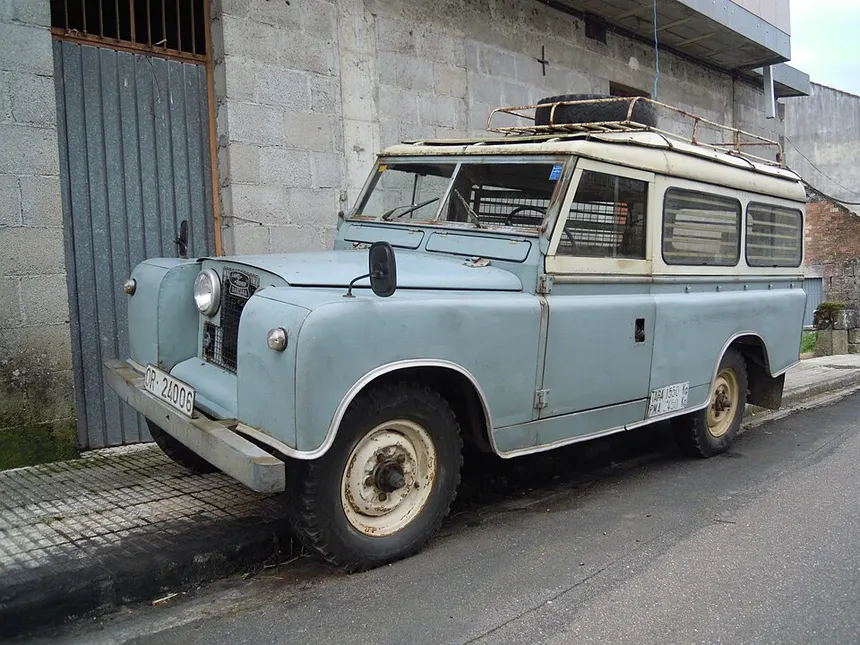
The Spaniards refused. They wanted the Series II — the brand-new model that hadn’t even reached full production. They negotiated. They held the line. And the British, against their original intention, gave in.
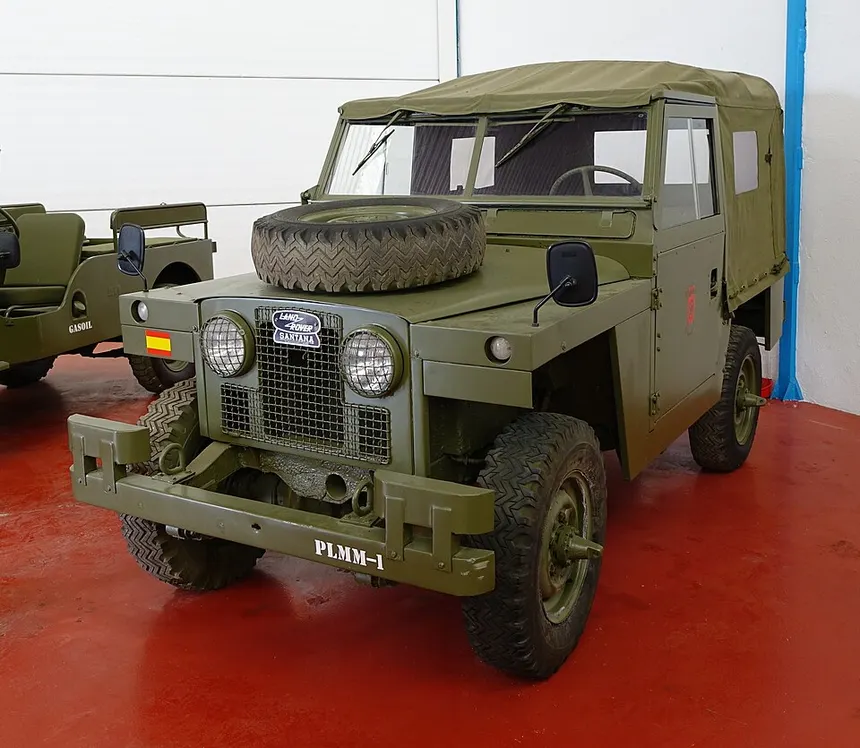
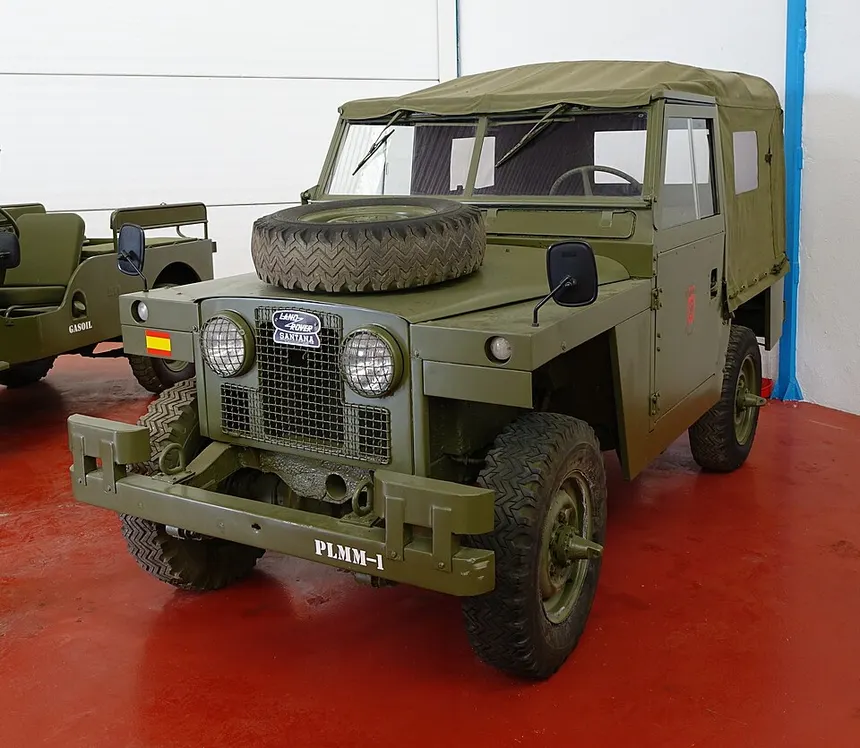
In 1958, Linares began producing the Land Rover Series II under licence, with most of the tooling shipped over from the UK. Component nationalisation started at 75% and rapidly approached 100%. By 1968 — pay attention to this date — Santana wasn’t simply assembling British kits anymore. They were developing their own evolutions of the platform: new engines, redesigned suspensions, structural improvements. The company changed its legal name to Land Rover Santana, S.A.
And that’s when something unexpected started to happen.
When the apprentice started teaching the master
Spanish-built Land Rovers were sold into some of the harshest markets on Earth: Morocco, Costa Rica, Central and South America, parts of Africa. The kind of terrain where a 4×4 works ten hours a day on sand, rock, mud and broken pavement. The kind of conditions Solihull engineers, testing on English country roads in English drizzle, never properly experienced.
Customer feedback in those export markets revealed problems that British Leyland — the financially stricken corporation that owned Land Rover by then — wasn’t seeing. The Spaniards were. And because British Leyland was in no condition to invest in solving them, Santana started fixing those problems on its own initiative.
By the late 1970s and early 1980s, Spanish Land Rovers featured anatomical seats, disc brakes, turbo-diesel engines, conical springs, helical springs, and Forward Control variants the British factory had never even attempted. The Spanish-built models had diverged so far from the original specification that, in many of those export markets, the Linares-built Santana was preferred over the Solihull-built Land Rover.
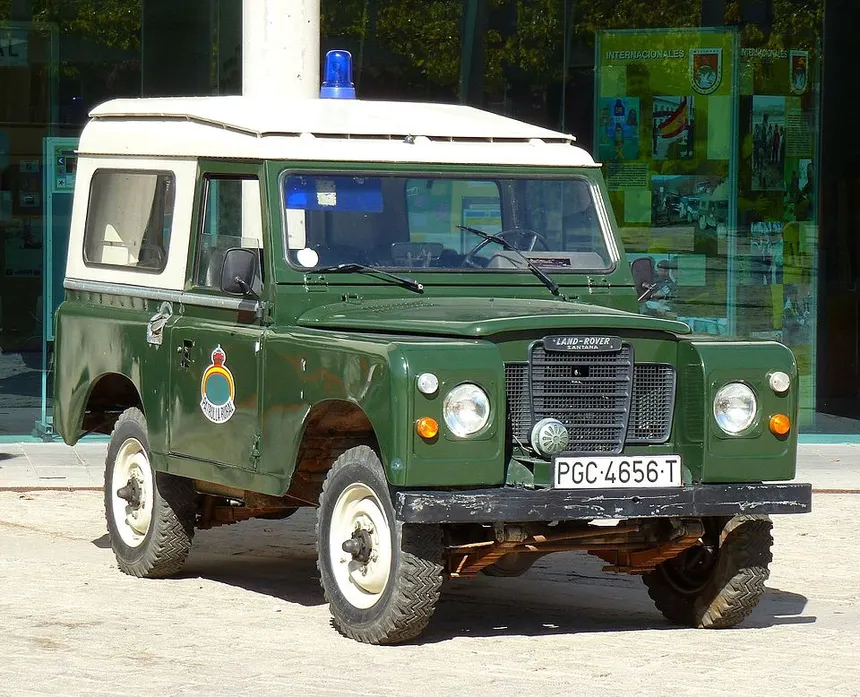
In 1983, Land Rover — drowning in British Leyland’s collapse — cancelled the licensing agreement. Santana didn’t fold. They kept building. The result was the Santana 2500, a Spanish-developed evolution of the Series III platform that became the Spanish 4×4 in the same way that the Defender became the British one. Over 300,000 units were built. The Spanish Civil Guard drove them. The army drove them. Bolivian mining engineers, Moroccan farmers and Andalusian shepherds drove them.
If you’re British and you ever drove a Series III in the 1980s with an oddly comfortable seat and a turbo-diesel that pulled like a tractor — there’s a non-trivial chance the chassis underneath you came from Linares.
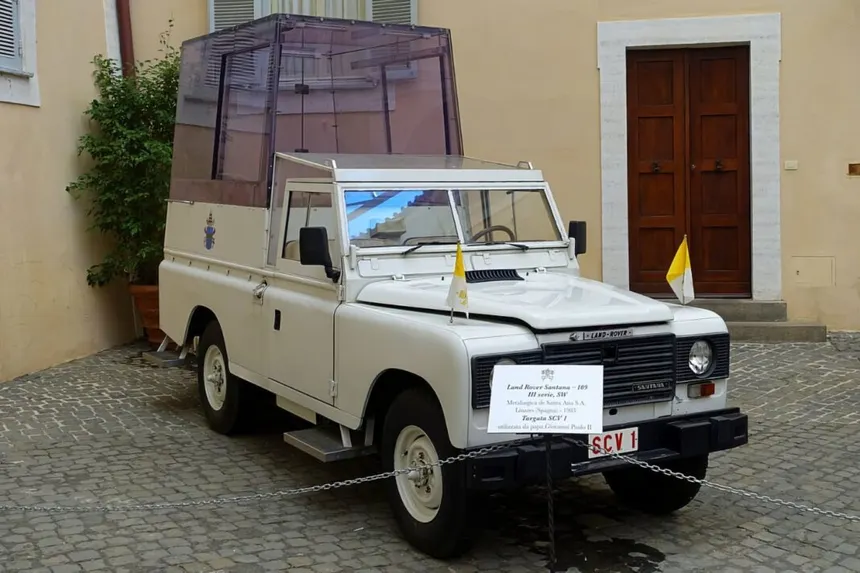
Suzuki, the 1990s, and a factory roaring at 30,000 units a year
By the mid-1980s, Santana was again exposed: no British licence, no foreign partner, increasingly outclassed by Nissan Patrol, Toyota Land Cruiser and Mitsubishi Pajero. They needed an ally.
They found one in Japan. Suzuki signed a partnership in 1985 that started as a licensing deal and gradually escalated. By 1991, the Japanese had become majority shareholders and poured serious investment into modernising the Linares plant.
The hard number: 30,000 vehicles per year coming out of Linares. First the Samurai. Then the Vitara. Then the Jimny. Three models that defined an entire era of accessible off-road motoring, especially in Europe. Three models that for many people across the continent meant their first 4×4 — a Vitara as the family car, a Samurai as the cheap ticket to weekend adventure.
Thirty thousand units. Per year. Coming out of a factory in southern Spain, not from any of Suzuki’s Japanese plants. If you grew up watching adverts in Europe in the 1990s — Marlboro Adventure Team campaigns, off-road editorials, weekend rally features — you were watching cars built in Linares.
But dependence on Suzuki was a knife under the table. When the Japanese decided in the mid-1990s that the partnership wasn’t paying off — the regional government of Andalusia stepping in as majority shareholder accelerated their exit — Santana found itself alone again. Massive plant. Thousands of workers. No car to build.
Same problem as 1983. Different decade.
The PS-10: how a Spanish off-roader humiliated the Defender
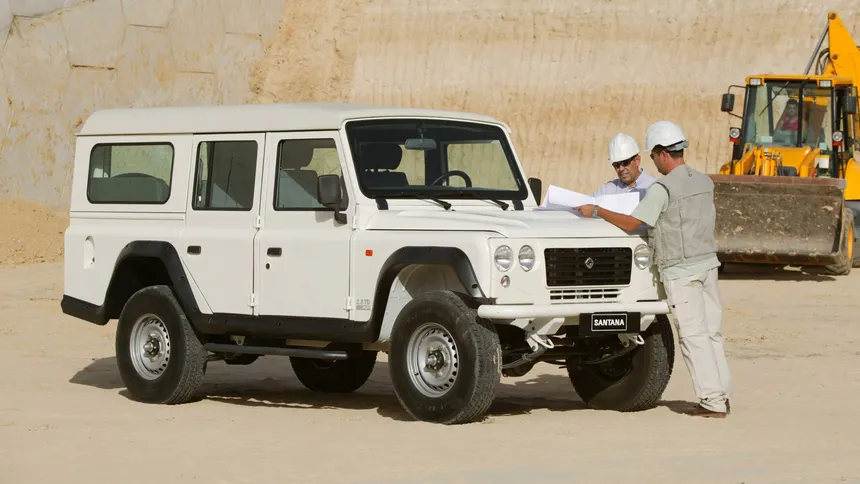
- The factory’s director at the time, José Antonio Navarro Yagüe, launches the project that’s supposed to save Santana: a fully Spanish-developed off-roader, evolved from the Land Rover heritage but engineered from the ground up. By January 1998 they had a scale model. The board approved development. Real prototypes followed.
May 2002. The car was unveiled at the Madrid Motor Show. Santana named it Aníbal — after Hannibal Barca, the Carthaginian general who, according to tradition, married a woman called Himilce, born in Cástulo, an Iberian city whose ruins lie within the municipal boundaries of Linares. A historical wink with real local weight.
There was a problem with the name internationally, though. Hannibal was a registered trademark in the United States — held by the manufacturer of the Hummer. So for export markets, Santana had to rebrand the vehicle. Internationally, it became the Santana PS-10.
Then came the moment.
In its July 2005 issue, British 4×4 Magazine put the Santana PS-10 against its rivals in a comprehensive comparison test. The competition: Land Rover Defender. Land Rover Discovery. Nissan Patrol. The verdict, in a British publication aimed at British 4×4 enthusiasts: the PS-10 was the best off-roader in the world.
Read that again. A British magazine, judging a Spanish-built off-roader against the Defender — Britain’s national mechanical icon — and concluding that the Spaniard won.
The PS-10 was sold into the armed forces of Spain (1,700 units), France and the Czech Republic. It went through evaluation for the British Army and Morocco. It was exported to civilian customers across Europe.
The Iveco move: when a multinational came to Linares to buy the apprentice’s car
Here’s where the story gets surreal.
In 2006, at the Madrid Motor Show, Iveco — the Italian commercial-vehicle giant, part of the Fiat ecosystem, one of Europe’s heavyweights in trucks and industrial vehicles — signed an agreement with Santana.
The agreement: Iveco wanted to buy the design of the PS-10.
Iveco took the PS-10, sent it through Italdesign — Giorgetto Giugiaro’s studio, no less, the man who shaped the original VW Golf and the DeLorean DMC-12 — for cosmetic restyling, applied some technical refinements, and launched it under their own brand as the Iveco Massif. Production began in July 2007 at the Linares factory itself and continued until 2011, when it died together with Santana. In its final year of operation, the factory shipped a closing batch of 426 Massif units to the Romanian Army — a last, almost ceremonial export that confirmed the design’s international validity even as the company collapsed beneath it.
Stop and think about what just happened.
The Land Rover had been born in Solihull in 1948 as a British agricultural workhorse. Linares had built it under licence since 1958. Linares had improved it for decades. Linares had developed an evolution so refined that a British magazine declared it superior to the Defender.
And in 2007, an Italian multinational decided the Spanish car was good enough to wear its corporate badge — and shipped it into the global market to compete head-on with the Land Rover Defender. With the great-grandfather of its own machine.
There’s a parallel that any car enthusiast will recognise. W. O. Bentley — founder of Bentley Motors, designer of the engines that won Le Mans five times in the late 1920s — ended up, after Rolls-Royce bought his company, unable to put his own signature on the engines he designed. The name belonged to someone else. The creator was locked out of his creation.
In Linares, it played out in reverse. The British creator — Land Rover — watched its Spanish offspring turn against it, wearing an Italian badge, built in an Andalusian factory by workers whose grandfathers had started by copying the original British template.
That’s industry. That’s real engineering. That’s what happened in Linares for half a century, and it’s a story barely anyone outside Spain knows.
The dark side: a political contract and the Aníbals stranded in Afghanistan
Santana wasn’t a fairy tale, though. The 2004 contract that put 1,700 Aníbals into Spanish Army service smelled of politics from every angle.
The Spanish motoring press, including Autobild, made the case clearly: Santana’s real advantage in winning the tender wasn’t technical or financial — it was political. At the time, the Junta de Andalucía was led by Manuel Chaves of the PSOE. The Spanish Ministry of Defence was held by another PSOE heavyweight, José Bono. The Galician regional government, run by Manuel Fraga of the centre-right, was backing a competing bid from Galician manufacturer Urovesa with their VAM-TL off-roader. PSOE-PSOE alignment trumped Galician hardware. Santana got the contract.
This is the kind of regional patronage Spaniards recognise on first reading. Two PSOE strongmen — one running Andalusia’s regional government, one running the national Ministry of Defence — and a tender result that conveniently keeps thousands of Andalusian jobs alive. Nobody went to court. Nobody had to. That’s how it worked.
The irony writes itself: Morocco bought hundreds of those rejected Urovesa VAM-TLs. The Moroccan Army still operates them today, with no reported reliability problems.
Spain bought Aníbals. And then the war zones started talking.
On 17 October 2007, at a Spanish military base in Istog, Kosovo, an Aníbal overturned during a patrol while attempting to avoid an oncoming vehicle. It crashed into a petrol station. Two soldiers died. Two more were wounded. The accident triggered an internal investigation that would expose just how badly the contract had aged.
According to documentation published by El Confidencial Digital in September 2008, citing internal Ministry of Defence data, the order to immobilise the Aníbal fleet came on 18 June 2008. The numbers, when they finally surfaced: 16 out of 31 vehicles deployed in Afghanistan, and 93 out of 96 deployed in Lebanon, were declared non-operational due to manufacturing defects. That works out to roughly 86% of the deployed fleet. The defects identified included seized wheel-bearing assemblies, fatigued materials, loosened transfer-case nuts and loose drive-flange bolts.
The British magazine that had crowned the PS-10 in 2005 hadn’t tested it with Helmand dust in the air filter or Lebanese summer heat in the transmission. The Spanish Army did. The reputation collapsed.
February 2011: the closure
The 2008 financial crisis hit Santana hard. Losses of €56.1 million in 2009. €23.83 million in 2010. Rolling redundancy plans affecting the entire workforce. Iveco’s purchase option, which would have provided a lifeline, expired on 31 December 2010 without being exercised.
In February 2011, Santana Motor was wound up.
The final settlement, called Linares-Futuro, was voted on by workers inside the factory itself. It included 790 early retirements for employees over 50, 80 severance packages with redeployment offers within the Santana industrial park, and a Social Action Plan covering another 300 workers under 50, with retraining commitments through December 2012.
Buses full of santaneros — that’s how Santana workers are known locally — left Linares to demonstrate outside government offices in Jaén capital. Over 1,200 direct jobs in the wider industrial park, split between the 363 in automotive assembly and the rest spread across suppliers like Ditecsa, Fasur, Arpa and Elyo. Entire families in Linares depended on the factory. When it closed, the city’s industrial oxygen was cut off.
Linares went from being a symbol of Spanish industrialisation to being a symbol of Spanish deindustrialisation. Local unemployment spiked. The province of Jaén slipped back, in industrial terms, to roughly where it had been in 1956 — before the Plan Jaén had even started.
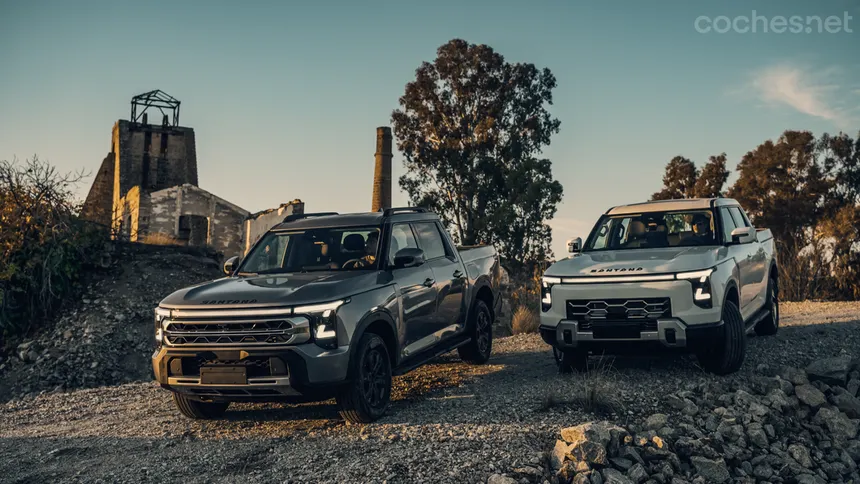
December 5th, 2025: the badge lights up again, with Chinese money
Fourteen years after the closure, on December 5th 2025, the Linares factory officially reopened. The reopening ceremony was attended by the President of the Junta de Andalucía Juan Manuel Moreno, by the First Vice-President of the Spanish government María Jesús Montero, and by the Mayor of Linares Auxi del Olmo.
The new Santana Motors S.L. — legally a different entity from the one that closed in 2011 — signed a strategic deal with two Chinese partners: Zhengzhou Nissan Automobile (ZZ Nissan), the Chinese arm of Nissan, and Anhui Coronet Tech. Later, BAIC joined the ecosystem. Initial investment: five million euros, later expanded to ten million for plant modernisation. 170 direct jobs created, with capacity for 200.
The production setup is SKD (Semi Knocked Down): vehicles arrive from China as component sets and final assembly happens in Linares. It’s not the Santana of the Series II era. It’s not the Santana of the Suzuki years. It’s not even the Santana of the Aníbal. It’s something else — a brand revival riding on imported engineering.
But the factory hums again.
The first product is the Santana 400D (diesel) and the Santana 400 PHEV (plug-in hybrid). Starting price for the diesel version: €29,900. That makes it the cheapest pickup truck on the Spanish market — between two and ten thousand euros below the Ford Ranger, Toyota Hilux and Mitsubishi L200, with broadly comparable technical specifications.
Whether this is genuinely a renaissance of Santana or a strategic licensing exercise wearing a famous old jacket — that question stays open. The factory is real. The engineering origin is Chinese. The badge is Spanish history. Make of that what you will.
What this story actually tells us
Santana Motor fits in a single paragraph in most industrial history textbooks. It shouldn’t.
Because the Santana story isn’t the story of a minor brand surviving on borrowed designs. It’s the story of how a factory planted in a declining mining province, capitalised at three million pesetas and staffed by men who’d come straight off pickaxes and shovels, ended up building off-roaders that beat the British in their own magazines, sold to four European armies, and licensed by an Italian multinational to compete against the Defender.
It’s the story of a country that, when it commits, can do real engineering. And of a country that, when it stops committing, knows perfectly well how to bury that engineering.
Linares isn’t just an industrial footnote. It’s a case study in how nations build, and how they unbuild.
The factory is open again. The 400D is rolling off the line. Whether this second act is a real comeback or a SKD assembly arrangement with a heritage badge — time will tell.
But somewhere in Spain, somewhere in Morocco, somewhere in rural France, somewhere in a Central American village, there’s a thirty-year-old Land Rover that doesn’t break. Repainted three times. Engine rebuilt twice. Still running.
That one was made in Linares.
Check you’re still alive.
3 thoughts on “SANTANA MOTOR”