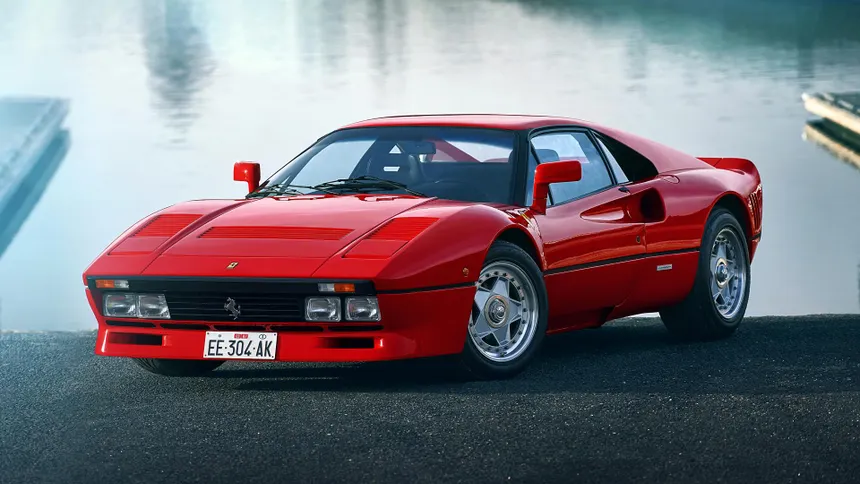
Ferrari 288 GTO and Evoluzione: The Last Ferrari Designed To Win Races That Never Raced
There’s a room in Maranello’s engine department where a Ferrari is parked that shouldn’t exist.
It has no licence plate. It has no race category. It has no calendar. It’s been sitting there for nearly forty years, preserved by the factory’s internal museum, occasionally photographed, never homologated for anything. It’s a car with a twin-turbo V8 producing 650 horsepower, dry weight of 940 kilos, top speed beyond 360 kilometres per hour, and exactly zero races to its name.
It’s called the Ferrari 288 GTO Evoluzione.
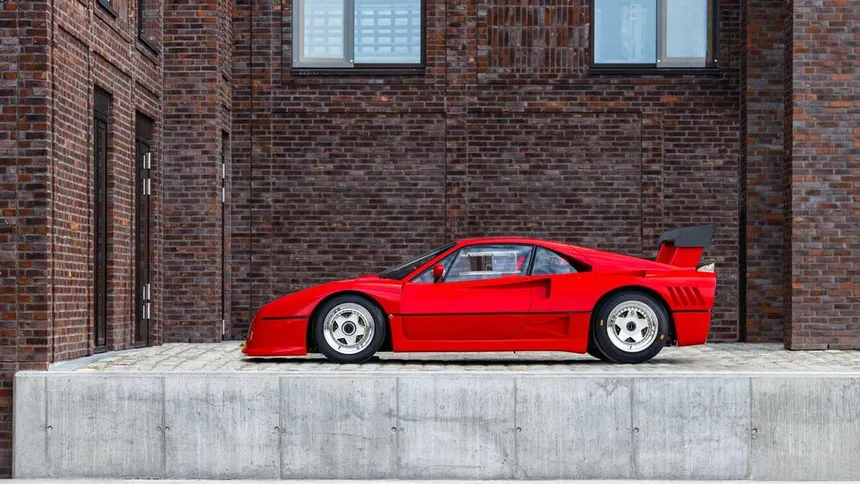
And it’s one of six examples Maranello built between 1985 and 1986 for a competition category that died before they could fire the engine on a starting grid.
This is the story of how Ferrari designed two consecutive cars — the road-going 288 GTO and the racing Evoluzione — for a war that never started. And of how, in the end, those six orphaned prototypes ended up fathering, more by industrial accident than by romantic inspiration, the most legendary road-going Ferrari of the 1980s.
But we’ll get to that part of the story at the end.
Let’s start at the beginning.
1982: The FIA Invents The Most Dangerous Championship In History
To understand the 288 GTO, you have to understand Group B.
In 1982, the Fédération Internationale de l’Automobile rewrote competition categories from scratch. The idea was modern and, on paper, brilliant: create a top class where manufacturers could build cars with practically unlimited technology, requiring only 200 road-homologated units as a condition of entry. The FIA called it Group B.
The rules were a blank cheque. No effective displacement limit. No turbocharger restriction. No strict aerodynamic regulation. No meaningful minimum weight. The FIA’s philosophy was simple: give technical freedom to manufacturers so they could build whatever they wanted, and let the road car market benefit later from the technology transfer.
What happened was that engineers in every factory locked themselves in their technical departments and built monsters. Audi Quattro Sport S1 with a 600-horsepower turbo engine. Lancia Delta S4 with both turbo and supercharger in series. Peugeot 205 T16 with all-wheel drive. Ford RS200 with a mid-mounted engine. Porsche 959 with twin turbos and electronic all-wheel drive. MG Metro 6R4 with a naturally aspirated V6. Cars with power-to-weight ratios comparable to contemporary Formula 1, run on dirt rallies through crowds without barriers.
When the major manufacturers saw what was being cooked up, some of them decided this was a historic opportunity. Ferrari was one of them.
The Conversation That Opened The 288 GTO Door
There’s a documented conversation in the memoirs of engineer Nicola Materazzi, head of project development, that deserves to be quoted directly. Materazzi, in an internal meeting at the end of 1982, raises with Enzo Ferrari the problem facing Ferrari customers in the modern era: with the new highway speed limits and increasingly severe fines, buyers of road-going Ferraris can no longer prove the potential of the cars they’re buying. Materazzi suggests an exit: return to GT class racing, now under the Group B umbrella. A category Ferrari had abandoned after the 512 BB LM era of the 1970s.
Enzo Ferrari said yes. But with two conditions, recorded in Materazzi’s later testimony.
First: formal authorisation for the project must come from Eugenio Alzati, general director of the factory.
Second — and this is the condition that defines the spirit of the car that came after — the engineers working on the racing GTO would do so outside of Maranello’s regular working hours. Monday to Friday, eight to five, all factory resources went into developing the Ferrari 328, the successor to the 308 GTB and the real commercial bet of the moment. The 288 GTO was built, literally, in the personal time of Maranello’s engineers. Saturdays, Sundays, nights. The philosophy Enzo had always applied to competition projects: if you believe in the idea, you’ll work on it in your own time. If not, it isn’t worth it.
The project started this way. With no visible official budget. With a small team. And with one objective: build the car that would take Ferrari back to the top of GT racing.
The 288 GTO Road Car: Anatomy Of A Pure Homologation Special
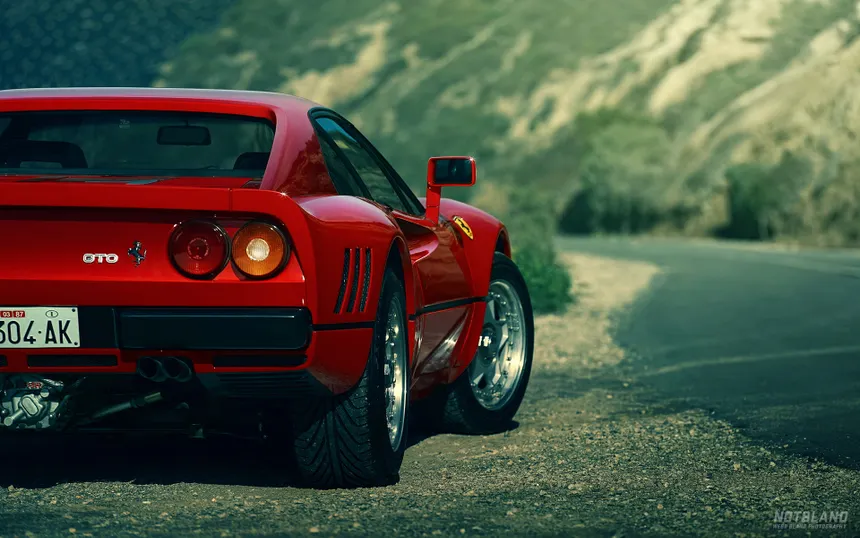
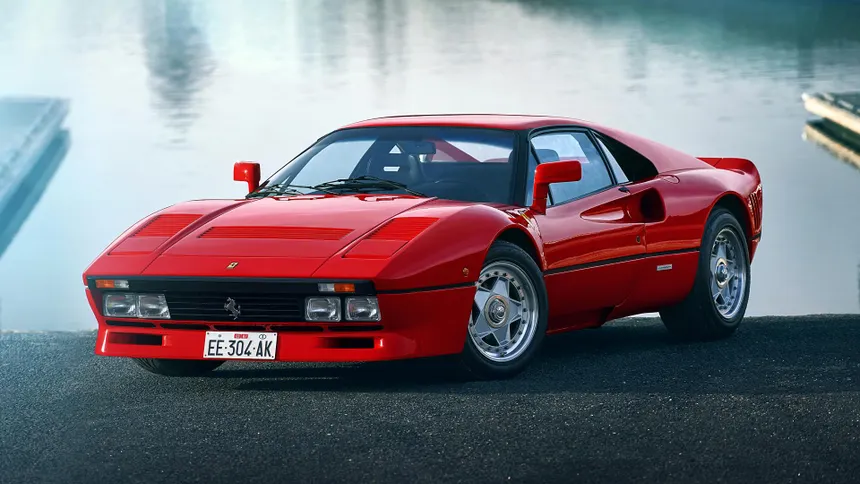
The 288 GTO was launched at the Geneva Motor Show in March 1984. On paper, it was just another road-going Ferrari. Beneath the paper, it was a race car somebody had bolted licence plates onto to satisfy the FIA.
The engine was the centre of the project. Ferrari took the naturally aspirated V8 from the 308 Quattrovalvole, dropped the displacement from 2,927 to 2,855 cubic centimetres (reducing the bore by 1 millimetre), added two IHI turbochargers with twin Behr intercoolers, and installed Bosch K-Jetronic injection. Internal designation: Tipo F114B. Final figures: 400 horsepower at 7,000 rpm, 366 lb-ft of torque at 3,800 rpm, 1.0 bar of boost pressure.
But the 2,855 cc displacement wasn’t a casual choice. It was pure mathematics applied to the Group B regulations. The FIA applied a 1.4 multiplier to turbocharged engines to place them in their corresponding competition class. 2,855 multiplied by 1.4 equals exactly 3,997 cubic centimetres. Three millimetres below the 4-litre class limit. Ferrari designed the 288 GTO’s engine calculating to the millimetre the displacement that would let them race in the highest category without overshooting. The name says everything: 288 (2.8 litres, 8 cylinders) GTO (Gran Turismo Omologato — Homologated Grand Tourer). The car was designed for a category before it was designed for a buyer.
The chassis was tubular steel, with composite body panels mixing fibreglass, kevlar and nomex in structural areas, carbon fibre in some panels and aluminium in others. The construction philosophy came directly from Formula 1: maximum lightness with stiffness derived from the internal chassis. The engine compartment was wrapped in an aluminium honeycomb skinned with kevlar, for thermal and fire resistance. Final dry weight: 1,160 kilos (1,280 kilos with all fluids), a notable figure for a car with the power and the homologation compromises it carried.
The body was designed by Pininfarina, with art direction by Leonardo Fioravanti. Visually, the 288 GTO looks at first glance like a widened, hardened Ferrari 308 GTB. The real difference, however, is radical: longer wheelbase (2,450 mm versus the 308’s 2,340), wider tracks, no shared body panels. The 288 GTO didn’t share a single body panel with the 308 it appeared to derive from. It was a different car.
Performance numbers for the road 288 GTO: 0 to 100 km/h in 4.8 seconds. Top speed of 304 km/h. Some sources cite it as the first production car in history to break 300 km/h while homologated for road use — a claim disputed by specialist press because it depended on what one defined as “production”.
Total production: 272 units, built between 1984 and 1987. The FIA required a minimum of 200 units for Group B homologation. Ferrari sold them all before production ended. Unit number 272 was personally gifted by Enzo Ferrari to Austrian driver Niki Lauda, three-time Formula 1 World Champion, when Lauda left the top category that same 1985. A detail that says a great deal about what Enzo thought of the car.
The road 288 GTO was ready. Homologated by the FIA on 1 June 1985.
And then the real work started.
The Evoluzione: The Car Ferrari Built To Win Group B
Group B regulations allowed something the smart manufacturers exploited to the last gram: once the base car was homologated, manufacturers could produce Evolution versions — cars specifically designed for competition, with free modifications relative to the homologated version, in production runs limited to 20 units per year.
Ferrari started development of the 288 GTO Evoluzione practically in parallel with the road 288 GTO production. The philosophy changed completely. If the road 288 GTO was a race car with concessions to wear plates, the Evoluzione was a pure race car that no longer needed to make any concessions.
The engine jumped two levels in succession.
First evolution, October 1984: the Tipo F114 CR engine. Boost pressure raised from 1.0 to 1.4 bar. Compression up from 7.6:1 to 7.8:1. Result: 530 horsepower at 7,500 rpm.
Second evolution, September 1985: the Tipo F114 CK engine. Deeper internal modifications. Final result: 650 horsepower at 7,800 rpm.
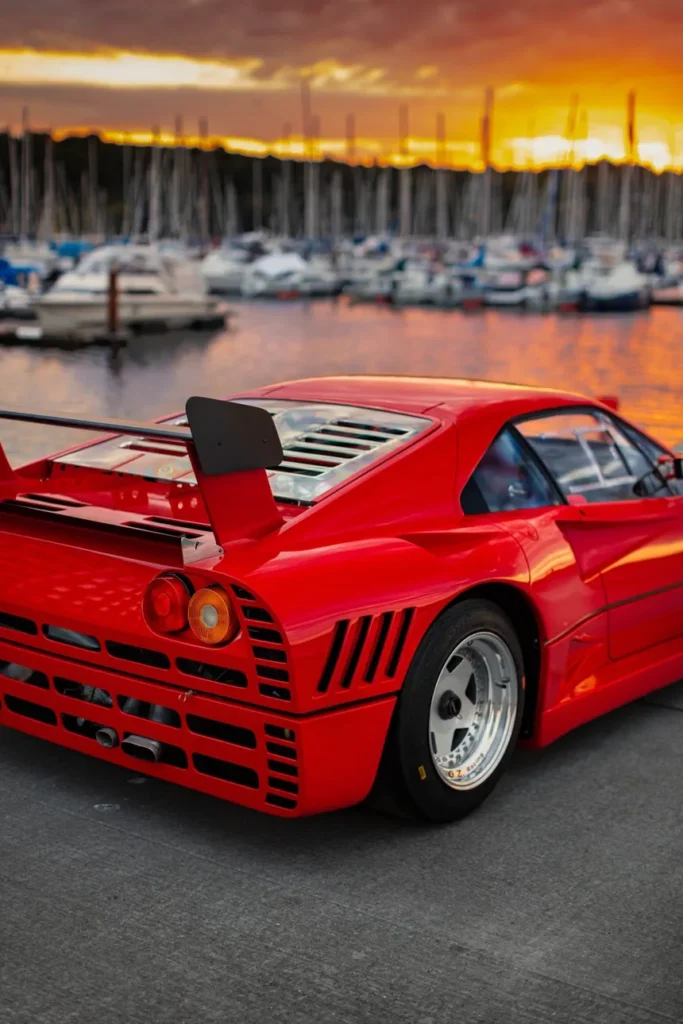
To grasp the magnitude of the jump: the Evoluzione had 250 horsepower more than the road GTO using essentially the same block. That’s what happens when you remove road homologation restrictions from an engine. That’s what the F50 GT, ten years later, would also demonstrate with the F130B block. And that’s what almost nobody tells you when they talk about Ferrari’s turbo era.
The Evoluzione’s chassis was redesigned from scratch: wheelbase shortened by 65 millimetres, width increased by 60 millimetres, height reduced by 20 millimetres. The body was built entirely in advanced composites — total weight dropped to 940 kilos dry, against the road GTO’s 1,160.
Aerodynamics was the other open front. The Evoluzione had front canards, a giant carbon fibre rear wing, NACA ducts all over the bodywork, and a front fascia radically different from the road GTO. Glass surface was reduced. Main headlights became fixed under Plexiglas with auxiliary retractable units above. Transmission remained five-speed manual, with twin-plate Borg & Beck clutch and 45% limited-slip differential.
Final Evoluzione numbers: 0 to 100 km/h in under 3 seconds. Top speed beyond 362 km/h.
In 1985, no car on the planet came close to those figures.
And then, on 2 May 1986, on a stage of the Tour de Corse round of the World Rally Championship, Henri Toivonen and his co-driver Sergio Cresto were killed when their Lancia Delta S4 went off the road, struck a tree and burned to the ground. Toivonen was 29. He was the leading candidate for the World Drivers’ title.
Within days, the FIA announced the end of Group B at the close of the 1986 season.
Ferrari had five Evoluziones ready in Maranello. Plus a sixth prototype chassis. And nowhere to race them.
What Happened Next: No Executive Gives The Order
Here’s where the official story tip-toes past and where NEC stops to look.
Ferrari, unlike Audi, Lancia, Peugeot or Ford, had never actually debuted in Group B with a factory car. Audi had launched the Quattro Sport S1 in 1985. Lancia had been racing the Delta S4 for two seasons. Peugeot was dominating with the 205 T16. Ferrari, having started the project last, had the Evoluzione homologated on paper in September 1985 — but never formally requested effective homologation from the FIA. And here’s the detail almost nobody tells you: when Toivonen died in May 1986, the Evoluzione was still not formally sanctioned to race.
Why hadn’t Ferrari homologated the Evoluzione?
The answer, gathered from later technical sources, is that Ferrari had quietly decided to abandon the Group B project months before Toivonen’s death. The reason wasn’t sporting but industrial: Group B had become a championship dominated by rally cars, not circuit GTs. Ferrari never wanted to run rallies with the GTO. Materazzi’s original idea was to return to circuit GT racing. But Group B, in practice, was the World Rally Championship. And the GT championship Ferrari really wanted — the one that would later become the BPR Global GT Series and then Le Mans GT — didn’t yet exist as a serious category.
Ferrari built six perfect Evoluziones for a category they no longer wanted to compete in. They let homologation deadlines pass. They left the cars at Maranello. And they waited to see what the FIA would do.
The FIA did what it did: kill Group B.
And Ferrari, by the end of 1986, was sitting on six orphaned prototypes in the competition warehouse. Five production units and one prototype chassis. Twin-turbo V8 with 650 horsepower. Formula 1-grade aerodynamics. Reinforced tubular chassis. Bodywork in advanced composites. No category to race. No effective homologation. No sporting future.
What they decided to do with those six cars is the next part of this story. And it deserves its own article.
Where The Six Evoluziones Are Today
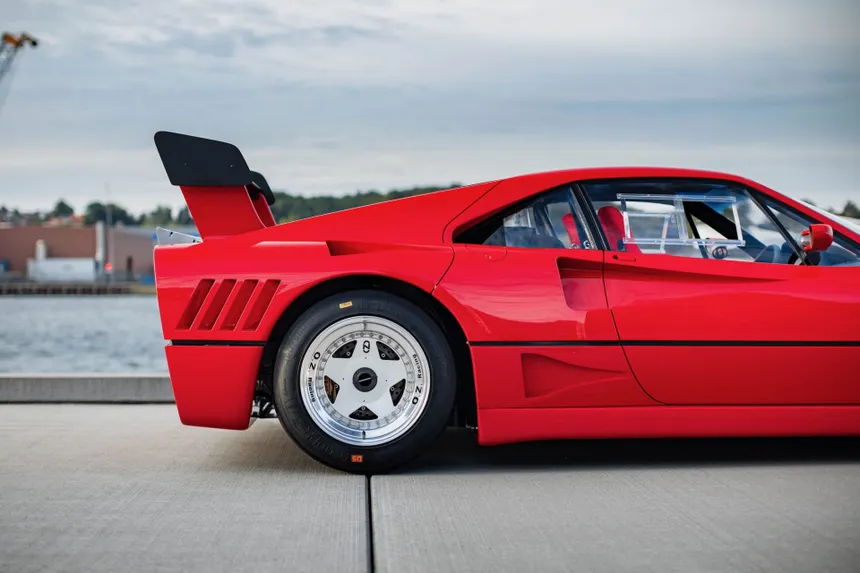
All six examples of the 288 GTO Evoluzione still exist in 2026.
One remains at Maranello, on permanent display in the factory’s engine department. It’s the one you’ve seen, if you’ve ever been on an authorised internal tour through Ferrari Classiche, and the one most visitors mistake for an F40.
Four are in international private collections. They’ve come up at auction at specific moments. The last publicly sold example changed hands at figures above 2 million euros, although the real market moves above 3.5 million in discreet collector-to-collector deals.
The sixth chassis — the prototype — is reasonably suspected of having been used as a development mule during the Ferrari F40 programme. That trail, specifically, is the one that opens the door to the next article.
Because when Ferrari was left with five orphaned Evoluziones in the competition warehouse at the end of 1986, with no category to race, somebody at Maranello made an industrial decision. That decision changed the history of the modern road-going Ferrari. We tell it in the next chapter of this series.
Why The 288 GTO Matters More Now Than Ever
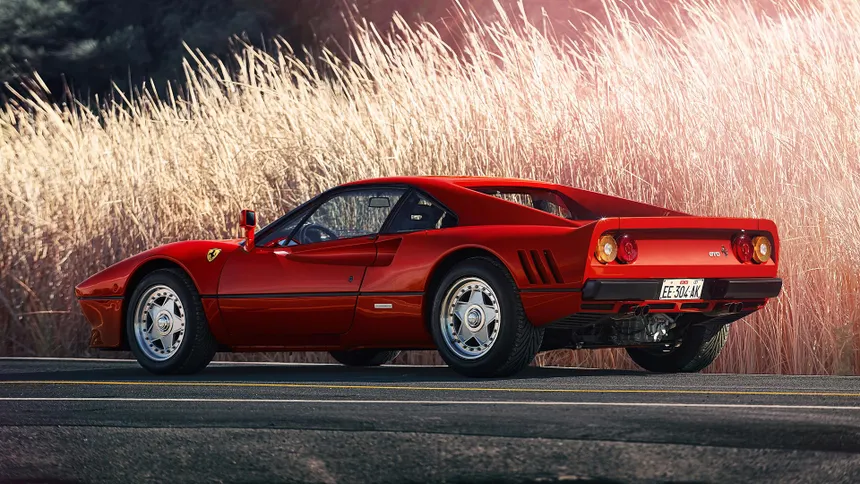
There are faster Ferraris. There are more expensive Ferraris. There are Ferraris with more competition history attached to their names.
But the 288 GTO occupies a unique place in Ferrari mythology for one reason almost nobody articulates well.
It’s the last Ferrari designed purely to win races.
Before the 288 GTO, all the great competition Ferraris were designed thinking first about the track and second about the road: 250 GTO, 250 LM, 330 P4, 512 S, 312 PB. After the 288 GTO, all the great Ferraris were designed thinking first about the customer and second about the track day: F40, F50, Enzo, LaFerrari, SF90, F80. The dividing line passes exactly through the 288 GTO Evoluzione.
It’s the last Ferrari where the opening question was “where do we want to race?”, not “what do buyers want?”.
And fate decided that this last pure competition Ferrari would never actually race. That it would stay in the Maranello warehouse while Audi, Peugeot and Lancia were literally killing each other in 1986 rallies. That it would go down in history as the car they designed for a category that didn’t exist.
Next time you see a photograph of the 288 GTO Evoluzione — the prototype chassis at Maranello, the four in private collections, the fifth off the radar — remember what you’re looking at. It’s not a beautiful Ferrari. It’s a piece of engineering frozen at the exact moment when Maranello stopped building cars to race and started building cars to sell.
That’s why the 288 GTO is the last of its kind. That’s why the F40 that came after was something else, even though it inherited its engine, its chassis, and its philosophy. And that’s why, almost forty years later, the 288 GTO Evoluzione remains the most fascinating Ferrari in Maranello’s historical catalogue. Because it’s the only one untouched by marketing concessions.
They built it to race. It didn’t race.
Sometimes legends are written that way.
Check you’re still alive.
3 thoughts on “FERRARI 288 GTO”