
FRANCO SCAGLIONE — THE GENIUS ITALY CHOSE TO FORGET
There’s a letter Nuccio Bertone wrote on May 19, 1993. It reads: “I remember with great emotion your contribution to our project. I remember your sharpness in the shape of futuristic cars. I also remember our fierce discussions looking for excellence. Your passion and knowledge of aerodynamics took you to such a high level that I couldn’t do anything but follow you.”
Franco Scaglione received that letter in Suvereto, a small village in Tuscany where he’d been living in seclusion for over a decade. He had lung cancer. Letters from admirers — people who for years had believed he was dead — were arriving for the first time. Thirty days after receiving Nuccio’s letter, Scaglione died. He was 76. The man who had invented the visual language of the modern automobile was gone without almost anyone knowing he was still alive.
That’s Franco Scaglione. The most important designer that automotive history has tried to forget.
Florence, war, and five years in India
Francesco Vittorio Scaglione was born in Florence on September 26, 1916. His father, Vittorio, was a chief army doctor. His mother, Giovanna Fabbri, was a captain of the Italian Red Cross service. A family of noble ancestry — counts of Martirano San Nicola and Mottafilocastro. At age six, Franco and his younger brother Eugenio lost their father.
His early studies were humanistic, but he chose to enter aeronautical engineering at university. He spoke four languages. He read compulsively. He played tennis, rode horses, rowed. The profile of a Florentine aristocrat who couldn’t sit still.
When World War II broke out, Scaglione volunteered for assignment to a combat unit — the Genio Guastatori, a demolition sapper unit. He was sent to the Libyan front. In 1941, British forces captured him. He was transferred to the Yol detention camp in India. And there he stayed for five years. Five years as a prisoner of war on the Indian subcontinent, far from Italy, far from cars, far from everything that would become his life.
He didn’t return to Italy until late 1946. The country he found was not the one he’d left. Italy was physically and economically destroyed. And Scaglione was 30 years old, with an incomplete aeronautics education and zero professional experience.
From fashion to metal
Between 1945 and 1950 — the dates are fuzzy and details scarce — Scaglione worked sketching clothes for fashion houses in Bologna, Milan, and Turin. It wasn’t what he wanted to do. What he wanted was to design cars. But fashion taught him something that pure engineers don’t learn: how a line flows over a three-dimensional form. How a fold changes the perception of a volume. How functional grace and beauty can be the same thing.
In 1951, at 35, he wrote to Italy’s specialist coachbuilders offering his services as a designer. Only Pinin Farina and Bertone bothered to reply. He joined Pininfarina but lasted two months — he left after a heated argument with Battista Farina. The underlying issue was clear: Scaglione demanded that every car he designed carry his signature, “FraSca.” Pininfarina didn’t allow designers’ names to be associated with the company’s creations. It was company policy. Scaglione wouldn’t accept it.
Nuccio Bertone, on the other hand, understood him. Years later, he recalled their first meeting: “He had no automotive background but had his heart set on becoming a stylist. He came from a fine old family, spoke four languages, was well read and well-equipped intellectually. I recognised there was good in him and said: I don’t know how realisable your ideas may be, but if you will agree to let me make them so, as I wish, I am willing to try working with you.”
Scaglione negotiated his entry as head of design. A position that for a man with no automotive experience was unheard of. But Nuccio saw what Pininfarina refused to see: a talent that couldn’t fit inside a conventional structure.
The Bertone years: from MGs to BATs
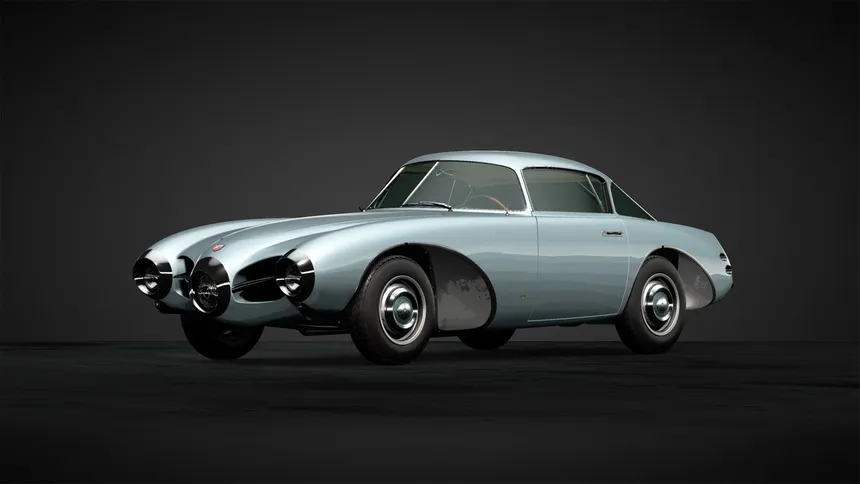
The first job with Bertone was the 1952 Abarth 1500 Biposto, a styling exercise presented at the Turin Motor Show that many consider the direct precursor to the B.A.T. cars. Then came the rebodied MG TDs that saved Bertone from extinction at the 1952 show, the Arnolt-Bristol for the American sports car racing market, and the Ferrari-Abarth 166MM/53 Spyder.
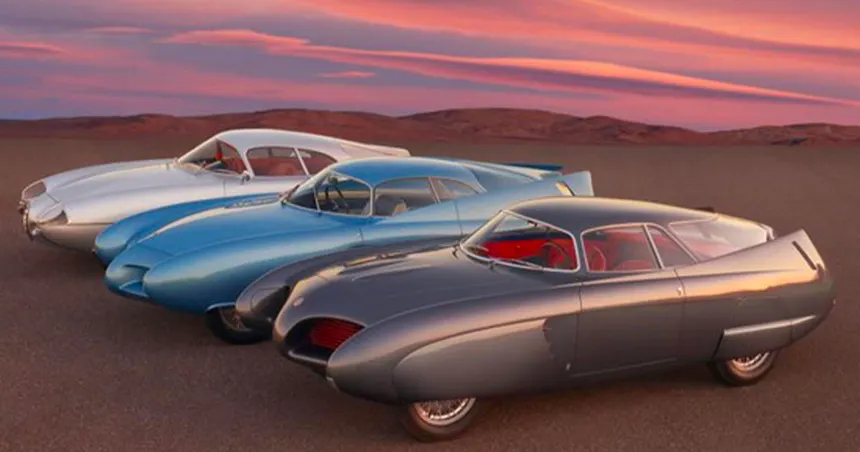
But what changed everything were the B.A.T.s — Berlinetta Aerodinamica Tecnica. Three concept cars on Alfa Romeo 1900 chassis, presented in Turin in 1953, 1954, and 1955. Scaglione designed them by applying his aeronautical knowledge — wing profiles, laminar flow, turbulence minimisation — with an empirical method that today seems impossible: wool threads taped to the bodywork, photographed in motion from a car running alongside. BAT 5 achieved a Cx of 0.23. BAT 7, a Cx of 0.19 — better than a current Porsche Taycan. BAT 9 returned to forms closer to production.
Scaglione worked the models directly at full size, with minimal preliminary sketches, under Nuccio’s supervision and with Ezio Cingolani as development chief. That was his method: few lines on paper, everything resolved in three dimensions. He didn’t think flat — he thought in volume and in how air would travel over that volume.
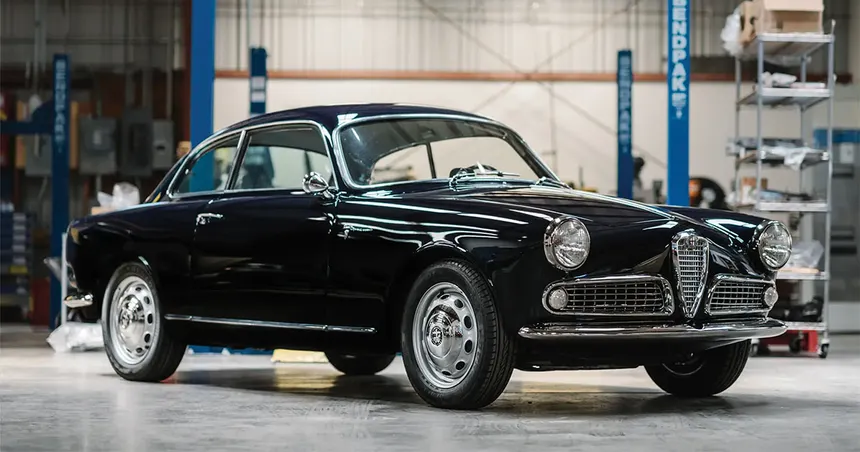
Then came the Giulietta Sprint — the car that turned Bertone into a volume manufacturer, with over 100,000 units produced — and the Giulietta Sprint Speciale, which translated the B.A.T. language into a production car. The relationship with Bertone lasted nine years and gave the carrozzeria its identity as a radical design studio.
The break and life after Bertone
In 1959, Scaglione ended the exclusive relationship with Bertone and started working independently. His first freelance collaboration was with Carlo Abarth and Porsche: the Porsche 356 B Abarth Carrera GTL, a car many consider the direct forerunner of the 911’s visual language. The taut, muscular, contained line of the Abarth GTL is recognisable in every iteration of the 911 that followed — and none of them has matched the elegance of Scaglione’s original.
Then he designed the 1963 Lamborghini 350 GTV. Lamborghini’s first concept car. The DNA from which the first production Lamborghini, the 350 GT, would emerge. The story has a detail that defines the era: the body panels didn’t fit around the engine, so during the Turin Motor Show the engine bay was ballasted with bricks and the bonnet stayed shut throughout. The car had no brake callipers, no pedals, no windscreen wipers. But its design became the foundation for everything Lamborghini would build afterwards.
Scaglione also designed the ATS 2500 GT, the Prince Skyline Sprint 1900 for the Japanese market — presented at the Tokyo Motor Show, with a Japanese engineer, Takeshi Inoue, who spent an entire year in Italy learning Scaglione’s working method — and multiple models for Intermeccanica: the Apollo GT fastback coupé, the Torino, the Italia, and the Indra.
His influence on American design was direct and documented. Harley Earl at GM, Virgil Exner at Chrysler, and George Walker at Ford regularly visited the European auto shows — Turin, Geneva, Paris, London — from the early 1950s onward, absorbing the futuristic lines that Scaglione was introducing. The dramatic fins of the B.A.T. cars found their way into American production design within years. But while the Americans borrowed his language, the Japanese went further — they invited him in. Prince Motors sent Inoue to spend a full year working alongside Scaglione in his workshop, studying not just his designs but his entire approach to a project. A strong personal friendship developed between the two men.
And in 1967, came what many consider the most beautiful car ever built.
The 33 Stradale: the summit and the beginning of the end
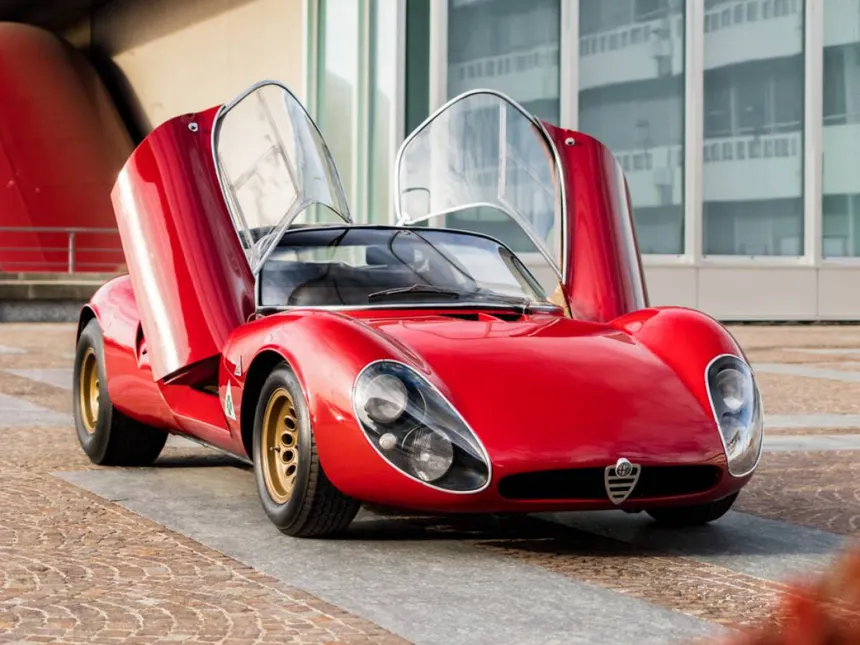
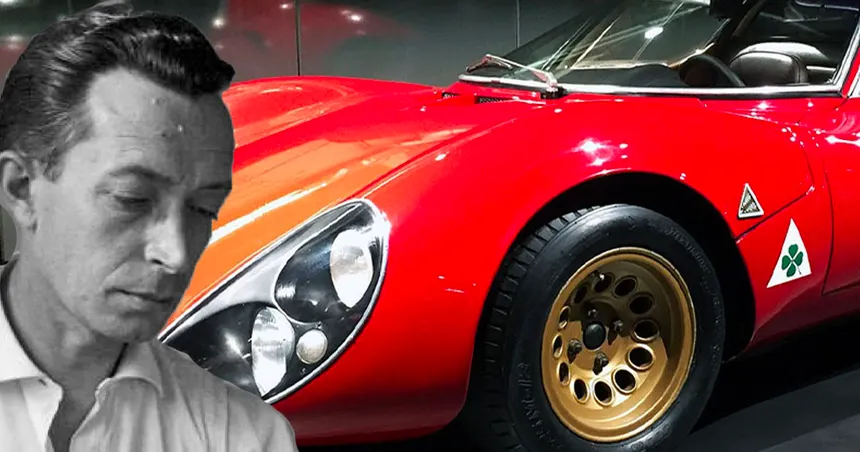
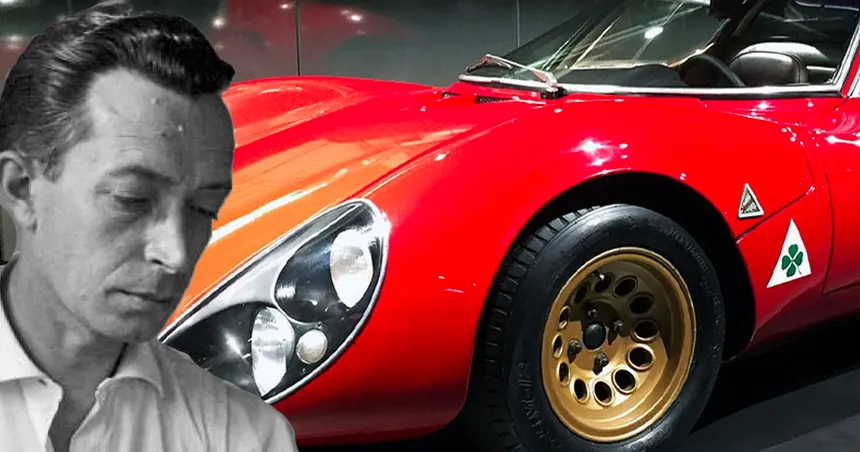
Alfa Romeo Autodelta commissioned Scaglione to create the road version of the Alfa Romeo Tipo 33. The result was the 33 Stradale. A 2-litre mid-mounted V8, butterfly doors, curved windows, an aluminium body that flowed as if metal were liquid. Only 18 were built. It’s a car that when you see it in person leaves you speechless — not because of speed or figures, but because every line seems inevitable. As if it couldn’t have been any other way.
The 33 Stradale proved that Scaglione, eight years after leaving Bertone, had lost none of his creative ability. But it was also one of the last times the world paid attention.
Intermeccanica, financial ruin, and disappearance
The relationship with Intermeccanica and its founder, Hungarian-Canadian Frank Reisner, was the catastrophe that marked the end of Scaglione’s career. Scaglione invested his personal savings in the production of the Indra — 170 million lire in 1972, equivalent to approximately 2.8 million euros today. Intermeccanica went bankrupt. Reisner fled to Canada. Scaglione was left with no money, no work, and without the industry he’d helped define.
He retired from automobile design. His last known design was the Indra, around 1972. In 1981 he moved to Suvereto, a small town in Tuscany. He lived in seclusion. His health deteriorated. Rumours of depression circulated. The car industry — the very one that had been transformed by his designs — forgot him. In 1991, a journalist at Autocar stated in an article that Scaglione had died. Both Nuccio Bertone and Giorgetto Giugiaro confirmed the news when the journalist asked them. Both were wrong. Scaglione was still alive.
In 1993, journalist Maurizio Tabucchi finally tracked him down. Scaglione, already diagnosed with lung cancer, agreed to speak for the first time in decades. The interview appeared in the June 1993 issue of AutoCapital. Letters from admirers who’d believed him dead began to arrive. Nuccio wrote that May 1993 letter. Thirty days later, on June 19, Franco Scaglione died in Suvereto.
What remains
Approximately 60 cars designed throughout his career. The B.A.T.s with their 0.19 Cx. The Giulietta Sprint that saved Bertone. The Porsche Abarth that anticipated the 911. Lamborghini’s first concept. The 33 Stradale. Direct influence on American designers like Harley Earl at GM, Virgil Exner at Chrysler, and George Walker at Ford, who visited European shows to absorb the stylistic language Scaglione was inventing.
And yet, for years the industry believed he was dead. He worked in the shadow of the great coachbuilders because in that era designers lived in the shadow of the names that signed the cars — Bertone, Pininfarina, not Scaglione, not Gandini, not Giugiaro. Scaglione was the first to demand that his name appear alongside the car. Pininfarina rejected him for it. Bertone accepted him. And still, history forgot him.
Franco Scaglione taped wool threads to an Alfa Romeo in 1953 and changed the history of automobile design. Thirty years later, Nuccio Bertone and Giorgetto Giugiaro — the two men who knew him best — thought he was dead. And when the industry finally discovered he was still alive, he had thirty days left.
Some injustices can’t be corrected. They can only be told.
Check you’re still alive.
1 thought on “FRANCO SCAGLIONE”