
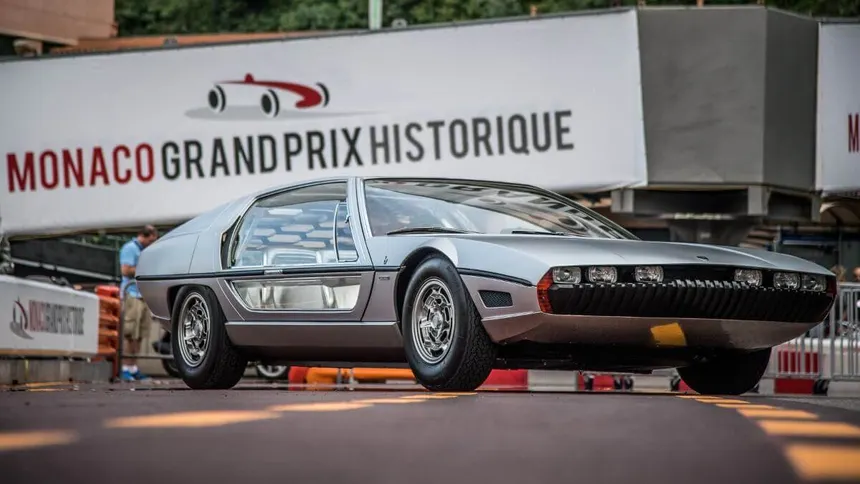
Lamborghini Marzal: One lap of Monaco, then forty years of nothing
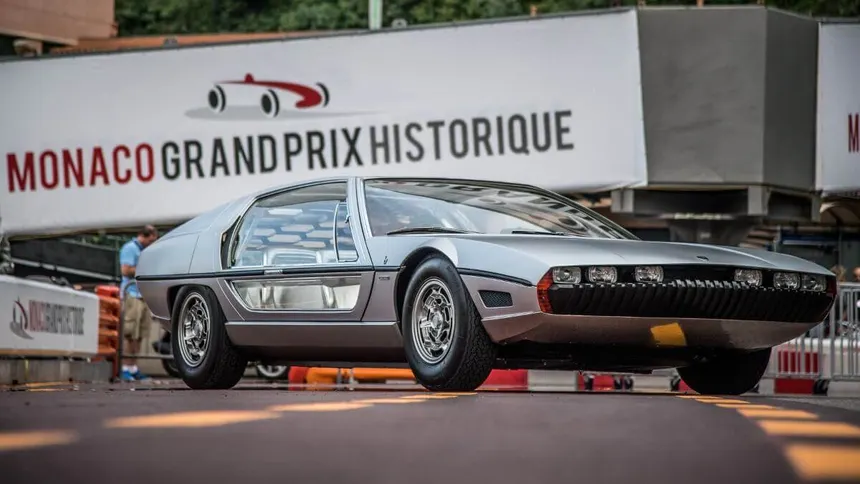
There’s a photograph from May 7th, 1967 that tells you everything you need to know about the Lamborghini Marzal. Grace Kelly is sitting in the passenger seat. Prince Rainier III is driving. The car has glass doors that run from the roofline all the way down to the sill, so you can see Kelly’s legs from outside the car. The interior is covered in silver leather with a hexagonal honeycomb pattern. And they’re about to complete the ceremonial lap before the Monaco Formula 1 Grand Prix while every camera in the principality fires at once.
That image circled the globe within a week. A four-seat Lamborghini made almost entirely of glass, carrying the most photographed woman in the Western world, on the most glamorous stretch of tarmac on earth. In 1967, that was more powerful than any advertising campaign money could buy.
After Monaco, the Marzal vanished. And that’s the story.
Twenty-six and already impossible
Marcello Gandini was 26 years old in 1967, and he’d already designed the Lamborghini Miura. Let that settle for a moment. At an age when most designers are fetching coffee and adjusting someone else’s clay models, Gandini had drawn what many considered the most beautiful car in the world. He’d been chief designer at Bertone for less than two years, having taken over from Giorgetto Giugiaro, and he’d already made his predecessor’s work look cautious.
L’Auto Journal, in its May 25th, 1967 issue, described him as a young Turinese with a rather difficult character, which perhaps prevented him from being already famous. Difficult. With the Miura on his portfolio. The French automotive press had a talent for understatement.
Ferruccio Lamborghini gave Gandini a brief that nobody at Sant’Agata had attempted before: a genuine four-seater. Not a 2+2 with token rear seats that would cripple anyone over five feet tall. A proper four-seater where adults could sit behind adults without requiring chiropractic intervention afterward. Ferruccio was a tractor manufacturer who’d started building cars because he thought Enzo Ferrari was rude to him. He understood market expansion the way agricultural equipment people do: you don’t survive on one product line.
The Miura was a masterpiece, but it only appealed to people who wanted a racing car with number plates. Ferruccio wanted the man who takes his wife to the opera. The man with children. The man who needs a back seat that actually works.
Gandini heard the brief and did what he always did: exactly what he wanted.
Building with light
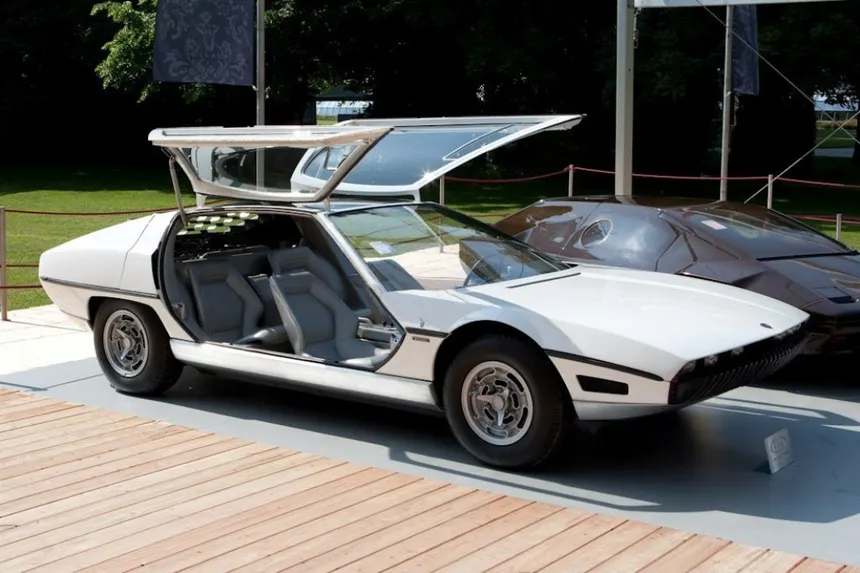
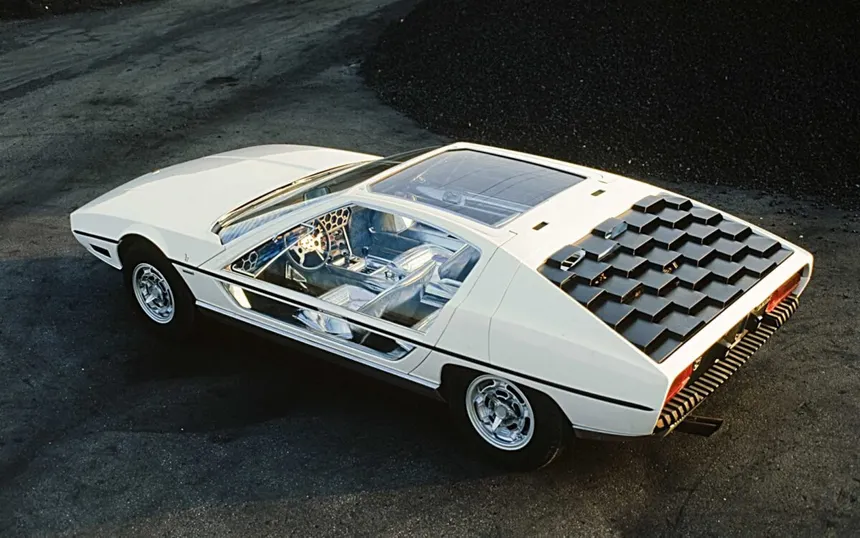
The first thing you notice about the Marzal isn’t its shape. It’s the light. Gandini designed a car where glass isn’t a supplement to the bodywork. Glass is the bodywork.
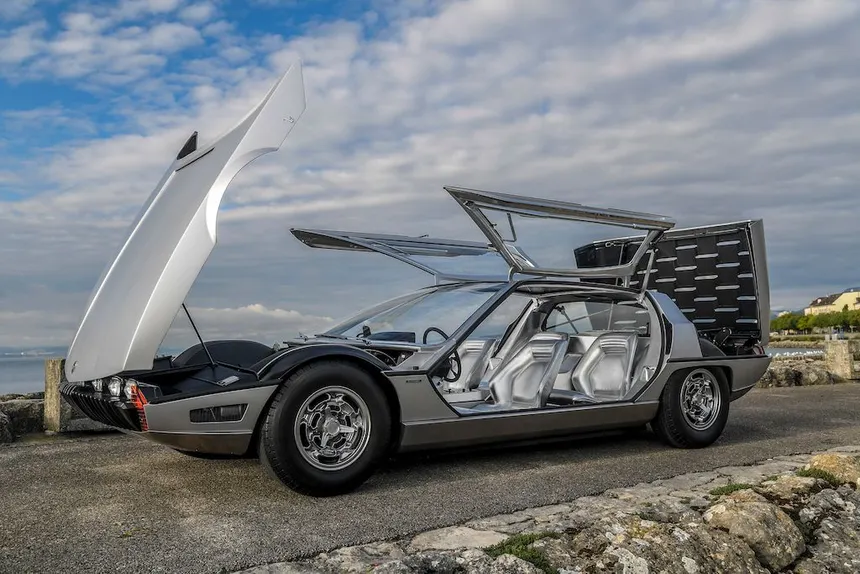
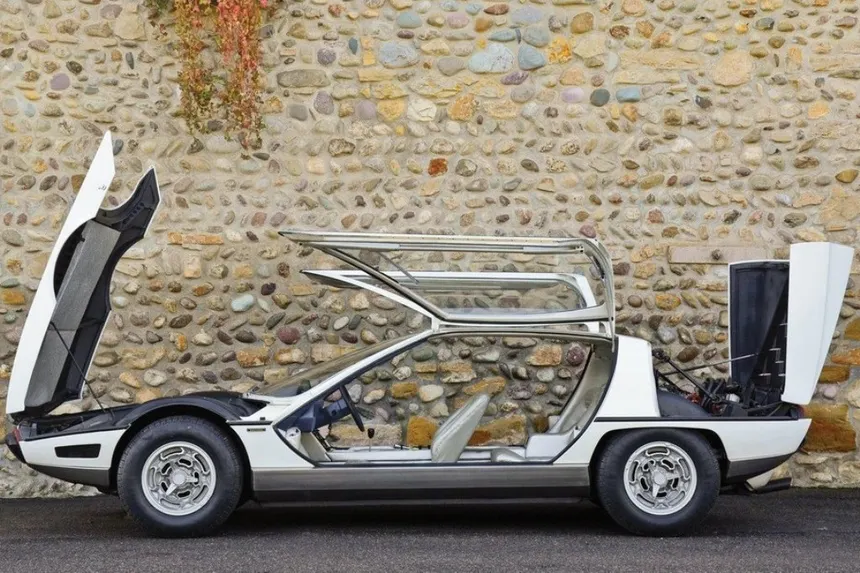
The doors open upward as gullwings, and when I say they’re glass, I don’t mean they have large windows. I mean the entire door panel, from the edge of the roof to the bottom sill where you place your foot to climb in, is transparent glass. You can see the driver’s and passenger’s legs from outside the car as clearly as if you were looking into an aquarium.
Ferruccio saw the doors and delivered a comment that would end careers in any modern corporate communications department: they offer no privacy — a lady’s legs would be on display for everyone to see. Said in 1967, by the company’s owner, in front of journalists. That was Ferruccio being Ferruccio.
The roof is panoramic glass as well. The effect from inside is of sitting in a bubble. And the interior inverts everything Lamborghini had done before: silver leather with a hexagonal honeycomb pattern covering the dashboard, the steering wheel, and the seat cushions. It looks like science fiction. It looks like the cockpit of a spacecraft designed by someone who decided the future is metallic and luminous and that black leather interiors are for people who lack imagination.
Four real seats. Not two seats and two apologies. Four places where four adult humans can sit with knee room. In a 1967 Italian concept car, that was arguably more radical than the glass doors.
Half a heart
Here’s where the Marzal becomes technically fascinating, and where a single engineering decision reveals what Lamborghini thought of itself in 1967.
The engine is a 2.0-litre inline six-cylinder producing 175 horsepower, fed by three horizontal Weber carburettors. Those numbers, in isolation, aren’t going to quicken anyone’s pulse. But context changes everything: that engine is one bank of the Miura’s 4.0-litre V12. Lamborghini took its most celebrated powerplant — the V12 that Giotto Bizzarrini had originally developed and that Dallara and Stanzani had refined for the Miura — and separated a complete bank of six cylinders to create the Marzal’s power unit. Not a V6: an inline six, because that’s what you naturally get when you take one bank from a 60-degree V12. The block retains the integrated transmission and differential architecture of the Miura, mounted transversally but rotated 180 degrees and positioned fully behind the rear axle. It’s an engine born from another engine, and that single detail says more about Lamborghini’s philosophy in 1967 than any horsepower figure.
Think about what that means. In 1967, if you’re Lamborghini and you need to power a four-seater, you have two obvious options. The first is to use the full V12, which is what any marketing department would demand. The second is to design an entirely new engine from scratch, which is the most expensive and the slowest path. Ferruccio chose a third way: take the V12 and derive a completely new motor from the internals of his greatest engine. It’s pure pragmatism disguised as engineering. It’s thinking like a tractor manufacturer who knows that parts get shared between models because that’s how you survive.
The engine sat behind the rear axle, driving the rear wheels through a five-speed manual gearbox. The chassis was an extension of the Miura’s steel box-section platform, adapted for the longer wheelbase that four real seats demand. And here’s what gets overlooked: the Marzal wasn’t merely a styling exercise. It was a car that worked. It drove. It turned. It stopped. It had a real engine, a real transmission, and four wheels that touched tarmac with genuine intent.
Geneva, then the world
The Marzal debuted at the 1967 Geneva Motor Show, and the press reaction was unanimous. Road & Track called it a Bertone design so fresh that everything else looked dated. They were right. The same show floor held cars from Ferrari, Maserati, and every other marque that defined European luxury in 1967. The Marzal made them all look old. Not through speed, not through power, not through anything you could measure with a stopwatch. Through vision.
Gandini was 26 years old and had forced an entire industry to look backwards to understand what they’d just seen. You can’t buy that. You can’t manufacture it. It either appears or it doesn’t, and at Geneva in 1967, it appeared with glass doors and silver leather.
The day Monaco stopped
Two months after Geneva, the Marzal arrived in Monaco. What happened there was one of the most brilliant brand exercises in automotive history, even though nobody probably planned it as such.
May 7th, 1967 was the day of the Monaco Formula 1 Grand Prix. The pre-race ceremonial lap is a circuit tradition: a special car carries a special guest around the track before the single-seaters take to the grid. That year, the car was the Lamborghini Marzal. The guests were Prince Rainier III and Grace Kelly.
Grace Kelly. The actress who left Hollywood to become the princess of a principality the size of a neighbourhood. The woman who in 1967 was arguably the most photographed person in the Western world. Sitting in a glass Lamborghini where you could see her legs from outside. Exactly what Ferruccio had warned about.
The photographs travelled the planet. There was no Instagram, no Twitter, no social media of any kind. There were photographers with 36-exposure rolls and magazines that took weeks to print. And still, the image of the Marzal at Monaco with the royal couple became one of the most iconic automotive photographs of the decade. Not because the car was fast. Not because it had a competition V12. Because it had glass doors, silver leather, and Grace Kelly sitting inside.
For Lamborghini — a five-year-old company building cars in a village in Emilia-Romagna — that photograph was worth more than ten Le Mans victories. It proved you don’t need to win races to be relevant. You need the right person in your car at the right moment.
Forty years in the dark
And then the Marzal disappeared.
After Monaco, the car appeared at a few more shows, a few private presentations, and then Bertone’s museum swallowed it. The Marzal entered Carrozzeria Bertone’s private collection and wasn’t seen in public for decades. No announcements. No explanations. The car simply ceased to exist for the outside world.
Why? Because Ferruccio was never convinced. The glass doors were too extreme, the six-cylinder engine was a compromise no customer would accept at V12 prices, and the design was too radical for a car meant to broaden the brand’s appeal. Ferruccio saw the Marzal for what it was: a statement of intent, not a product. Bertone, who had invested his own money in building it, kept the car as a museum piece in his Turin studio. For 44 years, the Marzal was the crown jewel of a private collection nobody could visit. It only came out when Bertone could no longer afford to keep it.
But although Ferruccio didn’t want the Marzal as it stood, he wanted what it represented. The proof was the Lamborghini Espada.
The Espada arrived in 1968, one year after the Marzal, and it was exactly what the Marzal had promised: a real, production four-seat Lamborghini you could buy with money and drive every day. Gandini designed it too, but the glass doors were gone, the silver leather was gone, the engine was the full 4.0-litre V12 instead of the half-measure. The Espada was the Marzal after reality had run it over. And it worked: over a thousand units were built between 1968 and 1978, making it one of the best-selling Lamborghinis of the Ferruccio era.
The Marzal, meanwhile, slept in Turin.
In 1996, nearly thirty years after Monaco, the Marzal resurfaced at the Concorso Italiano in Monterey, California, as part of a celebration of Carrozzeria Bertone. It was brief. The car appeared, people saw it, photographers fired, and it disappeared again.
In 2011, the Marzal went to auction. RM Sotheby’s, Villa d’Este, May 21st. Bertone’s financial troubles had forced the liquidation of part of its collection, and the Marzal was the most valuable piece in the lot. The hammer fell at 1,512,000 euros. The buyer was Albert Spiess, a Swiss entrepreneur who owns one of the most significant Lamborghini collections in the world — from the 350 GTV bearing chassis number 0001, the very first car to wear the Lamborghini name, to every limited-run model the marque has ever produced. Spiess doesn’t hide the Marzal. He lends it to MUDETEC, Lamborghini’s museum in Sant’Agata Bolognese, where it holds a place of honour. He exhibited it at the 2019 Concorso d’Eleganza Villa d’Este, where it won first in class. And in 2018, it was Spiess who made the car available for its return to Monaco.
Fifty-one years later, the same corner
- Grand Prix Historique de Monaco. The circuit where Grace Kelly and Rainier III drove the Marzal half a century earlier hosted another ceremonial lap. This time, the car was the same 1967 Marzal. But the passengers were different: Prince Albert II, son of Rainier and Grace, and his nephew Andrea Casiraghi.
Albert II drove the Marzal through the same streets his father had covered in 1967. The same corners. The same harbour straight. The same glass Lamborghini with the same transparent doors. Fifty-one years apart, two generations of the Grimaldi family, and the Marzal was still the most photogenic car in Monaco.
There’s something in that image that transcends the automobile. This is a car designed by a 26-year-old they called difficult, built by a tractor manufacturer who wanted to compete with Ferrari, driven by a Hollywood princess on the most glamorous circuit in the world, forgotten for forty years in a Turin museum, sold for a million and a half euros, and returned to the same circuit by the princess’s son. Write that as a screenplay and they’d tell you it’s too much.
The glass that didn’t break
The Marzal never reached production. It was never more than one car, a single prototype that completed its mission and disappeared. But its DNA survived. The Espada was its direct consequence, and through the Espada, Lamborghini proved it could be something beyond a factory for brutal two-seaters. It could be a grand touring marque. It could be elegant, not just violent.
And Gandini. After the Marzal, Gandini designed the Countach, contributed to the Diablo through the P132 project with Chrysler, drew the Citroën BX, the Renault 5 Turbo. But the Marzal was the first time he demonstrated something the Miura had only hinted at: that he could design a car where beauty didn’t depend on speed. Where the attraction came from light, from space, from transparency. A car that didn’t need to be fast to be unforgettable.
Every time you see a concept car with glass doors, a panoramic roof, an interior that looks more like a living room than a cockpit, you’re seeing something that started in Turin in 1967, when a 26-year-old they called difficult decided a Lamborghini could be made of glass and that a lady’s legs didn’t need hiding from anyone.
Check you’re still alive.