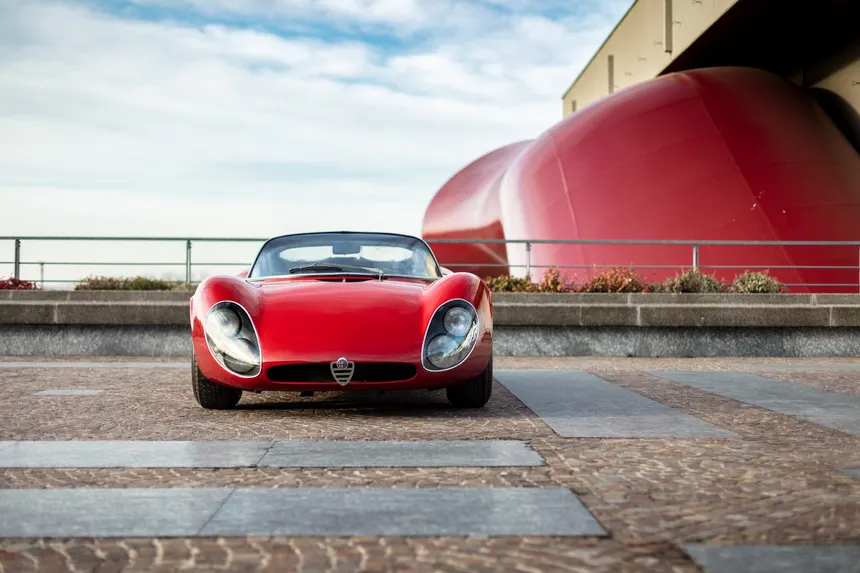
Alfa Romeo 33 Stradale: the most beautiful car ever made?
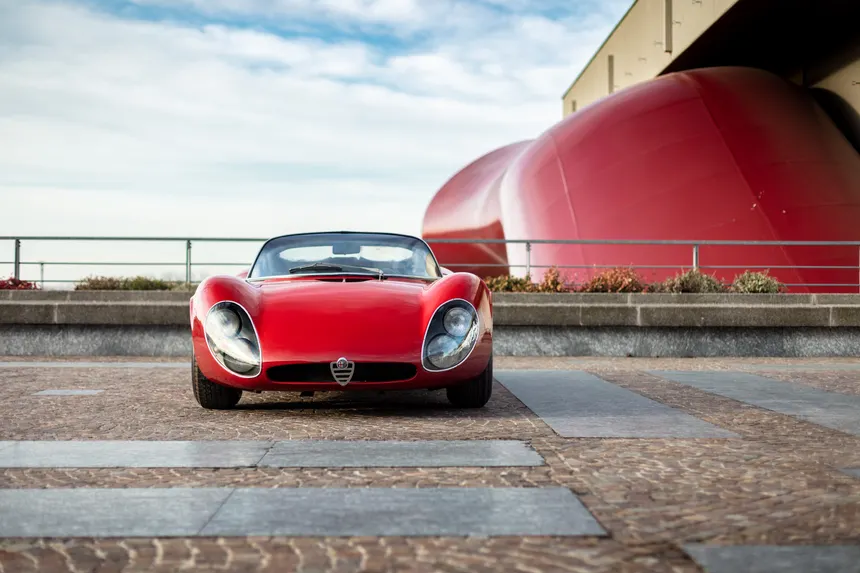
There is a certain kind of claim that gets repeated so often in car magazines that it loses its meaning. “The most beautiful car ever made.” Top Gear has said it. Chris Harris has said it. Pebble Beach jurors say it every time a 33 Stradale crosses the lawn. The Goodwood crowd nods along when one rumbles up the hill. And yet, somehow, the claim survives. Because when you actually look at the car — not at the marketing, not at the auction estimates, just at the car — there is no obvious better candidate.
This isn’t an article about beauty, though. Beauty is the consequence. The 33 Stradale of 1967 is one of those rare machines where nearly every engineering decision was the right one, and the shape that wraps them all just happens to look like the answer to a question nobody else thought to ask. Eighteen chassis exist. Eight became production cars. The rest went on to do something even stranger.
A race car that was made street legal almost by accident
In the mid-1960s, Alfa Romeo had a problem. The brand wanted to be in motorsport at the top level, but its mainstream cars were sedans, coupés and convertibles built for a postwar Italian market. The bridge between those worlds was Autodelta, a semi-independent racing outfit run by Carlo Chiti. Chiti was a Pisan engineer who had walked out of Ferrari with most of the engineering department in the famous 1961 mutiny, founded ATS, watched it collapse, and landed at Alfa Romeo with a chip on his shoulder and something to prove.
His project was the Tipo 33, a prototype sports racer built to fight in the International Manufacturers Championship — the same arena where the Ford GT40 and Porsche 908 were operating. The Tipo 33 was, by results alone, a failure. It never won the championship. It rarely won outright in the period that mattered. But it was, mechanically, a sophisticated piece of work.
Giuseppe Luraghi, Alfa’s chairman, decided that this racing platform deserved a road-going twin. Not for homologation, which the regulations didn’t require. Not for profit, which a run of eighteen cars made impossible. The car existed as a statement. Luraghi’s brief to Chiti was that the road version’s performance could not drop more than 5% from the race car. This is not a brief any modern car company would issue. It is, frankly, insane. The closest modern analogue would be Ferrari building a road-legal 499P, which they very deliberately have not done.
Franco Scaglione, aircraft engineer
The body went to Franco Scaglione, who is the reason this car looks the way it does. Scaglione was Florentine, aristocratic by birth, and trained as an aeronautical engineer before turning to car design after the Second World War. That background is the whole story. An aircraft engineer doesn’t draw decoration. He sculpts surfaces to manage airflow, and if the result is beautiful, that’s a bonus.
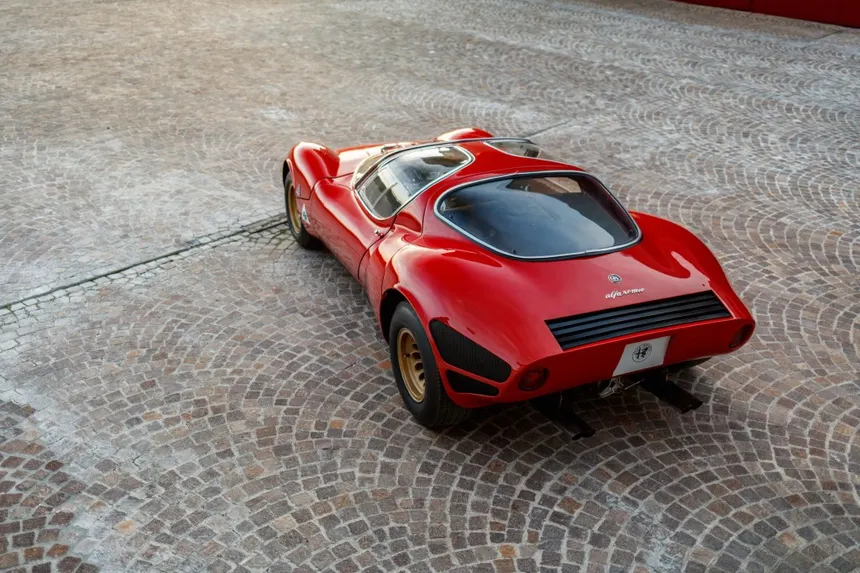
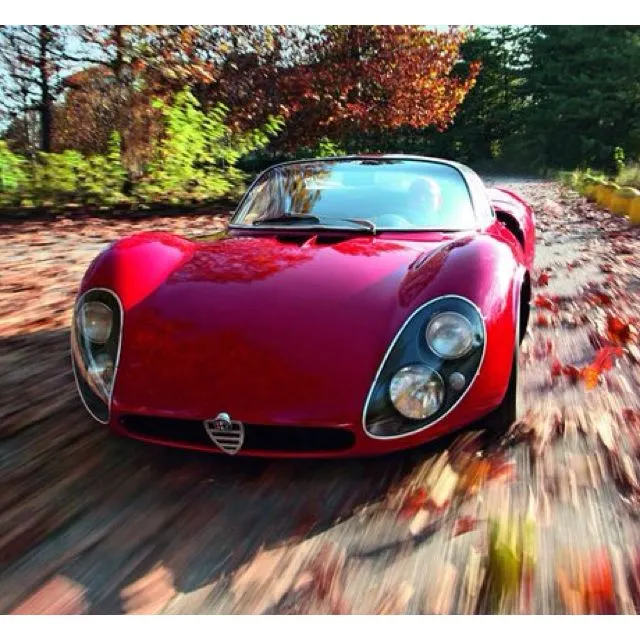
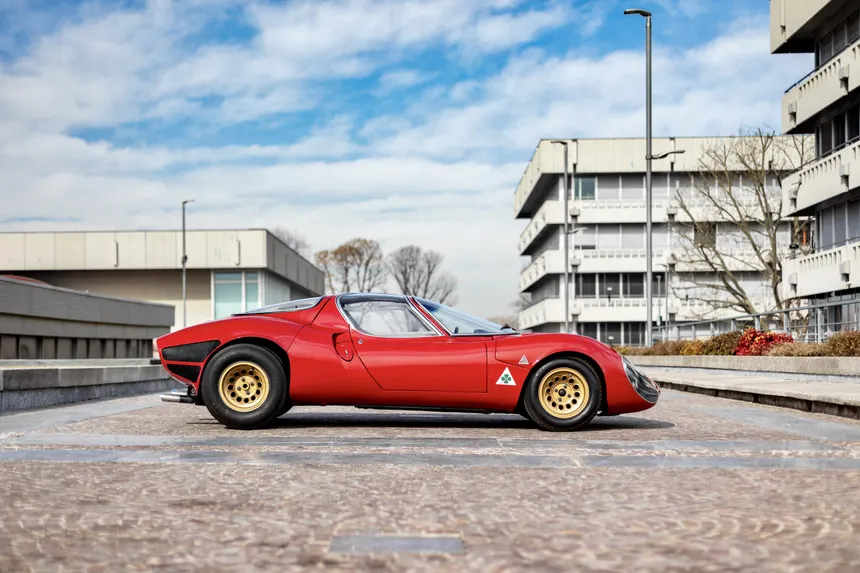
The 33 Stradale is, more than almost any car of its era, an exercise in aerodynamic sculpture. The roof flows into the side glass without a break. The tail is truncated, Kamm-style, because Scaglione knew the rear wake mattered more than length. The intakes are placed where the air actually wants to go in. There is no element on the body that is purely cosmetic. Look at a contemporary Ferrari 365 GTB/4 Daytona, beautiful as it is, and you can see the difference: the Ferrari is sculpted to look fast. The Alfa is sculpted to be fast.
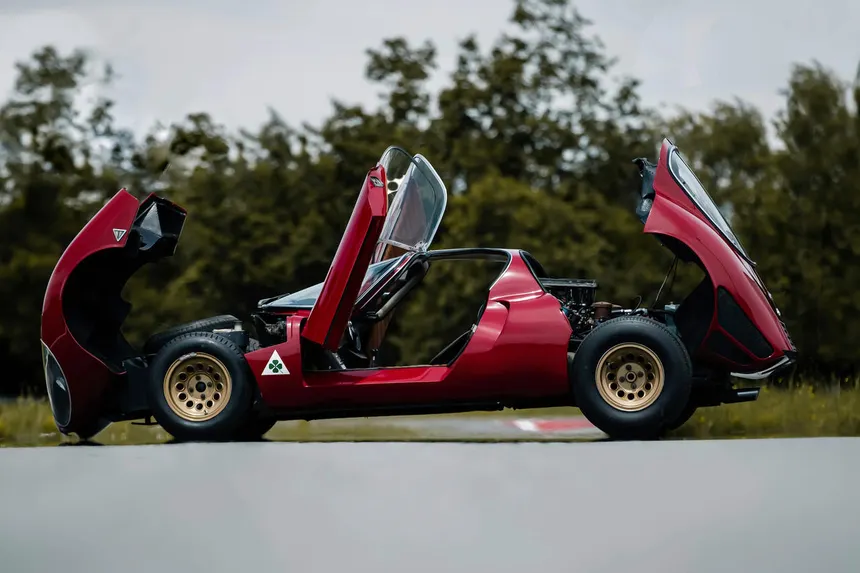
Scaglione also solved the worst problem the car presented him with. The thing was 991 mm tall. Less than a metre. Lower than a GT40. A normal door was a non-starter — there was no way for an adult to get in. His solution was a hinged door that opened forward and upward, pivoted at both the base of the windshield frame and at the top, taking part of the roof with it. The car became one of the first production vehicles to feature this kind of dihedral door geometry, with the side glass curving up into the roof itself. Every supercar door since that’s hinged anywhere except the conventional pillar — the McLaren F1, the Saleen S7, the Ferrari Enzo — owes a debt to what Scaglione drew in 1967.
The V8 that revved to ten thousand
Chiti’s engine is the second half of the story. A two-litre, all-aluminium V8, mid-mounted, derived directly from the Tipo 33 race unit but with several concessions to the realities of street use. The bore and stroke were 78 mm by 52.2 mm. That’s massively oversquare, which is what you need if you want an engine that lives at high RPM without destroying itself from piston speed. The redline was 10,000 rpm. In 1967. In a car you could legally drive on the road. There are modern naturally aspirated production engines that don’t approach that figure.
The lubrication system was dry-sump, the kind you find in race cars, because under sustained cornering loads a wet-sump motor would starve the bearings. The crankshaft was flat-plane, like Ferrari V8s a generation later, which is the configuration that gives the engine its scream and its even gas flow but costs you smoothness at low revs. Fuel was metered by mechanical SPICA injection — no electronics, just precision pistons feeding the inlet tracts. Ignition was twin-spark per cylinder, with four coils firing eight plugs, the better to burn the charge completely at high revs.
The one concession Chiti made for road use was the camshaft drive. The Tipo 33 race engine used gear-driven cams, which are mechanically more precise but loud. The Stradale switched to chain drive — quieter, slightly less accurate at the highest revs, but acceptable for a car that needed to be civilised enough to drive on Italian roads. That’s the level of granularity we’re discussing here. Engineers were arguing about cam drive noise.
Quoted output was 227 bhp, but each car was hand-built and the figures varied. The factory data sheet for the first production Stradale (chassis 750.33.101) reported 243 PS at 9,400 rpm with the street exhaust and 254 PS with the open one. Each car different. The transmission was a six-speed Colotti transaxle.
Auto Motor und Sport tested one in 1968 and measured 252 km/h — 156.6 mph — and 24 seconds for the standing kilometre, which made it the fastest commercially available car for that distance at the time. Faster than a 275 GTB. Faster than a Miura. From two litres.
Seven hundred kilograms
The chassis was a tubular aluminium structure with hand-beaten aluminium bodywork. Total weight: 700 kg. Less than a current Mazda MX-5. Less than a Caterham 620R. With a mid-mounted V8, six-speed transaxle, four-wheel disc brakes, and 13-inch magnesium Campagnolo wheels, the Stradale put 227 to 254 bhp into a package light enough that the power-to-weight ratio comfortably outguns most modern hot hatches.
The rear brakes were mounted inboard, against the differential rather than at the wheels. That’s a race car decision. By moving the discs inward you reduce unsprung mass, which gives the suspension a much better time over uneven surfaces. The cost is access — any rear brake service means dropping more than just a calliper — but for a hand-built race-derived road car that was always going to live with attentive owners, it was the right call. The fact that Alfa specified it on a customer car tells you everything about the priorities.
Marazzi: eighteen cars, eighteen interpretations
Production was contracted out to Carrozzeria Marazzi in Caronno Pertusella, near Milan. Between November 1967 and March 1969, 18 chassis were built. Marazzi himself claimed to have built 18 chassis: five were used as the basis for six concept cars (one chassis was used twice), and eight became production cars. The remaining numbers don’t quite reconcile because, when a car is made this way, the paperwork doesn’t always agree.
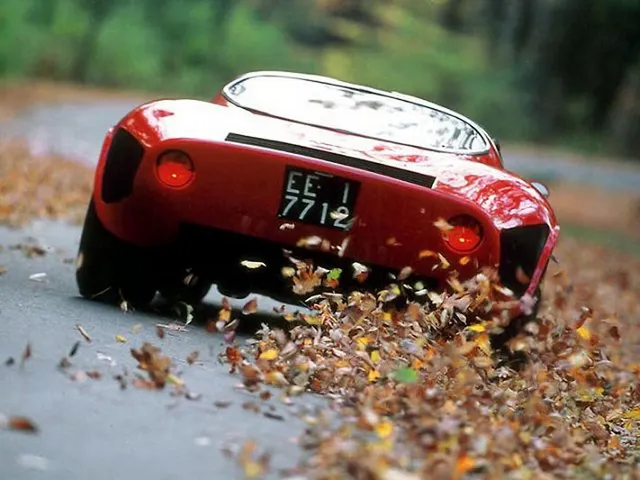
Here’s the part that would terrify any modern OEM quality control engineer: every car is slightly different from the next. Because the bodies were hand-formed by Marazzi’s craftsmen, decisions were made along the way to improve the design or the production process. Some cars have one windscreen wiper, some have two. Some have additional vents behind the wheels to evacuate brake heat — added on later cars after early units showed thermal issues. The first two prototypes had a double headlight arrangement that didn’t meet European minimum height regulations, so Scaglione had to redesign the front with a single light per side for the production run.
In modern terms, this is a production nightmare. In 1967 Italy, this is craftsmanship. Each car was a slightly better version of the one that came before, because the people building it were learning as they went.
Five chassis became something else
What lifts the 33 Stradale from “great car” to “cultural artefact” is what happened to the remaining chassis. Five of them were handed to the three biggest names in Italian coachbuilding — Bertone, Pininfarina, and Italdesign — to do whatever they wanted with. The results changed the visual vocabulary of the supercar for a generation.
Italdesign’s Iguana, designed by Giorgetto Giugiaro, is one of the early statements that would lead to the Lotus Esprit and the wedge-era Italdesign work. Pininfarina got the P33 Roadster (1968), the 33.2 Coupé Speciale (1969), and the Cuneo (1971), the last two prefiguring much of what Ferrari would later do. Bertone produced the Carabo (1968), a Marcello Gandini wedge with scissor doors that you can trace, in a straight line, to the Lamborghini Countach. And later the Navajo (1976), another Bertone interpretation. Each one deserves its own piece, and will get one. For now, what matters is that the Stradale’s chassis was the canvas on which Italian design did its most radical thinking during the years it most mattered.
What it left behind
The Montreal V8, which powered Alfa’s grand tourer of the 1970s, is a direct descendant of the Stradale engine. Closely related, with larger displacement and a different crankshaft layout (cross-plane in the Montreal, flat-plane in the Stradale), it carried the bloodline of the Tipo 33 race programme into thousands of road cars over the next decade. That’s how racing technology used to filter down to production — not as marketing speak about “circuit-derived” pistons, but as actual engineering lineage from one engine to the next.
The doors became the supercar door. The mid-engined, light, race-derived road car became the template for everything from the McLaren F1 to the Pagani Zonda. The idea that a manufacturer might build a car simply to prove they could, with no homologation requirement, no business case, no return on investment — that idea barely survives today, and when it shows up (the McLaren F1 again, the Bugatti Veyron) it’s usually with a budget that dwarfs Marazzi’s entire output.
Why no one will build this again
The new 33 Stradale, unveiled in 2023 and delivered to its first customer in December 2024, is a legitimate piece of engineering — a 620 bhp twin-turbo V6 supercar built on a Maserati MC20 monocoque, with rear-wheel steering and active suspension and a top speed north of 200 mph. Thirty-three units, all sold before the car physically existed, hand-customised at the Bottega in Arese. It’s a good car. By every measurable metric, it’s a better car than the 1967 original.
But it isn’t this car. This car came from a different planet. A planet where a company president told an engineer to build a road car that performed within 5% of a race car. Where a designer who used to draw aeroplanes shaped the body. Where a coachbuilder in a Milanese suburb hand-formed eighteen unique cars over fifteen months and called it a production run. Where a two-litre V8 revved to ten thousand and powered a 700-kilogram road car that was, briefly, the fastest production car over a standing kilometre on Earth.
The 33 Stradale isn’t beautiful by accident. It’s beautiful because nobody told anyone involved to be sensible. Look at it long enough and you can see every decision sitting on the surface, all of them right, none of them compromised. Then check you’re still alive.