
Campogalliano: the Bugatti factory that’s been locked up with everything inside for thirty years
Type “abandoned Bugatti factory” into YouTube and you’ll get hundreds of results. Drone shots over a vast blue complex outside Modena. Urbex channels with creaky soundtracks pushing through cobwebbed corridors. Hagerty journalists being walked around by a softly spoken Italian called Enrico Pavesi. Aerial photographs that look more like a contemporary art museum than a car plant.
That’s because it was never quite a car plant. It was a temple disguised as a car plant. And the reason it has survived thirty years of weather, vandalism and indifference without being flattened for warehouses is the same reason most people who see the footage walk away from it slightly haunted.
This isn’t the wreckage of a failed project. This is the wreckage of a project that was too well built to be torn down. The story of Campogalliano is the story of what happens when industrial ambition collides with the wrong decade.
The Blue Factory, dropped into the heart of the Motor Valley
Geography first, because British and American readers tend to underestimate how dense this corner of Italy is. Campogalliano is a small town of nine thousand people, twelve kilometres northwest of Modena, sitting alongside the A22 motorway that runs from Modena to the Brenner Pass. You are in the middle of what Italians call the Motor Valley. From Maranello, where Ferraris are built, you can be in Campogalliano in under half an hour. Sant’Agata Bolognese, home of Lamborghini, is a similar distance south. Pagani, Dallara, dozens of specialist suppliers, all of them within a fifty-kilometre radius. When Romano Artioli decided to revive Bugatti in the late 1980s, this was the only sensible place to put it. Anywhere else, you’d have spent a decade building the supply chain. Here, the supply chain came to you.
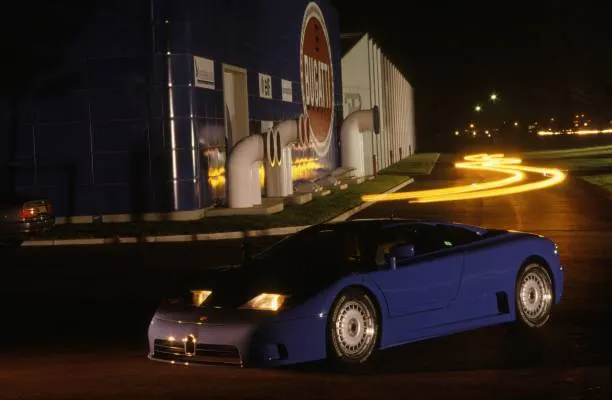
Construction began in 1988. And from the very first decisions, it was clear Artioli wasn’t planning a factory. He was planning a temple. He bought around 75,000 square metres of land, of which roughly 13,000 became built surface. Worth flagging this figure carefully, because for decades almost every outlet, including Bugatti’s own official Newsroom, has been repeating a figure of 240,000 square metres that is not correct. The actual figure, cross-checked with the Pavesi family who have looked after the plant since 1990 and with the Associazione Bugatti Automobili Campogalliano APS, is those 75,000 square metres. Still enormous, roughly ten full-size football pitches stitched together, on land right next to the motorway in an area where dirt isn’t cheap. But it’s worth telling correctly. He hired Giampaolo Benedini, the architect who would also have a hand in shaping the production version of the EB110 itself, and gave him one instruction. Make it not look like a factory.
Benedini delivered.
What he actually built
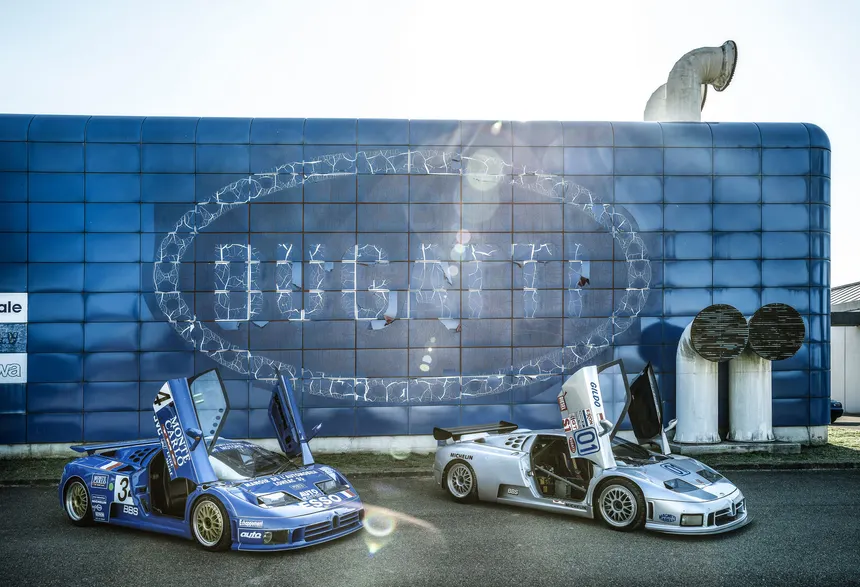
The main blocks are cobalt blue, Bugatti blue, sliced by white ventilation pipes that read more like sculpture than plumbing. From any decent aerial photograph the complex looks like contemporary architecture commissioned by a Swiss museum. Top-lit atriums bathe the interiors in natural light. Carrara marble floors run through the customer-facing areas, yes, Carrara marble, in a car factory. A circular showroom presents the EB110s like exhibits in a Tate Modern installation. The administration block is separate from the production halls. There’s a dedicated design studio. There’s an R&D centre. There’s a staff canteen with proper views. There’s a private test track inside the perimeter fence.
Worth pausing on this from the workshop bench point of view, because most British and American supercar fans think of factory environment as a footnote. It isn’t. The quality of what comes off the line is shaped by the quality of the space the line is in. If your technicians spend eight hours a day in a cold shed under flickering fluorescents, with concrete floors stained with old oil, the cars that roll out are going to carry that mood whether you can measure it or not. Bugatti at Campogalliano went the other way. They pushed to the extreme what Ettore Bugatti had practised at Molsheim almost a century earlier: treat the production space as part of the product.
That costs money. Real money. Some sources put the build cost at around a hundred million dollars at 1990 prices, which for a private car factory was extraordinary. By way of comparison, Ferrari at Maranello in the same period was still using a lot of buildings that traced back to the 1950s. Lamborghini at Sant’Agata, the same. Artioli built a state-of-the-art plant from scratch to produce roughly 150 cars a year. He did the maths with his heart, not his calculator. And in this business, when you do that, the bill always comes due.
What got built inside before the lights went off
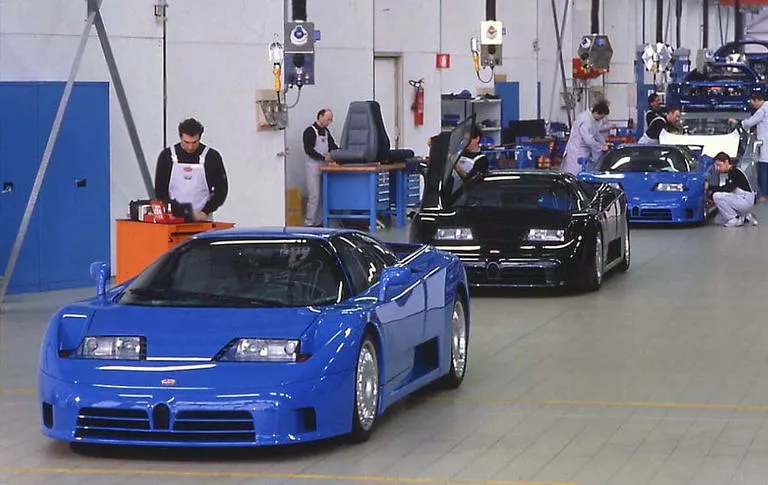
Between 1991 and September 1995, Campogalliano produced 96 EB110 GTs and 32 EB110 Super Sports, plus two factory race cars tuned up to 670 horsepower. Total: 128 cars. If you add the cars finished afterwards by Jochen Dauer in Nuremberg from the bankruptcy stock, and the few cars completed in the 2000s by B Engineering, the lifetime EB110 figure climbs to around 139. But the 128 produced in Campogalliano itself, while the factory was alive, are the ones that matter for this story. Those are the ones built by the people Artioli hired, in the rooms Benedini drew, with the marble floors and the natural light and all the rest of it.
One hundred and twenty-eight cars in four years. Thirty-two cars a year. Roughly one every eleven days. Each one with a full carbon fibre monocoque made by Aérospatiale, a hand-assembled quad-turbo V12 with sixty valves, three-differential AWD, six-speed manual. That isn’t Toyota production. That isn’t even McLaren F1 production. That’s a Stradivari workshop putting out violins, except instead of fiddles it’s putting out hypercars, in a marble-floored building in northern Italy. The fact that it lasted four years is, in industrial terms, a small miracle.
The day the doors closed
The closure didn’t happen in a single moment. The legal process dragged on for two years, from the bankruptcy filing in September 1995 to the administrators’ auction in September 1997. But the symbolic point is September 1995. Bugatti Automobili SpA files. The administrators take possession. The employees, many of them ex-Lamborghini, ex-Ferrari, ex-Maserati technicians who had moved their families across Italy to follow Artioli’s vision, walk out with their personal tools and never come back.
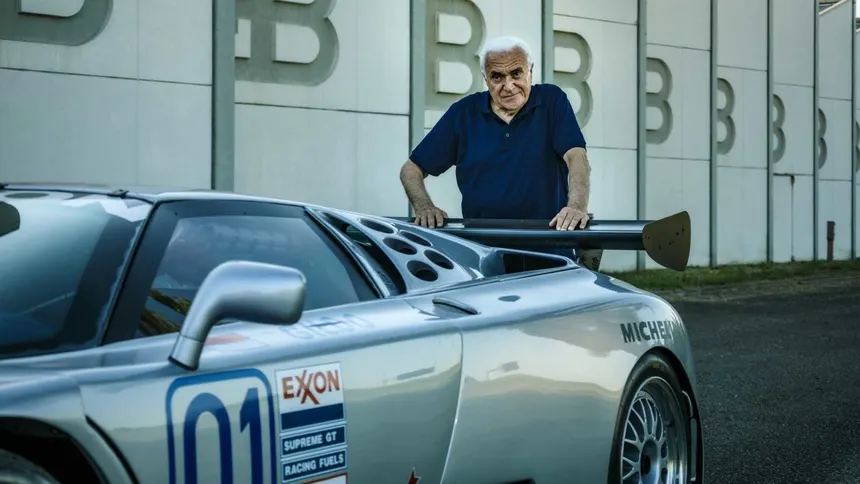
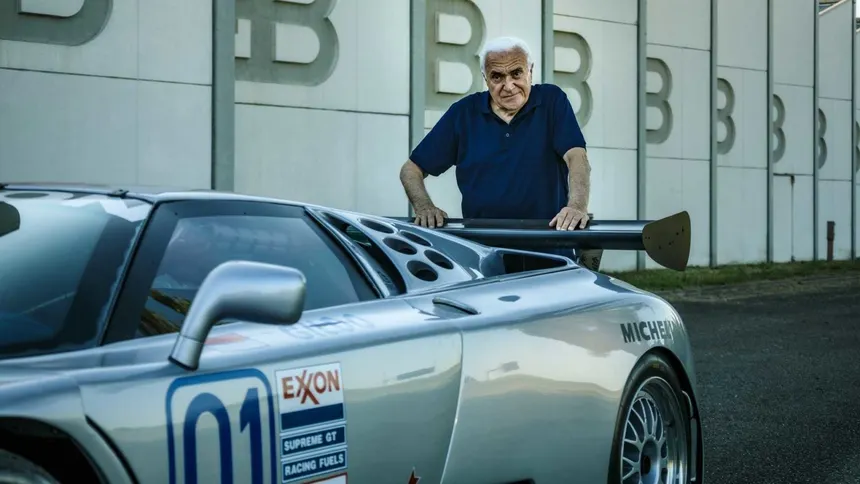
In the gap between closing and auction, someone had to watch the place. A quarter of a million square metres of empty factory with valuable mechanical parts still inside, half-finished prototypes on the lines, technical archives in the offices. That job fell to Ezio Pavesi, originally hired in 1990 as the site groundskeeper. The Pavesi family have been guarding Campogalliano ever since. Ezio is retired now. His son Enrico continues the role. If you’ve watched any serious documentary or read any Hagerty piece about Campogalliano in the last decade, the man walking the camera through the spaces is almost certainly one of the Pavesis.
A single family quietly guarding a vast abandoned factory for three decades, because nobody buys it and nobody dares demolish it. That alone is a story.
What was carried out, what stayed
At the 1997 administrators’ auction, Jochen Dauer, the German racing specialist from Nuremberg, bought most of what could be moved. Unfinished Aérospatiale carbon fibre tubs, mechanical components, several half-built cars. He took them home and between 1999 and 2000 finished three SS and one GT under the Dauer badge. B Engineering, the firm formed by ex-Bugatti engineers who refused to walk away from the project, set up shop inside Campogalliano itself and is still there, acting as the world’s reference workshop for the few EB110s still on the road. If you own an EB110 anywhere in the world and it breaks badly, the road to fixing it properly eventually leads back to the same town where the car was built.
Beyond the obvious assets, there was a strange domestic dispersal. The technicians who left took some of their tools. Local firms bought the canteen tables and are reportedly still using them as office desks in businesses around Modena, according to Enrico Pavesi’s account to Hagerty. Goldoni, the Italian tractor manufacturer, bought several complete assembly lines and kept them running in their own plant until 2017. Which means Bugatti machinery was making farm tractors in northern Italy as recently as a few years ago.
And then there’s the anecdote that wins the prize. At some point in the years after closure, somebody walked into what had been Romano Artioli’s office and took the bronze bust of Ettore Bugatti that sat on his desk. It has never resurfaced. Nobody has tried to sell it. Nobody has shown it off. Presumably it sits on a shelf in someone’s living room, Ettore’s bronze head staring out across an Italian dining table, having had quite a journey. There are novels with thinner plots.
What you see if you get inside today
The video evidence, shot by urbex YouTubers and journalists with permission alike, all tells roughly the same story from different angles. Nature is moving in slowly. The lower-level floors flood when it rains hard, and there are walls now bearing moss. There’s graffiti in places, but not nearly as much as you’d expect for an unguarded building this large in Italy, because the Pavesi family have done a remarkable job keeping intruders at bay. Machines stand rusting where they were last left. Shelves part-emptied. Barrels of Bugatti-blue paint still leaning against walls, unopened, waiting for hands that aren’t coming back.
And here is where the workshop bench point of view gets blunt. That image isn’t laziness. It’s reverence. If Campogalliano had been a failed project of the incompetent kind, it would have been bulldozed twenty years ago. Excavators would have moved in, logistics warehouses would have gone up, and the plot would be worth a fortune today because it’s bang next to a motorway in northern Italy. None of that has happened. And the reason it hasn’t is very specific. No owner, no administrator, no Italian local authority has been willing to sign the order to destroy it. Demolishing Campogalliano is like demolishing a cathedral because the diocese ran out of priests. You technically can. But nobody wants to be the one who does.
Modern Bugatti, now part of the Rimac Group, has been asked more than once whether they would acquire Campogalliano. The answer, recorded by Hagerty several years ago, was clean: “Our home is in Molsheim. Buying Campogalliano isn’t even a consideration.” And you understand the logic. Modern Bugatti tells its story through the French line, through Ettore, through Molsheim. The Italian decade under Artioli is, in their official genealogy, almost an embarrassment to be politely skipped.
What Campogalliano really proves
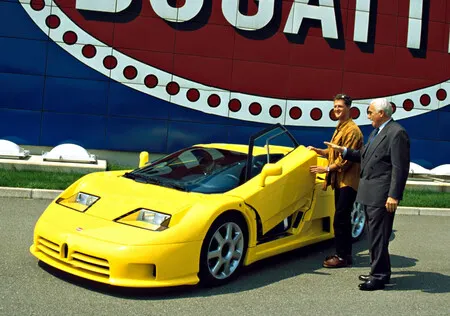
Here’s the centre of the whole thing. The abandoned factory you see today in Campogalliano is not proof that the EB110 was a failed car. It is exactly the opposite proof. It is the strongest physical evidence that the industrial project behind the EB110 was vastly more serious than almost anything else being sold under a supercar badge in that era.
When you look at the Carrara marble floors, you understand that Artioli wasn’t playing at building cars. When you see the integrated test track, you understand they wanted to do things properly. When you see the circular showroom, you understand they had thought even about how the product would be presented. When you see the unfinished Aérospatiale carbon tubs stacked in a corner, you understand this was not a garage-budget operation.
What sank the project wasn’t the factory. It was Artioli’s overstretch: the Lotus acquisition in 1993, the parallel EB112 saloon project that swallowed development money he didn’t have, the Suzuki business collapsing because of currency moves, the supplier pressure from Ferrari that no one likes to write about in press releases. The place where the cars were built was outstanding. In fact, it was more than outstanding. It was ahead of everything around it.
And that, looked at from the bench, is what makes Campogalliano’s current ruin hurt more, not less. The ruins of incompetent projects don’t hurt. They get bulldozed, forgotten, covered by a retail park, and nobody remembers. The ruins that hurt are the ruins of projects that were done properly and that collapsed for reasons beyond the workshop itself.
Campogalliano is one of those. That’s why it has been shut for thirty years and why nobody has dared touch it. That’s why a single family has spent three decades caring for an empty building. That’s why every few years someone walks in with a camera, films what’s there, posts it, and thousands of people who never knew the story end up staring at those blue walls with something tight in their throat.
They’re not looking at a ruin. They’re looking at a temple. And you don’t tear down temples, even when there’s nobody left to pray in them.
Check you’re still alive.