Bosch, MAHLE and AVL: Europe hasn’t quit combustion
Across five articles, NEC has been telling you how the combustion engine game is being played in 2026. If you’ve reached this one, you probably hold a simple idea in your head: Europe has surrendered. The Chinese push ahead, the Japanese hold the line, the Saudis manoeuvre — but Europe shuts plants, lays off engineers and signs regulation that kills the combustion engine in 2035.
That idea is false. Or at least incomplete. Let me explain why.
While you were reading all that coverage, in Stuttgart, in Graz and in Northampton, three European companies have been pouring billions of euros into keeping the combustion engine alive. Not out of nostalgia. Not out of pride. Pure industrial strategy, calculated down to the last decimal on the balance sheet. The three are called Bosch, MAHLE and AVL. You’ve probably heard some of those names. You probably don’t know that all three are doing more or less the same thing quietly. And you almost certainly don’t know that the combustion engine they’re building isn’t for the car you’re going to buy — it’s for a parallel market where European regulation has deliberately left the door open.
Let’s tell the story properly.
Bosch: €2.6 billion, hydrogen and a double bet
We start with the biggest of the three, because that’s where the headline numbers sit. Bosch generated €90.5 billion in revenue in 2024. It employs 417,900 people worldwide. Its Mobility division alone delivered €55.9 billion of that revenue. We’re talking about the largest automotive technology supplier on the planet. Not a side player.
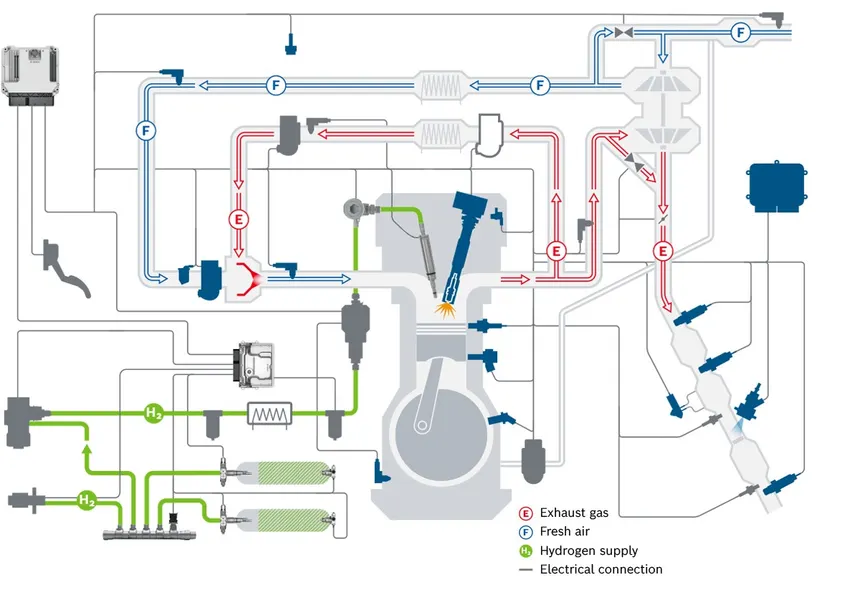
What almost nobody has reported clearly: Bosch is investing $2.6 billion in hydrogen technology between 2021 and 2026. This isn’t a pilot project. It’s a structural corporate bet. And inside that bet run two parallel lines worth separating.
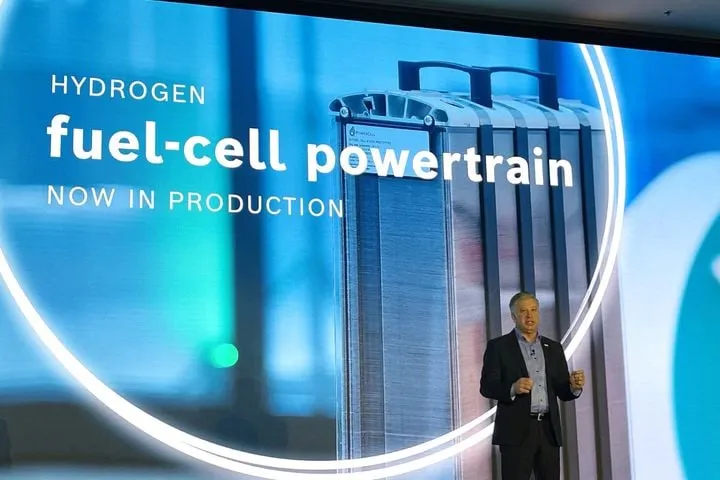
On one side, Bosch has been mass-producing fuel cell power modules for heavy trucks since July 2023. In January 2024 it announced it would also develop the hydrogen combustion engine — what the industry calls H2-ICE. A year later, at CES 2025, Bosch North America president Paul Thomas confirmed it on the record: “We’re still heavily involved in hydrogen.” Bosch is building two things at once. Fuel cells for some markets. Hydrogen combustion engines for others. Whichever the customer asks for.
Here comes the sharpest line of all, in the words of a Bosch executive quoted in Mobility Engineering Technology: H2-ICE reuses more than 90% of the existing diesel or gas engine infrastructure. That sentence, in industry language, means one thing: converting today’s diesel engine to hydrogen is dramatically cheaper than replacing it with a fuel cell stack or a battery. No assembly line overhaul. No re-skilling of engineers. No vehicle redesign. Just a different injection system, different valves, a partial rewrite of the engine management software, and not much else.
Bosch plans to launch in 2026 a new direct hydrogen injector that requires no additional lubrication. That’s high-end engineering. Hydrogen injectors fail because hydrogen doesn’t lubricate the way petrol or natural gas does, and mechanical components have to survive billions of cycles without that lubrication. Bosch has solved it, and it’s going to mass-produce it.
There’s a second side to this coin that has to be told, because it’s news that’s less comfortable. In February 2025, Bosch terminated its SOFC (solid oxide fuel cell) activities and cancelled a $200 million fuel cell plant in South Carolina. Does that mean Bosch is leaving hydrogen? No. It means it’s pivoting inside hydrogen. It has decided that the money for the next five years goes into PEM electrolysers and H2-ICE, not into SOFC or stationary fuel cells. Pure industrial pragmatism: put your capital where the market is going to pull first.
MAHLE: the line that demolishes the European narrative
We jump to MAHLE. €11.7 billion in revenue in 2024. 67,708 employees. 217 sites worldwide. Headquartered in Stuttgart. Founded in 1920. Long-time supplier of pistons, thermal management systems and engine components to practically the entire European industry.
In its 2024 annual report, MAHLE dropped a sentence worth framing. Signed by CEO Arnd Franz. Here it is verbatim: “for commercial vehicles in particular, the internal combustion engine will continue to dominate worldwide after 2035, with a share of approximately 60%.”
Read it twice. That’s the CEO of one of Europe’s largest engine technology suppliers stating, in his own annual report, that combustion will dominate commercial vehicles after 2035. And the sentence isn’t an opinion. It’s a commercial projection grounded in MAHLE’s actual order book. When a Tier 1 announces investment plans for the next decade, it isn’t guessing. It’s doing it because the contracts are already signed.
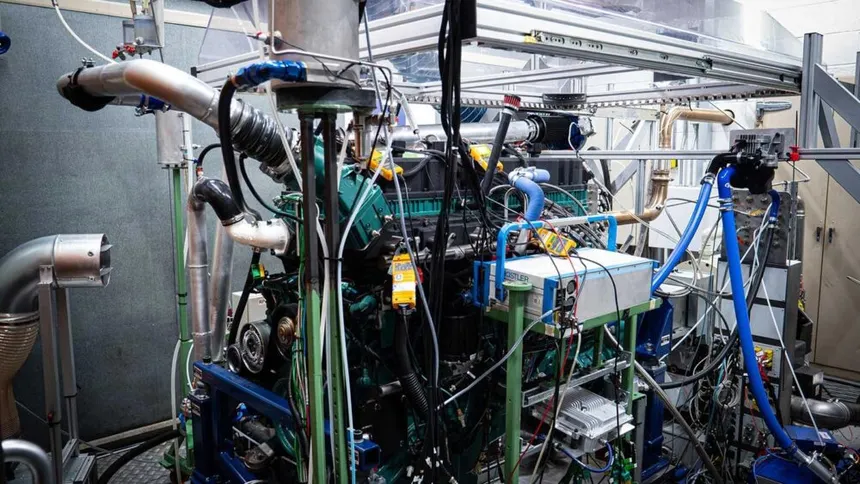
MAHLE doesn’t stop at sentences. It has product on the table. In February 2025 the Project Cavendish entered its testing phase — a £9.8 million programme funded by the UK’s Advanced Propulsion Centre to develop hydrogen combustion engines for heavy long-haul transport. MAHLE’s test facility in Northampton is equipped to accommodate two hydrogen tube trailers simultaneously, with rapid switchover for near-continuous supply. The project partners are PHINIA, BorgWarner, Cambustion and Hartridge. Half the European parts industry is involved.
Another piece: MAHLE has been supplying DEUTZ since late 2024 with specific components for stationary hydrogen engines. These components are called “power cell units”: piston, ring pack and pin — the heart of the cylinder, built by MAHLE specifically to withstand the chemical and thermal conditions of hydrogen combustion. The first commercial market this engine will enter in real-world use is off-highway: agricultural and construction machinery.
And one more detail that says a lot about the bet. MAHLE invested €630 million in R&D in 2024, equivalent to 5.4% of its revenue. And it filed 427 new patent applications that year. When a company that’s closing plants and reducing headcount maintains its R&D investment at 5.4% of turnover, it’s because it knows exactly where the next decade of business sits. And that decade, according to MAHLE, runs through combustion — not through the electric car.
AVL: the hydrogen racing engine almost nobody has seen
And we get to AVL. If you ask me which of the three is the most interesting piece for NEC, it’s this one. Because AVL is the least known outside the industry, and it’s the one with the most spectacular hardware figure.
AVL List GmbH. Based in Graz, Austria. 12,200 employees. 90 global locations. Over 50 tech and engineering centres. Revenue 2024: €2.03 billion, with 11% reinvested in R&D. AVL is Austria’s biggest patent filer, every year without interruption. Its business: development, simulation and testing of propulsion systems for the automotive, rail, marine, aerospace and energy industries. AVL doesn’t manufacture engines. It designs, tests and validates the engines that everyone else manufactures. A lot of what sits under your car’s bonnet has been validated on its Graz test benches.
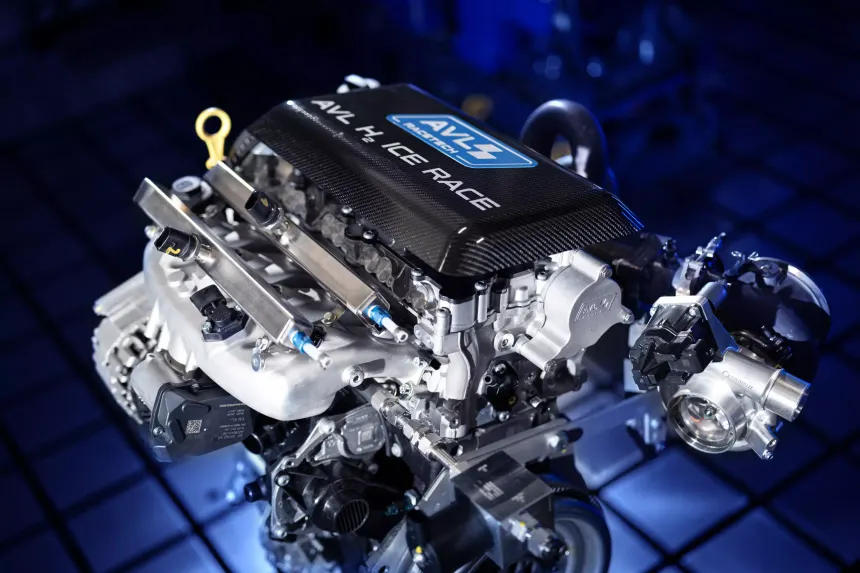
In October 2023, AVL did something you probably didn’t expect. Its AVL RACETECH division, the motorsport arm, presented a 2.0-litre turbocharged hydrogen race engine producing 410 horsepower. That’s 205 hp per litre of specific output. For context: that’s perfectly competitive in any current racing category. Modern Indycar sits around there. Some GT4 sits below. AVL RACETECH has shown that you can build a hydrogen-powered race engine with petrol-equivalent performance, using PFI water injection to moderate combustion.
Why does that matter for NEC? Two reasons. One: it kills the myth that hydrogen combustion is slow or low-power. That’s a lie that has been repeated for years, and AVL has buried it with a dyno prototype. Two: motorsport is the most demanding industrial test bench that exists. If AVL can build a 410 hp H2-ICE that survives racing duty, the technical problems of hydrogen as a fuel are essentially solved. What remains is regulation and infrastructure.
There’s more. Since 2021, AVL has been collaborating with TUPY (Brazil) and Westport Fuel Systems (Canada) on a heavy-duty H2-ICE using high-pressure direct injection. AVL’s motorsport director, Ellen Lohr, said it clearly when the project launched: “AVL RACETECH has decided to become a leader also in hydrogen combustion engines.” It isn’t a side project. It’s corporate strategy.
One more quote, unfiltered, from Tom Howell (Conventional Power Train Segment Leader at AVL): “it will be hard to get beyond 53% thermal efficiency in diesel engines, which engineers in China have already achieved.” Read it slowly. That’s AVL’s head of conventional powertrains acknowledging, in an Assembly magazine interview, that Chinese engineers are technically ahead in diesel thermal efficiency. A European, working for a European company, saying it out loud. That’s professional integrity.
The paradox that closes the hub
If you’ve read the five previous articles in the hub, you already have almost all the pieces. This sixth one connects them.
Aramco designs cheap engines to keep crude demand alive. Horse Powertrain consolidates industrial-scale manufacturing. The Chinese win on thermal efficiency with F1-grade numbers. Toyota pours hydrogen R&D into road cars. Mazda keeps 36 engineers developing the Wankel rotary against all economic logic.
And Europe? Europe, officially, banned the sale of new combustion cars from 2035. Closed plants. Made engineers redundant. Renault took its engines off the balance sheet. Stellantis cut. Volkswagen cut. Audi paused. European regulation is, on paper, the most radically anti-ICE in the world.
But beneath that regulation, the three biggest European engine technology suppliers are doing precisely the opposite. They are developing, testing and selling combustion engines. That is what NEC has to tell you, straight, because it’s what defines the real situation.
How do you reconcile that paradox? Look at the markets the products of Bosch, MAHLE and AVL are aimed at.
Heavy commercial vehicles. Trucks, coaches, public works vehicles, agricultural and construction machinery, locomotives. All of those vehicles are either exempt or have far softer deadlines under European regulation. The EU’s CO2 directive for heavy vehicles demands a 45% reduction by 2030, 65% by 2035 and 90% by 2040. But “90% reduction” isn’t “ban”. And the remaining 10% allowed in 2040, plus the existing fleet still on the road, are a vast market in which combustion is the only technically viable option.
Export markets. Bosch, MAHLE and AVL don’t sell only in Europe. They sell in the United States, Asia, South America, Africa. In those markets, internal combustion is the standard and will stay so for decades. AVL runs centres in China and India. MAHLE operates plants across 30 countries. Bosch is present in 66 countries. European regulation only touches roughly 25% of their real market. The other 75% keeps buying engines.
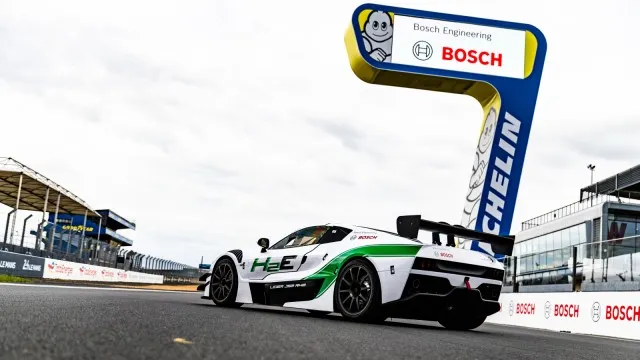
Motorsport. International federations (FIA, IMSA, ACO) are opening categories for hydrogen, e-fuels and biofuels. AVL RACETECH has already built the engine. Bosch and MAHLE are supplying components. It’s a relatively small market in pure revenue, but enormous in marketing and technical validation.
What this means for the car you buy
Here’s the part that stings.
Bosch, MAHLE and AVL are not developing these engines for the Volkswagen, Renault or Peugeot you’ll be allowed to buy in 2030. Those cars, in Europe, will be pure electric or, at best, hybrid. Regulation demands it. What these three European suppliers are developing is a combustion engine for the truck that will haul freight down the motorway, for the excavator running on a building site, for the tractor harvesting crops, and for the export markets where their customers will keep selling combustion cars for many years to come.
That is the exact opposite of what the Chinese are doing — fitting their efficient engines to €12,000 private cars. The exact opposite of what Toyota is doing — pouring hydrogen R&D into a compact street car. Europe’s paradox is this: it has the best combustion engine technology suppliers on the planet, and their engines are not going to reach the European end consumer.
Why? Because European regulation has decided that the private car must electrify at forced march, while leaving heavy commercial transport with softer deadlines. And suppliers, logically, put their money where regulation lets them sell.
The question I leave you
If Bosch, MAHLE and AVL are pouring billions into combustion engines, does that mean European industry believes ICE has a future? Probably yes. If those engines won’t reach the average European consumer, is that because European regulation has decided to ban them in that specific market? Also yes.
Is Europe anti-combustion? No. It’s Europe having made a political decision about where to allow combustion and where not to. A decision its own industrial suppliers quietly qualify by investing in hydrogen engines for everyone else.
The combustion engine isn’t dying in Europe. A specific door is being closed on it: the door of the private passenger car. But it stays alive in trucks, buses, machinery, motorsport and exports. And the three biggest European suppliers in the sector are funding that engine with figures running into the billions.
When, ten years from now, you’re driving your Chinese-built electric car down a Spanish motorway and a Mercedes truck running on Bosch-developed and AVL-validated hydrogen overtakes you, you’ll understand why NEC wrote the sixth pillar of the combustion hub.
Europe hasn’t abandoned anything. It has just changed who it sells to.
Check you’re still alive.