
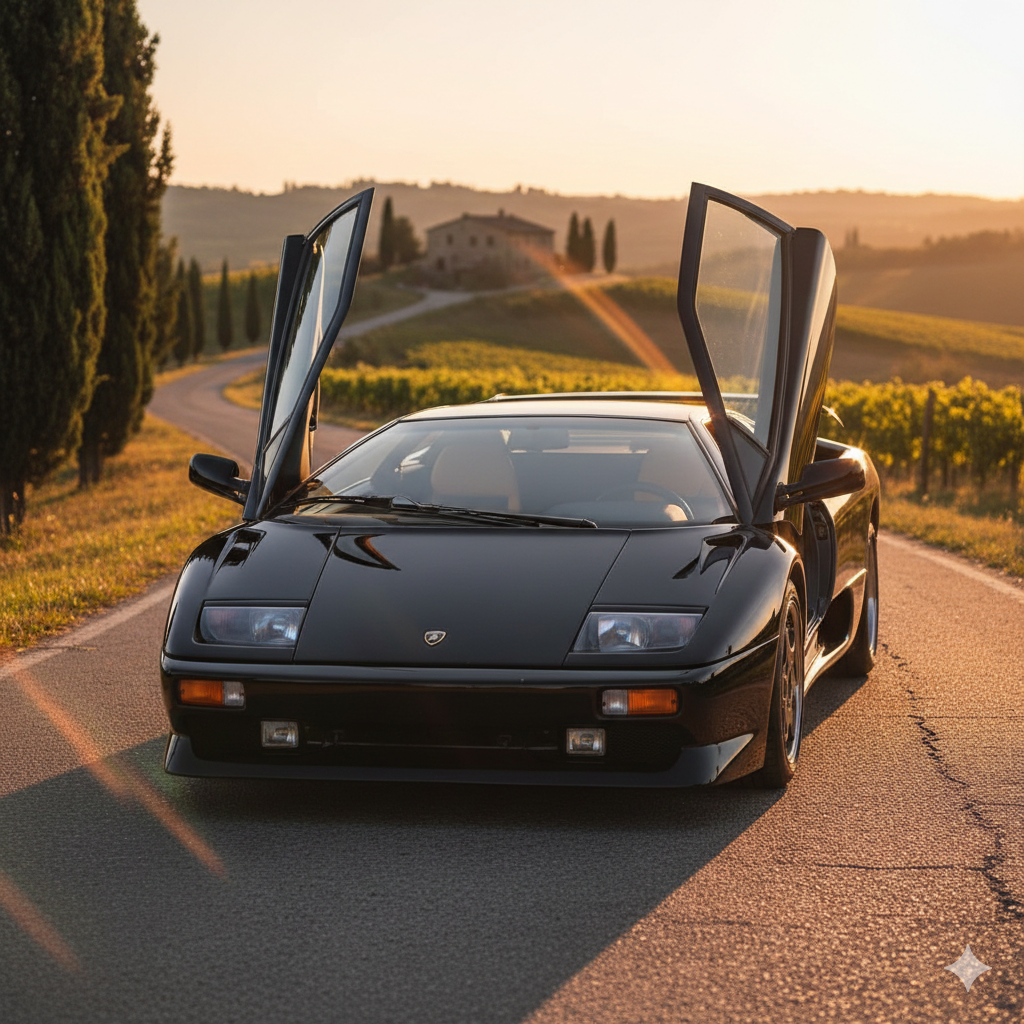
Lamborghini Diablo: The Last Wild Bull
Not Enough Cylinders — Unfiltered Automotive Opinion

There are cars that define an era. And then there’s the Lamborghini Diablo, which defined the very idea of what a supercar should be.
The Diablo wasn’t just the successor to the Countach. It was the car that took everything Lamborghini had learned in thirty years of Italian madness and pushed it to the absolute edge. Faster, wider, more violent, more impossible. When you saw it drive by, you didn’t ask if it was beautiful or ugly. You asked if what you just saw was real.
I know some will say the Countach is more iconic, the Miura more elegant, or the Aventador more powerful. And they’re right about all of it. But the Diablo has something none of them achieved: it is the last Lamborghini designed, developed, and sold with the brand’s original spirit intact. Before Audi. Before invasive electronics. Before sanity ever walked through the doors of Sant’Agata Bolognese.
The Diablo is the last truly wild bull. And this is its story.
The Birth: Project 132
It all started in 1985, when Lamborghini began working on the Countach’s successor under the codename “Project 132.” The company was then under the ownership of the Mimran brothers, Swiss-Senegalese entrepreneurs who had bought the brand in 1980 and, truth be told, kept it alive during one of its darkest hours.
The job of designing the new car fell to Marcello Gandini, the same genius from Bertone who created the Miura and the Countach. Gandini presented an absolutely radical design: sharp lines, extreme proportions, a silhouette that looked like a weapon. It was brutal, it was controversial, it was perfect for Lamborghini.
But then came Chrysler.
In 1987, Chrysler Corporation bought Lamborghini. Along with the purchase came American engineers and their ideas of what a supercar should be. Tom Gale, Chrysler’s design chief, took Gandini’s design and “softened” it. The more aggressive lines were rounded off, and some details were modified to meet U.S. regulations.
Gandini was furious. So much so that he refused to have his name associated with the final design. The version that hit the market in 1990 was a blend of the original Italian vision and American pragmatism. Interestingly, that tension between two worlds is part of what makes the Diablo so special.
A curious note: Gandini’s original design wasn’t entirely lost. If you look closely at the Cizeta-Moroder V16T—an ultra-exclusive supercar Gandini designed after his split from the project—you’ll see many of the elements discarded from the Diablo. It’s like seeing a parallel universe of what could have been.
The Numbers That Changed the Game
When the Diablo was presented in January 1990, the figures spoke for themselves.
- Engine: 5.7L 60° V12, a direct evolution of the legendary engine designed by Giotto Bizzarrini in the ’60s for the Miura. DOHC, 48 valves, multi-point injection. This engine is a masterpiece of mechanical engineering, and the fact that its DNA traces back to the original Miura gives it a legitimacy few engines can claim.
- Power: 485 HP @ 7,000 rpm. In 1990, that was a figure from another planet. For context: the Ferrari F40—its direct rival—produced 478 HP, but with the help of two turbos. The Diablo did it all naturally aspirated. Pure displacement, pure sound.
- Top Speed: 202 mph (325 km/h). The Diablo became the fastest production car in the world at launch, snatching the title from the Ferrari F40. This mattered because it placed Lamborghini exactly where Ferruccio always wanted to be: ahead of Ferrari.
- 0-60 mph: 4.5 seconds. Today that might not impress, but in 1990—with the tires of the era, no traction control, no launch control, and no electronic help whatsoever—that figure meant you had to be a real driver to get the most out of it.
- Weight: 3,474 lbs (1,576 kg). It wasn’t light, but the weight distribution was balanced thanks to the mid-rear engine position.
The Versions: An Escalation of Madness
What made the Diablo even more special was its evolution. Over eleven years of production (1990–2001), Lamborghini refined, boosted, and diversified the model in ways that seem unthinkable today.
- Diablo VT (1993): “VT” stood for Viscous Traction (all-wheel drive). A viscous coupling sent up to 25% of the torque to the front axle when the rear wheels lost grip. Suddenly, the Diablo went from a car trying to kill you to a car trying to kill you with a bit of a safety net. It also got power steering. Yes, the original Diablo didn’t have power steering. Parking was a CrossFit workout.
- Diablo SE30 (1994): Special edition to celebrate Lamborghini’s 30th anniversary. Only 150 units. Engine boosted to 525 HP, weight reduced, Spartan interior with carbon fiber panels. One of the most sought-after versions by collectors.
- Diablo SV (1995): “Super Veloce.” Pure rear-wheel drive, 510 HP, adjustable roof intake. For many purists, this is the definitive Diablo. No AWD compromises, no softness. Raw, direct, terrifying. If the VT was the bull with filed-down horns, the SV was the bull with sharpened horns and a hunger.
- Diablo VT Roadster (1995): Because someone in Sant’Agata thought driving a 530 HP RWD car without a roof was a reasonable idea. Surprisingly, the torsional rigidity didn’t suffer as much as expected, and the Roadster became a sales hit.
- Diablo SV-R (1996): The racing version. 550 HP, weight stripped down to 3,064 lbs (1,390 kg), built for the Diablo Supertrophy one-make series. If you ever hear one of these on a track, your definition of “beautiful noise” will change forever.
- Diablo GT (1999): Only 80 units produced. 575 HP, carbon fiber everywhere, and a fixed rear wing designed to slice the air in half. It’s the most extreme street version and is worth an absolute fortune today.
- Diablo 6.0 (1999–2001): The final version, under Audi’s direction. Engine bumped to 6.0L, 550 HP, redesigned headlights, and an interior finally worthy of its price tag. It was the bridge to the Murciélago, and while some purists feel it lost some of the original wild character, it is objectively the most refined and complete Diablo.
Trivia and Anecdotes You Didn’t Know
The Diablo is surrounded by stories that go beyond spec sheets. These are some of the best:
- The Name: “Diablo” wasn’t chosen at random. Following the tradition of naming cars after famous bulls, it bears the name of a legendary bull from the Duke of Veragua’s ranch that fought so fiercely in 1869 that his name went down in bullfighting history. Perfect for a car that fought against everything and everyone.
- The Garage Door: The scissor doors became a symbol. But what few people know is they have a brutal practical problem: in a low-ceiling garage, you can’t open them all the way. There are documented cases of owners literally raising the roof of their garages just to get in and out of the car.
- The 90s Poster: If you grew up in the 80s or 90s, there’s a high probability you had a Diablo poster on your wall. It was arguably the most “postered” car in history, rivaled only by the F40 and the Testarossa. For a generation, the Diablo was THE definition of a supercar.
- Need for Speed: The Diablo was one of the first playable cars in the Need for Speed saga (1994). For millions, it was their first contact with the Lamborghini brand. Driving it in pixels was a dream; driving it in real life was a delicious nightmare.
- The Heat: The Diablo was famous for its interior heat. The V12 engine, mounted right behind the occupants, generated hellish temperatures. The A/C, when it worked, was more of a suggestion than a solution. Driving a Diablo in an Italian summer was an experience combining adrenaline with a sauna.
- The Pedals: The clutch pedal travel on an original Diablo was legendarily heavy. Driving in city traffic was an endurance exercise for your left leg. There are stories of owners arriving at their destination with cramps.
- Jay Leno’s Diablo: Jay Leno has mentioned multiple times that the Diablo was one of the first supercars he ever bought. He also mentioned it was the car that left him stranded the most. Italian reliability at its finest.
- Mario Andretti: When Lamborghini launched the Diablo VT, they invited Mario Andretti to test it. The F1 legend, after a few laps at Nardò, said it was “one of the most exciting cars” he had ever driven. Coming from someone who drove F1 cars, that’s quite the endorsement.
Why the Diablo is One of the Best Lamborghinis Ever
And here is the personal part. My argument. My hill to die on. The Diablo is one of the greatest Lamborghinis ever made for several reasons:
- It was the last analog bull. No stability control, no driving modes, no touchscreens. It was you, a steering wheel, three pedals, a shifter with the throw of a military truck, and a naturally aspirated V12 responding directly to your right foot. No filters. No intermediaries.
- It was the fastest car in the world. Today that might sound like a history fact, but the impact at the time was seismic. Lamborghini, a brand perpetually on the edge of bankruptcy, had produced the fastest car on the planet. That meant something.
- It democratized the myth. Yes, it cost a fortune. But through posters, video games, and pop culture, the Diablo made Lamborghini a global brand. The Miura was for the connoisseurs; the Countach was for the gearheads. The Diablo was for everyone. Everyone knew what a Diablo was.
- It evolved without losing its essence. Eleven years of production, multiple owners (Mimran, Chrysler, MegaTech, Audi), and yet, the last Diablo 6.0 was still unmistakably a Diablo. The essence remained.
- The Sound. There is no debate. The Diablo’s V12, especially in the SV and GT versions, produces one of the most visceral, primitive, and exciting sounds in automotive history. It’s not the polite roar of a Ferrari V12. It’s the battle cry of an animal that knows it’s the most dangerous thing in the jungle.
- It represented an era. The 90s were the last great era of the analog supercar. The F40, F50, XJ220, McLaren F1, EB110, and the Diablo. All cars that demanded respect, skill, and a bit of madness to be driven to the limit. The Diablo didn’t just participate in that era; it was its cover star.
If the Miura invented the supercar, and the Countach made it an icon, the Diablo made it a universal legend. And that, for me, puts it on the podium of the greatest Lamborghinis of all time.
The Legacy
The Diablo handed the baton to the Murciélago in 2001, which in turn handed it to the Aventador in 2011. Both were great cars. But neither had that unrepeatable mix of danger, beauty, sound, and personality that the Diablo possessed.
Today, Diablo prices are steadily rising. Special versions—SE30, GT, 6.0 SE—reach astronomical figures at auction. And the “normal” versions, if anything about the Diablo can be called normal, have become relatively accessible collector’s items that appreciate every year.
The market knows something enthusiasts have always known: the Diablo is special. It’s the car that defined how we imagine a Lamborghini. It’s the bull that, thirty years later, continues to gore the imagination.
And at Not Enough Cylinders, it will always have a place of honor.
What’s your favorite version of the Diablo? VT, SV, GT, 6.0? Or do you prefer the original without the letters? Let me know in the comments.
—Not Enough Cylinders
4 thoughts on “LAMBORGHINI DIABLO”