Doble Steam Motors: the car that nearly killed petrol
Sit down. I’m going to tell you this one workshop-bench style, because the story is worth telling slowly.
- Emeryville, California. A small factory with fewer than a hundred employees rolls out a car that does the following: cold-starts in 30 seconds at sub-zero temperatures, runs 2,400 kilometres on a single water fill, exceeds 140 km/h at less than 1,000 rpm with no noticeable vibration, hits 75 mph from a standstill in ten seconds, needs no clutch, needs no gearbox, and runs in literal silence. The only thing you hear is wind noise.
Electric? No. Petrol? No either. It’s a steam car. And the company that built it is called Doble Steam Motors.
I’ve just typed those numbers and I’m still processing them, so take a breath too. Because the question any curious mind asks straight away is: if a car like that existed in 1924, how on earth are we still driving piston petrol cars with clutches and gearboxes a century later?
Short answer: because it cost sixty times more than a Ford Model T.
Long answer is what we’re about to unpack.
The company and the brothers
Start with the people, because without them the whole story falls apart. Abner Doble and his brother John are the main characters. Californian family, third-generation engineers. The grandfather made his fortune supplying tools to the Gold Rush miners. The father, William, refined and patented power-generation technologies. So Abner and John didn’t come out of nowhere. They came from a bloodline where steam and fluid engineering was practically a religion.
Abner started building steam cars before he turned twenty. By 1909 he already had a working prototype. What set Doble apart from the many other steam-car makers of the era wasn’t the idea: it was the obsession with solving every single problem the others had left unfixed.
Stanley’s steam cars, for example, were fast and quiet. But they took twenty minutes to cold-start because you had to wait for the boiler to build pressure. For a 1920s middle class wanting a usable car, that was a deal-breaker. Henry Ford had given them the answer with his crank-start Model T, and GM had nailed it from 1912 with the electric starter. Petrol was winning ground on convenience, not on technical superiority.
Abner Doble obsessed over fixing that. And he fixed it. His “American” monotube boiler, fitted to the Doble Series E from 1922, operated at 750 psi and 400°C and was ready to move the car in 30 seconds from cold. Thirty seconds. In winter. At sub-zero temperatures. Today that figure feels normal because any modern diesel starts instantly, but in 1924, a Ford T took longer to crank into life on a cold morning than a Doble took to be ready from stone-cold.
This is brutal engineering. The boiler was a coiled seamless steel tube — 175 metres of tubing wound into a cylinder just 56 centimetres in diameter and 84 centimetres tall. Cold-water tested at 7,000 psi, almost ten times the normal working pressure. That’s military aerospace safety margin, on a 1920s street car.
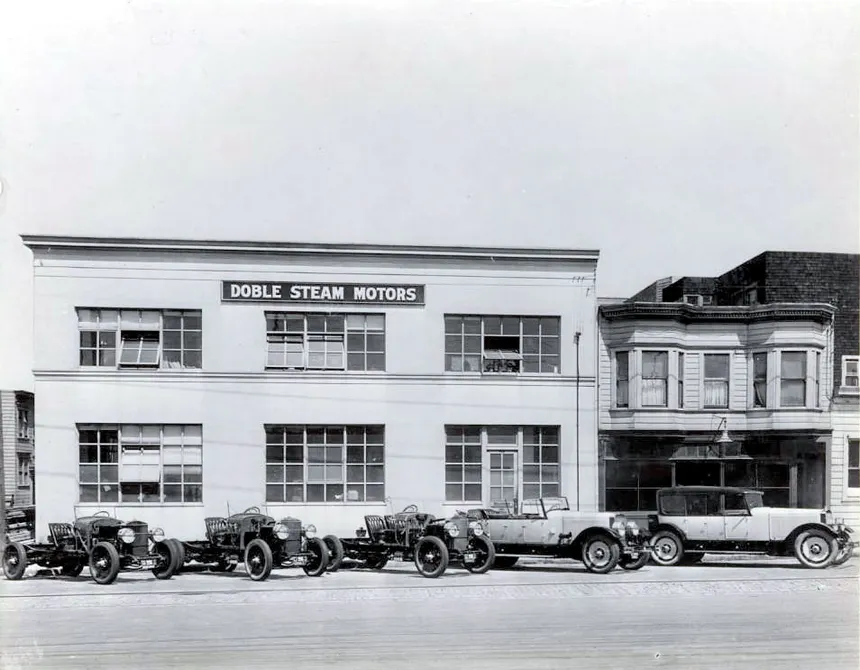
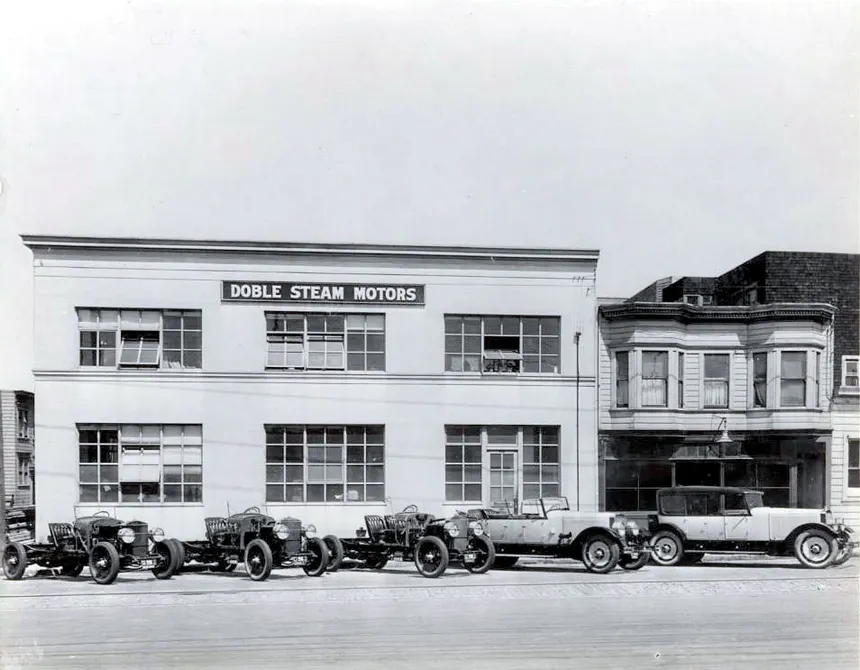
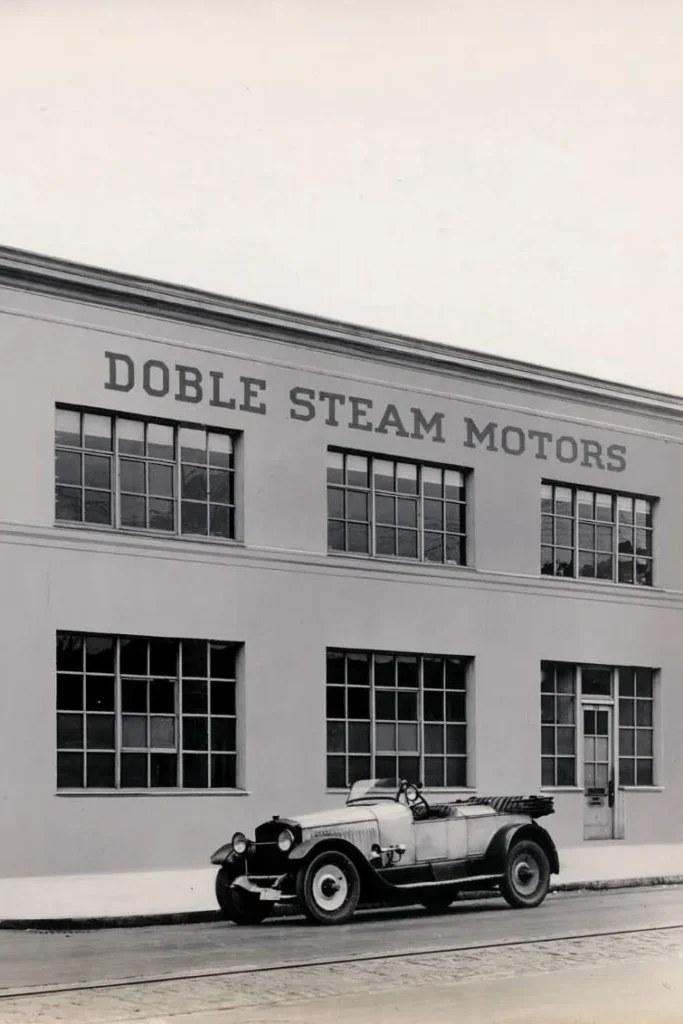
In 1920, the brothers formally founded Doble Steam Motors in Emeryville, California. Three years later they unveiled the Series E. And the entire automotive industry looked on in dread.
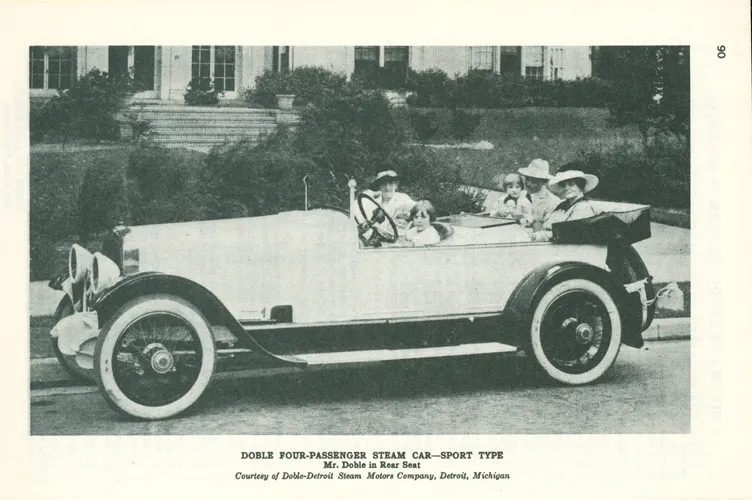
The Doble Series E, number by number
Let’s pull it apart with verified figures, because without numbers there’s no real story.
Engine. Four cylinders, compound architecture: two high-pressure cylinders and two low-pressure ones, mounted back-to-back. Woolf compound layout, a technique used in steam locomotives since the late 1800s, which Abner adapted to the automobile. The engine pushes the piston on both strokes, up and down. That means every crankshaft revolution produces four useful strokes, not two like a conventional petrol engine. It’s why the Doble produced 1,000 lb-ft of torque (1,356 newton-metres). Today, that’s the torque of a competition turbo V8. In 1924, it was applied science fiction.
Boiler. Already described above. American monotube, 750 psi working pressure, 400°C. Ready in 30 seconds from cold thanks to an electric spark ignition system that lit the burner instantly. This was the key innovation. Stanley and White, its competitors, were still using wick or manual pilot ignition.
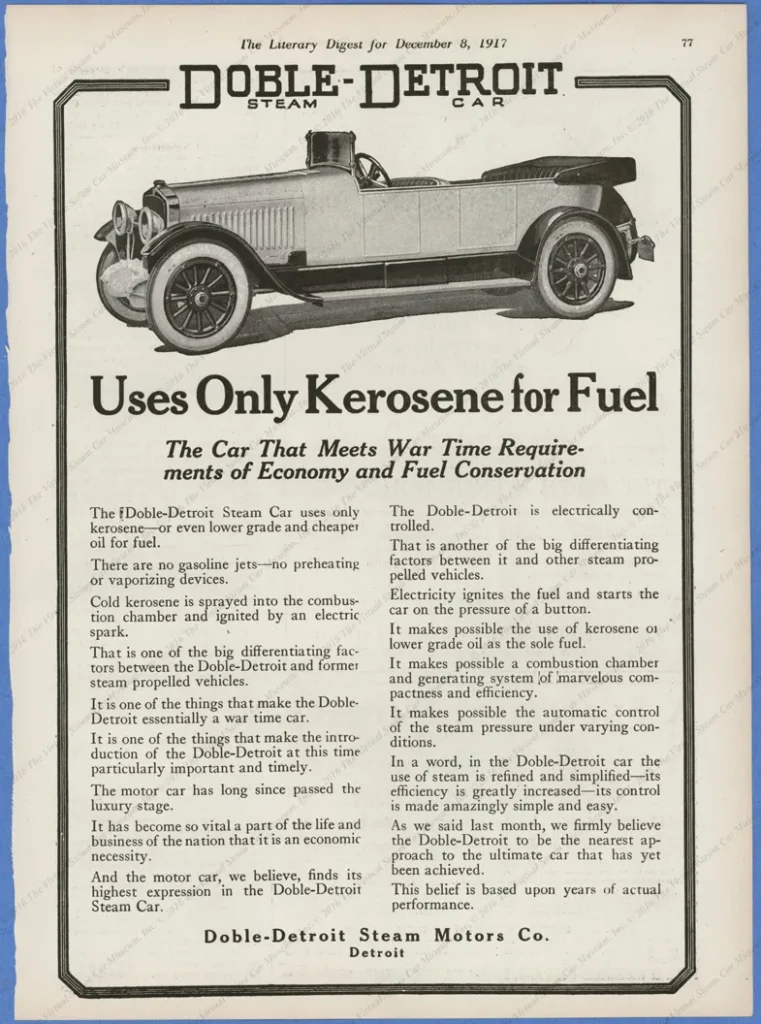
Fuel. Here’s the lovely bit. The Doble could burn any flammable liquid: petrol, diesel, kerosene, alcohol, fuel oil. The preferred fuel was kerosene because it was cheap and burned cleanly. This matters enormously: it meant the Doble was independent of the petrol supply chain, and in rural areas you could fill it with whatever was at hand. For a manufacturer eyeing the 1920s American market, that was a massive advantage.
Consumption and range. Roughly 15 miles per gallon (6.4 km/l) in normal use. 24-gallon (91-litre) water tank giving 2,400 kilometres between refills. How? Because the Doble carried a condenser that recovered the exhaust steam, cooled it back to water and fed it into the supply circuit. It didn’t vent steam to the atmosphere except in moments of maximum demand. Technically, this was an almost closed-loop system. It solved the other historical steam-car problem: stopping to refill water every 50 kilometres like a Stanley.
Speed and acceleration. Declared top speed in excess of 90 mph (140 km/h). One reached 110 mph without bodywork streamlining. Zero to 75 mph (120 km/h) in ten seconds, in a stripped variant. In 1924, those were Le Mans-grade figures. And here’s the kicker: it managed all that without changing gear. The Doble had no gearbox and no clutch. A steam engine delivers peak torque from zero revs, so a single gear ratio covered the full operating range. No crank-start required either, no gear-shifting skills, no clutch control. Push a button, wait 30 seconds, drive away like a modern EV.
Refinement. At 110 km/h, the engine was turning at around 900 rpm with practically no vibration. It was literally silent. The only audible noise was wind on the bodywork and tyres. Picture driving a car in 1924 that felt like a Tesla. That’s the impression reported by the few privileged enough to test a Doble.
Warranty. A 100,000-mile warranty on the engine. A figure today only premium manufacturers with iron nerves dare match.
The price tag that killed it
Here comes the guillotine. A Doble Series E cost approximately $18,000: $9,000 for the chassis plus another $9,000 for the coachwork, commissioned from an external coachbuilder (often Murphy of Pasadena). That’s roughly $250,000 in today’s money, adjusted for inflation.
To make the contrast land, in 1924 a Ford Model T cost between $260 and $400, depending on the exact year and bodystyle. That means a Doble cost between 45 and 70 times more than a Ford T.
Read that slowly. Forty-five times. Seventy times.
Who bought a Doble in those years? Two types of client only. Aristocrats and celebrities. Howard Hughes bought one (his roadster, chassis number 20, is today owned by Jay Leno). The Maharajah of Bharatpur, in India, commissioned another. Hollywood stars, American oil magnates, industrial heirs. For those customers, $18,000 was the normal price of a luxury car. For everyone else, the Doble was completely unreachable.
The two reasons it died
Here’s the heart of the story, the part NEC has to tell you without dressing it up.
Doble Steam Motors didn’t die because its technology was inferior. It died for two very specific reasons, and both are industrial, not technical.
Reason one: economies of scale. Henry Ford and General Motors figured out before anyone else that the secret to the modern automobile wasn’t building the best car in the world. It was building a car good enough at the lowest possible price, made on a production line at brutal pace. The Model T came off the line in 90 minutes per unit. The Doble Series E was built by hand, 24 units in total between 1922 and 1925. Twenty-four. The full production run of the manufacturer’s flagship model.
In other words: while Ford was building 9,000 Model Ts a day, Doble was building 24 cars in three years. It’s mathematically impossible to compete on mass market with that differential. Your car can be ten times better technically. It doesn’t matter. If your rival ships twenty thousand times more units, the war is lost before it begins.
Reason two: Abner Doble’s killer perfectionism. Abner was so obsessive about engineering that he refused to put the car into volume production until every detail was solved to his satisfaction. That blew up launch schedules. Wrecked deadlines. Shot costs through the roof. And Doble Steam Motors was eventually wound up in 1931 amid financial trouble and accusations of irregularities in the sale of company shares, according to historical sources like The Henry Ford. But the underlying problem wasn’t the stock-market ending. The underlying problem was that Abner Doble never understood that engineering alone doesn’t win industrial wars. What wins them is engineering that’s commercially viable.
The paradox that gives NEC its angle
Here’s where I want you to land, because it ties directly to everything we’ve been telling you in the NEC combustion hub over the last few weeks.
In 1920, it wasn’t yet clear that petrol would win. Three technologies were competing: steam (Doble, Stanley, White), electric (Detroit Electric, Baker, Columbia) and internal combustion (Ford, GM, Chrysler). By 1925 the war was over. Thermodynamics didn’t decide it. Henry Ford’s production line decided it.
A hundred years later, look at what we’re seeing. The Chinese are building combustion engines with F1-grade thermal efficiencies. Toyota is pouring hydrogen R&D into road cars. Mazda is keeping the rotary alive against all economic logic. And meanwhile, Europe pushes the electric transition by regulation, not by superior technology.
Bosch, MAHLE and AVL are pouring billions into combustion engines for markets where regulation lets them sell. Just like in 1920, what decides the industrial war isn’t thermodynamics — it’s industrial scale, regulatory policy and money.
The story of Doble Steam Motors is exactly the lesson NEC needs to tell you right now. A technically brilliant technology can lose. And it can lose not because it was inferior, but because the industrial ecosystem decided to play a different game. Doble was killed by Ford. Not by Otto, not by Daimler, not by Benz. By the assembly line. That’s what NEC celebrates acknowledging, because it’s industrial truth without makeup.
The epilogue almost nobody tells
There’s one final detail worth telling, because it closes the story with the right feeling.
When Doble Steam Motors folded in 1931, Abner Doble didn’t quit. He sold technology to German locomotive manufacturers, to Henschel & Sohn, where his monotube steam system was applied to experimental light trains up to World War II. He later tried to resurface with Paxton Engineering, a McCulloch Motors division, where they designed a steam car using his Doble Ultimax technology at 2,000 psi and 650°C. The project was cancelled in 1954.
Of the 24 original Series E cars, roughly nine survive today, scattered across private collectors in the US, museums, and at least one in Europe. Howard Hughes’ roadster number 20, bought new by Hughes in 1925 and kept intact, is currently owned by Jay Leno. When Leno fires it up for his YouTube videos, that hundred-year-old car cold-starts in 30 seconds and rolls silently down the streets of Burbank, California.
A hundred years later. Still running exactly as Abner Doble designed it.
The question I leave you
If the most advanced car of the 1920s could do everything the Doble Series E did, and still lost to the Ford Model T on industrial scale, what does that tell you about what’s happening in 2026 with combustion, electric and hydrogen?
I won’t sign the answer for you. NEC isn’t a prophecy publication. But if you’ve made it this far, you have all the pieces to draw your own picture. The history of the automobile isn’t decided by engineers. It’s decided by economies of scale, regulatory policies, and shareholders with deep pockets. Everything else, however brilliant, ends up as legend.
The Doble Series E is exactly that: a quiet legend, still rolling around California in Jay Leno’s garage, reminding us that in engineering, being the best doesn’t guarantee winning. And that when you read tomorrow that some manufacturer has solved combustion, or electric, or hydrogen, it’s worth asking: who’s going to mass-produce it? Who’s going to sell it cheap? Who has the industrial ecosystem to get it into every garage on Earth?
That’s the question that killed Doble Steam Motors. And that’s the question still calling the shots in the sector a hundred years later.
Check you’re still alive.