Fiat: 126 years to build an empire, five to dismantle it
Every so often Top Gear used to do those hagiographies about brands that “shaped motoring”. They did Ferrari. They did Aston. They did Porsche. They never quite did Fiat properly, and if you think about it for more than thirty seconds, that omission is embarrassing — because if you strip out Fiat from the twentieth-century history of the European car industry, half of what’s left doesn’t exist. No Lada. No SEAT. No Yugo. Half of Poland walks. Ferrari as a Formula 1 constructor has to be reinvented. Alfa Romeo doesn’t survive the eighties. Chrysler dies in 2009. And you don’t get one of the most influential industrial-design awards ever given to a manufacturer, in Milan in 1959, for a 479 cc air-cooled two-cylinder toy car with suicide doors.
Fiat is that big. And it’s currently being dismantled in real time by a management structure that treats it as a balance sheet rather than an industrial legacy. This is the story of how that happens over 126 years.
Buckle in. There’s a lot.
1899-1922: a basement, a suicide, and a copied car
The founding charter of the Fabbrica Italiana Automobili Torino is signed on 11 July 1899 at Palazzo Bricherasio, a baroque townhouse in central Turin. Nine investors put in 800,000 lire between them for 4,000 shares. The first president is not Giovanni Agnelli — he’s Ludovico Scarfiotti, a landowner. Agnelli, a 32-year-old former cavalry officer, is one shareholder among nine, paying roughly 400 dollars for his stake. The founding is driven by Count Emanuele Cacherano di Bricherasio and lawyer Cesare Goria Gatti, co-founders of the Italian Automobile Club. Nobody yet calls the company Fiat — the initial name is “Fia”. That changes within months.
The first car is a 3½ HP, built in a basement on Corso Dante, a direct copy of the Welleyes designed by Aristide Faccioli for the Ceirano workshop. Twin-cylinder engine, 22 mph flat out, eight units built in the whole of 1899. That’s how the largest industrial group in twentieth-century Italy gets going. A copied car in a basement.
Then something odd happens. In 1904, Count Emanuele Cacherano di Bricherasio — the man who had made the whole thing happen — shoots himself at 35. Circumstances: never fully clarified. Reported cause: a serious dispute with his partners. Agnelli emerges as the majority shareholder. The dynasty starts there. Nobody has ever wanted to look too closely at what actually happened in that argument.
By 1906 Fiat is building 1,149 cars a year, listed on the Milan stock exchange, and has opened a New York dealership. It builds aircraft engines. Trams. Buses. Trucks. Machinery. In 25 years it goes from a basement to being the industrial spine of northern Italy. And from day one, it races. And it wins.
Nazzaro: when Fiat basically invented Grand Prix racing
Felice Nazzaro started out working in the Ceirano brothers’ workshop. When Fiat absorbed Ceirano, Nazzaro became Giovanni Agnelli’s personal chauffeur. Chauffeur, aged 19. Within a few years he was a works Fiat driver and about to become the best racing driver on the planet.
In 1907, aged 25, Nazzaro did something no driver has ever repeated: he won the three biggest European road races of the season — the Targa Florio in Sicily, the German Kaiserpreis, and the French Grand Prix — all in Fiats, all under different regulations. One driver, one year, three overall wins, three different Fiat racing cars. At the French Grand Prix in Dieppe he averaged 114 km/h over 770 km in a Fiat 130HP with a 16.3-litre engine. At the Kaiserpreis in the Taunus hills north of Frankfurt, he dominated his qualifying heat and won the final. At the Targa Florio through the Madonie mountains in Sicily, he beat his teammate Vincenzo Lancia into second. Yes — that Vincenzo Lancia. The man who a few years later would found his own manufacturer. In 1907, he was a Fiat works driver. Everything ran through Fiat.
In 1908, Nazzaro set the world speed record at Brooklands, in an 18.3-litre Fiat SB4, at 121.58 mph. And in September of that year he won the Circuito di Bologna. In the crowd, a ten-year-old kid named Enzo Ferrari watched Nazzaro pass and, years later, said that day was when he decided he wanted to be a racing driver. Fiat, without meaning to, invented Ferrari as well.
The Nazzaro story doesn’t end there. In 1911 he left Fiat to build his own cars. It didn’t work. He came back. And in 1922, aged 41, he won the French Grand Prix again — fifteen years after his first win at the same race — in a Fiat 804, a two-litre six-cylinder Grand Prix car. Fifteen years, same manufacturer, same race, same driver. No other marque has that continuity. Nobody comes close.
Fiat pulled out of Grand Prix racing in 1927 after winning the Grand Prix of Milan with the radical 806. And then — this bit is strange — Fiat itself ordered the 806 destroyed. Every single component. Every blueprint. Everything scrapped. Even by Italian standards, that was unusual. That withdrawal from Grand Prix racing left space for Alfa Romeo, and then Enzo Ferrari‘s Scuderia, to dominate Italian motor sport for the next fifty years. But when Ferrari founded his stable in 1929, the shadow of Nazzaro racing in Bologna in 1908 was very much part of the reason he even wanted to.
Lingotto: the factory with a race track on the roof
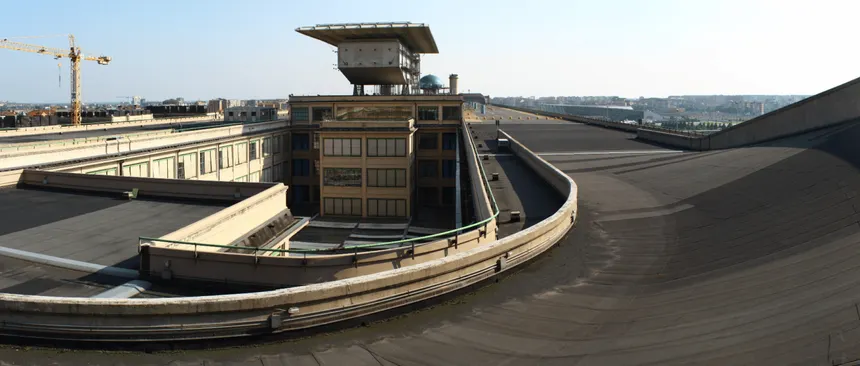
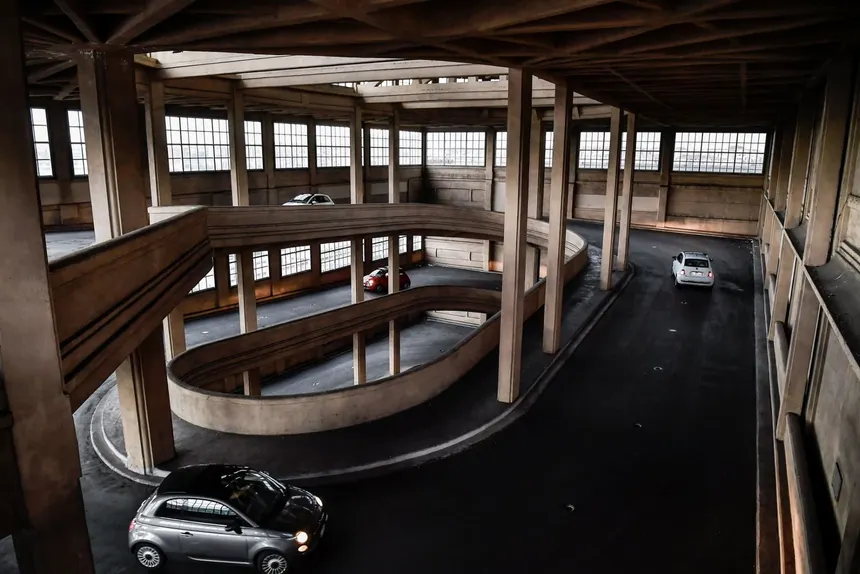
In 1916 Giovanni Agnelli travelled to Detroit and saw what Henry Ford was doing with the moving assembly line. He came back with a different idea. If Ford was stacking cars horizontally across a vast plot of land in the American Midwest, Fiat would stack them vertically in Turin, where real estate cost money. He commissioned architect Giacomo Mattè-Trucco. Five floors. Raw materials went in at the ground level. The car worked its way up through helical concrete ramps as it was assembled. And it emerged completed at the top.
At the top, meaning the roof. Because the Lingotto’s roof was a 1.5 km oval test track, banked at the corners, where every finished car was driven before descending the ramps to the warehouse. A test track on the roof of a five-storey factory. Nothing like it had ever been built. Nothing like it has been built since. Nothing like it will ever be built again.
Le Corbusier came to visit and called it “one of the most impressive sights industry has ever offered”. Marinetti called it “the first invention of Futurist construction”. They weren’t wrong. In 1923 there was nothing anywhere in the world that combined reinforced concrete engineering on that scale with pure industrial theatre. Eighty different Fiat models rolled off that assembly line over sixty years, including the Topolino in 1936 — Giacosa’s first signed car.
Lingotto closed in 1982 when Mirafiori made it obsolete. Renzo Piano rehabilitated it in the late eighties. Today it’s the administrative HQ of Stellantis Italy, plus a shopping centre, hotel, and the Pinacoteca Agnelli art museum (housing Gianni Agnelli’s personal collection). The rooftop track survives — La Pista 500, they call it now, used for photo shoots of the modern 500 electric. That a race track designed in 1916 has ended up as a photo backdrop for an EV probably tells you where this story is going better than anything else could.
It also appears briefly in The Italian Job (1969), during the getaway sequence with the three Mini Coopers going up the helical ramps. Fiat rented the location out to a British production. That happened too.
Topolino, aircraft, war
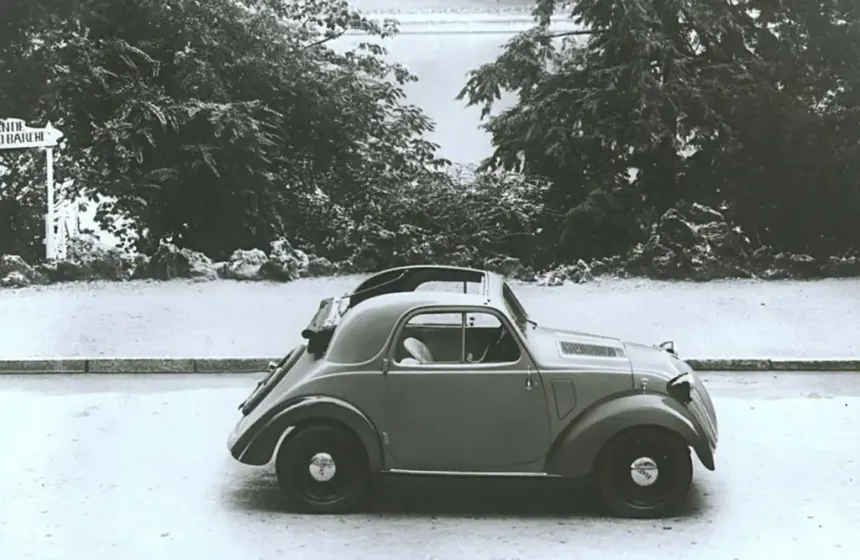
In 1936, during the fascist regime, Fiat launched the 500 Topolino, designed by a young engineer named Dante Giacosa. One of the first genuinely popular cars in Europe. 569 cc, 13 hp, two seats. The car that opened the door to the 500 of 1957. It also confirmed that Fiat could design proper utility vehicles at scale.
But in the thirties Fiat wasn’t just cars. Fiat was military aviation. The Fiat Aviazione division built the CR.32 and CR.42 Falco biplane fighters — biplanes that fought in the Spanish Civil War and later in North Africa. The G.50 Freccia and G.55 Centauro monoplane fighters, initially with Fiat A.74 engines and later with license-built Daimler-Benz DB 605s. Fiat built locomotives. Trucks. Machine tools. Household appliances. When Italy entered the war on 10 June 1940, Mirafiori (opened 1939, the largest car plant in Europe at the time) converted entirely to military production. Over 7,900 units of the Fiat 626 medium truck went out to the Regia Aeronautica and the army in North Africa and the Balkans. TL37 4×4 light utility trucks equipped most Italian transport units. Aircraft engines by the thousand. The Turin plants took Allied bombing raids. When the war ended, Giovanni Agnelli died in December 1945, and the leadership vacuum was filled by the man who had actually been running things day-to-day for years: Vittorio Valletta.
Valletta: the man who rebuilt Italy
Valletta took over a Fiat destroyed by Allied bombs, in a country politically shattered by the war. And over the next twenty years — 1945 to 1966 — he did two things: he rebuilt the company, and he rebuilt the Italian middle class. Under Valletta, Fiat went from 70,000 cars in 1946 to over 800,000 in 1963. A tenfold increase. In Italy, practically every car you saw on the road was a Fiat.
And it was Valletta who commissioned Giacosa’s 600 in 1955 and 500 in 1957. The two cars that motorised Italy. The two cars that opened the door to Fiat’s licensing empire — one of the most brilliant, and least-recognised, industrial strategies of the twentieth century.
The global network: Fiat as a tech exporter
At a moment when Italy had no diplomatic weight for anything, Fiat signed manufacturing licences with half the planet. And those licences built entire national car industries from scratch.
Spain, 1953. Fiat took a strategic stake in SEAT. The SEAT 600 was a Fiat 600 built in Zona Franca de Barcelona. The SEAT 124 was the Fiat 124. The SEAT 127 was the Fiat 127. Fiat held its stake in SEAT until 1981, when Volkswagen took over. Nearly every SEAT built in the first three decades of that brand’s existence was, mechanically, a Fiat.
Soviet Union, 1966. Fiat signed a landmark agreement with the Soviet government to build the largest car factory in the USSR, in the newly-created town of Togliatti (named after Italian communist leader Palmiro Togliatti). Fiat engineered the VAZ plant and licensed the Fiat 124 — European Car of the Year 1967 — to be built as the VAZ-2101 “Zhiguli”, exported west as the Lada 1200. The Lada Riva and Lada Classic, derivatives of the 124, kept rolling off Russian lines until September 2012. 17,332,954 units total. That’s the second-largest single-design production figure in the history of the automobile. Ever.
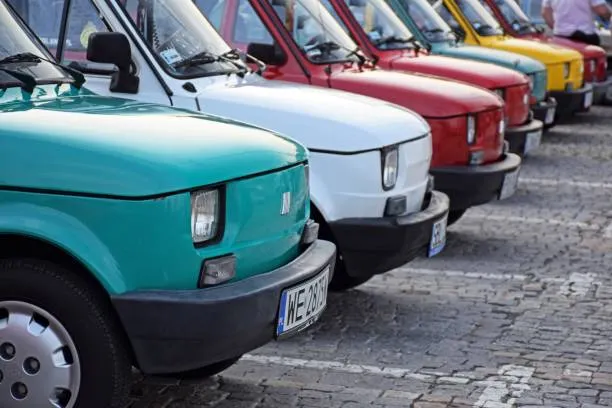
Poland, 1965 and 1972. Fiat signed with communist Poland — first under Gomułka, later under Gierek — for the license of the 125 (built as Polski Fiat 125p from 1967 to 1991) and the 126 (Polski Fiat 126p, nicknamed Maluch — “the little one” — built in Bielsko-Biała and Tychy between 1972 and 2000). 3.3 million Polish 126p units. It became the Polish people’s car by definition, still a cultural icon that turns up on T-shirts, memes, and Instagram feeds today. Tom Hanks owned one. Mat Watson from CarWow bought one for laughs and never quite got rid of it.
Yugoslavia. Zastava built the Fiat 600 under license as the Zastava 750 (nicknamed Fićo), the Fiat 128 as the Zastava 101 (nicknamed Stojadin), the Yugo (a Zastava adaptation of the 128), and the Polski Fiat 126p PGL. When Yugoslavia collapsed in the nineties, Zastava survived on Fiat infrastructure.
Germany. NSU-Fiat (later Neckar) built Fiats under license in Heilbronn from the thirties through 1973.
And elsewhere: Argentina, Brazil, India (Premier Automobiles built a version of the 118NE derived from the SEAT 124), South Korea (Kia built the Fiat 124 as the Fiat-KIA 124 between 1970 and 1975), New Zealand (Torino Motors assembled 500s in Ōtāhuhu), Egypt, Cuba.
Add it up. Just the Ladas, Polski Fiats, Zastavas, SEATs and other significant licence variants come to well over thirty million cars built outside Italy on Fiat architecture. Fiat didn’t just motorise Italy. It motorised half the planet through other people’s factories.
Gianni Agnelli and the empire (1966-2003)
Gianni Agnelli, grandson of Giovanni, joined the company in 1963 and took the presidency in 1966. He would be the public face of Fiat for the next 37 years. But Gianni Agnelli wasn’t only an industrialist. He was Italy itself. The playboy with his tie deliberately loose and his watch worn over the shirt cuff, the friend of John F. Kennedy, of Anita Ekberg, of Henry Kissinger, of Giulio Andreotti. When Italy won at football, the photograph was with Gianni Agnelli. When Juventus won the Scudetto — and Juventus had been in the Agnelli family since 1923 — the picture was with Gianni Agnelli. When there was a political crisis, the phone call was to Gianni Agnelli. Editor and majority owner of La Stampa, Italy’s second-largest daily. Made a senator for life by President Ciampi in 2000, a distinction reserved for people who had shaped the country.
Under Gianni, Fiat became something bigger than a car company. It bought Lancia in 1969, when it was insolvent. Same year, it took a 50% stake in Ferrari, leaving the other half to Enzo — and in 1988, after the Old Man’s death, absorbed the remainder. When Ford tried to buy state-owned Alfa Romeo in 1979, Gianni Agnelli killed the deal politically and took Alfa himself in 1986 for a symbolic price. He bought Maserati from De Tomaso in 1993 and passed it to Ferrari in 1997. Autobianchi, Innocenti, OM, Iveco commercial vehicles, Comau industrial robots, New Holland tractors, cross-holdings everywhere. Fiat was the largest private industrial group in Italy. And for twenty years, the third-largest carmaker in the world by volume.
And the cars produced under his watch, the ones that matter, are a proper roll call.
The 124 of 1966 — European Car of the Year, later Lada in the Soviet Union for 45 years, with a twin-cam aluminium engine designed by ex-Ferrari’s Aurelio Lampredi that would live for decades.
The 128 of 1969, the first Fiat with a transverse front engine and front-wheel drive. That’s the architecture every European hatchback would use for the next forty years. No 128 means no Golf. No Peugeot 205. No Renault 5. All of them are descendants of the 128.
The 127 of 1971 — Car of the Year again. The Panda of 1980, designed by Giugiaro, the definitive functional European city car — plastic, right angles, zero pretension, all utility. Still taught in industrial design courses. The Uno of 1983, Giugiaro again, Car of the Year again. The 131 Abarth Rally that won the World Rally Championship in 1977, 1978 and 1980 with Röhrl and Alén. Every three or four years Fiat put a car on the market that redefined its segment.
And it also built strange cars. Cars only Fiat could have signed. The 130 Coupé of 1971, designed by Paolo Martin at Pininfarina — a two-door limousine coupé with a 3.2-litre V6, one of the finest pieces of industrial design of the twentieth century and a complete commercial flop. The Dino Coupé and Spider (1966-1973), with V6 Ferrari engines actually built by Fiat. The 8V of the fifties, Fiat’s forgotten V8, which Fiat itself walked away from mid-life-cycle. The X1/9 of 1972, mid-engined, designed by Bertone, a junior supercar for less than the price of a hot hatch.
Autunno caldo, Marcia dei Quarantamila
None of this came free in social terms. Mirafiori employed more than 60,000 workers in the sixties. Turin had become the industrial capital of Italy and the epicentre of the hardest Italian trade unionism. In 1969 came the Autunno caldo — the Hot Autumn: mass strikes at Mirafiori, factory occupations, clashes with police. Out of that came Italy’s Statuto dei Lavoratori — the workers’ rights charter. Out of it came the 40-hour week. Out of it came modern Italian labour law. And out of the same environment came the Red Brigades. Between 1976 and 1982, eighty Fiat executives and shop-floor supervisors were attacked by the Red Brigades. Eleven died.
October 1980 broke the balance. Fiat announced 24,000 redundancies as part of a restructuring plan. The unions called an open-ended strike. It lasted 35 days. And on 14 October, something nobody had expected: forty thousand white-collar workers, foremen and technical staff from Fiat marched through the streets of Turin demanding to be allowed back to work. La Marcia dei Quarantamila. Nobody organised them. They organised themselves. That was the moment Italy’s union consensus broke, and the moment the country realised the whole model of heavy industrial employment was going to have to reinvent itself. The strike collapsed within days. The layoffs went ahead. Nothing was ever the same again between Fiat, its workers, and Italy.
The eighties and nineties: good cars, patchy management, hidden gems
The eighties were odd years for Fiat. Volume was strong — Uno, Panda, Tipo, Punto — but build quality slipped. Bodies rusted. Interiors fell apart. The Tipo of 1988 won Car of the Year and then developed chronic electrical faults. The Croma was forgotten. The Cinquecento of 1991 (the first modern 500, built in Poland) was competent but soulless. And yet, in the nineties, Fiat put out some of its most desirable cars in decades. The Fiat Coupé of 1993, exterior by a young Chris Bangle (with those distinctive slashes down the flanks that split opinion instantly), interior by Pininfarina — a 2+2 with 2.0-litre turbo engines up to 220 hp and a chrome-steel cabin that still hasn’t aged. The Barchetta of 1995, a front-wheel-drive roadster on the Punto platform, quietly beautiful. The Bravo/Brava of 1995 with a proper 20-valve 2.0-litre four. The Punto GT turbo with 133 hp, a proper urban knife. And the Multipla of 1998, that low-slung MPV with two rows of three seats, so ugly it looped back to beautiful, designed by Roberto Giolito. That Multipla won the Compasso d’Oro in 2004. Forty-five years after the one the original 500 won. Two different cars, two different Compassi d’Oro. No other single manufacturer has that CV.
But the shadow was growing. In 2000 Fiat signed an agreement with General Motors that gave GM a 20% stake and gave Fiat a put option to force GM to buy the rest. In 2003, Gianni Agnelli died at 81, after years of cancer and the grief of his son Edoardo’s suicide in 2000. In 2004, his brother Umberto — who had taken the presidency — followed him. The company was in serious financial trouble. And that’s when the man who saved it against every prediction walked in.
Marchionne: the black jumper that propped up an empire
Sergio Marchionne wasn’t an engineer. He was a lawyer, an accountant, ex-Deloitte, Italian-Canadian, had run SGS in Switzerland. He joined Fiat’s board in 2003 and in June 2004 was made CEO. He turned up to board meetings in a black roll-neck jumper instead of a suit. Chain-smoked. Drank espressos at twice the speed of an actual Turinese. Worked twenty hours a day. When the press asked about the jumper, he said he liked it. When asked why he never wore a tie, he said ties were invented to hang people with.
His first move was a bank shot. In 2005 he forced General Motors to pay 2 billion dollars to walk away from the 2000 agreement — because the contract contained the clause allowing Fiat to force GM to buy the rest of the company, and GM had no appetite. Those 2 billion dollars gave Fiat the oxygen it needed. Contract law turned into industrial strategy.
With Fiat stabilised, he launched the modern 500 in 2007 (deliberately on the fiftieth anniversary of the original), the new Panda in 2003, and then he started looking abroad. In 2009, when Chrysler collapsed into bankruptcy in the United States and the Obama administration was looking for a rescuer, Marchionne showed up in Washington in his black jumper and convinced the Auto Task Force that Fiat was the right partner. He got 20% of Chrysler for free, conditional on hitting industrial targets. By 2011 he had 53.5%. On 1 August 2014 the merger completed and Fiat Chrysler Automobiles (FCA) was born, HQ in Amsterdam, listed on NYSE. Marchionne repaid the US Treasury bailout in full — six years ahead of schedule, with interest. Nobody had expected Chrysler to survive, let alone repay.
In 2015 he spun off Ferrari as a separate listed company on NYSE with John Elkann as chairman. FCA retained Fiat, Chrysler, Dodge, Jeep, Ram, Alfa Romeo, Maserati, Lancia and Abarth. Jeep exploded globally. Ram became the group’s most profitable brand. Alfa Romeo returned with the Giulia and Stelvio, engineered by former Ferrari technicians. All of it happened with Marchionne at the wheel.
And in April 2015, he published a 25-page presentation titled “Confessions of a Capital Junkie”. In it, he argued that the auto industry hadn’t earned its cost of capital in a cycle, that OEMs were wasting billions duplicating R&D on components customers couldn’t even distinguish, and that consolidation — mergers, joint ventures, shared platforms — was the only way forward. Every analyst at the time called him crazy or reckless. Ten years on, in 2025, every OEM CEO in the world agrees with him. In 2015, they laughed.
In July 2018, following what should have been a routine shoulder operation in Zurich, complications set in. He fell into a coma. He died on 25 July 2018, aged 66. He had been due to retire in April 2019. He didn’t make it. John Elkann announced the death with a handwritten note. And that’s the point where Fiat starts falling in earnest.
Stellantis: the merger that wasn’t
With Marchionne gone, John Elkann appointed Mike Manley as FCA CEO. Manley had grown Jeep well but he didn’t have Marchionne’s strategic weight. In 2019 a merger was announced with PSA (Peugeot, Citroën, Opel, DS) — the French-based group run by Portuguese CEO Carlos Tavares. It closed on 16 January 2021, and Stellantis was born: 14 brands under a single roof — Fiat, Alfa Romeo, Maserati, Lancia, Abarth, Chrysler, Dodge, Jeep, Ram, Peugeot, Citroën, DS, Opel, Vauxhall. HQ in Amsterdam. Listed in New York, Milan and Paris. Tavares in charge.
On paper: synergies, cost savings, shared platforms. Exactly what Marchionne had preached in Confessions. In reality: the merger of equals wasn’t of equals. Tavares came in with a purely financial philosophy. Cut. Reduce. Close plants. Offshore. And the plants that took the hits were Italian, not French.
In 2024, Stellantis announced 3,597 redundancies in Italy alone. Mirafiori lost 1,560. Cassino 850. Pratola Serra 100. Melfi, Pomigliano d’Arco, Termoli, Cento, Verrone — all hit. Italian production dropped to historic lows. The Fiat brand was reduced to the Panda and the 500e. Alfa Romeo languished with an unrefreshed Giulia and Stelvio. Lancia sales collapsed by 68% between 2024 and 2025. Maserati, unloved, with constant rumours of a sale.
Tavares gave the group’s brands ten years to justify their existence. In December 2024, with the North American business in crisis, Jeep losing market share, and relationships with US dealers and unions in ruins, the board fired him. He walked away with a compensation package worth close to 100 million euros. In 2025 Antonio Filosa took over and started openly considering divestitures. Lancia, DS, Chrysler and Maserati are all on the possible casualty list. Fiat, the parent brand, survives for now — but as a small-car marque that has lost its Italian industrial capacity, its historic plants, and most of its identity.
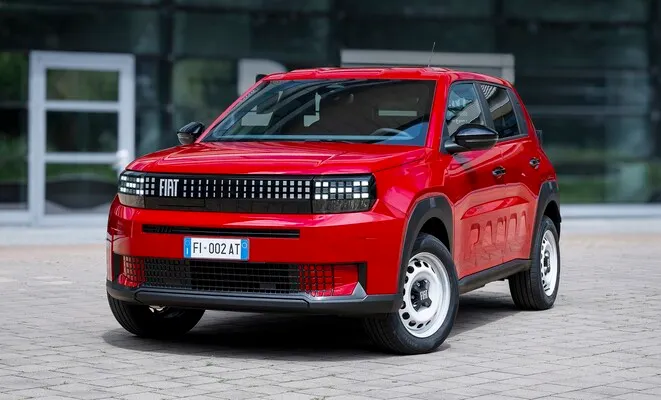
The 125th anniversary celebrations in July 2024 revolved around the launch of the new Grande Panda electric. Not Turin. Not Mirafiori. Not a refreshed 500. A model developed on the shared Stellantis Smart Car platform and built in Serbia at the old Zastava plant in Kragujevac. Anyone paying attention understood that day that Fiat as it had existed was already gone.
The Italian design school: Bertone, Pininfarina, Giugiaro, Zagato, Vignale
One last thing before wrapping up. The Italian school of car design exists because Fiat paid the bills.
Bertone designed the X1/9. Pininfarina designed the 130 Coupé, the Dino Spider, the 124 Sport Spider. Giugiaro (Italdesign) designed the Panda, the Uno, the Croma. Zagato produced special-bodied versions. Vignale built the Gamine. Ghia signed off the Jolly. All of them had standing contracts with Fiat that paid the salaries of their design teams during the years when independent industrial design didn’t pay for itself. Without Fiat, the Italian design school doesn’t exist. Without the Italian design school, European car design in the twentieth century is unrecognisable. That’s the chain. And today that chain is broken — Bertone went bankrupt, Pininfarina was absorbed by India’s Mahindra in 2015, Italdesign is part of the Volkswagen Group since 2010. The school survives in fragments.
What’s left, and why it hurts
Fiat built Turin. It built the Italian middle class. It built the European small-car template. It motorised a continent after the war. It motorised Poland. It motorised the Soviet Union. It motorised Spain. It motorised Yugoslavia. It absorbed Ferrari without stepping on its soul, Alfa Romeo when the Italian state could no longer sustain it, Lancia when the brand was already dead, Maserati when nobody else wanted it. It saved Chrysler from bankruptcy. It employed hundreds of thousands of families for over a century. It invented an industrial architecture the world copied. It won the Compasso d’Oro with two different cars, forty-five years apart. It built fighter aircraft that fought on three continents. It won three Grands Prix in a single 1907 season with the same driver. It put Giacosa, Bertone, Giugiaro, Pininfarina, Vignale, Zagato and Bangle to work under the same corporate umbrella. It built a race track on top of a factory. It put Agnelli’s own chauffeur behind the wheel and won the Kaiserpreis with him.
And today it’s a small-car brand a Brazilian CEO is openly considering breaking up for parts.
It isn’t that Stellantis is worse than other industrial mergers. The problem starts earlier. It starts the day Marchionne dies and nobody with industrial vision takes over. It continues with a merger where the French side effectively ran things and the Italians never regained control. It ends with the purely financial management of a legacy that isn’t financial — it’s industrial, cultural, national. Fiat isn’t a brand. It’s part of the story of Italy itself. When you run a story like it’s a balance sheet, you kill it.
If Giovanni Agnelli could look up today and see that the brand he founded in 1899 is being built in Serbia on a platform shared with Peugeot and run from Amsterdam by executives who have never set foot on the Mirafiori shop floor — he would probably order an espresso, light a cigarette, and call his lawyer.
If Nazzaro could see that the Fiat competing in any category today is the Abarth 500 in a spec series, he would walk away without saying anything.
If Giacosa could look at the Grande Panda on its shared platform, he would pull out a pencil and start redesigning it from scratch.
The Agnellis are still there. The family holding company, Exor, with John Elkann at the helm, is still Stellantis’s biggest single shareholder at nearly 15%. But they don’t run the business. They just collect.
One hundred and twenty-six years to build an industrial empire that motorised half the planet and won everything from Grand Prix to Compasso d’Oro. Five to dismantle it, through redundancies, closures, offshoring and soulless product. And the dismantling isn’t finished yet.
That basement on Corso Dante doesn’t exist anymore. The Lingotto has been hollowed out and turned into a shopping centre. Mirafiori is running at half capacity. And the next 500 will be built by a robot in Serbia.
Happy 126th birthday.
Check you’re still alive.