

Spyker C8 Spyder: The Last Supercar Of The 20th Century Built By One Pair Of Hands

There’s a YouTube clip from 2004 in which Jeremy Clarkson is sitting inside a brand-new Spyker C8 Spyder, looking down at the exposed gear linkage and the polished aluminium dashboard, and he says something that has stuck with the brand ever since: “It’s a car you wear, rather than drive.” Clarkson meant it as a compliment, or perhaps as a description, or perhaps as both. What he didn’t say in that clip, because he probably didn’t know, is that the cabin he was admiring had been imagined by one man, working alone, in a small workshop in a Dutch town called Naarden, between 1990 and 1996.
His name was Maarten de Bruijn. He was 25 years old when he started. He had a master’s degree in urban planning, not in automotive design. He had no investors, no engineering team, no supplier network, no marketing department. What he had was a metalworking background dating back to his teenage years, a stubborn idea, and a six-year window of his life he was prepared to dedicate to building a supercar by himself.
He finished it in 1996. Audi V8 engine, aluminium spaceframe chassis, hand-beaten aluminium bodywork, 940 kilos. One man, six years, one prototype. He called it the Silvestris V8. And before he had even finished welding the chassis, he had quietly walked into the Dutch trademark office and bought the rights to one of the most evocative dormant names in European automotive history: Spyker.
That story matters because the C8 Spyder, which debuted at the Birmingham International Motor Show on 17 October 2000, is the direct production evolution of that lone prototype. The Silvestris became the C8. And the C8 became the last supercar of the twentieth century that began life as a single individual’s personal project rather than as the output of a corporate design studio. Pagani had a team. Koenigsegg had a team. Even Horacio Pagani, who is rightly celebrated as a designer-engineer of singular vision, had assembled a workshop of skilled hands before the Zonda existed. De Bruijn did the Silvestris on his own. That distinction is not trivial. It is the entire reason the C8 looks and feels the way it does.

The town planner who wanted to be a coachbuilder
Maarten de Bruijn was born in Naarden, near Amsterdam, in 1965. He graduated in 1996 from the University of Amsterdam with a master’s in urban and regional planning, which is to say his formal academic training had absolutely nothing to do with cars. He was supposed to spend his career thinking about how cities allocate space, how zoning works, how transportation networks integrate with housing density. Cars were nowhere on the script.
But de Bruijn had been working with metal since his teens. He understood welding, panel-beating, fabrication. And from an early age he had an ambition that wouldn’t go away: he wanted to build a sports car. Not own one. Build one.
In 1990 he started. And here is where the story diverges from every other modern supercar origin story: he did it alone. No team. No declared budget. No investors. No board. In a small workshop he set up himself. Buying components piecemeal, modifying others, fabricating whatever he couldn’t source. He used an Audi 4.2-litre V8 because it was reliable and available second-hand. He used Audi transmission components for the same reason. The bodywork he beat by hand out of aluminium sheet. The chassis he designed himself on paper before welding it together.
Six years. Between 1990 and 1996, working through evenings and weekends and university holidays, de Bruijn produced what major supercar manufacturers produce with teams of fifty engineers, dozens of suppliers, and budgets running into the millions. He produced it alone, with his hands, in his free time, unable to show anyone what he was doing because if he had they would have called him deluded.
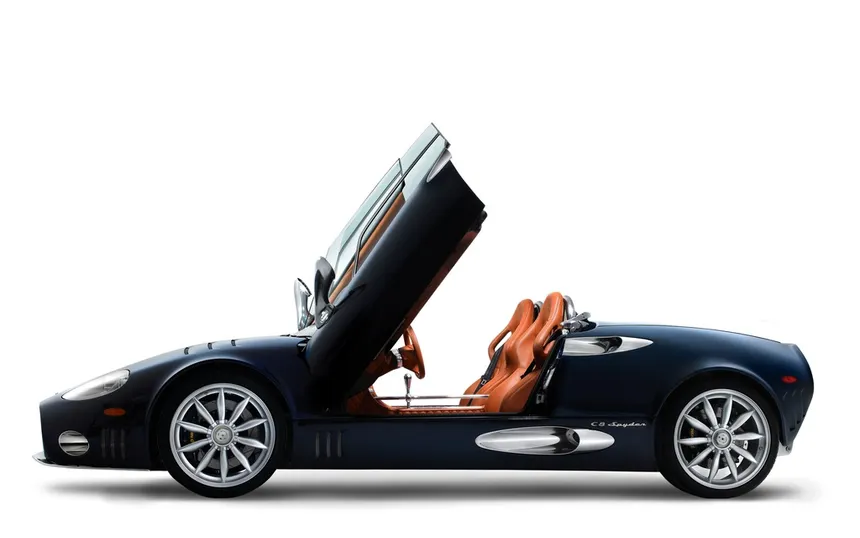
When he was done, in 1996, the car worked. It weighed 940 kilograms. It was a low-slung two-seater coupé with proportions that nodded vaguely towards 1970s Lotus design but with a cabin that exposed its own engineering. Rivets visible. Aluminium panels brushed by hand. A naturally aspirated 3.6-litre Audi V8 producing 265 horsepower. Zero unnecessary electronics. Just enough to make the thing breathe.
And then came the critical decision. De Bruijn was not going to call this “the Maarten de Bruijn car.” Somewhere during those six years he had gone to the Dutch trademark registry and purchased every right to the name Spyker, a Dutch marque that had gone bankrupt in 1926 and lain dormant for three quarters of a century. He bought it. He registered it under his name. And he christened his car the Spyker Silvestris V8.
The Goodwood moment
In 1999, after three additional years of refinement, de Bruijn took the Silvestris to the Goodwood Festival of Speed. This matters because Goodwood is not a trade show. It is the British motoring aristocracy’s annual garden party, where Aston Martins of provenance line up next to Ferraris registered to Gulf royalty next to prototypes worth more than your house. A man arriving with a one-off he had hand-built in his workshop, with no known marque behind him, was either going to be quietly dismissed or noticed.
He was noticed. By a great many people. Most importantly by a man called Victor Muller, a Dutch lawyer, entrepreneur and serious car collector with enough capital to buy whatever caught his eye. Muller walked up to the Silvestris, looked at it, and saw two things at once. First, the car had soul. Second, the name on the nose had history. Real history. Not boutique history. Spyker. That was a marque with a 60HP in a Dutch museum that had invented the world’s first six-cylinder petrol engine, first petrol-powered four-wheel drive, and first four-wheel braking system in 1903. (There’s a piece on NEC about that car. Worth your time.)
Muller approached de Bruijn and offered to finance bringing the Silvestris to production. De Bruijn accepted. That same year, 1999, the two of them founded Spyker Cars N.V. in the Netherlands. The first private customer to fall in love with the prototype had just become the co-founder of the company that would manufacture it.
That phrase deserves framing. The first customer became the co-founder. In any other industry this would sound improbable. In the boutique supercar industry it is roughly how things work: the first wealthy enthusiast to commit becomes the financial spine of the operation, and the original creator gets to keep building.
Between 1999 and 2000, de Bruijn evolved the Silvestris into the C8. He refined the bodywork, lengthened the proportions slightly, upgraded the powertrain, sharpened the details. And for the production work he couldn’t undertake alone, he found two specialist coachbuilders to take on the parts of the job that exceeded his workshop’s capacity.
The first was Coventry Prototype Panels (CPP), based in Coventry, England, run by an Irishman named Brendan O’Toole. CPP specialised in hand-beaten aluminium panels and low-volume chassis work for manufacturers without in-house capacity. The same firm would later assemble the entire Aston Martin One-77 and produce one-off bodywork for Bentley. CPP built the original C8 prototype shown at Birmingham in October 2000 and retained the contract for chassis work and the most complex body panels: bonnets, side scoops, anything requiring three-dimensional compound curvature. Old-school panel-beating with rawhide hammers and English wheels.
The second was Karmann, in Osnabrück, Germany. The legendary coachbuilder that had been producing convertible bodywork for Volkswagen and Mercedes-Benz since the 1950s. Karmann didn’t hand-beat panels. Karmann produced panels using serial tooling: stamping dies, presses, repeatable industrial quality. Spyker contracted Karmann to manufacture the flat and repeatable panels, the parts that needed to come out identical unit after unit. Door skins, hardtops, floor sections.
The division of labour was clear. CPP handled the parts that required the soul of the old craft. Karmann handled the parts that needed the muscle of modern industry. For the first seventy chassis, every panel without exception was hand-beaten. From chassis number 70 onwards, Karmann had developed sufficient tooling to mass-produce the panels assigned to them. The pure artisanal phase of the C8 Spyder ended at that unit. After that, the process became semi-industrialised, though final assembly remained manual.
Birmingham, 17 October 2000
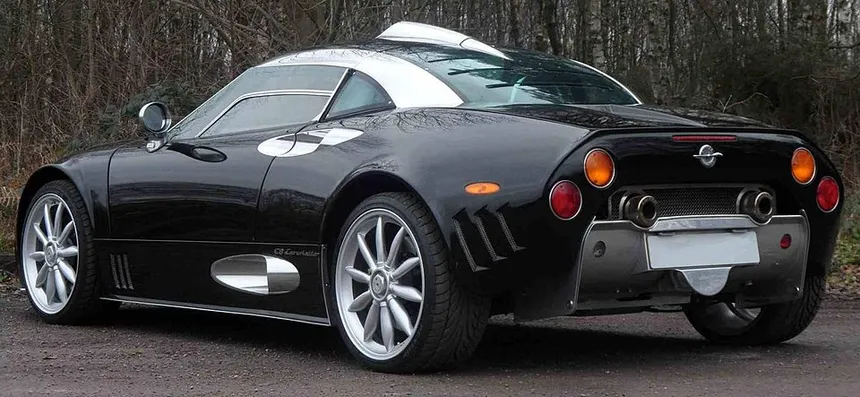
The Birmingham International Motor Show of 2000 was the British motoring industry’s big annual showcase. Every important manufacturer was there with new models. And in a modest stand the lottery had assigned to the new arrival, Spyker pulled the cover off the C8 Spyder.
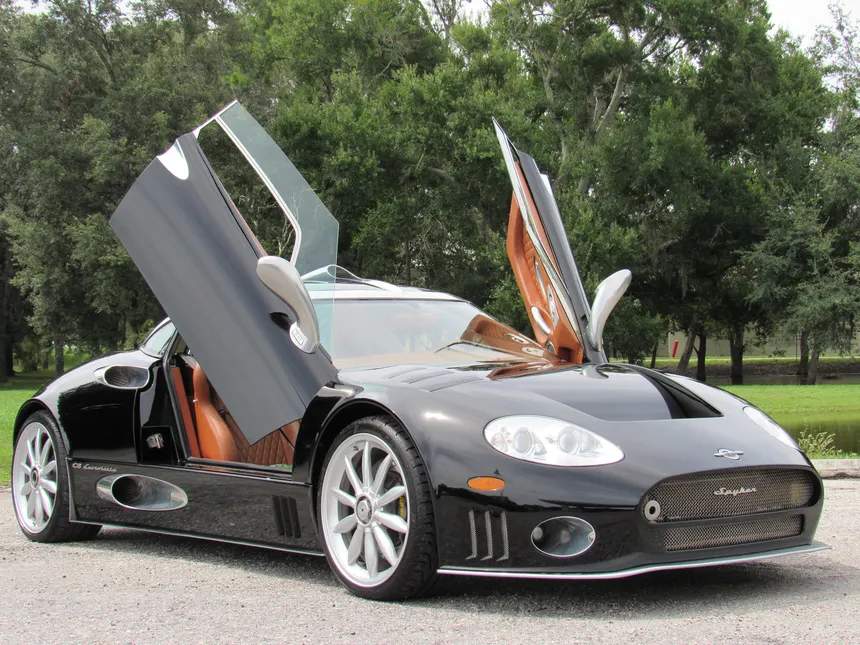
Seventy-five years after the last Spyker had rolled out of a factory, in the middle of the MP3 era, in a hall where everyone else was launching minivans with side airbags and infotainment touchscreens, this thing appeared: a mid-engined open-top supercar with a naturally aspirated Audi V8 producing 400 horsepower, a six-speed Getrag manual, an all-aluminium spaceframe chassis, hand-formed aluminium bodywork. 1,275 kg dry. 0–100 km/h in 4.5 seconds. Top speed 300 km/h. Scissor doors with electric-hydraulic operation.
But the specifications, frankly, were almost beside the point. What made the C8 Spyder different from anything else in that hall was what happened when you swung those doors up and sat inside.
A watchmaker’s cabin
This is where de Bruijn played his real hand. The cabin of the C8 Spyder did not resemble any other supercar cabin produced in the year 2000. It still doesn’t resemble most cabins produced today.
The instrument panel was hand-brushed aluminium. The dashboard air vents were aircraft propellers. Literal propellers. When you adjusted the airflow, the blades spun. The switches were aviation toggle switches, the kind that wouldn’t have looked out of place on a Lancaster bomber. The seats were hand-stitched. And the detail that would define the marque forever: the gear lever and its entire mechanical linkage were left fully exposed, with no centre console hiding them. You could see how the lever connected to the gearbox, watch the linkage articulate as you changed gear, observe the mechanism actually working.
In 2000, when the rest of the automotive industry was moving in the exact opposite direction, towards visual simplification, soft-touch plastics and “limousine-grade interior ambience”, this was a flagrant gesture against industrial common sense. It was putting the mechanical in plain view. Like a Swiss skeleton watch. A skeleton watch with four wheels.
Months after launch, the C8 Spyder won the Institute of Vehicle Engineers Design Award. The industry quietly acknowledged that this car had done something nobody else had dared.
The engine as the sound system
There is a detail about the C8 Spyder that gets passed over as quirky trivia but which is actually a statement of philosophy. Roughly 80% of all Spykers sold were ordered without a stereo system. The figure was confirmed by Spyker itself in an interview with Top Gear. The official explanation was one of the great marketing lines in modern supercar history: “the engine provides all the sound one could possibly wish for.”
That wasn’t a slogan. It was an engineering decision. The naturally aspirated 4.2-litre Audi V8 that sits behind the cabin of the C8 was originally developed for the Audi S6 and RS6, where it has a reputation for being smooth, refined, well-mannered. A polite German V8 designed to propel premium saloons in quiet executive comfort. But take that same engine, mount it mid-chassis less than a metre behind the driver’s head, in a cabin with virtually no sound-deadening, exhaust through a stainless steel system with twin operating modes (a rumble setting and a stealth setting, controlled by bypass valves), and the personality of the powerplant changes completely.
Evo magazine put it in a sentence that has followed the marque around ever since. The V8 in the Spyker sounds “loud, raw and raucous enough to strip paint off walls, the leaves from the trees and the colour from your passenger’s cheeks.” Evo concluded the same review with: “the Spyker is about as civilised as a bear in a trap.” Jeremy Clarkson on Top Gear compared the exhaust note directly to the Ferrari V8s of the era and meant it as a compliment.
The decision to skip sound-deadening was deliberate, technical, and ideological all at once. Any additional acoustic insulation would have compromised the C8’s power-to-weight ratio, one of the few specifications Spyker would not negotiate on. The result is that the cabin acts as a functional resonance chamber. The Audi V8, which in its native habitat is a gentleman, in the C8 barks. When you climb the rev range you feel the vibration through the headrests. When you bury the throttle, you don’t need an audio system. Spyker knew this. That’s why they sold cars without one and were proud to advertise the fact.
That is another layer of what the C8 Spyder actually is. It is not just a car to look at. It is a car to hear.
And here is the piece almost nobody tells about the C8 Spyder. The original steering wheel was a three-bladed aluminium propeller. The Spyker logo turned into the driver interface. It was the definitive detail, the signature of the car. It had to be replaced shortly after launch with a steering wheel sourced from a Lotus, and later from a Lamborghini Gallardo, on safety grounds. The propeller design could not accommodate a regulation-compliant airbag, and a car without a homologated airbag cannot be sold.
There, in microcosm, is everything that would later happen to Spyker as a marque. Craftsmanship versus regulation. Aesthetic identity versus industrial viability. De Bruijn had designed a steering wheel that was perfect in terms of brand identity and proportional logic, and he had to swallow it because regulations don’t care about identity. The car went from a propeller to a Lamborghini wheel and nobody made a great fuss about it at the time. But it stays in the record. The first amputation.
Production reality
For the first years of the C8’s life, Spyder and its coupé sibling the C8 Laviolette were built in Zeewolde, Netherlands. The number that matters is this: between 2000 and 2011, Spyker produced approximately 240 cars across the first-generation C8 family, including the Spyder, the Laviolette and the Double 12. That works out to roughly one car every two weeks. That is not a factory. That is a workshop operating on a watchmaker’s calendar, panel by panel, chassis by chassis.
From chassis number 70 onwards, Karmann began producing panels using proper serial tooling rather than purely hand methods. The fully artisanal phase of the C8 Spyder ended at that unit. After that, the process became semi-industrialised, though final assembly remained manual.
And in 2005, with relatively little press attention, Maarten de Bruijn left Spyker. He sold his shares and walked away. The previous year the company had listed on Euronext Amsterdam. The following year, Mubadala, Abu Dhabi’s sovereign wealth fund, would acquire 17% of the company. The marque was no longer a workshop. It was becoming a publicly traded company with major institutional investors and quarterly analyst calls.
De Bruijn left, by every available account, because of that drift. His own design philosophy, in his words, was about creating “sculptures.” Making “engineering look beautiful.” Making cars that were simple, natural, drawn from forms in nature rather than from focus groups or trend forecasts. That philosophy did not survive contact with boards of directors and shareholder meetings. So he took his shares, walked out, and founded a boat company called Silvestris Aquamotive with several former Spyker employees. He built aluminium speedboats using the same construction techniques as the Silvestris and the C8. In 2014, he sold the hull design to Aston Martin, which produced it as the AM37.
In 2023, eighteen years after leaving Spyker, he returned to cars. He founded deBruyn Cars with two partners (Wouter van Everdingen, owner of Palmesteyn, and Niek van Exel, founder of Bloomit Ventures) and unveiled the deBruyn Ferox V8 at the Wheels at the Palace event in the Netherlands in September 2023. The Ferox isn’t a tribute to the Silvestris. It’s its logical continuation.
Hand-beaten aluminium bodywork. Bonded aluminium chassis. Aluminium suspension componentry. The whole car weighs 1,050 kilograms, thirty kilos less than the original Spyder. A 6.2-litre naturally aspirated V8 adapted from a GM source unit (not Audi this time) producing 500 horsepower and 650 Nm of torque. Six-speed manual. The power-to-weight ratio is essentially the same as a Ferrari 488 Pista, but the Ferox is 300 kilos lighter than the Pista. That is the metric that matters here.
The Ferox’s design carries the Silvestris DNA evolved by thirty years of accumulated experience. The same aerodynamic proportions, refined. The same hand-built cabin details, but now with the practical knowledge of what worked and what didn’t in the original C8. No scissor doors, because de Bruijn has said publicly he never really liked them as a design statement. No propeller steering wheel, because he learned the homologation lesson the hard way. But brushed aluminium everywhere, an exposed gear linkage running the length of the cabin, an instrument panel built by hand. Prices start from €650,000 per car, built to order. Three units sold before public reveal. He builds them himself. In his workshop. The same way he built the Silvestris.
And here’s the detail that no novelist would have dared to invent. At the public launch of the Ferox in September 2023, Victor Muller, de Bruijn’s former business partner, attended the event and congratulated him publicly in front of the assembled crowd. After eighteen years. After the boardroom departure, the Euronext IPO, the corporate drift, the Formula 1 misadventure, the Saab acquisition, the two bankruptcies. The man who had once financed the production version of the car that de Bruijn had built alone, returned to acknowledge in public that the man in the workshop was still doing the same thing, three decades on, and was still doing it well. Full circle. Literally.
The car that could no longer be made
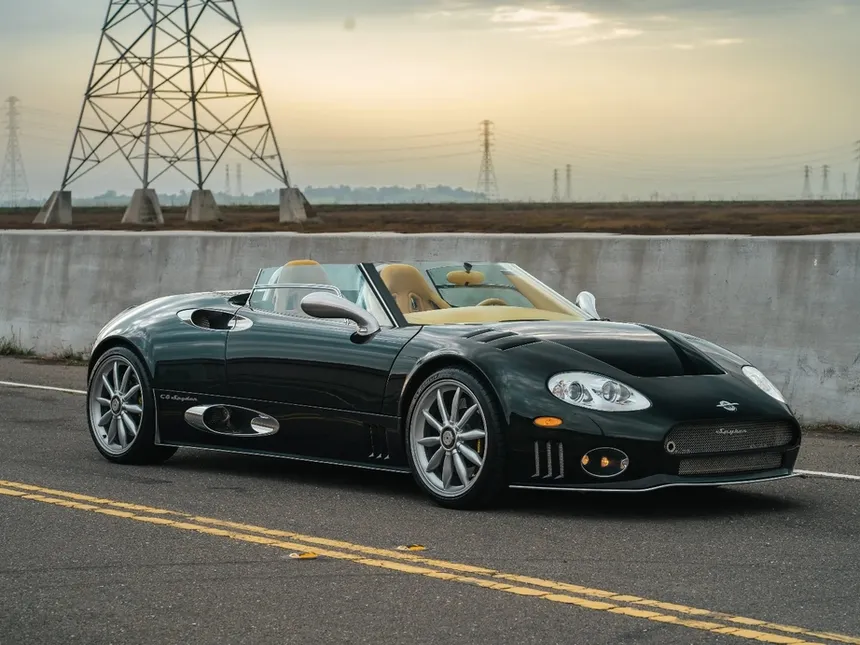
Why does the C8 Spyder matter? It matters because it is the last meaningful supercar of the twentieth century that one human being conceived and built with his own hands, before the industry processed him. The Silvestris first, the C8 Spyder as its direct production successor. Every dominant trend in twenty-first century automotive industry runs in the exact opposite direction to the C8 Spyder: mass production efficiencies, mandatory electrification, software-defined vehicles, over-the-air updates, sensor packages, advanced driver-assistance systems, mechanical components hidden behind soft-touch panels. The C8 Spyder is the precise opposite of all of that.
That is why it is important. It marks a point on the calendar. It is the last supercar of the twentieth century that could be born outside the industrial system. After it, that path closed. Today you cannot build a supercar in your workshop and sell it. You will not get the instrument cluster homologated. You will not get the steering wheel signed off. You cannot meet pedestrian impact regulations, side-impact regulations, type-approval emissions cycles, ADAS minimum specifications. What de Bruijn did between 1990 and 1996 is functionally impossible today. And that closes the twentieth century for good.
The C8 Spyder is the frontier. The last photograph of a world in which a town planner from Naarden, with his hands and six years of his life, could build a car and resurrect a marque. After him, every new boutique supercar would be a project of investor groups, contracted engineers, homologation departments and press teams. Pagani worked with a team from the start. Koenigsegg too. The Spykers that followed de Bruijn within Spyker itself were corporate products, not the product of a single pair of hands.
That makes the C8 Spyder more than a supercar. It makes it a historical specimen. A fossil of a way of doing things that no longer exists.
What happens when you see a C8 Spyder rolling past you in the street, if the naturally aspirated V8 reaches your ear before the exposed gear linkage reaches your eye, is exactly this: you are watching the end of a century of automotive industry rendered into four wheels. You are watching the last thing that was made this way.
What comes next, you already know. Cables.
Check you’re still alive.