Aixam Mega Track: the off-road supercar that arrived 25 years early
The best-selling Lamborghini in history isn’t a Countach or a Miura. It’s the Urus, an SUV. The Porsche the internet lost its mind over a couple of years ago was the 911 Dakar, a jacked-up, all-wheel-drive 911 built to leave the pavement. The whole industry now agrees that a supercar you can actually drive up a dirt road, through snow, over a curb, is a brilliant and hugely profitable idea.
A French company figured that out in 1992. A French company that, at the time, built glorified go-karts you could drive without a license. They put a Mercedes V12 in a five-meter monster with all-wheel drive, off-road tires, and suspension that could hoist the whole thing a foot off the ground. The press had no idea what to do with it. And it took the rest of the world a quarter of a century to admit those crazy French people had been completely right.
From license-free microcars to a V12
To understand the madness you have to start with who committed it, because that’s half the joke. Aixam is a French company from Aix-les-Bains, founded by entrepreneur Georges Blain in 1983 on the ashes of a bankrupt firm called Arola. And what did Aixam do? It built microcars. Specifically, those peculiar little French machines you can drive without a license — the “voiture sans permis,” lightweight, slow vehicles for people with no license or fourteen-year-olds. Boxes on wheels. About as far from a supercar as it’s possible to get.
But that wasn’t enough for Blain. He was an ambitious man, and in the early nineties he decided his toy-car company was going to build a supercar. To do it, in 1992 he created a separate brand, Mega, and set to work on a project that had been brewing for a couple of years. The result was shown at the 1992 Paris Motor Show, and it was one of the strangest things ever to set a tire on a show floor.
The contrast is worth pausing on, because it’s almost comic. Aixam came from a world where the key words were “no license required”: vehicles designed so a fourteen-year-old or someone without a license could legally get around, limited in power and speed by law, the absolute antithesis of aspiration and excess. That a company like that, specialized in the small, the slow and the humble, would wake up one morning and decide to fight in the league of Ferrari and Lamborghini is one of those stories of runaway ambition the car world produces with unusual frequency. Blain didn’t want to build a better microcar. He wanted to build the wildest possible car, and it didn’t matter to him that his company had neither the name, nor the history, nor the factory for such a leap.
A supercar with off-roader ground clearance
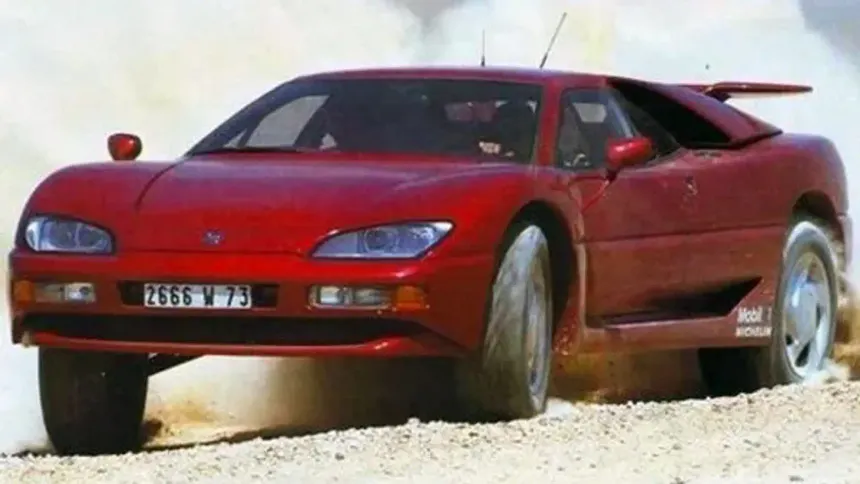
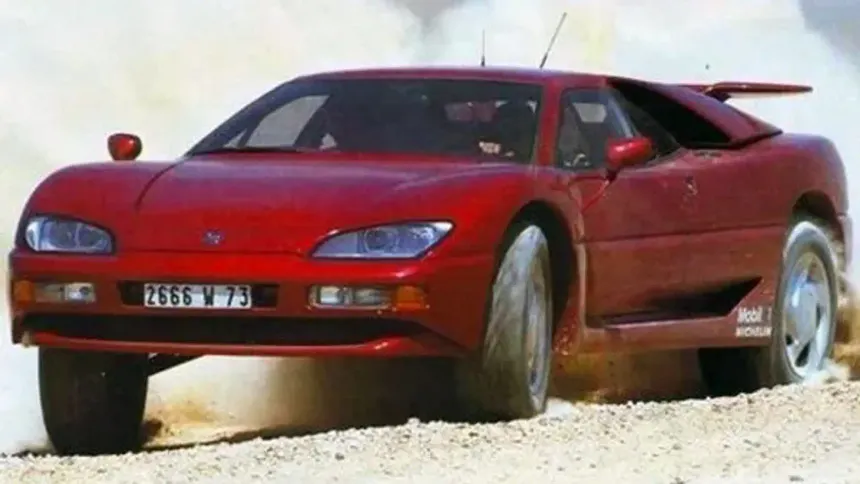
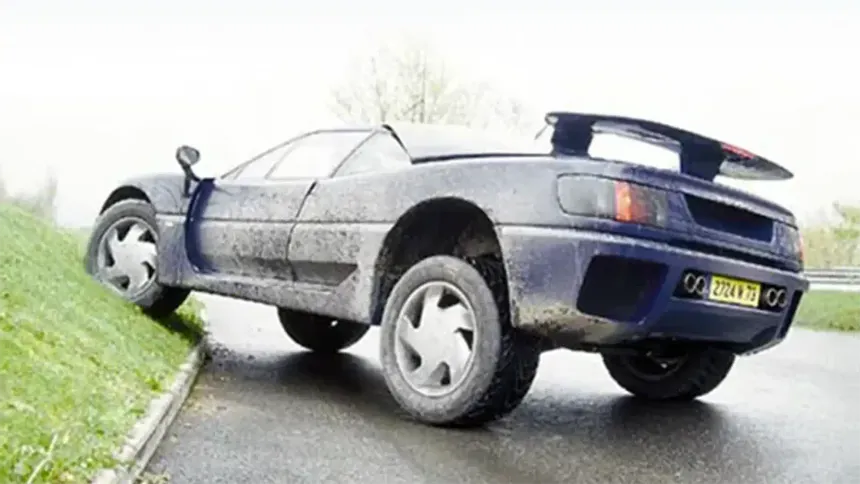
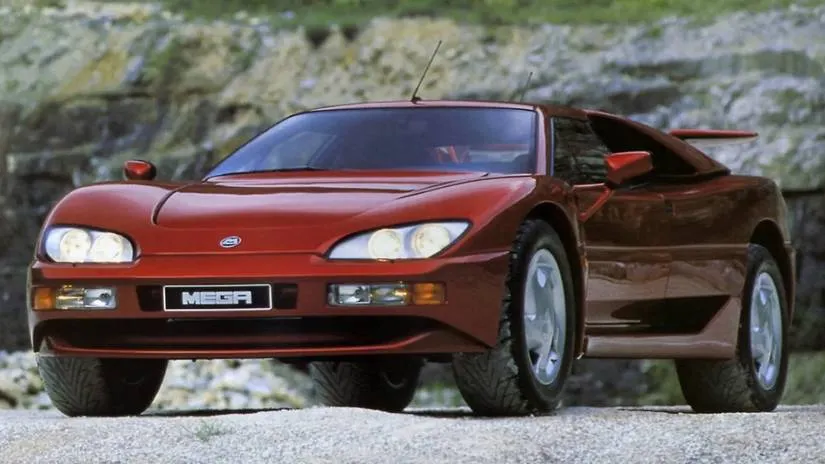
The Mega Track had the silhouette of a nineties supercar: low, long, wide, mid-engined, with exotic proportions. But look twice and something didn’t add up. It was enormous, nearly five meters long and over two wide, bigger than many cars in its class. It wore huge 20-inch wheels, when a Lamborghini Diablo of the day ran 18. And above all, it sat too tall. It had a ground clearance that, in a supercar — a world where cars bragged about scraping the asphalt — looked simply like an aberration.
Because the Mega Track hid its ace: height-adjustable air suspension. In normal position it already stood taller than any rival, but it could rise to around 33 centimeters of ground clearance. With that, and its all-wheel drive, this supercar could leave the tarmac and head onto dirt roads, gravel, even snow. Michelin custom-built it special 20-inch tires capable of handling both road speed and off-road abuse. It carried a 110-liter fuel tank, meant for big distances far from gas stations. It was, in essence, the world’s first off-road supercar. A category that in 1992 didn’t exist, because it had never occurred to anyone that it could.
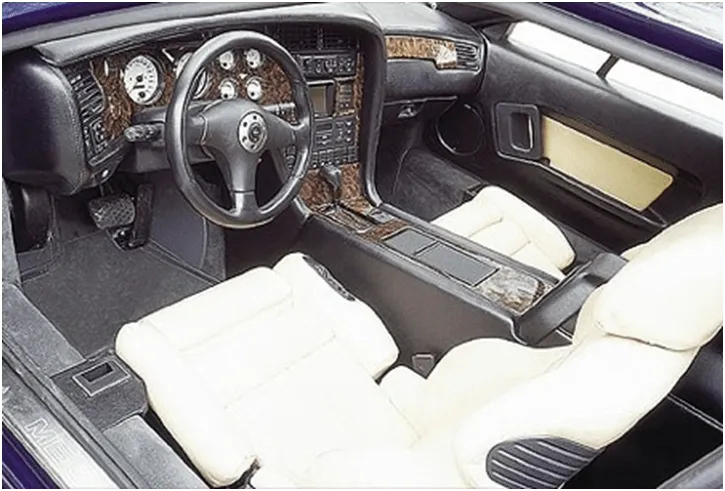
The heart came from Mercedes: the big 6.0-liter M120 V12 from the Mercedes-Benz S600, the German brand’s flagship, delivering close to 394 horsepower and an ocean of torque. It mated to an automatic gearbox and an all-wheel-drive system with a 32-to-68 power split front to rear. During development, that huge engine suffered overheating problems buried in the bodywork, and the engineers had to add four electric fans to keep it in check. With all that hardware, the Mega Track weighed around 2,280 kilograms, an absurd figure for a supercar, closer to a light truck than a Ferrari. A sumo wrestler in the supercar dojo.
And it wasn’t, mind you, a badly resolved monstrosity. Under the bodywork sat a tubular spaceframe chassis, double-wishbone suspension, and despite its size and height, a drag coefficient around 0.40, not far off a Lamborghini Countach 5000S of the era. The engineering was thought through. There were even competition-oriented versions built for surfaces off the tarmac, and the Mega brand went on to win the Andros Trophy, the French ice-racing championship, in the 1994-1995 season. The concept of a hugely powerful car unafraid of difficult surfaces wasn’t an aesthetic whim: it was an idea with real technical legs, proven on ice before anyone had thought up the phrase “high-performance crossover.”
The right idea at the most wrong moment
And here’s the drama, the part that turns this oddity into a story worth telling. The Mega Track wasn’t a joke or a bored engineer’s folly. It was a coherent, even brilliant idea: an extremely fast, powerful car that also wouldn’t get stranded or beached the moment the road turned bad. An exotic you could actually use, at a mountain chalet, on a snowy track, anywhere a normal supercar would never dare go. Practicality and performance in the same package.
The trouble is that in 1992 nobody wanted that. The nineties supercar buyer wanted exactly the opposite: a car that sat impossibly low, hard-riding, impractical, scraping the ground, a torment over any bump. Impracticality was part of the appeal, almost a status symbol. Saying your supercar could climb a dirt road was like saying your tuxedo also worked for painting the fence: nobody saw it as a virtue. They saw it as an incomprehensible contradiction. The Mega Track offered a brilliant answer to a question absolutely nobody was asking yet.
Blain’s vision, in hindsight, was startlingly specific. Picture the buyer he imagined: someone wealthy enough for a V12 exotic who also lived somewhere the roads were bad, or had a ski chalet up a mountain track, or simply wanted to drive their supercar three hundred kilometers across country without shredding the underside on every ridge. That 110-liter tank wasn’t decoration; it spoke of long journeys, of a car meant to actually go places rather than pose outside a hotel. It was a supercar reimagined as a tool instead of an ornament. Two decades later that’s the exact pitch of every performance SUV on the market. In 1992 it sounded like nonsense.
And the price finished the job. It cost around two million francs of the day, some 300,000 to 400,000 dollars, a figure that put it in the territory of the most expensive exotics without a legendary badge behind it. Who was going to pay Ferrari money for a tall, strange car built by a company that made license-free vehicles? The answer was: almost nobody. Despite the enthusiasm it stirred at launch, the orders didn’t come. The project dragged on and by the mid-nineties it was dead, replaced by a slightly more conventional model, the Mega Monte Carlo. In total, barely five or six Mega Tracks were built. Five or six cars for an idea that today generates billions.
What vanishes and what just arrives late
Careful with the easy nostalgia, because the Mega Track didn’t exactly disappear: it never really existed in enough quantity to disappear. Those five or six examples are extremely rare collector’s pieces today, ghosts of a future the company saw ahead of time. Physically, the car barely existed.
But its idea didn’t die. It just came early. Think about what’s happened in the car world in recent years. Porsche launches the 911 Dakar, a raised 911 with all-wheel drive and the ability to leave the road, and the press hails it as bold genius. Lamborghini reveals the Huracán Sterrato, a mid-engined supercar set up for dirt, and it sells out. The Lamborghini Urus, an SUV with a supercar’s soul, becomes the best-selling model in the brand’s history and rescues it financially. The idea of mixing an exotic’s performance with the ability to go wherever you want stopped being an aberration and became one of the most profitable trends in the industry.
All of that — every bit of it — had already been laid out by a French maker of license-free cars in 1992. Physical death and paper death aren’t the same: the Mega Track barely existed as an object, but as an idea it sits today in every premium dealership on the planet. Only none of those now making millions off the concept remembers poor Georges Blain and his impossible supercar.
What the Mega Track teaches
This story fascinates me for what it says about the price of being early. Arriving late to an idea is an obvious failure, everyone gets that. But arriving too early is a far crueler failure, because you’re right — you’re completely right — and you still lose. The Mega Track wasn’t wrong about the idea. It was wrong about the date. It had the right vision a quarter century before the world was ready to buy it, and so, instead of founding an empire, it sold half a dozen cars and went quiet.
There’s a hard lesson in this for anyone with ideas. Being right isn’t enough. You have to be right at the right moment, not before, not after, and that part isn’t fully up to you. Georges Blain saw the future with astonishing clarity. His only mistake was seeing it too soon, while people were still laughing. Those who showed up twenty-five years later, with exactly the same idea but at the right moment, took the millions and the applause.
Ask yourself something next time you see a Porsche 911 Dakar climbing a dirt road in an ad, hailed as the height of daring: a maker of license-free cars already did it in 1992, and the world laughed at him. Automotive history is full of visionaries who committed just one sin — being right too early. And almost nobody remembers their names. The market rewards the well-timed, not the first; Blain got the idea and someone else got the empire. That’s not justice, but it’s how it works, and the Mega Track is one of its purest monuments.
Check you’re still alive.