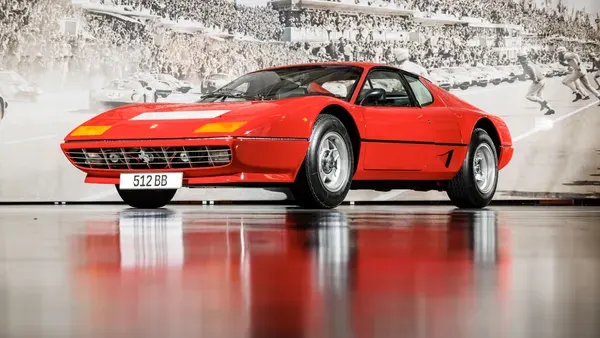
Ferrari 512 BB: The Boxer That Never Was
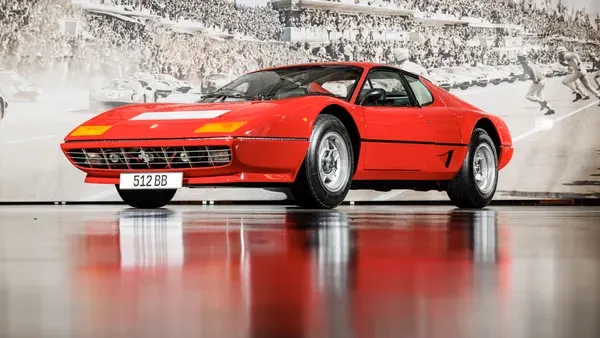
There is a Ferrari where almost nothing written on the car turns out to be true. The engine is not a boxer, despite half a century of the factory saying it is. The two letters in the name do not mean what Ferrari says they mean, according to the man who designed it. And the performance figures the factory published contradict each other from one manual to the next.
It is also the Ferrari you could not legally buy new in the United States. Not one car, in eleven years of production.
What the two Bs actually stand for
The official answer is Berlinetta Boxer. Berlinetta for the closed two-seat body, Boxer for the engine.
A second version, argued by Mauro Forghieri, holds that BB comes from Berlinetta Bialbero, Italian for twin overhead camshafts, since the 365 GT4 BB introduced belt-driven twin cams rather than the chain drive Ferrari had used before.
Then there is what Leonardo Fioravanti said. He designed the car at Pininfarina. In an interview with The Road Rat, he explained that the entire team had Brigitte Bardot on their minds. They had recently seen one of her films, he was very young at the time, and from the first moment they referred to the car as BB.
When it came time to sell it, somebody inside Ferrari pointed out the obvious: you cannot launch a car called the 365 GT4 Brigitte Bardot. So they needed two words starting with B that fit the product. Berlinetta Boxer was the result.
The technical name Ferrari has defended since 1973 is a retroactive alibi for a studio nickname.
And the engine is not a boxer either
Which is where the alibi becomes a problem, because the word they chose to cover for Bardot describes the engine incorrectly.
In a true boxer, each connecting rod has its own crankpin, so opposing pistons move inward together and their inertial forces cancel. In the BB’s engine, each crankpin carries two rods, one from each bank. When one piston moves out, its opposite moves in. That is a 180-degree V12, not a boxer.
The engine’s origins confirm it. It derives from Ferrari’s flat-twelve racing units, including the Formula 1 engines designed by Forghieri.
It is the same argument we made in our Testarossa piece, which inherited this engine. The difference is that here the error is stamped on the car.
Why it is called a 512
Ferrari named its twelve-cylinder road cars after the displacement of a single cylinder. The 365 GT4 BB carried that badge because each of its twelve cylinders displaced 365 cc, exactly as on the Daytona.
The 512 broke the convention. The 5 is liters, the 12 is cylinders, borrowing the logic of the earlier 512 racing cars. Displacement grew to 4,943 cc with compression raised to 9.2:1.
Three consecutive models, three different naming systems. Daytona by single-cylinder displacement, 512 by total capacity, Testarossa by the color of some cam covers from the 1950s.
The car that retired the Daytona
This is what closes the loop from our previous piece.
Enzo Ferrari spent the 1960s insisting that the engine in his road cars belonged up front, while Lamborghini launched the Miura in 1966 and the industry swung to mid-engine layouts. The Daytona of 1968 was the stubborn answer, and it worked commercially.
The Berlinetta Boxer is the surrender. It was the first road-going Ferrari with twelve cylinders behind the driver, and it arrived seven years after the Miura. Pininfarina had shown the prototype at the Turin Show in 1971, and production did not begin until 1973.
More than half a decade passed between the moment the argument was settled and the moment Ferrari accepted it in a twelve-cylinder road car.
Where they put the gearbox
This is the architectural decision that explains how the car behaves, and it deserves explaining because it drives everything else.
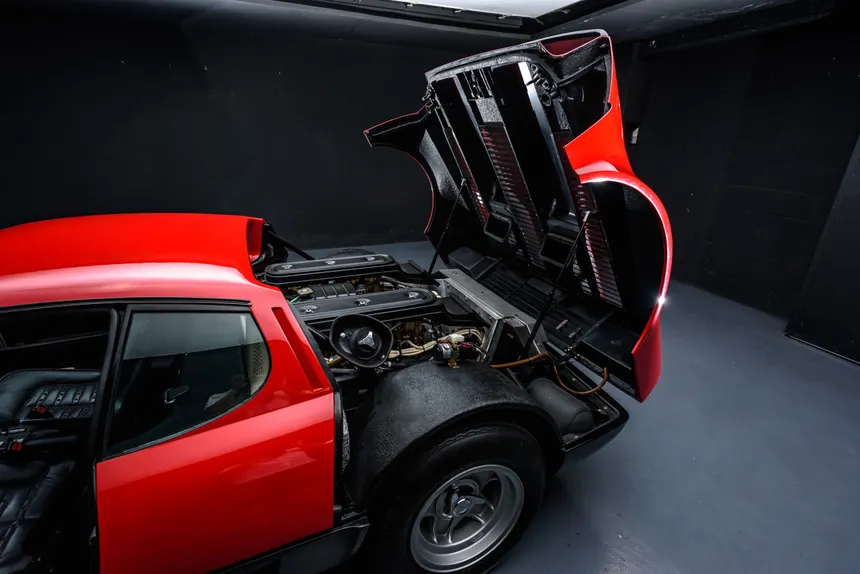
In the BB, the engine is not mounted ahead of the transmission the way a conventional mid-engined car does it. The assembly is stacked: the flat twelve sits on top of the five-speed gearbox and differential, sharing a casing and sharing oil.
The benefit is length. By stacking vertically instead of stringing components horizontally, Ferrari fit a five-liter twelve behind the cabin within a 2,500 mm wheelbase, which is shorter than the Daytona’s.
The cost is the center of gravity. A flat engine mounted that high raises the center of mass exactly where you least want it, and it leaves a significant share of the weight behind the rear axle. That is where the Boxer’s reputation among people who have driven one hard comes from: it gives little warning and it punishes a lifted throttle mid-corner.
The flat engine is misleading. The theoretical advantage of a low-profile twelve disappears the moment you set it on top of a gearbox.
What changed from the 365 GT4 BB
The 512 arrived at the Paris Salon in 1976 with the five-liter engine and what looked at a glance like the same body.
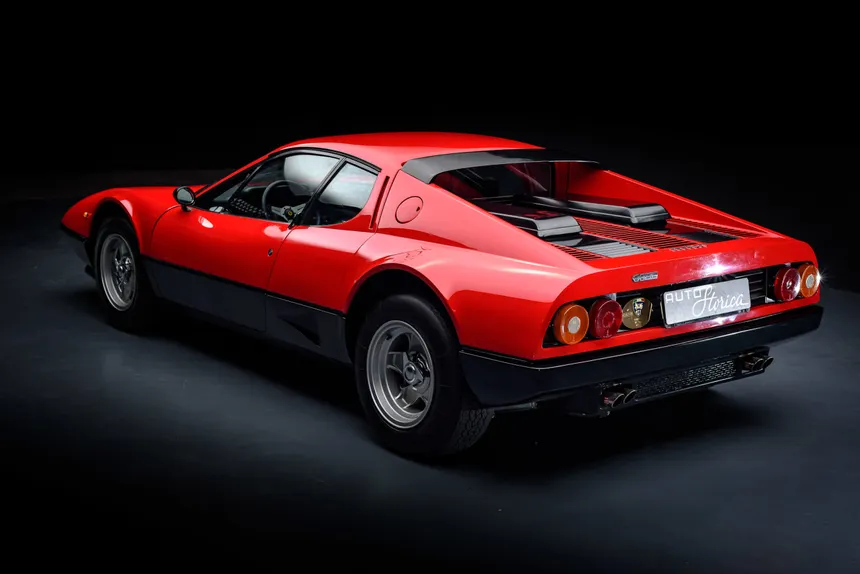
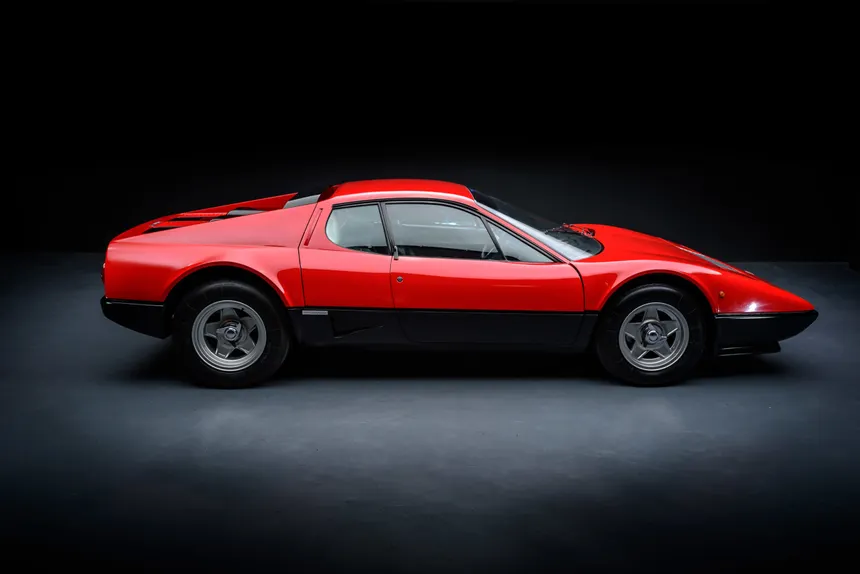
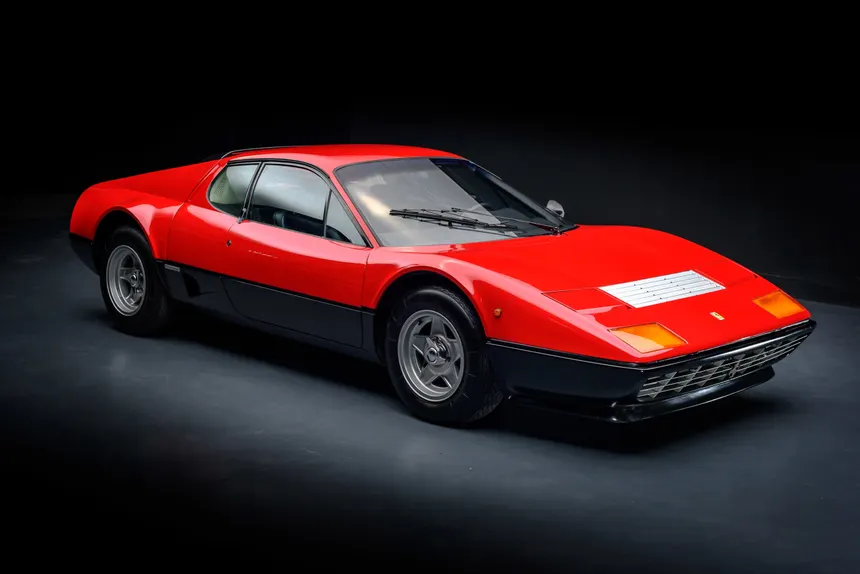
The changes were real. Rear track grew from 1,520 to 1,563 mm. NACA ducts appeared in the flanks, feeding cooling air to the exhaust system in the rear wheel arches. A front spoiler was integrated into the bumper. The three taillights per side became two. The rear grille panel switched to horizontal slats in satin black. And the car received metric Michelin TRX wheels with Rudge-type center-lock nuts, though legislation in some countries forced a large octagonal nut instead.
The new engine was not chasing peak power. It made the same figure at lower revs, with more torque and a smoother response than the 4.4.
Ferrari’s own numbers do not agree
This section is my favorite, because the problem is not the magazines. It is the factory.
According to the workshop manual, the 365 GT4 BB reached 302 km/h and the 512 BB managed 288. The five-liter car was slower than the 4.4 it replaced. Dry weight tells a similar story: 1,235 kg for the 365 against 1,515 for the 512.
Ferrari’s measurements from that period are inconsistent even between its own documents. The workshop manual records speed at the tachometer’s redline, while the owner’s manual documents an attainable speed, which is not the same thing. The workshop manual also fails to separate carbureted and injected cars with any consistency beyond the fuel system itself.
Which means the 302 km/h you have been reading about the Boxer for decades is a manual figure, not a timed run, published by a manufacturer whose own paperwork disagrees with itself.
America never got one
Not a single Berlinetta Boxer was officially imported into the United States. Not one car, across eleven years and three generations.
Enzo Ferrari’s reasoning was commercial. Between the escalating emissions and safety rules and the 55 mph national speed limit, he concluded that the company’s eight-cylinder cars were sufficient for the American market. Certifying a twelve for the US was not worth the cost.
That matches exactly what we covered in the Daytona piece: the Daytona was the last twelve-cylinder Ferrari sold new in the United States through official channels until the Testarossa in 1984. The Boxer is the car that fills that eleven-year gap, which is precisely why it is not there.
The ones on American soil arrived through the gray market, imported and federalized one at a time by third parties, modified to satisfy whichever rules applied. A car retaining original European specification is worth more to collectors today than a federalized one, and sorting out which is which is part of buying one.
The BBi and the end of a way of building cars
The 512 BBi arrived in 1981. The i is for iniezione: out went the bank of four triple-choke Weber carburetors, in came Bosch K-Jetronic injection. The goal was meeting tightening emissions rules and improving reliability.
The result was a more civilized, easier car with slightly less power and none of the carburetors’ immediacy. A good share of purists still prefer the earlier BB for that reason.
BBi production ended in 1984, closing out the last era of Ferrari road cars built essentially by hand from start to finish. The Testarossa that followed was conceived with a different industrial mindset and volumes roughly four times higher.
Chinetti, Le Mans and the BB LM
The Boxer was conceived as a grand tourer and ended up at La Sarthe because one man kept pushing.
Luigi Chinetti, Ferrari’s US importer and founder of the North American Racing Team, had been racing modified 365 GT4 BBs since 1975 with modest results. In 1976 something happened that stung in Maranello: for the first time since Ferrari began building cars, not a single Ferrari appeared in the 24 Hours of Le Mans.
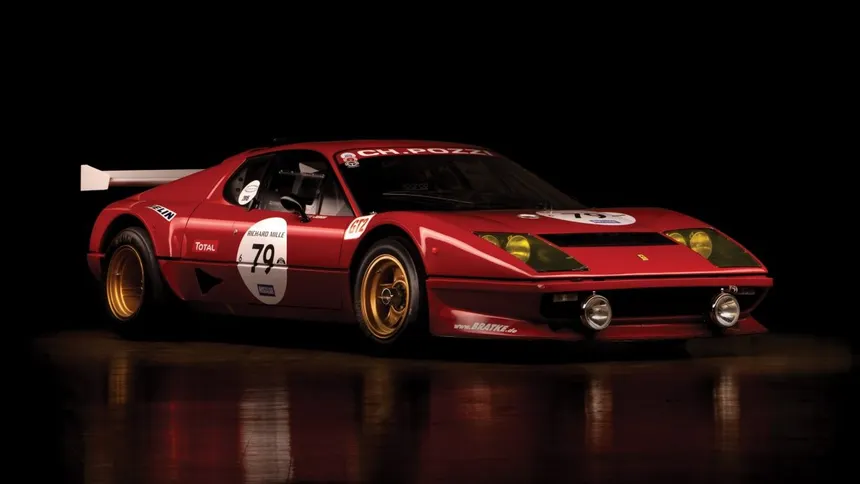
Chinetti kept lobbying until the factory agreed to develop a racing version. The 512 BB LM was built by the Customer Assistance department in Modena, with radically different bodywork developed in Pininfarina’s wind tunnel. Two small series were produced for private customers, roughly 25 cars, of which only 19 ever raced. None ran as a works entry.
The racing car’s numbers are a different world: 1,110 kg on the earliest examples, down to 1,058 kg on the last cars in 1982, with 500 bhp engines in the second series and speeds above 200 mph on the Mulsanne Straight.
Results were respectable rather than glorious. An IMSA class win, fifth overall at Le Mans in 1981 and sixth in 1982. Against the Group 5 turbo Porsches there was nothing to be done, and Ferrari itself treated the program as a customer operation rather than a factory campaign.
One of those cars belonged to Nick Mason, the Pink Floyd drummer.
Production and where it sits
Ferrari built 387 examples of the 365 GT4 BB, 929 of the 512 BB including 101 right-hand-drive cars, and 1,007 of the 512 BBi. Around 2,300 cars over eleven years.
For comparison, the Testarossa that followed ran to 7,177 units on its own. The Boxer is a far rarer twelve-cylinder Ferrari than the car that replaced it and became infinitely more famous.
The verdict
The Boxer is the Ferrari where the company wrote down three things that were not so.
It called the engine a boxer when it is a 180-degree V12. It called the initials Berlinetta Boxer when, according to the man who drew the car, they came from a French actress. And it published performance figures its own manuals contradict.
The car deserves better standing than it has. It is the exact moment Ferrari conceded that Lamborghini had been right, and then chose to solve the problem its own way, stacking engine over gearbox to fit a twelve into a ridiculously short wheelbase and accepting the handling consequences that came with it. That is a brave and arguable decision, which is the combination that produces interesting cars.
What happened afterward is that the Testarossa, which is this same machine in a different suit, took all the fame for turning up on television. The Boxer is rarer, harder to drive and clearer about what it is, and it gets a fraction of the airtime.
How much of what we take as settled about any car comes from the brochure rather than the scales?
Check you’re still alive.