Hartley Engines: The 1,070-HP V12 That Came Out of a Dirt-Track Shop
Toyota spent a fortune making a V12 that nobody would notice. The 1GZ-FE went into the Century, the hand-built limousine that outranks a Lexus in Japan, and every engineering decision behind it was aimed at silence, smoothness and the total absence of drama for the man riding in the back.
Thirty years later, a family shop in New Zealand set about undoing that work bolt by bolt until the emperor’s engine made a thousand horsepower and went into a drift car.
Those are the people now building the heart of Sasha Selipanov’s hypercar.
The name is Hartley. The address is 26 Domain Street, Palmerston North, on New Zealand’s North Island. The bread-and-butter work is speedway engines — dirt oval, concrete wall, full contact — plus twin-turbo V8s making 1,400 horsepower for jet sprint boats. That is the shop the man who penned the Bugatti Chiron went to for a naturally aspirated V12 spinning to 11,000 rpm.
The international press has framed this as though Selipanov found a diamond at the end of the earth. He didn’t find anything. What he found was forty years of a family building engines because there was no other way to go racing.
What actually happens at 26 Domain Street
Hartley Engines and Motorsport is a small business. Everything else in this story only makes sense once that lands.
Their long-standing customers race speedway, superstocks, stockcars and minisprints. American readers will recognize the DNA — dirt oval, big V8s, close quarters — but the New Zealand version takes it further than anything at Knoxville or Eldora. Brendon Hartley, the younger son of the house, describes it plainly: dirt oval, concrete wall on the outside, up to 120 cars, and full contact. It isn’t a demolition derby. The drivers take it entirely seriously. Contact is simply part of the sport.
The teams championship is where it gets genuinely strange. Every province or town fields a squad of four cars, staggered on the grid, racing another town’s four. Two of your cars are there to win. The other two are there to put the opposition into the wall. The only rule Brendon remembers is that you aren’t allowed to reverse. In Palmerston North, that event is the biggest sporting occasion of the year and it sells out.
Then there is jet sprint racing, a New Zealand specialty in which a boat with a 1,400-horsepower engine attacks a course of channels cut into a paddock at speeds that make no sense at all. Hartley builds those engines too.
And underneath all of it sits the rebuild business. Heads, blocks, dyno time. None of that makes hypercar press releases.
The Head Shop
All of this started with a carpenter.
Bryan Hartley was a carpenter by trade with an obsession for racing engines. He opened a small workshop and called it The Head Shop, because cylinder heads were all anyone brought him. By the mid-1990s it had grown into a larger building with a proper engine dyno and full rebuilds. Brendon’s mother runs the books. At any given time there might be one or two other employees. That’s the company.
Bryan raced everything. Minis, dirt speedway, Formula Atlantic, Formula Holden — the latter essentially Formula 3000 machinery with Holden power. In his Formula Atlantic years he shared a grid with Keke Rosberg, who was doing New Zealand seasons before he became a world champion. Bryan never had funding. He bought a Formula Atlantic that another driver had destroyed, paid almost nothing for it, spent the winter rebuilding it and raced it the following year. That is precisely the method his son now applies, only with a five-axis mill.
One story sums the man up. On the weekend of the first Melbourne Grand Prix, Bryan raced a support event against a young Australian named Mark Webber. Webber won the weekend. Bryan beat him in race one.
And one domestic detail explains this family better than any spec sheet: Brendon Hartley’s middle name is Morris. It comes from his father’s Minis. He wore out a videotape of Bryan racing Mini Sevens as a kid and later bought himself a 1967 car.
Nelson
The older son was named after Nelson Piquet. That alone tells you what kind of house this was.
Nelson Hartley left school young. He is entirely self-taught — he learned the design software on his own, and now draws the parts he machines. His younger brother, a four-time World Endurance champion and three-time Le Mans winner, says Nelson is the best engineer and designer he has ever met, and that he handles the whole chain alone: concept, design, manufacture. Once Nelson came into the business, the shop stopped simply rebuilding engines and started producing its own components in-house on CNC.
Nelson raced, too. Which brings us to the anecdote that carries this entire story.
The first official kart race between the two brothers was won by Nelson, aged ten, against a six-year-old Brendon. Brendon didn’t sleep that night. He has said that was the moment — six years old, beaten by his big brother — when he decided he had to win at everything he did. The rest of that sentence reads: four World Endurance titles, Le Mans overall wins in 2017, 2020 and 2022, and 25 Formula 1 starts with Toro Rosso.
Which makes the man building this V12 indirectly responsible for three Le Mans victories. By making his kid brother furious one night in the nineties.
Project 64: a Mini at 166 mph
Long before any hypercar showed up, Bryan and Nelson built the engine for a land speed record Mini.
The car was called Project 64 and belonged to friends from the South Island. It started with an original 1964 1000cc block and gearbox. Onto that went a BMW motorcycle twin-cam head and a very large turbo. The result was 328 horsepower on methanol and a run at 166 mph.
Nelson drove it.
The car eventually turned up on Jay Leno’s Garage, where the engineering got a proper examination. It remains the best possible calling card for the shop: a one-liter block, parts from three unrelated sources, and a self-taught guy behind the wheel at better than 160 mph.
The emperor’s engine
Here is the part nobody has written, and it is where Hartley’s twelve-cylinder education actually comes from.
The Toyota 1GZ-FE is the only V12 Japan has ever produced. Exactly five liters — 4,996cc — 48 valves, twin cams per bank, variable valve timing and two separate ECUs, one for each bank of six. Toyota built it for the Century, a car assembled largely by hand for emperors, prime ministers and company chairmen.
The entire engineering brief was the absence of sensation. Smooth, silent, vibration-free. It was rated at 276 horsepower under the Japanese gentlemen’s agreement, and advertised at 295 in export markets. A deliberately restrained engine. A deliberately boring one.
Hartley took it apart and undid every bit of that.
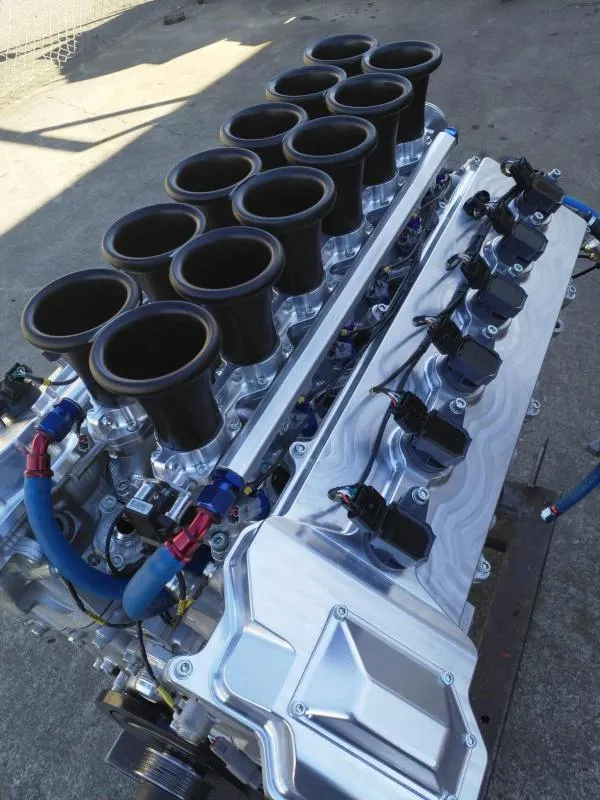
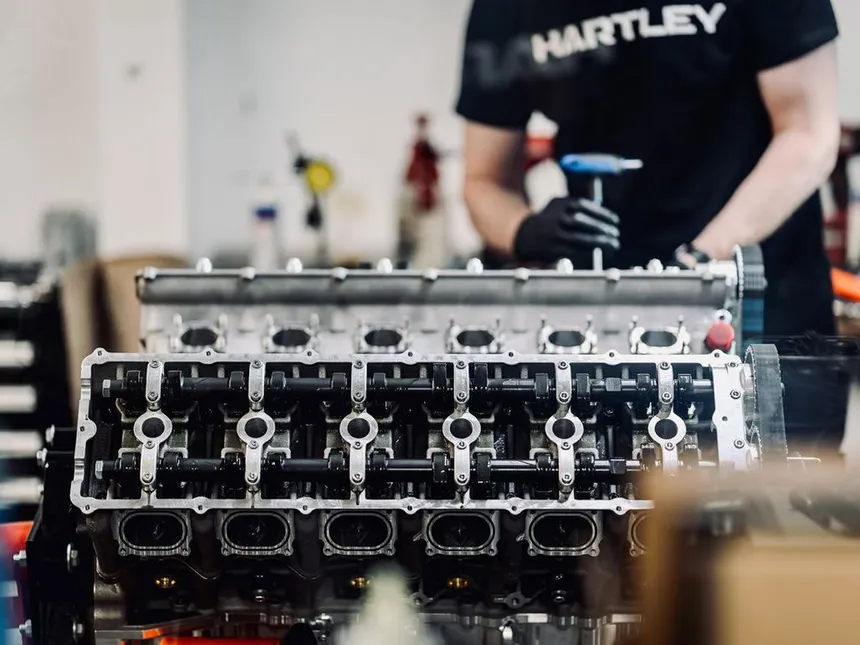
Forged pistons and rods. Ported heads. Billet camshafts. Billet cam covers. A billet dry-sump system. And individual throttle bodies — one per cylinder, twelve of them. On the dyno, the emperor’s engine made 720 horsepower, naturally aspirated, at 10,000 rpm.
Then came the twin-turbo version. The prototype went into Jaron Olivecrona’s Nissan S14 drift car and made 550 hp at 4,600 rpm, 800 at 6,000 and 1,000 at 8,100. The later evolution runs a comfortable 1,000 horsepower on seven pounds of boost, with settings available that push toward 1,500. All of it built in-house in Palmerston North, running a New Zealand ECU and a New Zealand gearbox.
That’s the real résumé. Before anyone from California boarded a plane, Hartley already knew how to machine, assemble and spin a V12 to five figures.
The NILU27 V12 is a different engine. Full stop.
This needs to be precise, because the internet is already blending the two.
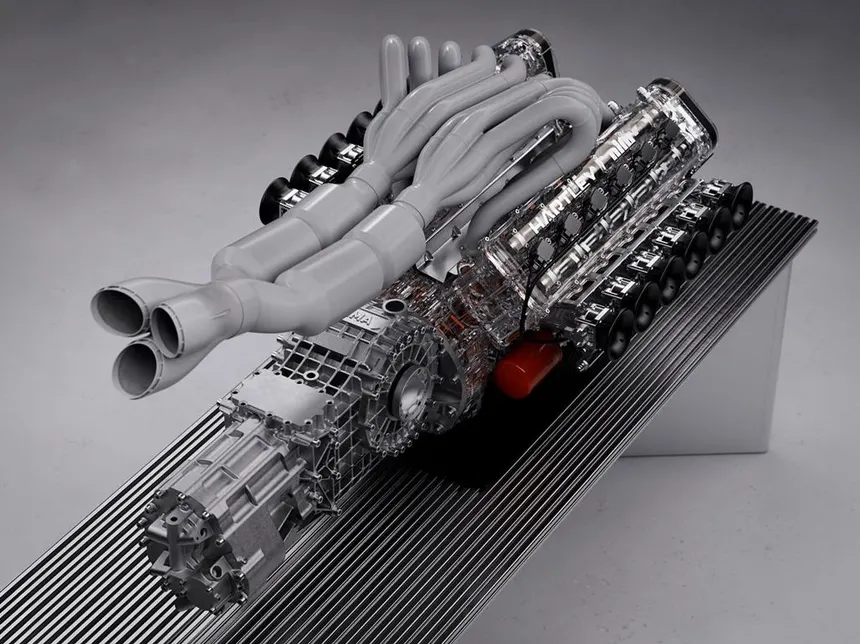
The NILU27 V12 does not derive from the Toyota. It is not a hopped-up 1GZ, not an evolution, not a parts-bin relative. It is a clean-sheet design. What the Toyota contributes to this story is the schooling — the place where Hartley learned twelve cylinders.
The other confusion is worth killing here too, and American readers are the most likely to fall into it. The famous V8 built from two Suzuki Hayabusa engines, the H1V8, is not this Hartley. That is John Hartley of Hartley Enterprises in Wisconsin. Different company, different country, different family. No connection whatsoever.
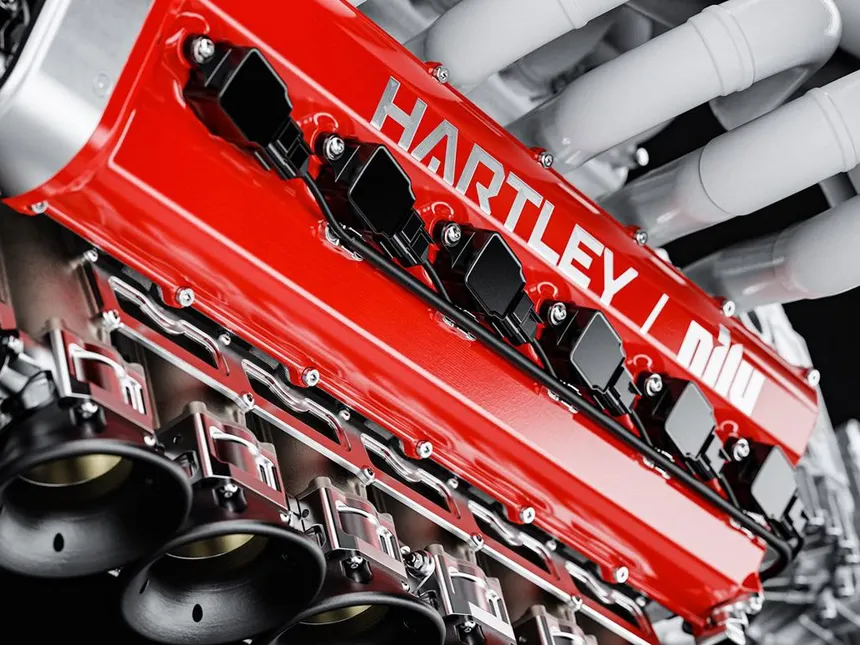
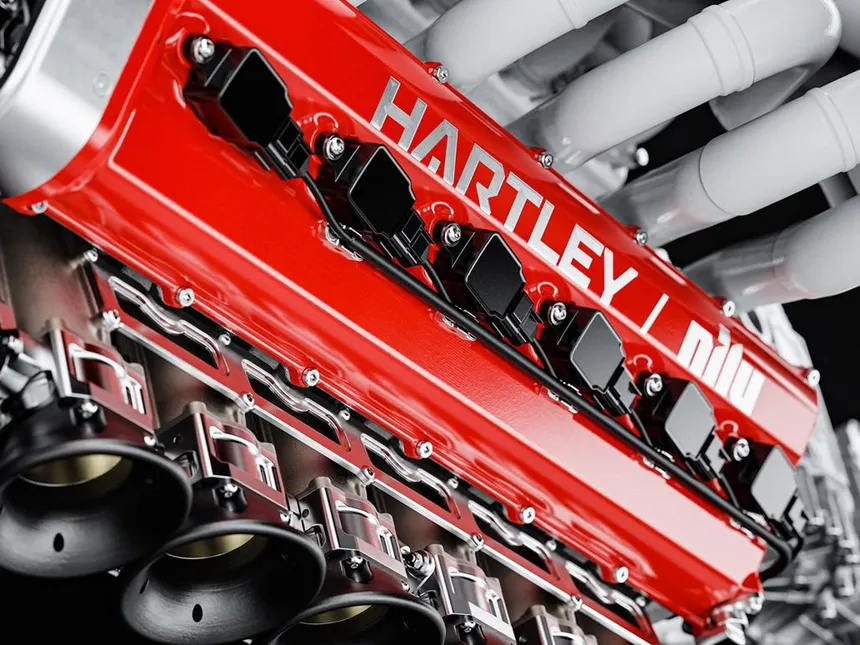
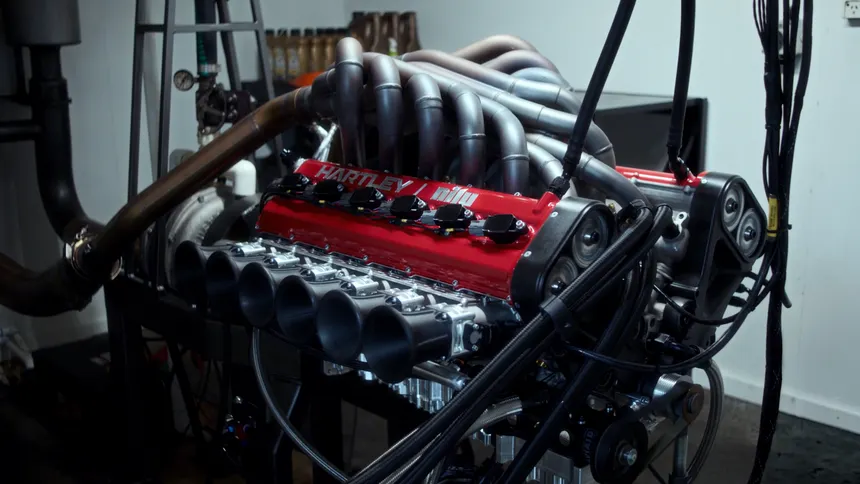
The NILU27 engine is a 6.5-liter naturally aspirated V12 in a hot-V configuration, with an 80-degree bank angle and the exhaust headers routed inside the vee, between the heads, to manage heat extraction. Redline is 11,000 rpm, with components rated to go higher. The stated target was 1,070 horsepower — around 798 kW — and early dyno work in Palmerston North has already exceeded that projection.
It’s worth flagging that the numbers vary by source. Some outlets report 6.4 liters and 1,055 horsepower. Until Nilu27 publishes a final specification, treat 6.5 and 1,070 as the manufacturer’s target rather than a settled figure.
The engine fired for the first time at the Palmerston North workshop. Selipanov got on a plane and crossed the planet to stand there when it happened.
What 1,070 naturally aspirated horsepower actually means
A number means nothing without context. So here it is.
The most powerful naturally aspirated V12 Ferrari has ever put in a road car is the 6.5-liter unit in the 812 Competizione, launched in 2021: 830 cv at 9,250 rpm with a 9,500 rpm limit, the highest-revving road car engine Maranello has ever homologated.
The Cosworth-built GMA T.50 engine is the other reference point, from the opposite direction: four liters, 661 horsepower at 11,500 rpm, redline at 12,100. The highest-revving road-car V12 in history, from a displacement you’d find in a family sedan.
The only naturally aspirated twelve playing in the thousand-horsepower league is Cosworth’s 6.5-liter unit for the Aston Martin Valkyrie. And Cosworth is Cosworth — eight decades of Formula 1, some two hundred Grand Prix wins, the company that built the DFV.
So here’s the fair comparison. A family shop in a provincial New Zealand town, with mum doing the accounts, has walked into a category occupied by exactly one company on earth. And on the early dyno evidence, it isn’t trailing.
Why New Zealand keeps doing this
Nobody has asked the obvious question, and it has an answer.
New Zealand has no auto industry. No supplier network. No subcontractors down the road. It sits thousands of miles from anywhere, and parts arrive weeks late and cost a fortune. In that environment you have two choices: don’t race, or build it yourself.
That’s the country that produced Bruce McLaren, an Auckland kid who went to Europe and ended up naming the second most successful team in Formula 1 history. It produced Burt Munro, who spent four decades modifying a 1920 Indian by hand in a shed in Invercargill and took it to Bonneville. It produced John Britten, who built an entire motorcycle in his Christchurch garage — chassis, engine, wheels, all of it — and went to America to embarrass factory teams.
When Nelson Hartley started 3D-printing engine parts, as Racecar Engineering reported back in 2020, it wasn’t a fashion statement. Printing was faster and cheaper than waiting for someone on the other side of the world to machine a part for him.
That’s the competitive advantage of being at the end of the earth. It forces you to depend on nobody.
What’s still a promise
And here is the part we aren’t going to skip.
The engine has run. That is confirmed and documented. But there is currently one V12 in existence, and it has to travel to Germany to be installed in the first running prototype. NILU27 was shown as a concept in 2024 and there is still no public launch date. Assembly of prototypes and the first customer batch is set for Aria Group in Irvine, California.
Hartley and Nilu27 are also finalizing a joint venture to design and produce high-performance engines beyond this project. That is the genuinely significant development, and no headline has led with it: this isn’t a one-off commission. It’s a New Zealand speedway shop becoming an engine supplier to the world.
But an engine on a dyno is not a car. Until a NILU27 moves under its own power, this remains a project in progress.

The NEC take
We have spent twenty years being told that real engines only come from places with heritage, a museum and a guided tour. That you need a century of tradition, a valley in Emilia and a five-hundred-person marketing department to build twelve cylinders that spin to eleven thousand.
Apparently not. Apparently the most ambitious naturally aspirated V12 of the decade is being built by a family in a shed in Palmerston North, in between a stockcar motor and a boat motor, by a guy who left school early and taught himself CAD.
That ought to embarrass a large chunk of the industry. We have the engineering schools, the supplier base, the wind tunnels and the subsidies. They have a dyno, a five-axis mill and no excuses. The difference isn’t money or equipment — it’s that they never stopped manufacturing, while the rest of us learned to outsource everything and call it strategy.
Ferrari says its V12 will survive. Lamborghini hybridized theirs. Aston Martin asked Cosworth for one. Meanwhile the biggest number anyone has seen from a twelve without turbochargers is coming out of a shop that has a superstock motor due next week, for somebody to crash into a concrete wall.
Do we still believe prestige is inherited?
Check you’re still alive.