
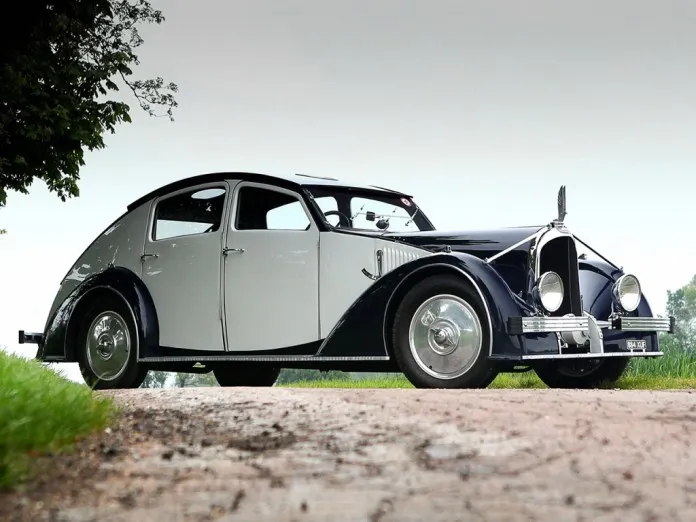
Voisin C25 Aerodyne: the plane that never left the ground
In October 1934, the busiest stand at the Paris Motor Show was not Voisin’s. It was Citroën’s, where André Citroën was unveiling the Traction Avant and permanently redefining what a mass-produced car could be. Front-wheel drive. Unibody construction. Independent front suspension. A genuinely modern car, built by the thousands, priced for the market.
A few metres away, Gabriel Voisin was showing the C25 Aerodyne. Twenty-eight units total. Eighty-eight thousand francs in 1935 — two and a half times the price of a Traction. A body that looked like it had been pulled off an aircraft fuselage. Two answers to the same historical moment. Two philosophies with no point of contact. Citroën won the commercial argument, comprehensively and permanently. Voisin won a different argument, slower and more durable, that hasn’t finished yet.
An Aviator Who Should Never Have Built Cars
Gabriel Voisin was born in Belleville-sur-Saône on 5 February 1880 and died on Christmas Day 1973, aged 93, without having abandoned the conviction that he was right about everything. Before he touched a car he was an aviator. With his brother Charles he built the first functional biplanes in Europe and founded what can reasonably be called the world’s first commercial aircraft factory. During World War I, Aéroplanes Voisin produced over 10,000 airframes and the engines — under Salmson and Hispano-Suiza licences — to power them. It was a serious industrial operation generating serious money.
Charles died in a road accident in 1912. When the war ended and the military contracts evaporated, Gabriel Voisin looked for something to do with his workforce. He experimented with motorised bicycles and prefabricated metal houses before deciding, in 1919, to buy the rights and prototypes for a luxury car built around a Knight sleeve-valve engine that André Citroën had rejected as too expensive to manufacture. He called it the C1 — the C in memory of Charles — and launched Avions Voisin from the workshops at Issy-les-Moulineaux, southwest of Paris.
What Voisin did from that point forward has no precise name in the vocabulary of the automotive industry. He wasn’t a series manufacturer. He wasn’t an artisan coachbuilder. He was an engineer with specific obsessions and the budget to pursue them, for as long as the budget lasted. His cars were light because he used aluminium where others used steel. His engines were quiet because the Knight sleeve-valve system — sliding cylindrical sleeves defining intake and exhaust ports rather than conventional poppet valves — produces almost no valve-train noise. His bodies looked like what they were: designed by someone who had spent years thinking about aerodynamic resistance, weight and structure, not fashion.
His customers either understood this or they didn’t. Those who understood it included Josephine Baker, Rudolph Valentino, H.G. Wells, Man Ray. And Le Corbusier, who not only bought Voisins but put them in his architectural illustrations as symbols of the modernity he was arguing for — the same Le Corbusier who in 1925 had presented the Plan Voisin, funded by the carmaker, proposing to demolish central Paris and replace it with cruciform 60-storey towers. The two men were equally radical. Both believed form should follow function without concession. The difference was that Le Corbusier didn’t have to sell cars.
The Engine Nobody Would Update
The C25 arrived in 1934 on a chassis derived from the C24, with the wheelbase stretched to 3,280mm and an aluminium body nearly five metres long. Kerb weight: 1,550kg. Under the bonnet, the three-litre inline-six with Knight sleeve-valve gear, the same basic block Voisin had been using since the 1920s with incremental adjustments. In the C25, with compression raised and twin Zenith carburettors fitted, output was around 90 horsepower — some specifications cite up to 100 — pushing the car to 130km/h.
The Knight engine had one clear virtue and one defect that grew more serious every year. The virtue: silence. The sliding sleeves produced a motor of unusual smoothness, with none of the ticking and clattering of a conventional valve train. The defect: high oil consumption, difficult sealing, and above all the inability to compete on specific output with the conventional-valve engines that had matured through the 1930s to the point where the Knight system was technically obsolete. By the time Voisin showed the C25, Bugatti already had the Type 57 with its twin-cam head. The Knight engine belonged to a different era, and Voisin knew it and used it anyway — because it was his engine, because he understood it, because switching base technology would have required capital he didn’t have.
The gearbox was an electromagnetic Cotal unit, two speeds plus overdrive, selected via a small rotary switch rather than a conventional lever. The driver chose ratios with minimal effort. Suspension was solid axle front and rear, with shock absorbers adjustable from the dashboard — a comfort detail few cars of the period offered. Four-wheel hydraulic drum brakes.

What the Roof Did
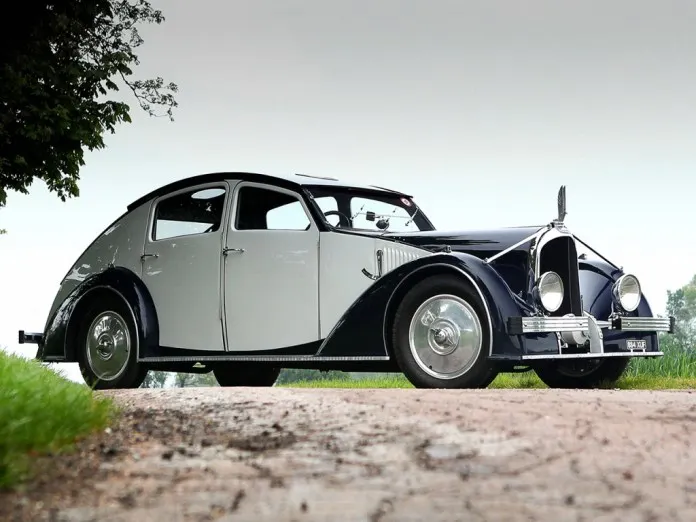
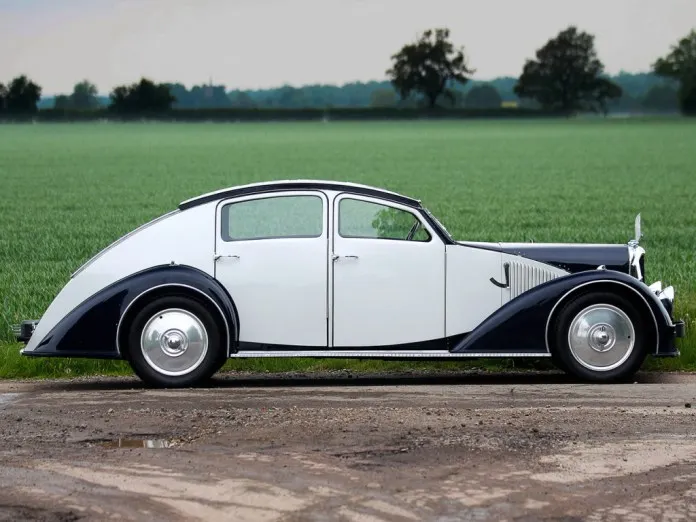
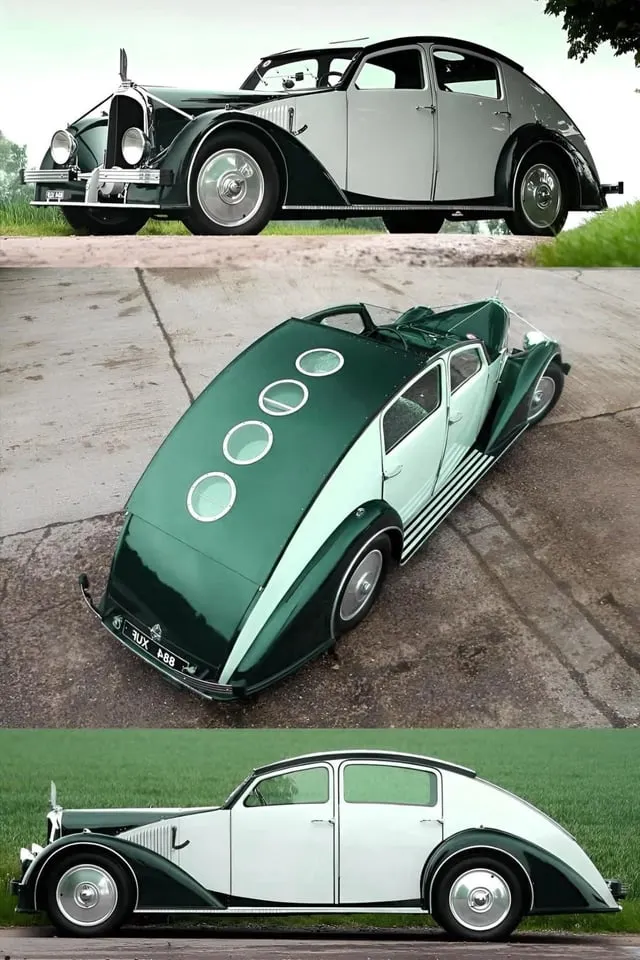
The Aerodyne was a body variant of the C25, the most extreme of the options available. The Cimier was a two-door coupé; the Clairière a more conventional four-door saloon. But the Aerodyne was what people came to the show to see. Four doors, four seats, and a roofline unlike anything in production.
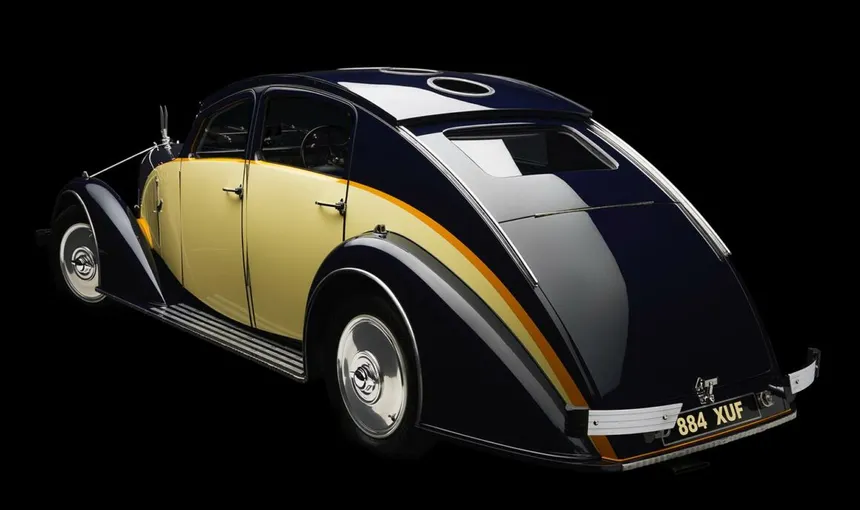
The body was designed by André Noël-Noël, Voisin’s regular collaborator, working from references Voisin had given him: Le Corbusier, architect Robert Mallet-Stevens, aircraft fuselage aesthetics. The result was a long, low fastback with fenders integrated into the general volume rather than projecting from it, headlights recessed into the body, a high beltline that trimmed the side windows to narrow horizontal slots, and a rear screen that disappeared under the descending roofline.
That roof was the Aerodyne’s central argument. Sliding. Aluminium. It ran back along rails, opening the cabin to the sky. So far, not unique — some manufacturers offered sliding roofs. What was not normal was the mechanism. The Aerodyne’s roof moved via a pneumatic system powered by the vacuum from the engine’s intake manifold. A small two-cylinder motor in the boot managed the pressure. No handle, no manual effort. The driver operated a control and the roof moved on its own.
In 1934 that was extraordinary. Not the sliding roof itself — the roof operated by engine vacuum, integrated into the body design from the beginning as a structural element of the fastback profile. Voisin didn’t add the roof to the car. He designed the car around the roof.
The interior completed the statement. Woven upholstery with Art Deco geometric patterns produced on a loom rather than printed — colours and geometry built into the fabric from the thread up. Le Corbusier’s documented influence on Voisin’s interior design philosophy is visible in the C25’s cabin: precise geometry, no decorative indulgence, aviation-grade instrument presentation. Quadrant gauges, clear dials, controls where the hand naturally reached them. A cockpit that felt like it belonged to something that flew.
The 1934 Show and What Came After
When the Aerodyne appeared in October 1934, the press responded with fascination. It was impossible to ignore. It was equally impossible to buy for anyone who wasn’t simultaneously wealthy and unconventional, and that combination was scarce in Depression-era France.
Eighty-eight thousand francs in 1935 wasn’t just expensive. It was a statement of intent. A Traction Avant cost around 35,000 francs. The Aerodyne cost two and a half times that. It wasn’t in the same market. It didn’t pretend to be. The problem was that the market for cars this radical and this expensive had been small before the Depression, and the Depression had reduced it to almost nothing.
Twenty-eight C25s were built in total. Of those, between six and eight — sources disagree — were Aerodynes. Four are known survivors. One of them, owned by Peter and Merle Mullin, won Best of Show at Pebble Beach in 2011, beating a Talbot-Lago T150C and a 1929 Bentley Speed Six. Another sold at Gooding & Company’s Pebble Beach auction in 2013 for $1,925,000. These are not collector car prices. These are artwork prices with number plates.
By the end of 1935, Voisin had replaced the Aerodyne with the Clairière — a conventional saloon silhouette that at least didn’t frighten potential buyers before they could sit down. The company continued until 1939, when the war closed the workshops. There was no real recovery afterwards.
What there was, was legacy. André Lefèbvre had worked as an engineer at Voisin through the 1920s and into the early 1930s. When the Depression forced Voisin to cut his technical staff, Lefèbvre moved first to Renault and then to Citroën, where André Citroën hired him for the project that needed an engineer willing to do things nobody had done before. The result was the Traction Avant. Then the 2CV. Then the DS. The chassis of Voisin’s last major car, the C30 — designed by Lefèbvre before he left — directly influenced the DS’s architecture. Voisin’s ideas didn’t die with the company. They walked out through the service entrance and installed themselves at the most innovative manufacturer in France.
What Gabriel Voisin Actually Was
The easy reading of the C25 Aerodyne is that it was too radical for its time and therefore failed. That reading is correct and incomplete.
Voisin was not a misunderstood visionary. He was an engineer with strong opinions who actively despised commercial concession. His famous dictum — “no line which does not fulfil a function can be beautiful” — is not a design philosophy. It’s a declaration of war against everything the mass market wanted. When the market told him his cars were too strange, too expensive and too difficult to explain, Voisin listened and continued doing exactly the same thing.
That is not incomprehension. That is a choice.
The C25 Aerodyne didn’t fail because the world wasn’t ready for it. It failed because Voisin didn’t have the capital to survive on 28 units sold, because the Knight engine was technically obsolete and he refused to replace it, and because the price was twice what the available market could absorb in 1934. These are business reasons, not vision reasons.
The vision was real. A roof operated by engine vacuum in 1934. Structural aluminium when steel was the standard. Interiors designed with the same aesthetic coherence as the exterior. A car that didn’t start with the sales targets and work back to the design, but went the other direction entirely.
No marketing strategy fixes that. And Voisin, who lived to 93, published his memoirs in 1962, and showed no apparent regret about anything, probably wouldn’t have wanted it fixed.
Check you’re still alive.