Twincharging and twin-turbo: how superchargers and turbos combine

America was twincharging before anyone had a name for it. Greyhound buses and semis powered by turbocharged two-stroke Detroit Diesels carried a Roots blower and a turbo on the same engine. Not as an exotic racing trick, but because the engine physically could not run without the blower. Those two-strokes needed the blower to sweep exhaust out of the cylinders through the ports, so when Detroit added a turbocharger for more power, the blower stayed. In the turbocharged 92 Series the turbo packs air into the blower, which pushes it into the cylinders, and the bypass blower fitted to those engines behaves like a blown engine at low rpm and like a turbo engine up top. That is the whole idea of this chapter, rattling down Interstate 80 years before Lancia made it famous.
So far in this series each engine has lived with one way of forcing air in: the supercharger, quick off the line but eating crankshaft power, and the turbocharger, efficient and strong up top but slow to wake up. This chapter is about engineers who refused to pick one.
Three words that get mixed up
Before the hardware, the vocabulary, because car forums butcher it daily. “Parallel” and “series” describe where the air goes. In parallel, two turbos sit side by side and each feeds the engine directly. In series, one turbo compresses the air and hands it to the next, which squeezes it again. “Sequential” describes something else entirely: timing. It means the turbos don’t come on together but one after the other. A sequential system can end up running its turbos in parallel, and a series system can be managed sequentially. People who say “sequential means a small turbo and a big turbo” are wrong too, as we’ll see.
Parallel twins: one turbo per bank
The obvious move: one turbo isn’t enough, bolt on two. On a V engine it’s also the tidy one. Instead of dragging exhaust from both banks across the engine to one big turbo, each bank gets its own smaller turbo, close to its own cylinders. A smaller turbo has less rotating mass, so it tends to spin up sooner, although each one only sees half the exhaust, and real-world response depends on sizing, manifolds and boost control. Parallel twins shrink lag. They don’t kill it. You still get turbo character, just from a smaller, livelier turbo.
The first production car with two turbos was the Maserati Biturbo, unveiled on December 14, 1981. Maserati’s own heritage site still calls the pair of small turbos a world first, and it was. The engine was a 1,996 cc 90-degree V6 making 180 hp, sized just under two liters because Italian tax on cars above that line was brutal, and Alejandro de Tomaso wanted a four-seat sports car that sold like a sedan. Americans got the Biturbo from 1984 with a bigger 2.5-liter engine, and it gave Maserati the kind of reliability reputation in the States that took decades to wash off: early cars ran a single carburetor pressurized by the turbos, heat soaked everything under the hood, and dealers who knew how to fix them were rare.
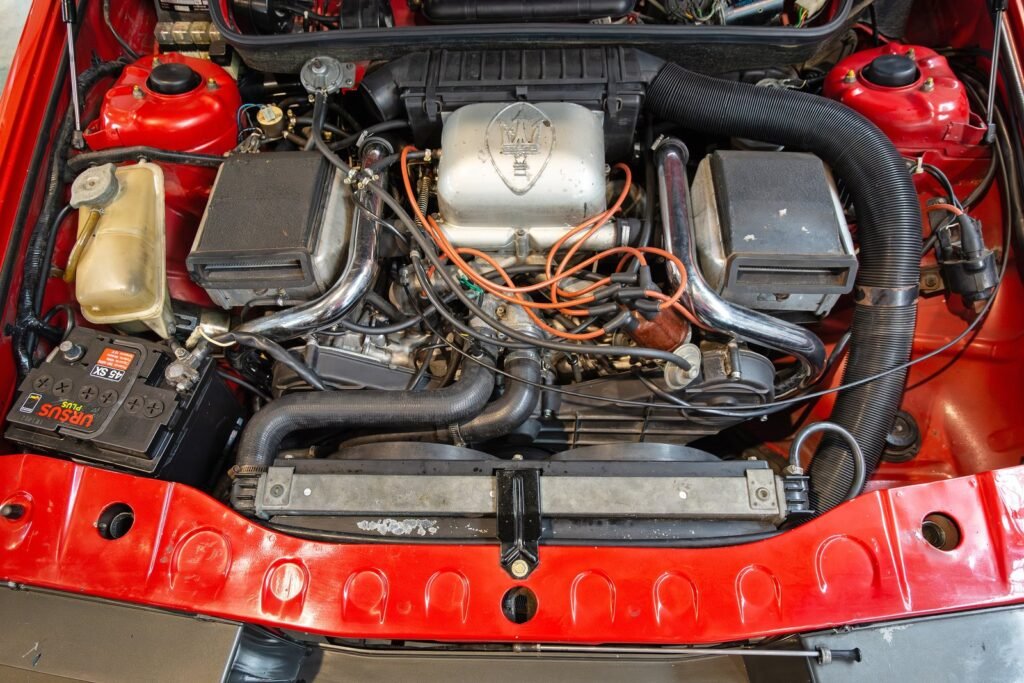
After that, parallel twins became the default for V engines with serious power. The Ferrari 288 GTO and the Ferrari F40 ran a pair of IHI turbos, one per bank. The 1990 Nissan 300ZX Twin Turbo brought 300 hp and the layout to American showrooms at sports-car money, and in 2011 Ford put a twin-turbo V6 in the F-150 and sold it to people who tow boats. EcoBoost did more to normalize twin turbos in America than any supercar. Even the Ferrari F80 keeps two turbos in parallel, now with an electric motor on each one so they never fall asleep.
Sequential: turbos that take turns
The cleverer trick is to stagger them. At low rpm, the system routes all the exhaust to one turbo, so that turbo gets twice the gas it would in a parallel setup and comes to life early. As revs climb and exhaust flow builds, valves open the path to the second turbo. In many systems the second one doesn’t replace the first; from some point on both blow together. Nothing about this requires two different sizes. It isn’t instant boost from idle either, because the turbines still need exhaust energy to spin up, but it attacks the turbine-size dilemma from the war on turbo lag from both ends at once.
The first production car with sequential turbos was the Porsche 959, shown in 1985 and built in 1987 and 1988. Porsche never federalized it, and for years the 959 was a car Americans could only see in magazines or in Bill Gates’s impound saga, until the 1999 Show or Display rule let a handful in legally. Here’s the detail most write-ups skip: in 1990 Mazda launched the Eunos Cosmo with its three-rotor 20B-REW and billed it in Japan as the world’s first production sequential twin-turbo. It was three years late. It was the first Japanese one, and it remains the only production car with a three-rotor engine.

Even earlier, in 1986, Claudio Lombardi at Abarth had a sequential twin-turbo four-cylinder running on the dyno with crossflow valves arranged in a way no one has copied since: the Lancia Triflux, built for the ECV rally car that never raced because the FIA killed Group S before it started.
For American enthusiasts, though, sequential means two cars. The third-generation Mazda RX-7 landed here in 1993 with 255 hp from its twin-turbo rotary, and the Mk IV Toyota Supra arrived the same year with 320 hp from the 2JZ-GTE, where the second turbo joins somewhere around 4,000 rpm depending on load and gear. Both systems were rat’s nests of vacuum lines, solenoids and actuators. On an RX-7, one cracked hose could make the second turbo come in late, at the wrong moment or not at all, leaving a hole in the middle of the power band at exactly the speed you were merging onto the freeway. That’s why so many Supras and RX-7s in the tuner scene lost their factory sequential plumbing in favor of one big single turbo. When everything sealed, the curve was nearly flawless.

The most extreme sequential system on the road sits in a Bugatti. The Chiron’s 8.0-liter W16 has four turbos, but up to about 3,800 rpm only two of them work; above that, a valve in the exhaust opens and the second pair joins in. The Veyron, with the same engine family, ran all four together. Keeping that thing cool is a story of its own, told in our piece on the W16 and its ten radiators.
Series turbos: the diesel truck answer
Compound turbos, as the diesel crowd calls them, chain two turbos in a line. A large low-pressure turbo compresses outside air and feeds it to a smaller high-pressure turbo, which compresses it again. That’s how you reach boost levels that would choke a single turbo, and it’s also how you get a small, quick stage working for you down low. Modern systems use bypass valves and run in different modes depending on rpm and load, so both stages aren’t screaming all the time.
America knows this layout from pickups. The 2008 6.4-liter Power Stroke in the Ford Super Duty shipped with factory compound turbos, a fixed-geometry low-pressure unit feeding a smaller variable-geometry high-pressure one, and it was the first diesel in the light-truck market to do that. It made 350 hp and 650 lb-ft. It also became the Power Stroke owners argue about most, which says something about the price of complexity. Meanwhile the diesel pulling community had been bolting compound turbos onto Cummins and Duramax engines for years, chasing numbers no single turbo could reach.
Europe took the idea into luxury sedans. BMW had run two-stage diesels since the days of the M57, and at the 2012 Geneva show it introduced the M550d xDrive with the N57S: a 3.0-liter straight-six diesel with three turbos, two small variable-geometry high-pressure units from BorgWarner and one large water-cooled low-pressure unit, managed to deliver 381 PS and 740 Nm, about 546 lb-ft, between 2,000 and 3,000 rpm. Three turbos, but not three stages. BMW never sold it in the United States. In 2016 the 750d went to a four-turbo B57 with 400 PS. Then the arms race quietly ended: the tri-turbo weighed 24 kg more than the twin-turbo engine it came from, and a full overhaul could run into thousands of euros.
Twincharging: the supercharger and the turbo, together
Now the heresy. One engine, one supercharger, one turbo. The supercharger, driven by the crank, delivers boost from idle and covers the bottom end where the turbo is still waking up. The turbo, running on exhaust that would otherwise be wasted, takes over once there’s flow to spare. Each machine covers the other’s weakness.
The hard part is the handoff. A bypass valve lets intake air flow around the supercharger once the turbo can do the job alone, so the blower stops getting in the way. Volkswagen went further and fitted its supercharger with an electromagnetic clutch, so the blower disconnects completely and stops taking power from the crank. Some installations add extra intercooling between stages, but that’s a choice of each design, not part of the definition.
The legend is the 1985 Lancia Delta S4, the Group B rally car that paired an Abarth Volumex supercharger with a KKK turbo on a 1.8-liter four. The blower gave instant shove out of hairpins, the turbo gave the big power on the straights. The road-going Stradale made 250 hp, the rally car roughly 480. It grew out of the Lancia 037, which had won with a supercharger alone. Accounts of the S4’s exact air path and switchover points vary wildly, so anyone quoting a precise rpm with confidence is probably copying someone else.
The first twincharged car you could actually buy from a dealer wasn’t Italian or German. It was a Japanese subcompact. Nissan built the March R for rallying in 1988 and sold the March Super Turbo on the street from 1989: a 930 cc four with both a supercharger and a turbo, its displacement trimmed from 987 cc so that, with the turbo multiplier applied, it fit under the 1.6-liter class. It made 110 PS in a car the size of a Micra, and it was sold only in Japan.

Volkswagen brought twincharging to the mass market in the mid-2000s with the 1.4 TSI in the European Golf GT: up to 170 PS from 1.4 liters and overall International Engine of the Year titles in 2009 and 2010. Americans never got it. They did get the Volvo T6 Drive-E, launched for the 2015 model year: a 2.0-liter four with an Eaton supercharger and a turbo, rated at 302 hp in the US-market S60 and declutching the blower at around 3,500 rpm. And Claudio Lombardi, the S4 and Triflux engineer, later consulted for Kimera on the EVO37, a modern take on the 037 that once again runs a supercharger and a turbo.
The Spanish connection: a twincharger for the price of a hatchback
SEAT has never been sold in the United States, which is why almost no American knows that Spain built a twincharged hot hatch. The 2009 SEAT Ibiza Cupra, assembled at Martorell outside Barcelona, used VW’s 1.4 TSI with supercharger and turbo, tuned to 180 PS and 250 Nm from 2,000 to 4,500 rpm, mated to a seven-speed DSG. The Ibiza FR got the same engine at 150 PS. Same principle as a Group B Lancia, sold in Spanish showrooms as a commuter with an attitude.

The name on the special edition is better still. SEAT showed the Ibiza SportCoupé Bocanegra concept at Geneva in 2008, and from the second half of 2009 sold an Ibiza Bocanegra edition based on the FR and Cupra, with a black front end. “Bocanegra” means “black mouth,” and it was the nickname of the 1975 SEAT 1200 Sport, the first car SEAT developed entirely at its own technical center, famous for a huge black polyurethane bumper that wrapped around the headlights and grille. A 1970s nickname ended up on the most sophisticated engine SEAT ever put in a small car. When the Ibiza was refreshed in 2015, the Cupra switched to a conventional 1.8 turbo with 192 PS. The twincharger chapter closed.

Stacking blowers is an admission of defeat
These systems are brilliant. A sequential twin or a good twincharger produces a torque curve no single compressor can match. But every extra turbo, every added blower, every switchover valve is an admission that the original machine wasn’t good enough and nobody found a clean fix. The S4, the RX-7 and BMW’s tri-turbo are engineering marvels and maintenance monuments at the same time, and the more parts coordinating a millisecond handoff, the more there is to leak, stick or blow apart. The proof came later: once variable-geometry and electrically assisted turbos matured, Volkswagen retired its twincharger, BMW went back to fewer turbos, and the vacuum-hose sequential system vanished. Magnificent engineering, born from not having one machine that does everything well.
Next chapter, we stop looking at the blower and look at the air itself. Compressing air heats it, hot air is less dense, and in a gasoline engine a hot intake charge invites detonation, the knock that cracks pistons. Air-to-air versus air-to-water intercoolers, why an intercooler doesn’t “add power” but gives back density you lost, and water injection as a way to cheat heat.
All that boosted air comes out hot. How it gets cooled, with a radiator or with water and methanol, is chapter six: the intercooler explained.
The roads that lost, from the Comprex that boosted with pressure waves to the Leclerc tank’s turbo with its own combustor, are in the pressure wave supercharger, the Hyperbar and other strange roads of forced induction.
What the industry did with all this air once it knew how to force it in is chapter 8: engine downsizing and why a small turbo burns less than a big one, superknock and cracked pistons included.
Check you’re still alive.
Photos: Mr.choppers (CC BY-SA 3.0), Thilo Parg (CC BY-SA 4.0), Sfoskett (CC BY-SA 3.0), Tokumeigakarinoaoshima (CC BY-SA 4.0), 先従隗始 (CC0), Calreyn88 (CC BY-SA 4.0), Spanish Coches (CC BY 2.0). Wikimedia Commons.